The Qajars
Agha Mohammad Khan Qajar
آقامحمدخان
Epithets and titles
- Āḡāāḡābyname (later or foreign)a title commonly given to senior court eunuchs; Adel Shah Afshar had him castrated as a boySource: J. R. Perry, “Āḡā Moḥammad Khan Qājār”, Encyclopaedia Iranica
- Pīrān-e Vēsabyname (later or foreign)Karim Khan Zand is said to have called him this, after Afrasiab’s wise counsellor in the ShahnamehSource: J. R. Perry, “Āḡā Moḥammad Khan Qājār”, Encyclopaedia Iranica
- Reign
- 1789–1797 CE (crowned 1796)
- Dynasty
- The Qajars
- Persian page
- فارسی
Featured dossier
Agha Mohammad Khan: unity by the sword
A boy castrated on Adel Shah’s orders, who spent sixteen years as Karim Khan’s guest-hostage at Shiraz, went on in eighteen years of ceaseless war to bring Iran under a single monarch and made Tehran its capital. He founded the Qajar dynasty; but his name is also tied to Kerman and Tiflis, where thousands were killed, blinded or enslaved.
- at Karim Khan’s court
- 16 years
- of conquest and consolidation (Perry)
- 18 years
- women and children enslaved at Kerman
- ~20,000
- enslaved from Tiflis
- ≥15,000
Animated map: life and events
Administration & economyc. 1742 CE1 of 16
Born into the Qajar tribe
He was the eldest son of Mohammad-Hasan Khan, chief of the Qavanlu clan of the Qajars of Astarabad. His grandfather, Fath-Ali Khan, had been executed by Tahmasp II.
Certainty: ProbablePerry gives the birth as “about 1155/1742”; he does not name the birthplace, and the map point marks the tribe’s homeland.
Sources: J. R. Perry, Encyclopaedia Iranica, 1984, updated 2018 (print: vol. I, fasc. 6, pp. 602–605)
BattleCampaignBuildingAdministration & economyReligionArrow keys, Home/End and Space work.
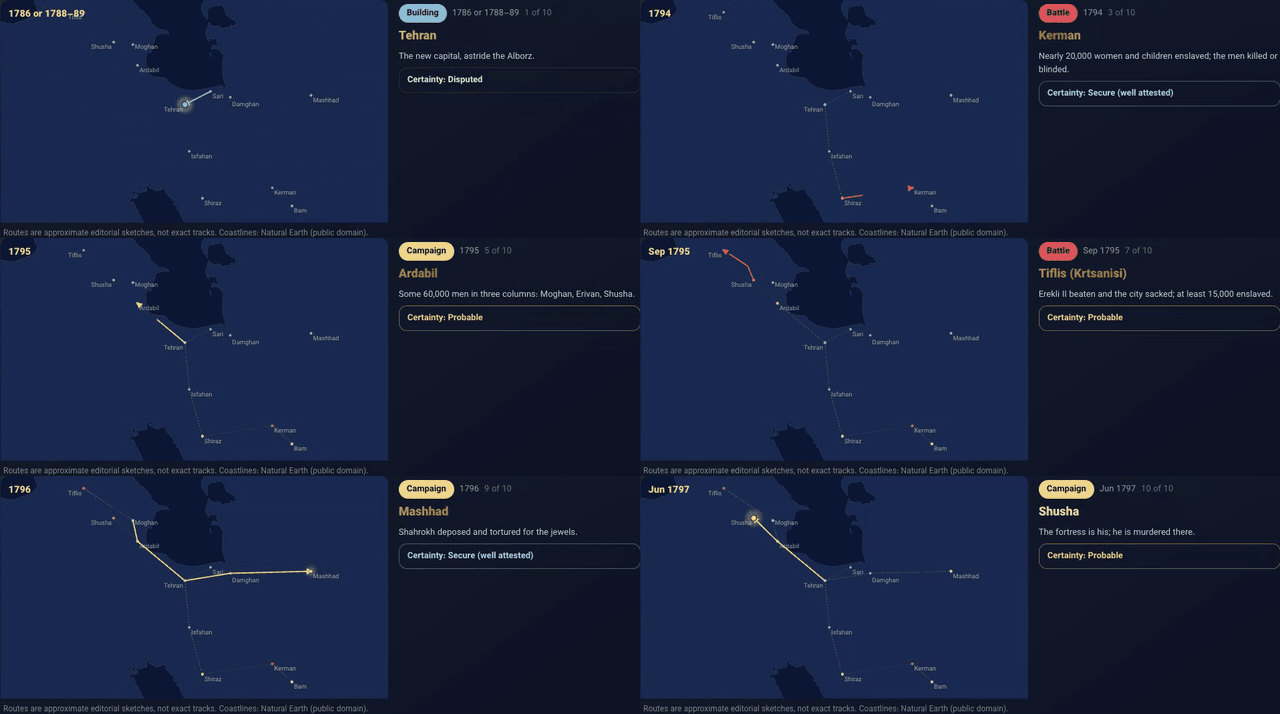
The campaigns of Agha Mohammad Khan (1786–1797 CE)
From Tehran to Shiraz, Kerman and Bam, then the Caucasus, Moghan, Mashhad and finally Shusha. Dates follow Iranica (Perry, Amanat and Hitchins); where the sources disagree, the stop is labelled “probable” or “disputed”. The routes are sketches.
Building1786 or 1788–891 of 10
Tehran
The new capital, astride the Alborz.
Certainty: DisputedThe sources give two dates: Amanat puts his accession at Tehran on 21 March 1786 (11 Jomādā I 1200 AH); Perry gives 1203 AH (1788–89 CE) and takes that as the effective start of his reign and of the Qajar dynasty. We show both.
Sources: J. R. Perry, Encyclopaedia Iranica, 1984, updated 2018 (print: vol. I, fasc. 6, pp. 602–605) · A. Amanat, Encyclopaedia Iranica, 1999, updated 2014
BattleCampaignBuildingAdministration & economyReligionArrow keys, Home/End and Space work.
Three separate layers
Each section has three layers: “Historical evidence” is only what the sources say; “Philosophical interpretation” is our reading by the standard of property and liberty; “Modern cultural meaning”. Quotations come only from published translations, with references.
Historical evidencePhilosophical interpretationModern cultural meaning
Dossier · 1
The eunuch hostage
As a boy he was castrated on the orders of Adel Shah Afshar; the title “Agha” comes from this. After his father was killed in 1759 he was taken captive, and from 1763 he spent sixteen years at Karim Khan’s court in Shiraz.
Perry writes that he was not used as a true hostage, and Karim Khan did not punish him even when his brother Hosaynqoli rebelled. He later told his nephew that every morning, at breakfast with Karim Khan, he would vent his anger by slashing the rug he sat on with a penknife; Karim Khan pretended not to notice and had a new rug laid every day.
treated more as an honored guest than a prisoner throughout his sixteen years at Karīm Khan’s court

Karim Khan is said to have called him his “Piran-e Visa”, his wise counsellor, after Afrasiab’s minister in the Shahnameh. Perry gives this with “is said to”, and so do we.
Malcolm suggested that his castration and long captivity channelled his energy into planning the Qajar triumph. That is a guess, not a report; Perry presents it only as a suggestion.
The slashed-rug story comes from his own account to Fath-Ali Shah, passed down through the Nama-ye khosravan and Malcolm; it is a story from inside the Qajar family, not an outside witness’s report.
Sources: J. R. Perry, Encyclopaedia Iranica
Dossier · 2
From Sari to Tehran
After his escape from Shiraz in 1779 he spent nearly ten years fighting his own brothers, rival Qajar chiefs and Zand pretenders. In 1781 he used a ruse to expel Count Voinovich’s Russian flotilla, which was trying to set up a fortified trading post near Ashraf.
After Ali-Morad Khan Zand died, he three times drove Jafar Khan’s army from Isfahan and moved his centre from Sari to Tehran to command both sides of the Alborz. At Tehran he took the throne and named Baba Khan his heir.
this habit does not seem to operate to the prejudice of the people. This chief has the reputation of being attentive to business . . . which is indeed obvious to common notice
The date of this enthronement is unclear: Amanat gives 21 March 1786 and Perry 1788–89. Amanat says that at first he did not take the royal title, out of respect for the last nominal Safavid claimant; he was crowned only in 1796.
To those who dealt with him in Mazandaran he was a hard-working ruler. George Forster, who saw him at Sari, wrote that his drinking did the people no harm.
Tehran has remained Iran’s capital ever since. Amanat writes that he adopted Baba Khan’s sons into his own harem; he prepared the succession carefully in advance.
Sources: J. R. Perry, Encyclopaedia Iranica · A. Amanat, Encyclopaedia Iranica
Dossier · 3
Shiraz and Kerman: coercion without limit
In 1792 Haji Ebrahim, the kalantar of Shiraz, handed the city over to him. He deported the remaining Zands and 12,000 families of Lak and Lor tribesmen to the north, pulled down the city walls and even carried the palace’s pillars and doors to Tehran. He dug up Karim Khan’s bones and reburied them under the threshold of his Tehran palace so that he could trample on them every day.
In 1794 Lotf-Ali Khan Zand was besieged in Kerman and escaped. Perry writes that nearly 20,000 women and children were given to the soldiers as slaves, and all adult men were either killed or blinded. Lotf-Ali Khan was betrayed by the governor of Bam, tortured, mutilated and executed in Tehran. He also lured his own brother Jafarqoli to Tehran under a promise of safe-conduct and had him killed.
Āḡā Moḥammad’s conduct at Kermān has come down as an exemplar of brutality: Nearly 20,000 women and children were given as slaves to the soldiers, and all adult males were either put to death or blinded.
his death should not have been such as my uncle made him to suffer


Through this site’s lens, Kerman is the purest case of arbitrary coercion: the lives, eyes, freedom and families of thousands who had not fought were taken as punishment for sheltering a claimant. There was no trial, law or limit, only one man’s will. That judgement is ours, not the source’s.
Perry writes that his cruelty was usually “politic or exemplary”, to terrorise the disaffected “as at Kermān”, but that he was also often gratuitously vindictive. The famous story of the eyes being counted or weighed is not in our sources; we do not repeat its numbers.
Kerman’s name is still tied to this massacre in Iranian memory. Even his nephew Fath-Ali Shah, no stranger to cruelty himself, told a British envoy years later that Lotf-Ali Khan’s death should not have been like that.
Sources: J. R. Perry, Encyclopaedia Iranica · A. Amanat, Encyclopaedia Iranica
Dossier · 4
Tiflis and the Caucasus
Erekli II, king of eastern Georgia and in practice autonomous since 1747, made the Treaty of Georgievsk with Russia in 1783. Agha Mohammad Khan demanded his submission and, when refused, marched from Ardabil with some 60,000 men in three columns towards Moghan, Erivan and Shusha.
Shusha and Erivan did not fall at first, and the army turned on Tiflis. Erekli’s outnumbered army was beaten and the city sacked. Hitchins dates this to September 1795 and says some 15,000 people were deported as slaves. Russia had no troops south of the Caucasus to help.
the old and infirm and the priests were massacred, and at least 15,000 able-bodied men and women taken into slavery

The campaign aimed to recover the Safavid lands, but Perry’s verdict is plain: his irredentist campaigns “must on balance be adjudged failures”. By alienating Georgia and Russia completely, he in effect fixed Iran’s north-western frontier on the Aras.
The sources disagree on the date of Tiflis: Perry puts the start of the campaign in “the spring of 1210/1796”, Hitchins says September 1795. We follow Hitchins because it fits the coronation of March 1796, and we show the disagreement.
In Georgian memory the battle of Krtsanisi and the sack of Tbilisi are a national tragedy, and the “300 Aragvians” memorial in Tbilisi recalls that battle. A year later Catherine II sent Zubov’s army in revenge; it took the Caspian coast up to Moghan, and only Catherine’s death in November 1796 stopped it.
Sources: J. R. Perry, Encyclopaedia Iranica · K. Hitchins, Encyclopaedia Iranica
Dossier · 5
Jewels, booty and property
Perry names his salient traits as “avarice and cruelty”. He was obsessively acquisitive of money and jewels, yet shunned pomp, lived as austerely as his soldiers and made sure they were regularly paid.
At Shiraz he took all movable property as booty and carried off the palace’s pillars and doors as well. At Mashhad the aged Shahrokh was tortured to reveal where the last of Nader’s Indian jewels were hidden. After his murder, the killers handed the crown jewels to Sadeq Khan Shaqaqi.
Obsessively acquisitive of money and jewels, he nevertheless shunned pomp and ostentation, lived as austerely as his soldiers, and ensured that these were regularly paid.
raised a royal palace, and cemented it with blood

This is our reading: in this state, property was safe only for as long as the shah’s will allowed. A city that had surrendered (Shiraz) was stripped as thoroughly as one that resisted (Kerman), and the former shah’s property (Shahrokh’s) was taken by torture. The soldiers’ regular pay was the one steady contract of this system.
The limits of this reading: our source says almost nothing about taxes, markets or land in his reign; we weigh only what is reported about booty and jewels.
Amanat writes that Agha Mohammad Khan believed he had “raised a royal palace, and cemented it with blood” for his nephew. The treasure he gathered was, thirty years later, drawn on by Fath-Ali Shah to pay the Turkmanchay indemnity; linking the two is our reading.
Sources: J. R. Perry, Encyclopaedia Iranica · A. Amanat, Encyclopaedia Iranica
Dossier · 6
Army, religion and law
Perry writes that he showed “a real concern for law and order”, prayed and fasted regularly, and yet drank heavily. Like Nader and Karim Khan, he kept executive power tightly in his own hands, using his ministers as little more than informants and secretaries; yet he valued able men such as Haji Ebrahim.
Religion also served his politics: at Ardabil he girded on the Safavid sword, and he went to Mashhad “ostensibly on pilgrimage” to take Khorasan. He would sometimes disembowel servants who displeased him and leave them alive for the crows (according to Watson), and once, while drunk, he shot and wounded his secretary for no reason (according to Kotzebue).
His “law and order” was order from above: obedience and fear, not a law that bound the shah himself. A law that binds only the subjects and not the ruler does not, by this site’s lens, protect individual liberty. That judgement is ours.
The stories of the tortured servants and the shot secretary come from European writers (Watson, 1866; Kotzebue, 1818) who wrote after his death; Perry cites them, and we give them with their narrators’ names.
The state he built, with a regularly paid army and a capital at Tehran, lasted until 1925. Perry writes that this integration enabled Iran to weather the storms of the nineteenth and early twentieth centuries.
Sources: J. R. Perry, Encyclopaedia Iranica
Dossier · 7
Death at Shusha
In the spring of 1797 he crossed the Aras again. Ebrahim Khalil Khan of Karabakh was ousted from Shusha by a coup and the fortress was handed to him. The army crossed the flooded Aras on boats, because the bridge had been demolished.
Two servants, Sadeq the Georgian and Khodadad Esfahani, quarrelled loudly, and the shah condemned both to death, but put off the execution until after Friday and left them free. With a third servant, Abbas Mazandarani, they stabbed him to death that same night. The killers gave the crown jewels to Sadeq Khan Shaqaqi, and the army broke up; Haji Ebrahim led part of it back to Tehran.
Perry writes that the very traits that raised him, avarice and cruelty, also caused his death, and that Sadeq Khan Shaqaqi may have urged the killers on. Amanat too says Sadeq Khan “allegedly” instigated the murder; we report it with the same doubt.
The sources disagree on the date: Perry gives 17 June 1797, Amanat May 1797.
He had no children and had prepared the succession for his nephew in advance; Baba Khan took the throne as Fath-Ali Shah in July 1797. Shusha today lies in the Republic of Azerbaijan.
Sources: J. R. Perry, Encyclopaedia Iranica · A. Amanat, Encyclopaedia Iranica
Synthesis: a united country, paid for in lives and liberty
Perry’s verdict is double: his campaigns to recover the Safavid lands were on balance failures and fixed the frontier on the Aras; yet it was chiefly owing to his eighteen years of conquest and consolidation that Iran, in its modern extent, was integrated under a single monarch.
Through this site’s lens, the price of that unity was paid by people whose lives, eyes, families and property were taken without any trial: at Shiraz, Kerman and Tiflis. The state he built was durable, but it rested on one man’s will, not on a law that also bound the shah. That judgement is ours.
Bibliography
- J. R. Perry, Encyclopaedia Iranica, Āḡā Moḥammad Khan Qājār (1984, updated 2018 (print: vol. I, fasc. 6, pp. 602–605)). https://www.iranicaonline.org/articles/aga-mohammad-khan/The spine of the Agha Mohammad Khan page: captivity, Kerman, Tiflis, coronation, murder and character. Perry quotes Forster, Malcolm, Watson and Kotzebue.
- K. Hitchins, Encyclopaedia Iranica, Georgia ii. History of Iranian-Georgian Relations (2001, updated 2015). https://www.iranicaonline.org/articles/georgia-ii-history/The Treaty of Georgievsk, the capture of Tbilisi in September 1795 and the deportation of some 15,000 people as slaves. Hitchins cites Hambly’s chapter in the Cambridge History of Iran, vol. VII; we have not consulted that chapter directly.
- A. Amanat, Encyclopaedia Iranica, Fatḥ-ʿAlī Shah Qājār (1999, updated 2014). https://www.iranicaonline.org/articles/fath-ali-shah/The spine of the Fath-Ali Shah page: succession, court, diplomacy and the indemnity.
- H. Busse, Encyclopaedia Iranica, ʿAbbās Mīrzā Qajar (1982). https://www.iranicaonline.org/articles/abbas-mirza/The crown prince and commander in both wars with Russia.
- Encyclopaedia Iranica, Golestan Treaty (online edition). https://www.iranicaonline.org/articles/golestan-treaty/Background, conflicting dates and consequences of the Golestan treaty.
- Encyclopaedia Iranica, Russia i. Russo-Iranian relations up to the Bolshevik Revolution (online edition). https://www.iranicaonline.org/articles/russia-i/The course of the first Russo-Persian war (1804–1813) and the second.
- J. C. Hurewitz, Diplomacy in the Near and Middle East: A Documentary Record, vol. I (1535–1914) (1956). https://archive.org/details/diplomacyinnearm1956hureThe published English translation of the Golestan and Turkmanchay treaties; the treaty quotations are taken word for word from it.
- H. Algar, Encyclopaedia Iranica, Amīr(-e) Kabīr, Mīrzā Taqī Khan (1989). https://www.iranicaonline.org/articles/amir-e-kabir/The spine of the Amir Kabir section: reforms, the Dar al-Fonun, dismissal and murder at Fin.
- Encyclopaedia Iranica, Ḥasan Širāzi, Mirzā Moḥammad (online edition). https://www.iranicaonline.org/articles/hasan-sirazi-mirza-mohammad/The Tobacco protest, the telegrams and the boycott fatwa, with the doubts about it.
- E. Yarshater, Encyclopaedia Iranica, Iran ii. Iranian history (2) Islamic period, page 5: the Qajar dynasty (online edition). https://www.iranicaonline.org/articles/iran-ii2-islamic-period-page-5/An overview of the reigns of Naser al-Din Shah and Mozaffar al-Din Shah.
- Encyclopaedia Iranica, Constitutional Revolution i. Intellectual background (online edition). https://www.iranicaonline.org/articles/constitutional-revolution-i/The constitutional edict, the Fundamental Law and its supplement.
- Encyclopaedia Iranica, Constitutional Revolution ii. Events (online edition). https://www.iranicaonline.org/articles/constitutional-revolution-ii/The events of 1905–1909: the sanctuaries, the First Majles, the coup and the taking of Tehran.
All photos are from Wikimedia Commons; licence and author were checked on each file page.
The Qajar dynastyKarim Khan Zand, his host and keeper at ShirazFath-Ali Shah, his nephew and successorNader Shah, crowned on the same Moghan plain