The Qajars
Fath-Ali Shah Qajar
فتحعلیشاه
Epithets and titles
- Bābā Khanbyname (later or foreign)his second name, by which he was known until his accession in 1797Source: A. Amanat, “Fatḥ-ʿAlī Shah Qājār”, Encyclopaedia Iranica
- Jahānbānījahānbānīofficial title“guardian of the world”, given with the governorship of Fars in 1792–93, in contrast to his father’s title jahānsūz, “world-burner”Source: A. Amanat, “Fatḥ-ʿAlī Shah Qājār”, Encyclopaedia Iranica
- Šāhanšāh (King of Kings)šāhanšāhofficial titlehow his court chroniclers addressed him, marking his rank above his sons, who were also styled shahSource: A. Amanat, “Fatḥ-ʿAlī Shah Qājār”, Encyclopaedia Iranica
- Ḵāqānḵāqānofficial title“supreme chief of all tribes”; it became almost synonymous with his name and was also his pen name as a poetSource: A. Amanat, “Fatḥ-ʿAlī Shah Qājār”, Encyclopaedia Iranica
- Reign
- 1797–1834 CE
- Dynasty
- The Qajars
- Persian page
- فارسی
Featured dossier
Fath-Ali Shah: a lavish court and a lost Caucasus
The nephew of the dynasty’s founder, Agha Mohammad Khan, he became shah after his uncle’s murder in 1797. His court was lavish and stable, but in two wars with Russia he lost the Caucasus, and the treaties of Golestan and Turkmanchay drew Iran’s new border.
- reign (1797–1834)
- 37 years
- wars with Russia
- 2
- silver roubles indemnity (Hurewitz)
- 20 million
- fixed duty on Russian trade
- 5%
Animated map: life and events
Administration & economyMay 1769 CE1 of 16
Born at Damghan
He was the elder son of Hosaynqoli Khan Qajar, “the world-burner”, and was known as Baba Khan until he became shah.
Certainty: Secure (well attested)
Sources: A. Amanat, Encyclopaedia Iranica, 1999, updated 2014
BattleCampaignBuildingAdministration & economyReligionArrow keys, Home/End and Space work.
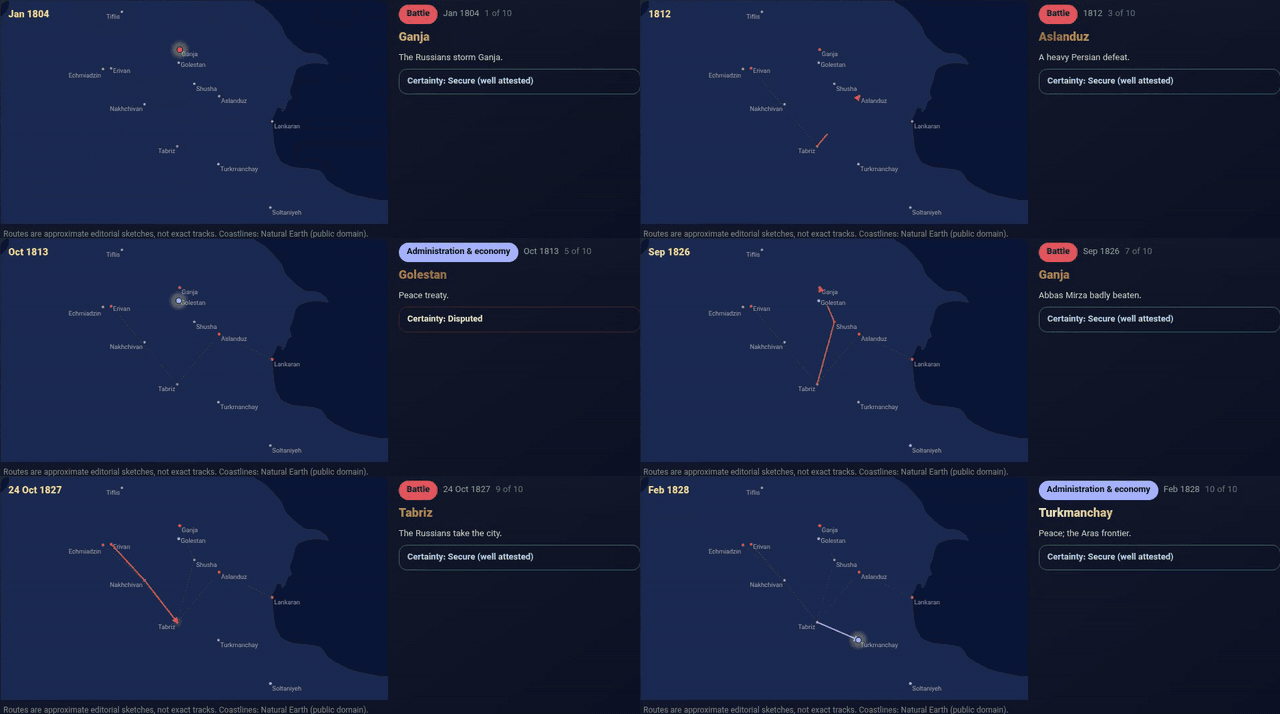
The Russo-Persian wars (1804–1828 CE)
Two wars in the Caucasus, from Ganja to Turkmanchay. Dates follow Iranica (Busse, Amanat and the Russia article) and the treaty texts follow Hurewitz; the routes are sketches.
BattleJan 18041 of 10
Ganja
The Russians storm Ganja.
Certainty: Secure (well attested)
BattleCampaignBuildingAdministration & economyReligionArrow keys, Home/End and Space work.
Three separate layers
Each section has three layers: “Historical evidence” is only what the sources say; “Philosophical interpretation” is our reading by the standard of property and liberty; “Modern cultural meaning”. Quotations come only from published translations, with references.
Historical evidencePhilosophical interpretationModern cultural meaning
Dossier · 1
Agha Mohammad Khan, the founder
Agha Mohammad Khan (born about 1742) was castrated as a child on the orders of Adel Shah Afshar and was long a hostage of Karim Khan Zand at Shiraz. After Karim Khan died in March 1779 he escaped from Shiraz, made Tehran his capital and won the war against the Zand successors.
In 1794 he took Kerman, and in September 1795 he sacked Tiflis. He was crowned on the Moghan plain in March 1796 and was murdered at Shusha in June 1797.
this habit does not seem to operate to the prejudice of the people. This chief has the reputation of being attentive to business . . . which is indeed obvious to common notice
Perry writes that his conduct at Kerman “has come down as an exemplar of brutality”. The famous popular story that the eyes were counted or weighed is not in this source; we do not repeat its numbers and give only Iranica’s report.
The same source calls him hard-working, austere and concerned with order, and quotes Forster’s testimony. He had Karim Khan’s bones moved from Shiraz to Tehran and buried under the threshold of his palace so that he could tread on them every day.
Tehran, which he made the capital, is still Iran’s capital. His memory in Iran today is double: the man who reunited the country and a ruthless ruler; both are in the sources.
Sources: J. R. Perry, Encyclopaedia Iranica
Dossier · 2
The shah and his court
Fath-Ali Shah took the throne in 1797 and put down revolts by kinsmen and chiefs until 1801. He made his sons governors of provinces: Abbas Mirza in Tabriz, Hosayn-Ali Mirza in Fars, Mohammad-Ali Mirza in Kermanshah.
Amanat writes that, unlike Agha Mohammad Khan’s austerity, his court was lavish. The shah discussed liberty in England with the British envoy John Malcolm.
your king is, I see, only the first magistrate of the country
has permanence, but it has no enjoyment

Amanat writes that his achievement was to turn a tribal khanship into a centralised and stable monarchy. His answer to Malcolm shows he chose absolute rule knowingly and saw its cost, instability.
His official portraits with long beard and crown, now in museums around the world, shaped the common image of “the Qajar shah”.
Sources: A. Amanat, Encyclopaedia Iranica
Dossier · 3
The Treaty of Golestan (1813)
After the defeats of 1812, and under pressure from Britain, which no longer wanted to fight its Russian ally, Persia accepted the peace of Golestan. Rtishchev dictated the terms, with Gore Ouseley mediating. It was ratified at Tiflis in September 1814.
Persia gave up Georgia, Karabakh and the khanates north of the Aras except Erivan and Nakhchivan. Article 4 made Russia the backer of whichever heir the shah named.
His Majesty the King of Persia, in demonstration of his amicable sentiments towards the Emperor of Russia, acknowledges in his own name and that of his heirs the sovereignty of the Emperor of Russia over the provinces of Karabagh and Georgia
engages for himself and heirs to recognise the Prince who shall be nominated heir-apparent, and to afford him assistance in case he should require it to suppress any opposing party. The power of Persia will thus be increased by the aid of Russia.
Article 4 looked like a favour to Persia, but it gave Russia a say in the Qajar succession. Iranica writes that the borders were not clearly defined, which prepared the ground for the second war.
Sources disagree on the signing date (12, 21 or 24 October 1813); we show the disagreement and do not choose.
The loss of the Caucasus at Golestan and Turkmanchay remains a lasting wound in Iranians’ historical memory. The line the two treaties drew is today part of Iran’s border with Azerbaijan and Armenia.
Sources: Encyclopaedia Iranica · J. C. Hurewitz
Dossier · 4
The Treaty of Turkmanchay (1828)
The second war (1826–1828) began with the ulama’s call for holy war and pressure from the war party at court. After the defeat near Ganja and the fall of Tabriz, Persia made peace at Turkmanchay, a village south-east of Tabriz.
The treaty ceded Erivan and Nakhchivan, imposed a heavy indemnity and made warships on the Caspian a right of Russia alone. The commercial treaty signed with it fixed customs at five per cent and allowed Russian subjects to be tried only in the presence of a Russian delegate.
His Majesty the Shah of Persia, both in his name as in that of his Heirs and Successors, cedes in entire ownership to the Russian Empire the Khanate of Erivan on both sides of the Araxe, and the Khanate of Nakhitchevan.
His Majesty the Shah of Persia undertakes to make them good by means of a pecuniary indemnity.
with the exception of Russia, no other Power shall be able to have war vessels on the Caspian Sea.
the courts of the country may only proceed to take cognizance and give judgment concerning the crime in the presence of a delegate of the Russian Mission or Consulate
Article VIII of the commercial treaty became the model of “capitulations” (legal privileges for foreigners) in Persia, and other powers sought the same rights.
The indemnity appears in three forms in the sources (20 million silver roubles, £4 million, 10 million gold tomans); we show all three.
Iranica writes that the border Turkmanchay drew stayed unchanged until 1991, and Iran’s frontier still follows the Aras. The name “Turkmanchay” is still a byword for an imposed treaty in Persian political language; that is our reading of current usage, not a report from the sources.
Sources: J. C. Hurewitz · H. Busse, Encyclopaedia Iranica · A. Amanat, Encyclopaedia Iranica
Dossier · 5
The shah’s treasure and the country’s indemnity
Amanat writes that after Turkmanchay the state treasury was bankrupt, and only under British persuasion did the parsimonious shah reluctantly part with a large portion of his own royal treasures to pay the indemnity.
In the same years Russia backed Abbas Mirza, whom the shah had named heir, under Article 4 of Golestan.
This is our reading: in this episode the line between the shah’s property and the country’s wealth was not clear. The state treasury was empty while the shah’s treasure was full, and paying the indemnity for a war the country had lost depended on the shah’s personal will.
The limits of this reading: our source does not say how much treasure was handed over, and we know the shah’s motives only through Amanat.
The question of separating the state budget from the court’s property came back in the constitutional era; linking the two episodes is our reading.
Sources: A. Amanat, Encyclopaedia Iranica
Synthesis: stability within, defeat on the frontier
Agha Mohammad Khan reunited the country by the sword and with great cruelty, and Fath-Ali Shah held it together through his court, his governor sons and tribal ties. Amanat counts this as his achievement: a stable monarchy in place of a tribal khanship.
But this structure fell short against a modern army and European diplomacy. Golestan and Turkmanchay took the Caucasus, brought a heavy indemnity and legal privileges for foreigners, and drew a border that still stands.
Bibliography
- J. R. Perry, Encyclopaedia Iranica, Āḡā Moḥammad Khan Qājār (1984, updated 2018 (print: vol. I, fasc. 6, pp. 602–605)). https://www.iranicaonline.org/articles/aga-mohammad-khan/The spine of the Agha Mohammad Khan page: captivity, Kerman, Tiflis, coronation, murder and character. Perry quotes Forster, Malcolm, Watson and Kotzebue.
- K. Hitchins, Encyclopaedia Iranica, Georgia ii. History of Iranian-Georgian Relations (2001, updated 2015). https://www.iranicaonline.org/articles/georgia-ii-history/The Treaty of Georgievsk, the capture of Tbilisi in September 1795 and the deportation of some 15,000 people as slaves. Hitchins cites Hambly’s chapter in the Cambridge History of Iran, vol. VII; we have not consulted that chapter directly.
- A. Amanat, Encyclopaedia Iranica, Fatḥ-ʿAlī Shah Qājār (1999, updated 2014). https://www.iranicaonline.org/articles/fath-ali-shah/The spine of the Fath-Ali Shah page: succession, court, diplomacy and the indemnity.
- H. Busse, Encyclopaedia Iranica, ʿAbbās Mīrzā Qajar (1982). https://www.iranicaonline.org/articles/abbas-mirza/The crown prince and commander in both wars with Russia.
- Encyclopaedia Iranica, Golestan Treaty (online edition). https://www.iranicaonline.org/articles/golestan-treaty/Background, conflicting dates and consequences of the Golestan treaty.
- Encyclopaedia Iranica, Russia i. Russo-Iranian relations up to the Bolshevik Revolution (online edition). https://www.iranicaonline.org/articles/russia-i/The course of the first Russo-Persian war (1804–1813) and the second.
- J. C. Hurewitz, Diplomacy in the Near and Middle East: A Documentary Record, vol. I (1535–1914) (1956). https://archive.org/details/diplomacyinnearm1956hureThe published English translation of the Golestan and Turkmanchay treaties; the treaty quotations are taken word for word from it.
- H. Algar, Encyclopaedia Iranica, Amīr(-e) Kabīr, Mīrzā Taqī Khan (1989). https://www.iranicaonline.org/articles/amir-e-kabir/The spine of the Amir Kabir section: reforms, the Dar al-Fonun, dismissal and murder at Fin.
- Encyclopaedia Iranica, Ḥasan Širāzi, Mirzā Moḥammad (online edition). https://www.iranicaonline.org/articles/hasan-sirazi-mirza-mohammad/The Tobacco protest, the telegrams and the boycott fatwa, with the doubts about it.
- E. Yarshater, Encyclopaedia Iranica, Iran ii. Iranian history (2) Islamic period, page 5: the Qajar dynasty (online edition). https://www.iranicaonline.org/articles/iran-ii2-islamic-period-page-5/An overview of the reigns of Naser al-Din Shah and Mozaffar al-Din Shah.
- Encyclopaedia Iranica, Constitutional Revolution i. Intellectual background (online edition). https://www.iranicaonline.org/articles/constitutional-revolution-i/The constitutional edict, the Fundamental Law and its supplement.
- Encyclopaedia Iranica, Constitutional Revolution ii. Events (online edition). https://www.iranicaonline.org/articles/constitutional-revolution-ii/The events of 1905–1909: the sanctuaries, the First Majles, the coup and the taking of Tehran.
All photos are from Wikimedia Commons; licence and author were checked on each file page.
The Qajar dynastyAgha Mohammad Khan Qajar, his uncleKarim Khan Zand