Featured dossier
Karim Khan Zand: deputy of the subjects
A Lak tribal chief whom Nader had deported to Khorasan, after Nader’s death he ruled Iran, except Khorasan, from Shiraz. He never became shah and called himself “deputy of the subjects”, rebuilt Shiraz, and after his death his family lost the country to the Qajars in civil war.
- rule (1751–1779)
- 28 years
- times he took the title shah
- 0
- Shiraz’s rough population (“perhaps”)
- 40–50,000
- Lotf-Ali Khan executed (CE)
- 1794
Animated map: life and campaigns
Administration & economyc. 1705 CE1 of 11
Born into the Zand tribe
The Zand were a pastoral tribe of the Lak branch of the northern Lors, centred on the villages of Pari and Kamazan near Malayer.
Certainty: ProbableThe birth year is approximate (“ca. 1705”) and the source does not give the exact place.
Sources: J. R. Perry, Encyclopaedia Iranica, 2011, updated 2015
BattleCampaignBuildingAdministration & economyReligionArrow keys, Home/End and Space work.
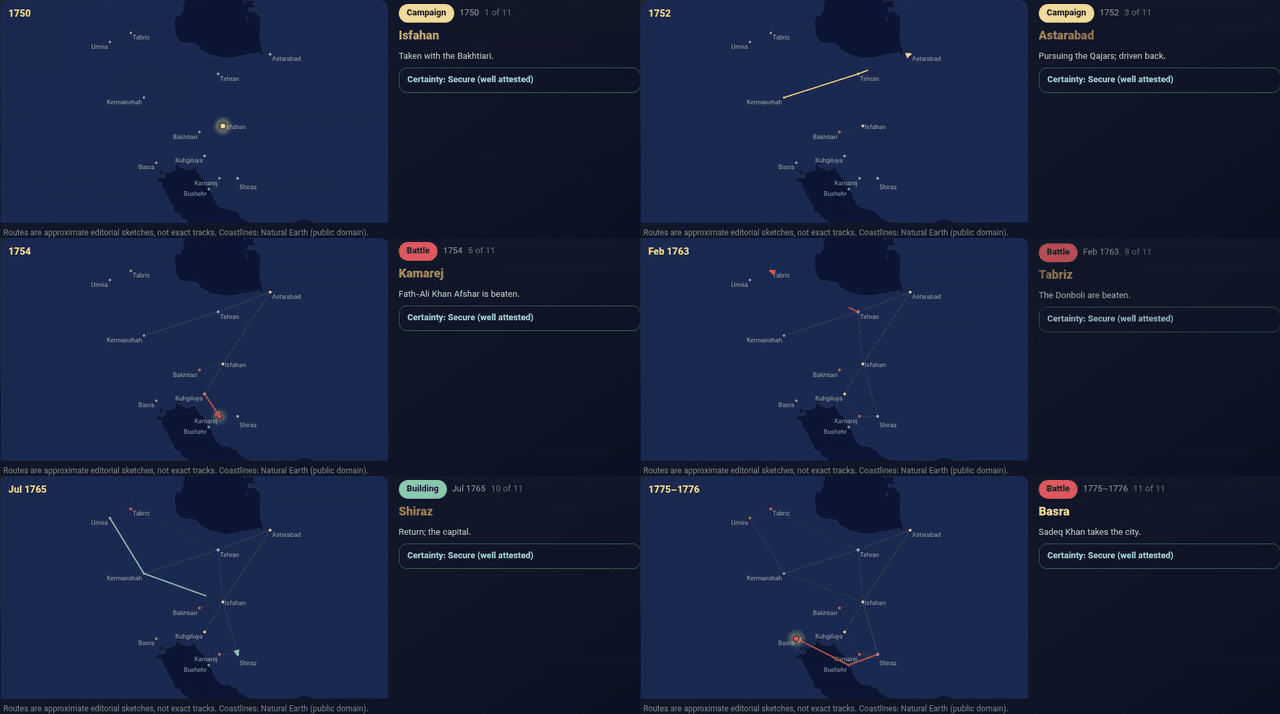
Karim Khan’s campaigns (1750–1776 CE)
From Isfahan and Bakhtiari country to Astarabad, Shiraz, Tehran, Tabriz and Urmia, and finally Basra. Dates follow Iranica (Perry); the routes are sketches.
Campaign17501 of 11
Isfahan
Taken with the Bakhtiari.
Certainty: Secure (well attested)
Sources: J. R. Perry, Encyclopaedia Iranica, 2011, updated 2015 · J. R. Perry, Encyclopaedia Iranica, 2000, updated 2016
BattleCampaignBuildingAdministration & economyReligionArrow keys, Home/End and Space work.
Three separate layers
Each section has three layers: “Historical evidence” is only what the sources say; “Philosophical interpretation” is our reading by the standard of property and liberty; “Modern cultural meaning”. Quotations come only from published translations, with references.
Historical evidencePhilosophical interpretationModern cultural meaning
Dossier · 1
Wakil, not shah
In 1751 Karim Khan took over his rival Ali-Mardan Khan’s title of wakil al-dawla (“deputy of the state”, regent) and ruled in the name of a Safavid puppet, Esmail III.
Perry writes that, against the expectations of Iranians, French and Russians, he never took the title of shah, and reinterpreted wakil as wakil al-raʿāyā, “deputy of the subjects”. From Safavid times wakil al-raʿāyā was the name of a local official appointed by the shah to investigate crimes and complaints of administrative abuse.
The happy reign of this excellent prince as contrasted with those who preceded and followed him, affords to the Historian of Persia that description of mixed pleasure and repose which a traveller enjoys who arrives at a beautiful and fertile valley, in the midst of an arduous journey over barren and rugged wastes

Wakil al-raʿāyā was a modest title, but his power was not modest: Perry writes that he kept executive authority to himself, his viziers were rubber stamps, and he gave military command almost only to close Zand kinsmen.
After Esmail III died (1773) the fiction of a Safavid revival was dropped, but he still did not become shah.
Perry writes that Karim Khan is still generally regarded among Persia’s rulers as, if not the greatest, undoubtedly the best. The title wakil al-raʿāyā is still a symbol of that good name; how far it protected subjects in practice is our judgement, and the sources do not measure it.
Sources: J. R. Perry, Encyclopaedia Iranica · J. R. Perry, Encyclopaedia Iranica
Dossier · 2
The Wakil’s Shiraz
Karim Khan largely rebuilt Shiraz. His Arg (citadel), mosque and several gardens still stand; the city wall, several baths and caravanserais and half of the Wakil’s covered bazaar were demolished, either on Agha Mohammad Khan’s order (1792) or in 20th-century redevelopment.
He repaired the neglected tombs of Shah Shoja, Hafez and Saadi. He housed Zand, Lak and Lor officers in Shiraz; the city grew larger than Isfahan, “perhaps 40–50,000”, and drew poets and artisans from there.

Donboli, his hostage-guest from Tabriz who later became a Qajar historian, paints the Shiraz court as a haze of wine, women and verse; that is a courtier’s view. Shakh-e Nabat (“Sugar-Candy”), Karim Khan’s favourite, bore a name popularly believed to be that of Hafez’s beloved; that is a popular belief, not evidence.
Perry writes that the taʿzia passion play “most likely” took shape in the Wakil’s reign, and that Shi’ism, under pressure in Nader’s time, fully reasserted itself as part of Iranian identity under the Zands.
The Arg, the Wakil’s mosque and bazaar and the tombs of Hafez and Saadi are part of Shiraz’s face today; what one sees now has been repaired and altered many times.
Sources: J. R. Perry, Encyclopaedia Iranica
Dossier · 3
Windfalls, grain and silver
Perry writes that Karim Khan made it a rule not to keep windfalls: he did not confiscate estates left without heirs, and when a pot of gold coins was dug up during the rebuilding of Shiraz he shared it among the workers. He had gifts of jewellery broken up and sold to top up the treasury.
In autumn 1775, during a famine in Isfahan and Fars, he opened the state granaries. Grain came from Tehran, Qazvin and Azarbaijan and cost fourteen times the nominal rate by the time it reached Shiraz, but he sold it to the needy at the nominal rate. The first trade agreement with the East India Company (Shiraz, July 1763) required the Company not to take all its earnings out of Iran in cash.
and not export from Persia the whole Amount of their sales in ready Money, as this will impoverish the Kingdoms [sic] and in the end prejudice Trade in general
This is our reading: Karim Khan did not treat the ruler’s property as the same thing as the country’s wealth. He handed out windfalls, sold grain below cost and tried to stop silver leaving the country, treating the treasury as a tool for keeping subjects at peace rather than a personal hoard. That is the opposite of Nader, whose state was built on booty.
The limits of this reading: Perry notes that much of this comes from popular anecdotes, and his record is not clean, with executions of Zand officers and of Fath-Ali Khan Afshar and the blinding of Shaykh-Ali Khan Zand.
The worry about silver leaving the country and the trade deficit, written into the 1763 agreement, is a question that has returned again and again in Iran’s economic history.
Sources: J. R. Perry, Encyclopaedia Iranica
Dossier · 4
From the Wakil to Lotf-Ali Khan
After Karim Khan died (1779) his kinsmen turned on each other. Zaki Khan seized Shiraz in the name of Karim Khan’s son Mohammad-Ali and was killed by his own troops. Sadeq Khan, Karim Khan’s brother, took Shiraz, but in 1781 Ali-Morad Khan took the city by treachery and both of Karim Khan’s sons and Sadeq Khan were killed. Agha Mohammad Khan Qajar, Karim Khan’s hostage for sixteen years, escaped from Shiraz on his death.
Lotf-Ali Khan (born 1769) recovered Shiraz in 1789. In 1791, on the road to Isfahan, his army deserted him at the instigation of the brother of Haji Ebrahim, the mayor of Shiraz, and Haji Ebrahim handed Shiraz to Agha Mohammad Khan (21 July 1792). Lotf-Ali Khan held Kerman for four months in 1794, then fled to Bam; its governor handed him to the Qajars, who blinded and tortured him and executed him in Tehran in November 1794.
Perry writes that the dynasty’s reputation rests on its founder: Karim Khan could both weld the Zagros tribes into one army and win the trust of the bureaucrats and magnates of the cities. His successors destroyed that achievement through civil war and could not keep the confidence of the townsmen, typified by Haji Ebrahim.
Lotf-Ali Khan is the only successor who, Perry says, won admiration for his courage and integrity; his heroic image in popular memory starts here, and part of it is legend.
The fate of Karim Khan’s bones is unknown: Agha Mohammad Khan moved them to Tehran; one report says Fath-Ali Shah sent them to Najaf, another that Reza Shah had them buried in Qom. Perry writes that his resting place is no longer known for certain.
Haji Ebrahim became the first Qajar grand vizier; the passage from Zand to Qajar was decided more by city magnates joining the winner than by a single battle.
Sources: J. R. Perry, Encyclopaedia Iranica · J. R. Perry, Encyclopaedia Iranica
Synthesis: a calm between two storms
After Nader, who ruled by sword and booty, Karim Khan governed a worn-out country through compromise, kinsmen and the trust of the towns. He did not become shah, built Shiraz, and thought about his subjects’ peace through grain and trade.
But his state was tied to his person. He gave command to his kinsmen, and after his death those kinsmen killed each other; the city magnates went over to the Qajars and the Zand dynasty was gone within fifteen years.
Bibliography
- J. R. Perry, Encyclopaedia Iranica, Karim Khan Zand (2011, updated 2015). https://www.iranicaonline.org/articles/karim-khan-zand/The spine of the Karim Khan page: his rise, Shiraz, the wakil title, the economy and his character.
- J. R. Perry, Encyclopaedia Iranica, Zand Dynasty (2000, updated 2016). https://www.iranicaonline.org/articles/zand-dynasty/Karim Khan’s successors to Lotf-Ali Khan and the rise of the Qajars.
All photos are from Wikimedia Commons; licence and author were checked on each file page.