Featured dossier
Nader Shah: from Darra Gaz to Delhi
The son of a humble Afshar herding family, he drove the Afghans out of Iran, set the Safavids aside and was made shah on the Mughan steppe. He marched to Delhi and took the Mughal treasure, but in an eleven-year reign he wore the country out with taxes and violence, and his own officers killed him.
- reign (1736–1747)
- 11 years
- Mehmandust; Afghan rule ends (CE)
- 1729
- Karnal and Delhi (CE)
- 1739
- tax remission after India
- 3 years
Animated map: life and campaigns
Administration & economyNovember 1688 CE1 of 13
Born at Darra Gaz
Into a humble pastoral family of the Qirqlu branch of the Afshar, at their winter camp in Darra Gaz, north of Mashhad.
Certainty: Secure (well attested)
Sources: E. Tucker, Encyclopaedia Iranica, 2006, updated 2015 · J. R. Perry, Encyclopaedia Iranica, 1984, updated 2018
BattleCampaignBuildingAdministration & economyReligionArrow keys, Home/End and Space work.
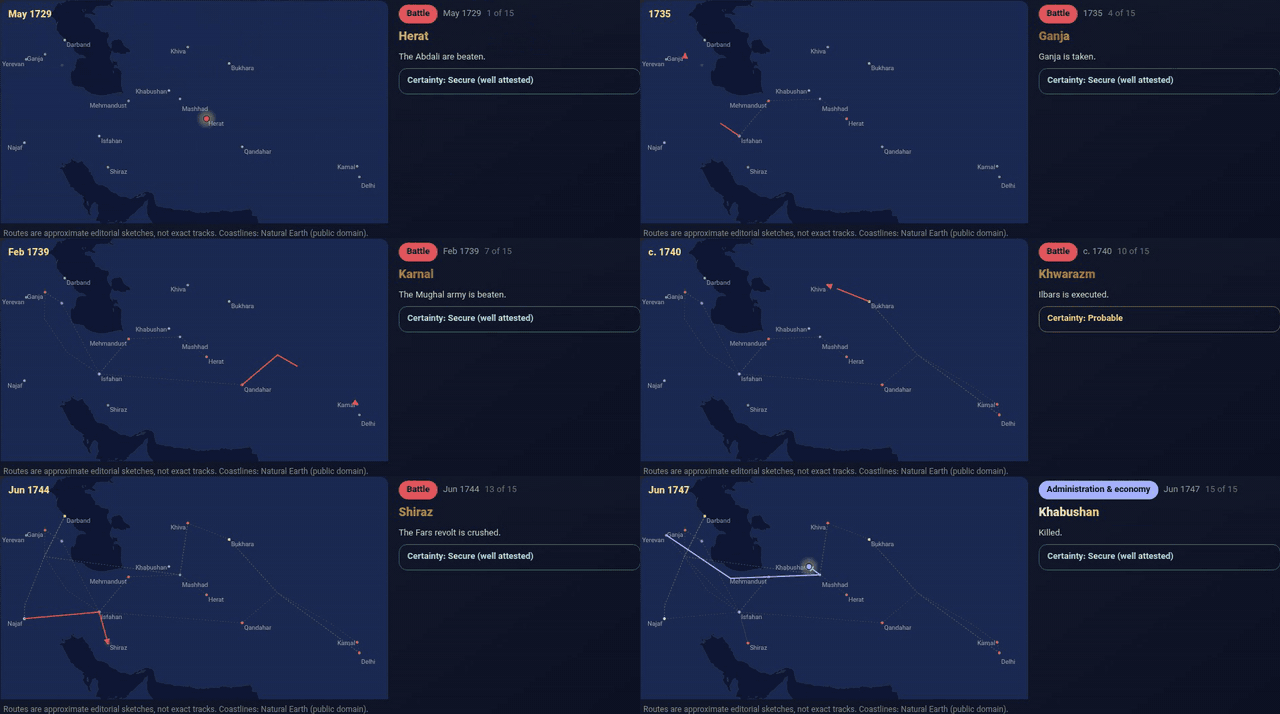
Nader’s campaigns (1729–1747 CE)
From Herat and Mehmandust to Ganja, Qandahar, Karnal and Delhi, then Bukhara, Daghestan, Iraq and Baghavard. Dates follow Iranica (Tucker and Perry); the routes are sketches.
BattleMay 17291 of 15
Herat
The Abdali are beaten.
Certainty: Secure (well attested)
Sources: E. Tucker, Encyclopaedia Iranica, 2006, updated 2015
BattleCampaignBuildingAdministration & economyReligionArrow keys, Home/End and Space work.
Three separate layers
Each section has three layers: “Historical evidence” is only what the sources say; “Philosophical interpretation” is our reading by the standard of property and liberty; “Modern cultural meaning”. Quotations come only from published translations, with references.
Historical evidencePhilosophical interpretationModern cultural meaning
Dossier · 1
From Abivard to Tahmasp-qoli
Nader was born in November 1688 into a humble pastoral Afshar family. From the 16th century the Safavids had settled Afshars in northern Khorasan to defend Mashhad against the Uzbeks.
The Afghan invasion and the fall of Isfahan (1722) opened the field. Nader was at first an ally of Malek Mahmud Sistani and then turned on him. Tahmasp II made him his chief commander. In 1729 he beat the Abdali near Herat and Ashraf’s Ghilzai at Mehmandust.
I am the rarity of the age, and by the grace of God, the servant of the Eight and Four [i.e., the Twelve Imams].

His personal seal on a waqf deed of 1732 still shows an ordinary Shi’ite. Tucker writes that after Mehmandust many Afghan soldiers joined his army; that mixed army later became one reason for his religious policy.
The Qajars blamed Nader for the murder of their ancestor Fath-Ali Khan (1726); this is their claim, and our source does not rule on it.
Darra Gaz and Abivard now lie on either side of the Iran–Turkmenistan border: Nader was born in today’s Iran and began his career outside its present frontier.
Sources: E. Tucker, Encyclopaedia Iranica · J. R. Perry, Encyclopaedia Iranica
Dossier · 2
Mughan and the “Jaʿfari madhhab”
In February 1736 Nader gathered the leaders on the Mughan steppe and asked them to choose him or a Safavid. It is reported that when he heard the chief cleric had said “everyone is for the Safavid dynasty”, he had him arrested and strangled the next day. The assembly proclaimed Nader shah, and all present had to sign a document.
Nader banned the ritual cursing of the first three caliphs and named Shi’ism the “Jaʿfari madhhab”. He asked the Ottomans to recognise it as a fifth school, give a Jaʿfari imam a place at the Kaʿba, accept a Persian pilgrimage leader, exchange permanent ambassadors and free prisoners. The four-peaked Nāderi hat replaced the twelve-gored Qizilbash cap.
everyone is for the Safavid dynasty,
Tucker sees three motives: to keep Sunni–Shi’ite conflict out of the way of his conquests, to reconcile the Sunni and Shi’ite parts of his army, and the revenue of the pilgrimage caravan. He also used a “common Turkmen descent” as the basis of ties with the Ottomans and Mughals.
The idea faced mostly outwards: a decree to the ulama of Isfahan presented the Jaʿfari madhhab simply as a way to keep peace between Sunnis and Shi’ites and did not mention the Safavids. The Ottomans rejected all the religious proposals and agreed only on the pilgrimage, ambassadors and prisoners.
The sources differ on the second condition (a place for a Jaʿfari imam at the Kaʿba): Tucker sets Perry’s and the Encyclopaedia of Islam’s reading against Lockhart’s.
The Najaf meeting (1743) can be seen as an early attempt at Sunni–Shi’ite coexistence; that is our reading. It was not followed up after Nader.
Sources: E. Tucker, Encyclopaedia Iranica
Dossier · 3
India: Karnal and Delhi
After the destruction of Qandahar (1738) many Afghans joined Nader’s army. Nader accused the Mughals of sheltering Afghans who had fled, and the pursuit grew into an invasion of India.
In February 1739 he defeated the Mughal army at Karnal near Delhi and made Muhammad Shah his vassal. After a rumour that Nader had been killed, people in Delhi attacked his troops, and Nader let his soldiers plunder the city and massacre its inhabitants. He took the Peacock Throne and the Koh-i-Noor diamond, put the crown back on Muhammad Shah’s head and took the title shahanshah himself.

Nader’s chroniclers presented the victory as another sign of his likeness to Timur, and Tucker writes that Nader was “obsessed” with emulating Timur. Our sources give no death toll for Delhi, and we give none.
The Indian treasure made Nader suddenly rich: he cancelled taxes for three years and turned to building a navy at Bushehr; the shipbuilding was not finished, but by 1745 he had bought about thirty ships in India.
Ahmad Shah Durrani, one of Nader’s commanders, founded the Durrani dynasty after his death; Tucker writes that he is credited as the first ruler of an independent Afghan state.
Sources: E. Tucker, Encyclopaedia Iranica
Dossier · 4
Land, coin and army
Nader ordered a land survey to produce registers known as the raqabat-e Nāderi. With the Jaʿfari madhhab he suspended the Safavid system of pious foundations, although their revenue supported the leading ulama; only in his last year did he order them restored.
He dropped the Safavid silver ʿAbbāsi and struck a silver Nāderi on the weight of the Mughal rupee. He tried to pay soldiers and officials fixed salaries instead of land revenue, greatly increased the troops under his direct command, and expanded the forced resettlement of tribes.

This is our reading: Nader wanted to pull land revenue away from tribes, officials and ulama and turn it into cash that ran an army loyal to him alone. The Indian treasure made that possible for a few years, but plunder is not a lasting revenue.
Tucker likewise writes that these reforms answered weaknesses of the late Safavid era but none solved the problems tied to the world economy. Perry adds that the hundreds of thousands of deportees brought to Khorasan went mostly into the standing army and became a strain on the province rather than an asset.
When the money ran short Nader had to reimpose taxes, and the heavy levies set off one revolt after another. It shows that an army paid from war booty cannot last without fresh booty.
Sources: E. Tucker, Encyclopaedia Iranica · J. R. Perry, Encyclopaedia Iranica
Dossier · 5
Nader’s end and his successors
After 1741 Nader had his son Reza-qoli blinded; his chronicler Marvi reports signs of physical decline and mental instability. Taxes came back and revolts spread, above all in Fars (1744). In his last year, Perry says, at least 100 notables of Mashhad were executed.
On 20 June 1747 he was killed on the road to Khabushan. His nephew Ali-qoli (Adel Shah) massacred all Nader’s issue except Shahrokh. Ebrahim Shah blinded him and was himself blinded and killed. Shahrokh, Nader’s grandson and a grandson of Shah Soltan Hosayn, became shah at Mashhad; in 1750 the Safavid Solayman II briefly replaced him and Shahrokh was blinded, but he returned to the throne.

Perry writes that after Nader “Afsharid” is just a name for the history of Khorasan: Ahmad Shah Durrani took the east and the Zands western Iran, and Shahrokh was for a time a Durrani vassal. His sons melted down the treasure and even fittings of the Imam Reza shrine to pay troops.
Marvi’s report of Nader’s mental instability comes from a chronicler; we take it as a sign of his growing brutality, not a medical diagnosis.
Agha Mohammad Khan Qajar overthrew Shahrokh and tortured him to reveal where his jewels were. Tucker dates this to 1795, Perry to 1210 AH/1796. Khorasan passed fully to the Qajars in 1802.
Mashhad sat midway on the trade route between India and Russia, and Tucker writes that it grew into a major pilgrimage centre under Nader’s patronage; Perry adds that it was freer of Safavid associations than Isfahan.
Sources: E. Tucker, Encyclopaedia Iranica · J. R. Perry, Encyclopaedia Iranica
Synthesis: a country won back by the sword
Nader won Iran back from the Afghans, the Ottomans and Russia; the Russians left mostly through the treaties of Rasht and Ganja rather than by war. He then tried to build a new place for himself and Iran with the Jaʿfari madhhab and a shared Turkmen descent.
But his state stood on the army and on booty. When the treasure ran out, taxes and violence returned, and after his murder the empire fell apart within a few years.
Bibliography
- E. Tucker, Encyclopaedia Iranica, Nāder Shah (2006, updated 2015). https://www.iranicaonline.org/articles/nader-shah/The spine of the Nader page: his rise, the Mughan assembly, the Jaʿfari madhhab, India, his reforms and his murder.
- J. R. Perry, Encyclopaedia Iranica, Afsharids (1984, updated 2018). https://www.iranicaonline.org/articles/afsharids/Khorasan after Nader to 1796: Adel Shah, Ebrahim, Shahrokh and Solayman II.
All photos are from Wikimedia Commons; licence and author were checked on each file page.