Featured dossier
Shah Abbas: a new army, a new capital
At seventeen he became shah of a country in turmoil, parts of it held by the Ottomans and Uzbeks. With an army of Caucasian ghulams paid from crown lands he won the lost lands back, made Isfahan his capital and drove the Portuguese from Hormuz. The same reforms, Savory says, became in the long run causes of Safavid decline.
- reign (solar years)
- 41 years
- high posts held by ghulams
- 1/5
- on foot, Isfahan to Mashhad
- 28 days
- Hormuz (CE)
- 1622
Animated map: life and reign
Administration & economy27 January 1571 CE1 of 13
Birth
Third son of Soltan Mohammad Khodabanda. Savory does not give his birthplace; the dot marks the capital of the day, Qazvin.
Certainty: ProbableThe date is secure, the place is not.
Sources: R. M. Savory, Encyclopaedia Iranica, 1982, updated 2018
BattleCampaignBuildingAdministration & economyReligionArrow keys, Home/End and Space work.
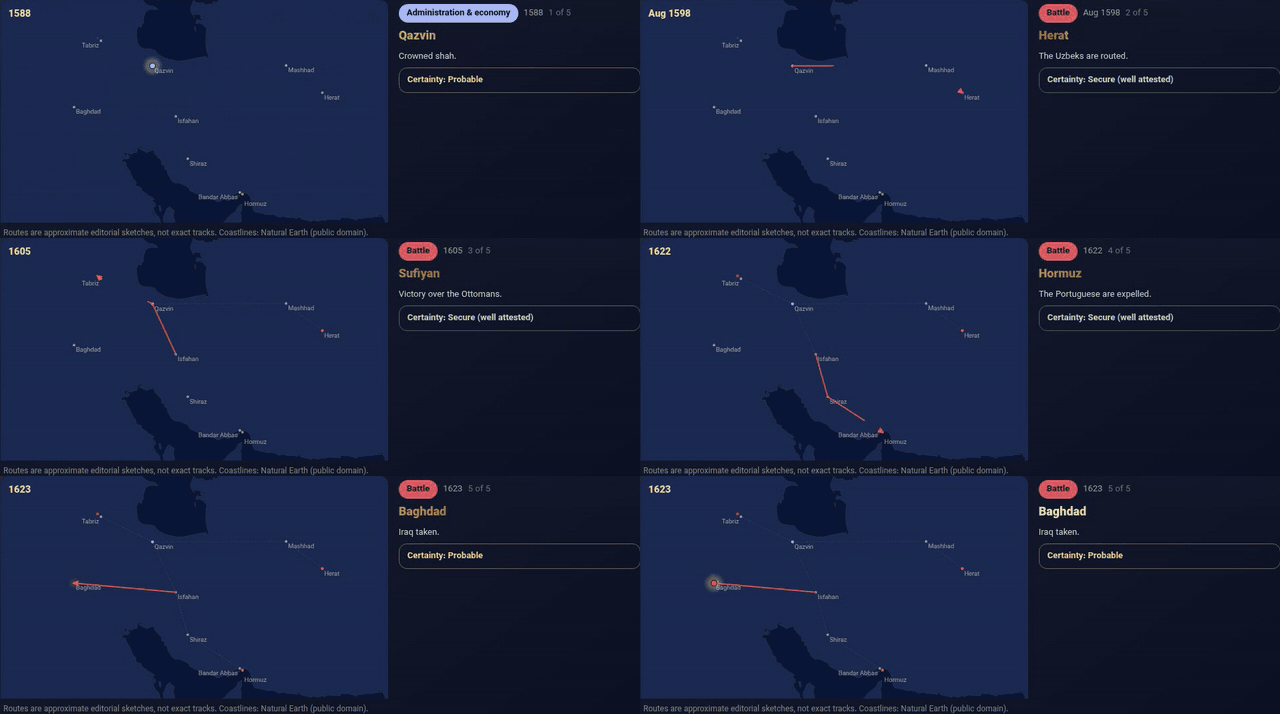
Shah Abbas’s campaigns (1588–1623 CE)
From Herat to Sufiyan, Hormuz and Baghdad. Dates follow Iranica (Savory and Matthee); the routes are sketches.
Administration & economy15881 of 5
Qazvin
Crowned shah.
Certainty: ProbableSavory 1588, Matthee 1587.
Sources: R. M. Savory, Encyclopaedia Iranica, 1982, updated 2018 · R. Matthee, Encyclopaedia Iranica, 2008, updated 2017
BattleCampaignBuildingAdministration & economyReligionArrow keys, Home/End and Space work.
Three separate layers
Each section has three layers: “Historical evidence” is only what the sources say; “Philosophical interpretation” is our reading by the standard of property and liberty; “Modern cultural meaning”. Quotations come only from published translations, with references.
Historical evidencePhilosophical interpretationModern cultural meaning
Dossier · 1
The ghulam army
Abbas built a standing army of ghulams: Georgian, Armenian and Circassian Christians taken captive in the Caucasus wars, converted to Islam and trained for the household and the administration. By the end of his reign ghulams held about one fifth of the high administrative posts.
A Georgian ghulam, Allahverdi Khan, took part in killing Morshed-qoli Khan Ostajlu, the very amir who had put Abbas on the throne.
The loyalty of the ḡolāms was to person of the shah, not to a tribe

Savory writes that the ghulams’ loyalty was to the shah, not to a tribe, so the shah gained a new support against the Qizilbash. It continued what Tahmasp had begun by moving Caucasian captives into Iran.
An army loyal to one man holds a country only as long as that man is able.
Sources: R. M. Savory, Encyclopaedia Iranica
Dossier · 2
Crown lands: income today, cost tomorrow
To pay the new army, Abbas turned more provinces from “state” (mamalek) land, held by Qizilbash amirs, into “crown” (khassa) land. There royal intendants collected the taxes and sent them straight to the treasury. Matthee says ghulams became governors of these provinces. In 1619 the export of silk also became a royal monopoly.
Savory calls this solution effective in the short term and adds that in the long run it became one of the principal causes of Safavid decline: extended by his successors, it upset the balance between Qizilbash and ghulam troops and weakened the army.
in the long run it constituted one of the principal causes of Safavid decline
This is our reading: Abbas moved revenue out of the amirs’ hands and into the shah’s treasury, but put no one in their place with a stake in the land’s long-term upkeep. An intendant who holds a province for a few years takes the income and does not pay for the future. We draw this from Savory’s remark on decline; he does not spell out this mechanism himself.
When property flows straight to the state and no one owns it for the long term, today’s income can be paid for with tomorrow’s weakness.
Sources: R. M. Savory, Encyclopaedia Iranica · R. Matthee, Encyclopaedia Iranica
Dossier · 3
Isfahan
After 1598 Abbas moved the capital from Qazvin to Isfahan. The Chahar Bagh avenue led to the Maydan-e Shah (Naqsh-e Jahan), around which rose the Ali Qapu palace, the Sheikh Lotfallah mosque, the Shah Mosque (begun 1611) and the Qaysariya bazaar. Thousands of Armenian craftsmen were moved from Julfa in Azerbaijan to New Julfa on the Zayanda-rud.
Savory says there had been no such comprehensive town planning in the Islamic world since the caliph al-Mansur built Baghdad.

Big numbers need care: Matthee says Chardin’s figure of 600,000 people for Isfahan is “almost certainly an exaggeration” and the traditional count of 999 caravanserais “much exaggerated”. Iranica’s date for the start of the Sheikh Lotfallah mosque is internally inconsistent, so we leave it out.
Naqsh-e Jahan put palace, mosque and bazaar side by side in one space; the layout shows how closely power, faith and trade were bound together in that state.
Sources: R. M. Savory, Encyclopaedia Iranica · R. Matthee, Encyclopaedia Iranica
Dossier · 4
Hormuz and the sea
In 1622 Abbas, with English help, expelled the Portuguese from the island of Hormuz. Matthee says he razed the town and founded a new port named after himself, Bandar Abbas, at the village of Gomru on the mainland.
Savory says Abbas used the rivalry of the Portuguese, English and Dutch to his own advantage. Matthee dates his peace with the Ottomans to 1611 while Savory places it at Sarab in 1618; whether these are two separate peaces or one counted two ways is not clear.
Bandar Abbas still bears his name: a port built for trade, a reminder of how closely shah and market were tied.
Sources: R. M. Savory, Encyclopaedia Iranica · R. Matthee, Encyclopaedia Iranica
Dossier · 5
Sons in the harem
Abbas stopped sending his sons to the provinces with Qizilbash guardians and kept them in the harem. Fearing plots, he had one son executed and two blinded; two others had died before him. His successor was his grandson Safi.
This practice was undoubtedly one of the major causes of Safavid decline.
Savory says princes raised in the harem had no experience of government and that this practice was “undoubtedly one of the major causes of Safavid decline”.
A state that lets no heir learn the work before he rules buries its competence with one man.
Sources: R. M. Savory, Encyclopaedia Iranica
Synthesis: strength now, a long bill later
With ghulams, crown lands and the silk monopoly, Shah Abbas built a state that gathered revenue and army into the shah’s hands. With those tools he won back the lost lands and built Isfahan.
Savory counts two of his measures, the spread of crown lands and the confinement of princes in the harem, among the principal causes of Safavid decline. Ninety-three years after his death, Isfahan fell to the Afghans.
Bibliography
- R. M. Savory, Encyclopaedia Iranica, Esmāʿīl I Ṣafawī i. Biography (1998, updated 2017). https://www.iranicaonline.org/articles/esmail-i-safawi/esmail-i-safawi-i-biography/The spine of the Ismail page: dates, Chaldiran and the army figures.
- C. P. Mitchell, Encyclopaedia Iranica, Ṭahmāsp I (2009, updated 2012). https://www.iranicaonline.org/articles/tahmasp-i/Tahmasp’s reign, the Peace of Amasya and the move to Qazvin.
- R. M. Savory, Encyclopaedia Iranica, ʿAbbās I (1982, updated 2018). https://www.iranicaonline.org/articles/abbas-i/The spine of the Abbas page: ghulams, crown lands and Isfahan.
- R. Matthee, Encyclopaedia Iranica, Safavid Dynasty (2008, updated 2017). https://www.iranicaonline.org/articles/safavids/The dynasty overview; where it differs from the other articles, the page says so.
All photos are from Wikimedia Commons; licence and author were checked on each file page.