Featured dossier
Shah Ismail: from Ardabil to Chaldiran
Grandson of Uzun Hasan through his mother and head of the Safavid order, he became shah at Tabriz at fourteen and made Shi’ism the official religion. In ten years he took everything from Shirvan to Merv, but at Chaldiran Ottoman guns beat his horsemen. His son Tahmasp held his state together for fifty-two years.
- reign (1501–1524)
- 23 years
- Qizilbash at Erzincan (1500)
- 7,000
- Chaldiran (CE)
- 1514
- Tahmasp’s reign
- 52 years
Animated map: life and campaigns
Religion17 July 1487 CE1 of 9
Born at Ardabil
Son of Haydar, head of the Safavid Sufi order, and Halima Begum, daughter of Uzun Hasan of the Aq Qoyunlu.
Certainty: Secure (well attested)
Sources: R. M. Savory, Encyclopaedia Iranica, 1998, updated 2017
BattleCampaignBuildingAdministration & economyReligionArrow keys, Home/End and Space work.
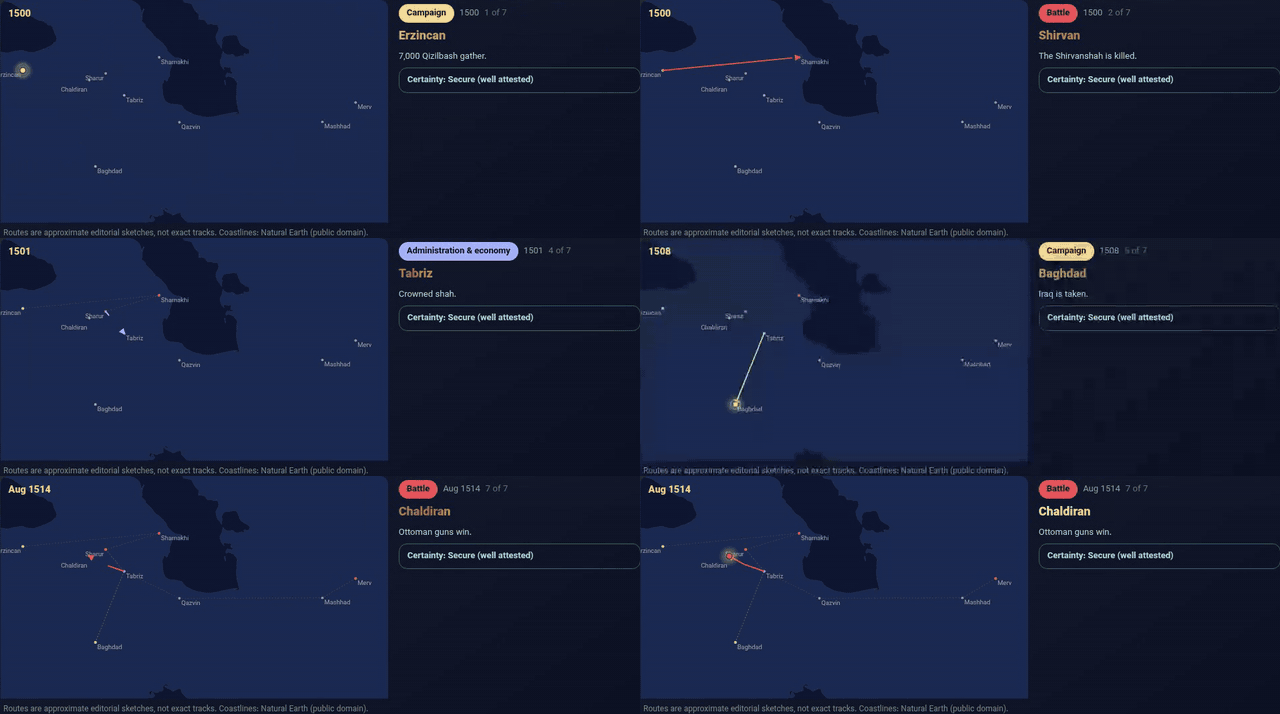
Shah Ismail’s campaigns (1500–1514 CE)
From Erzincan and Shirvan to Tabriz, Baghdad and Merv, and defeat at Chaldiran. Dates follow Iranica (Savory and Matthee); the routes are sketches.
Campaign15001 of 7
Erzincan
7,000 Qizilbash gather.
Certainty: Secure (well attested)
Sources: R. M. Savory, Encyclopaedia Iranica, 1998, updated 2017
BattleCampaignBuildingAdministration & economyReligionArrow keys, Home/End and Space work.
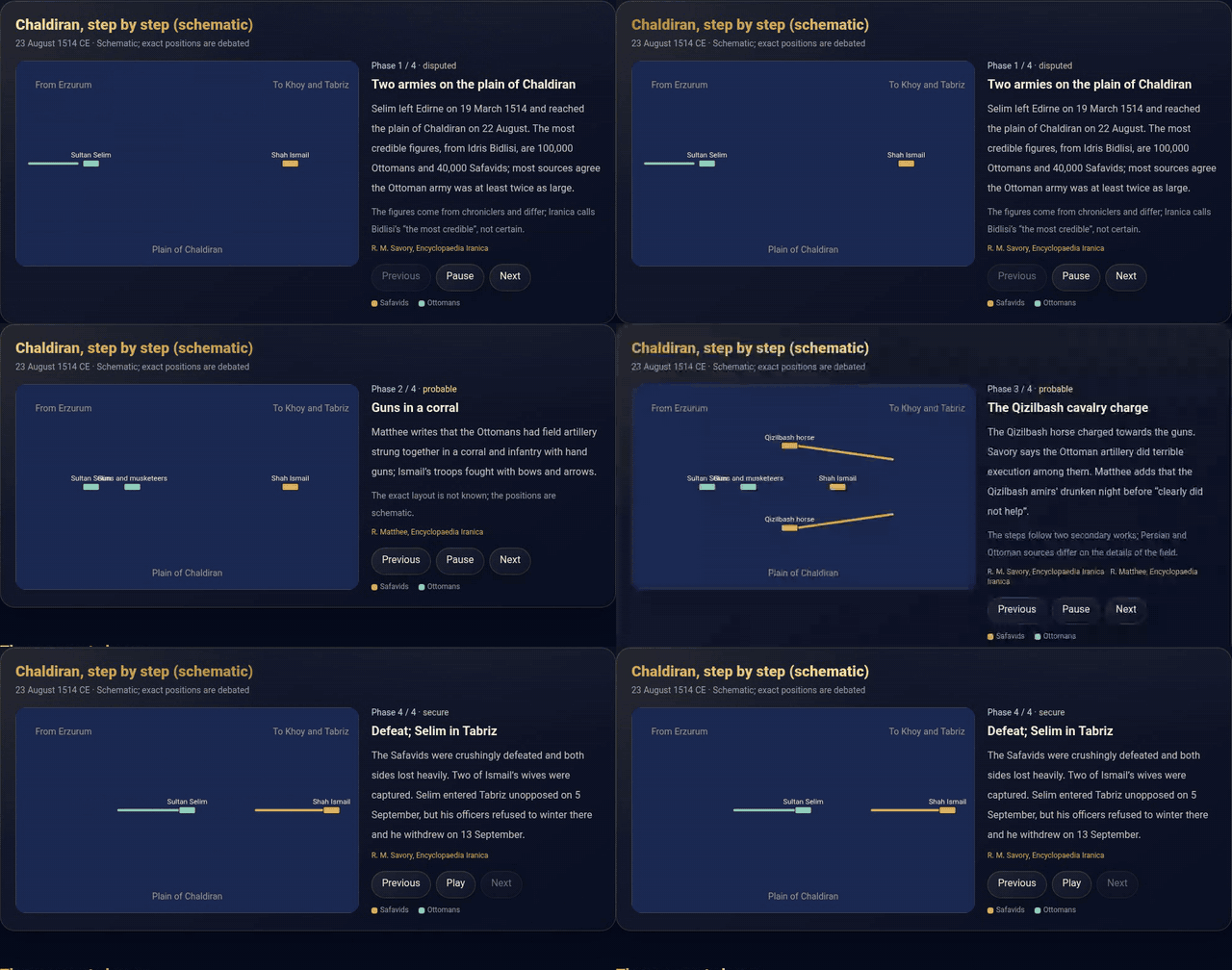
Chaldiran, step by step (schematic)
23 August 1514 CE · Schematic; exact positions are debated
Phase 1 / 4 · disputed
Two armies on the plain of Chaldiran
Selim left Edirne on 19 March 1514 and reached the plain of Chaldiran on 22 August. The most credible figures, from Idris Bidlisi, are 100,000 Ottomans and 40,000 Safavids; most sources agree the Ottoman army was at least twice as large.
The figures come from chroniclers and differ; Iranica calls Bidlisi’s “the most credible”, not certain.
R. M. Savory, Encyclopaedia Iranica
SafavidsOttomans
Three separate layers
Each section has three layers: “Historical evidence” is only what the sources say; “Philosophical interpretation” is our reading by the standard of property and liberty; “Modern cultural meaning”. Quotations come only from published translations, with references.
Historical evidencePhilosophical interpretationModern cultural meaning
Dossier · 1
An official faith: a step without precedent
In 1501 Ismail made Twelver Shi’ism the official religion. Savory writes that this step had no precedent among Islamic states. His followers, the Qizilbash, saw him as divine, and his Turkish poems under the pen name “Khata’i” encouraged that belief.
Matthee says the conversion of Iran was a long process: in the mid-16th century Qazvin, Shiraz and Hamadan were still Sunni centres, and in 1720 an Ottoman observer counted a third of the people as Sunni.

Savory sees the political gain in setting the new Safavid state apart from its powerful Sunni neighbours, the Ottomans to the west and the Uzbeks to the east. We treat this as his reading, not Ismail’s own words.
The religious border drawn then is still part of the region’s political map.
Sources: R. M. Savory, Encyclopaedia Iranica · R. Matthee, Encyclopaedia Iranica
Dossier · 2
Chaldiran: horsemen against guns
On 23 August 1514, on the plain of Chaldiran, Ottoman artillery and musketeers broke the Qizilbash horse. Selim took Tabriz but left eight days later. Ismail went into mourning in black and had his standards dyed black.
Savory writes that he never again led his troops in battle; Matthee calls this “famously said” and notes it is true that the shah did little to stop the loss of Balkh and Kandahar.
If the Turk had been beaten, the power of Esmāʿīl would have become greater than that of Tamerlane’s, as by fame alone of such a victory he would have made himself absolute lord of the East

Defeat shook the belief in the shah’s invincibility and divine aura; that is Matthee’s reading. That Chaldiran “broke Ismail’s spirit” is a famous story, and we label it as such, not as a record.
Courage without new weapons does not last against a state that has them. A century later Shah Abbas acted on that lesson.
Sources: R. M. Savory, Encyclopaedia Iranica · R. Matthee, Encyclopaedia Iranica
Dossier · 3
Land in return for loyalty
Matthee writes that the Qizilbash received land in return for their loyalty and were made governors of newly conquered provinces. The chancery stayed in Persian (Tajik) hands.
Minorsky, quoted by Savory, said the Turkmans and Persians did not mix freely, “like oil and water”. At Ghijduvan many Qizilbash left the field because they had been put under a Persian commander.
This is our reading: land in this state was a reward for loyalty to a holy leader, not a lasting right. When the leader’s aura shook at Chaldiran, the bond between land and loyalty loosened, and the Qizilbash amirs fought over the provinces while Tahmasp was a child.
Property tied to one man’s favour loses its protection when he falls.
Sources: R. M. Savory, Encyclopaedia Iranica · R. Matthee, Encyclopaedia Iranica
Dossier · 4
Tahmasp I: fifty-two years
Tahmasp was born near Isfahan on 22 February 1514, became shah at ten on 23 May 1524 and died at Qazvin on 14 May 1576: the longest Safavid reign. Until about 1533 Qizilbash amirs ruled in his name. In 1528 at Jam he beat the Uzbeks with the help of gunpowder.
He campaigned in the Caucasus and by 1553 had moved more than 30,000 people, mostly women and children, to the Iranian plateau; Mitchell sees this as the start of the ghulam corps. On 29 May 1555 he made the Peace of Amasya with the Ottomans. Humayun, the Mughal emperor, was his guest from 1543 to 1545. The Shahnama of Shah Tahmasp was finished in the mid-1540s.
the modern originality of Persian Shiʿism has its roots [with Shah Ṭahmāsp].


The year the capital moved from Tabriz to Qazvin is disputed: Matthee gives 1548, Mitchell 1557. Mitchell sees the motive more in reducing Turkic influence at court than in fear of the Ottomans.
Amasya drew a line that, Matthee says, through the Treaty of Qasr-e Shirin in 1639 became the basis of Iran’s border with Turkey and Iraq today.
Sources: C. P. Mitchell, Encyclopaedia Iranica · R. Matthee, Encyclopaedia Iranica
Synthesis: a state built on faith
Ismail turned a Sufi order into a state and set it apart from its neighbours with an official faith. His strength was the Qizilbash’s belief, and that strength was not enough against Ottoman guns.
After Chaldiran the state survived but changed shape: Tahmasp moved the capital to Qazvin, brought Caucasian captives into Iran and opened the way for Shah Abbas’s ghulams.
Bibliography
- R. M. Savory, Encyclopaedia Iranica, Esmāʿīl I Ṣafawī i. Biography (1998, updated 2017). https://www.iranicaonline.org/articles/esmail-i-safawi/esmail-i-safawi-i-biography/The spine of the Ismail page: dates, Chaldiran and the army figures.
- C. P. Mitchell, Encyclopaedia Iranica, Ṭahmāsp I (2009, updated 2012). https://www.iranicaonline.org/articles/tahmasp-i/Tahmasp’s reign, the Peace of Amasya and the move to Qazvin.
- R. M. Savory, Encyclopaedia Iranica, ʿAbbās I (1982, updated 2018). https://www.iranicaonline.org/articles/abbas-i/The spine of the Abbas page: ghulams, crown lands and Isfahan.
- R. Matthee, Encyclopaedia Iranica, Safavid Dynasty (2008, updated 2017). https://www.iranicaonline.org/articles/safavids/The dynasty overview; where it differs from the other articles, the page says so.
All photos are from Wikimedia Commons; licence and author were checked on each file page.
The Safavid dynastyShah Abbas the GreatUzun Hasan, his maternal grandfather