Featured dossier
Uzun Hasan: from Amed to Tabriz
Hasan the Tall, leader of the “White Sheep” Turkmans, rose from the fortress of Amed, defeated the Qara Qoyunlu and the last conquering Timurid, and made Tabriz his capital. He allied with Venice against the Ottomans, but at Otlukbeli Ottoman guns beat his horsemen. His law code stayed in force long after him.
- from Amed (1452) to death (1478)
- 26 years
- end of the Qara Qoyunlu (CE)
- 1467
- Otlukbeli (CE)
- 1473
- law code that outlived his state
- 1
Animated map: life and campaigns
Administration & economyAutumn 1452 CE1 of 9
The coup at Amed
His brother Jahangir had accepted Qara Qoyunlu overlordship. Hasan, called “Uzun” (the Tall), saw this as betrayal and, while Jahangir was away on campaign, seized Amed (Diyarbakır) in a bloodless coup. He sent the keys of the fortress to the Mamluk sultan in Cairo and received a diploma as governor.
Certainty: Secure (well attested)
Sources: R. Quiring-Zoche, Encyclopaedia Iranica, 1986, updated 2013
BattleCampaignBuildingAdministration & economyReligionArrow keys, Home/End and Space work.
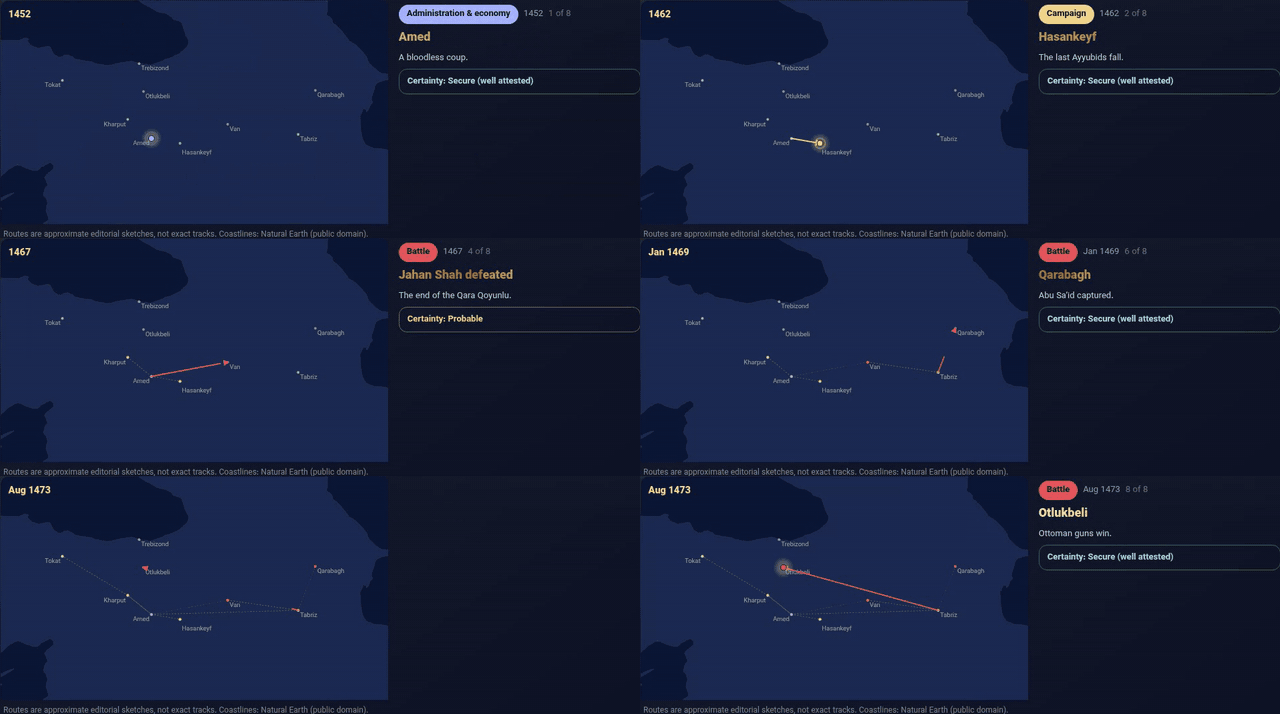
Uzun Hasan’s campaigns (1452–1473 CE)
From the coup at Amed to victory over Jahan Shah and Abu Sa‘id, and defeat at Otlukbeli. Dates follow Iranica (Quiring-Zoche, after Woods); the routes are sketches.
Administration & economy14521 of 8
Amed
A bloodless coup.
Certainty: Secure (well attested)
Sources: R. Quiring-Zoche, Encyclopaedia Iranica, 1986, updated 2013
BattleCampaignBuildingAdministration & economyReligionArrow keys, Home/End and Space work.
Three separate layers
Each section has three layers: “Historical evidence” is only what the sources say; “Philosophical interpretation” is our reading by the standard of property and liberty; “Modern cultural meaning”. Quotations come only from published translations, with references.
Historical evidencePhilosophical interpretationModern cultural meaning
Dossier · 1
Otlukbeli: horsemen against guns
According to Iranica, Uzun Hasan’s army, with all its provincial contingents, may well have exceeded 100,000 men; its strength was the cavalry, and its great weakness was the lack of firearms. He asked Venice for guns; they were shipped in spring 1473 but arrived too late. In August 1473 at Otlukbeli, Mehmed the Conqueror brought artillery and muskets into action with decisive effect.

The 100,000 is an estimate, not a count. The lesson that became clear later was that Turkman cavalry no longer prevailed against guns; forty years on, the Safavids learned the same at Chaldiran.
Courage does not make up for adopting new technology too late.
Dossier · 2
The law code of Hasan Padishah
Iranica writes that Uzun Hasan appreciated the worth of the rural population, or at least knew there were limits to what peasants could produce. To prevent arbitrary exploitation he had the statutes, probably mostly existing rules, codified in the Qanun-nama of Hasan Padishah, which stayed in force long after his time; much of his tax and trade law survives in Ottoman sources. In the Iranian provinces he kept the existing administration and its Iranian officials.

This is our reading: written law, even from a ruler, draws a limit to taking; the farmer knows what he owes and the collector cannot take whatever he wants. That was a small step towards secure property. Alongside it, though, the amirs’ heritable suyurghal grants, with tax exemption and sometimes their own courts, divided the land among the powerful; the attempt to reform them under his son Ya‘qub failed and did not outlast him.
Clear law, even imperfect, protects people’s property better than arbitrary command.
Dossier · 3
The Safavid son-in-law
Uzun Hasan supported the urban religious establishment and persecuted extreme sects, but kept contact with popular dervish orders that leaned towards Shi‘ism. He had sheltered the Safavid shaykh Junayd and given him his sister in marriage; he then married his daughter Halima Begum to Junayd’s son, Shaykh Haydar. Halima’s mother was Despina Khatun, a princess of Trebizond. Haydar’s son Ismail overthrew the Aq Qoyunlu in 1501.

Iranica warns that the clear-cut contrast between “Sunni Aq Qoyunlu” and “Shi‘i Qara Qoyunlu and Safavids” rests mainly on later Safavid sources and “must be considered doubtful”.
Family ties can raise an heir from inside a rival’s house.
Sources: R. Quiring-Zoche, Encyclopaedia Iranica · R. M. Savory, Encyclopaedia Iranica
Synthesis: a tribal state on the threshold of an Iranian one
Uzun Hasan was the first Aq Qoyunlu ruler to call himself an independent sultan. He kept the Iranian officials and wrote down the law, but the gap between Turkman warriors and settled people, in Iranica’s words, remained unbridgeable.
After him, tribal chiefs used child princes as tools of their power and the state fell apart. Ismail Safavi, son of his son-in-law Haydar, took over his inheritance.
Bibliography
- R. Quiring-Zoche, Encyclopaedia Iranica, Āq Qoyunlū (1986, updated 2013). https://www.iranicaonline.org/articles/aq-qoyunlu-confederation/The spine of this page: the Aq Qoyunlu rise, Uzun Hasan, his law code and the collapse.
- R. M. Savory, Encyclopaedia Iranica, Esmāʿīl I Ṣafawī i. Biography (1998, updated 2017). https://www.iranicaonline.org/articles/esmail-i-safawi/esmail-i-safawi-i-biography/The Safavid family ties to Uzun Hasan.
- S. Aube, Encyclopaedia Iranica, Tabriz x. Monuments (1): The Blue Mosque (2011, updated 2018). https://www.iranicaonline.org/articles/tabriz-x-monuments/The Blue Mosque of Tabriz and its founders.
All photos are from Wikimedia Commons; licence and author were checked on each file page.