Featured dossier
Timur: from Samarqand to Ankara
An amir of the Barlas tribe with no Chinggisid blood, who rode from Delhi to Ankara. He took Herat, Isfahan, Baghdad and Damascus, broke the Golden Horde and captured the Ottoman sultan. His cruelty stands out even in the sources; his successors, Shahrukh, Gowharshad and Ulugh Beg, made their names through art and learning. Follow the campaigns on the map.
- in power (1370–1405)
- 35 years
- towers of heads Hafiz-i Abru counted at Isfahan
- 28
- Ankara; Bayezid captured (CE)
- 1402
- death at Otrar (CE)
- 1405
Animated map: life and campaigns
Administration & economy8 April 1336 CE1 of 12
Born in Kesh
He was born in Kesh (Shahr-i Sabz) in Transoxania. His father, Amir Taraghai, was respected in the Barlas tribe, though not wealthy. “Timur” means iron in Turkish; the Persian “Timur-i Lang”, Timur the Lame, became “Tamerlane” in Europe.
Certainty: Secure (well attested)
Sources: H. R. Roemer, Cambridge History of Iran, vol. 6, 1986
BattleCampaignBuildingAdministration & economyReligionArrow keys, Home/End and Space work.
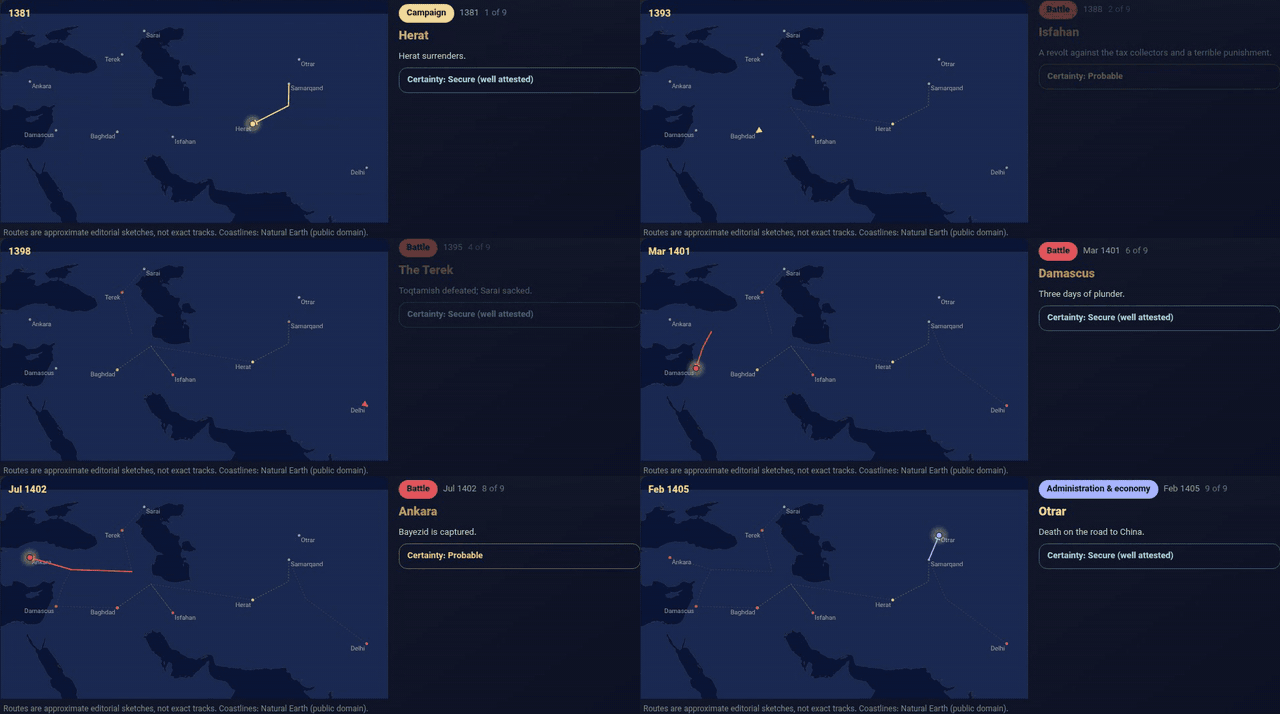
Timur’s campaigns: from Herat to Ankara (1381–1405 CE)
From Herat and Isfahan to the Terek, Delhi, Damascus, Baghdad and Ankara, and finally death at Otrar. Dates follow Roemer (Cambridge History of Iran, vol. 6); the routes are sketches.
Campaign13811 of 9
Herat
Herat surrenders.
Certainty: Secure (well attested)
Sources: H. R. Roemer, Cambridge History of Iran, vol. 6, 1986
BattleCampaignBuildingAdministration & economyReligionArrow keys, Home/End and Space work.
Three separate layers
Each section has three layers: “Historical evidence” is only what the sources say; “Philosophical interpretation” is our reading by the standard of property and liberty; “Modern cultural meaning”. Quotations come only from published translations, with references.
Historical evidencePhilosophical interpretationModern cultural meaning
Dossier · 1
Towers of heads: fear as a method
According to Roemer, the people of conquered cities counted as booty: they were sold or deported to Transoxania, and many, often one in two, died on the way. Outside the gates of cities he punished, Timur raised towers of heads. At Isfahan, Hafiz-i Abru counted twenty-eight. At Baghdad (1401) only theologians and dervishes were spared. The leading men of a city, as at Herat in 1381, were usually spared.

Roemer calls the towers “direct symbols of his unbridled cruelty” and writes that the Mongols too achieved nothing that “equalled this degree of inhumanity”. Some accounts come from hostile writers such as Ibn ‘Arabshah; but Hafiz-i Abru’s count is a first-hand report. We treat overall death tolls as estimates, not counts.
Power built on fear comes apart quickly once its founder dies.
Dossier · 2
Amir, not khan
Timur was not a descendant of Chinggis Khan. A burial inscription later gave his family a common ancestry with Chinggis, but in his lifetime he made no such claim. He set up puppet Chinggisid khans in Samarqand, called himself “amir”, and, having married a Chinggisid khan’s daughter, took the title güregen, “son-in-law”. A Sunni, he brought scholars such as Taftazani and Sharif Jurjani to Samarqand, in Algar’s words “sometimes forcibly”.

Roemer writes: “This suggests that he felt his rule stood in need of legitimisation.” The sword was not enough; he also needed the name of Chinggis and the backing of religious scholars.
Even conquerors cannot rule without acceptance from people and institutions.
Sources: H. R. Roemer, Cambridge History of Iran, vol. 6 · H. Algar, Encyclopaedia Iranica
Dossier · 3
Property: plunder for the capital
Timur spent decades adorning Samarqand and ringed it with villages named after the great cities of Islam. Craftsmen and scholars from conquered cities were deported there. After the Terek, the cities of the Golden Horde were so devastated that, in Roemer’s account, long-distance trade by that route was virtually paralysed; he writes that Timur had “probably” intended to ruin that country’s economy.

This is our reading: in Timur’s state, the property and even the lives of conquered townspeople belonged to the conqueror. Wealth was moved by force from the edges to the capital; only those the conqueror chose to spare were safe. That was wealth, but not ownership.
A capital made splendid by plundering others stands on others’ ruin.
Dossier · 4
After Timur: Shahrukh, Gowharshad and Ulugh Beg
After a succession struggle, Timur’s son Shahrukh took Samarqand without a fight on 13 May 1409 and made his son Ulugh Beg governor of Transoxania; he himself stayed in Herat. His wife Gowharshad built the great mosque at Mashhad (finished 1418) and endowed it in 1426; she also built a madrasa and mosque in Herat (1417–1437), with Qavam al-Din Shirazi as architect. Ulugh Beg built an observatory in Samarqand, and his astronomical tables made his name last. Shahrukh died at Ray on 13 March 1447. After two years on the throne, Ulugh Beg was defeated by his son ‘Abd al-Latif and, after a sham trial, was killed on his way to Mecca in October 1449. Gowharshad was executed on the orders of the Timurid Abu Sa‘id on 31 July 1457.


Roemer writes that at the Herat court others, especially Gowharshad, had more influence on government than Shahrukh himself. Manz is more precise: Gowharshad ranked below Shahrukh’s Chinggisid wife, Malekat Agha, but was closer to him and more active politically. The date of the observatory is not certain either: Roemer gives 825 AH, about 1420. Roemer calls Ulugh Beg a cultured prince but “not a man of action”.
A conqueror’s descendants found their lasting legacy in mosques, madrasas and an observatory, not in war.
Sources: H. R. Roemer, Cambridge History of Iran, vol. 6 · B. F. Manz, Encyclopaedia Iranica
Synthesis: conquest without a state
In thirty-five years Timur rode from Delhi to Ankara, but built no lasting state; after his death his heirs fought over the inheritance. What remained were cities and an art that his descendants nurtured, above all in Herat and Samarqand.
Through the lens of property, Timur’s state treated the possessions of conquered people as its own and moved wealth by force to the capital. Samarqand’s splendour stood on the ruin of other cities.
Bibliography
- H. R. Roemer, Cambridge History of Iran, vol. 6, Tīmūr in Iran; The Successors of Tīmūr (1986). https://archive.org/details/roemer-1986-timur-successorsThe spine of this page: the campaigns, the dates and the assessment of Timur and his successors.
- B. F. Manz, Encyclopaedia Iranica, Gowhar-šād Āḡā (2002, updated 2017). https://www.iranicaonline.org/articles/gowhar-sad-aga/Gowharshad’s life, buildings and death.
- H. Algar, Encyclopaedia Iranica, Iran ix. Religions in Iran (2.2): Mongol and Timurid Periods (2006, updated 2016). https://www.iranicaonline.org/articles/iran-ix1-religions-in-iran/iran-ix2-islam-in-iran/iran-ix22-mongol-and-timurid-periods/Timur’s religion and his patronage of Sunni scholars.
All photos are from Wikimedia Commons; licence and author were checked on each file page.