Featured dossier
Hulagu: Alamut, Baghdad and ‘Ain Jalut
Chinggis Khan’s grandson, sent to Iran by his brother Möngke. He took the Isma‘ili castles, captured Baghdad and ended the Abbasid caliphate, but was beaten by the Mamluks in Syria. The state he built, the Ilkhanate, ruled Iran for nearly eighty years. Follow the campaigns on the map.
- in Iran (1256–1265)
- 9 years
- fall of Baghdad (CE)
- 1258
- ‘Ain Jalut (CE)
- 1260
- siege of Maymun-Diz
- < 2 weeks
Animated map: life and campaigns
Campaign1253 CE1 of 9
His brother’s mission
His brother Möngke, the Great Khan, sent him west with a huge army, together with families and herds. It set out in 1253 and reached Transoxania in 1255; Hulagu wintered at Shibarghan.
Certainty: Secure (well attested)
Sources: R. Amitai, Encyclopaedia Iranica, 2004, updated 2013 · J. A. Boyle, Cambridge History of Iran, vol. 5, 1968
BattleCampaignBuildingAdministration & economyReligionArrow keys, Home/End and Space work.
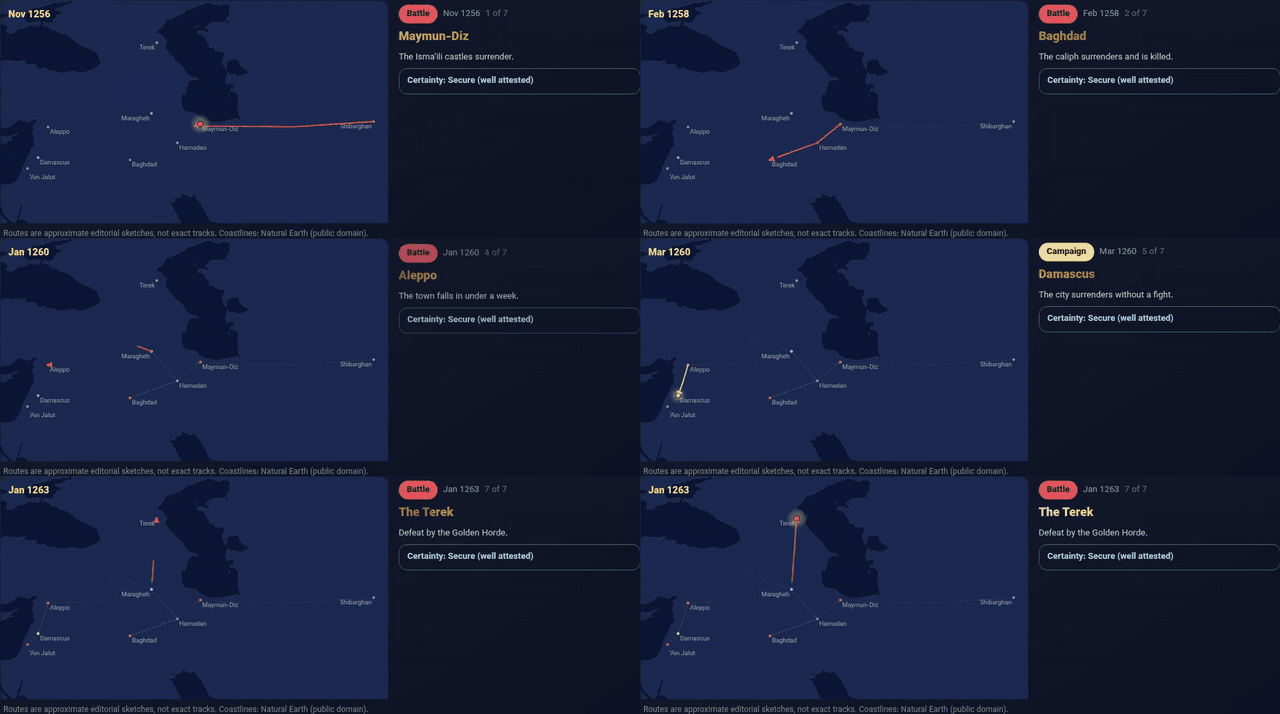
Hulagu’s campaigns: from Alamut to ‘Ain Jalut (1256–1263 CE)
From the Isma‘ili castles to Baghdad, Maragheh, Aleppo and Damascus, then the defeat at ‘Ain Jalut and the war with the Golden Horde. Dates follow Boyle and Iranica; the routes are sketches.
BattleNov 12561 of 7
Maymun-Diz
The Isma‘ili castles surrender.
Certainty: Secure (well attested)
Sources: J. A. Boyle, Cambridge History of Iran, vol. 5, 1968
BattleCampaignBuildingAdministration & economyReligionArrow keys, Home/End and Space work.
Three separate layers
Each section has three layers: “Historical evidence” is only what the sources say; “Philosophical interpretation” is our reading by the standard of property and liberty; “Modern cultural meaning”. Quotations come only from published translations, with references.
Historical evidencePhilosophical interpretationModern cultural meaning
Dossier · 1
Baghdad: the end of a caliphate
Hulagu’s armies converged on Baghdad and besieged it. On 10 February 1258 the caliph al-Musta‘sim came out with his three sons. On his order the people laid down their arms and came out, only, in Boyle’s words, “to be slaughtered as they issued into the open”. On 20 February the caliph himself was killed. A member of the Abbasid family later reached Syria, and the Mamluks made him caliph in 1261.
We give no death toll; the figures in the sources vary widely and are exaggerated. How the caliph died is not certain either: Nasir al-Din and Rashid al-Din are silent, and the story that he was rolled in a carpet and trampled comes from later writers, though Boyle thinks them “almost certainly right”.
An ancient institution without an army or allies cannot hold out against a new power.
Sources: J. A. Boyle, Cambridge History of Iran, vol. 5 · R. Amitai, Encyclopaedia Iranica
Dossier · 2
His brother’s orders, or a state of his own?
Rashid al-Din writes that Möngke ordered Hulagu to destroy the Isma‘ilis, subdue the Kurds and Lurs and bring the caliph to submission; and that he publicly told him to come home afterwards, but secretly told him that he and his descendants should stay in Iran. After Möngke died in 1259, Hulagu in effect built an independent state that lasted some three-quarters of a century.

Amitai warns that Rashid al-Din was an open partisan of the Toluids and the Ilkhans, and that the contemporary Juvayni does not confirm the secret order. Mamluk sources even suggest that Hulagu went beyond his brief. So how the Ilkhanid state began is disputed.
A court historian tells the founding story in the dynasty’s favour; the reader needs to know that.
Sources: R. Amitai, Encyclopaedia Iranica · R. Amitai, Encyclopaedia Iranica
Dossier · 3
Property: treasure on an island, taxes on the people
Hulagu’s treasure was kept in the castle on Shahi island in Lake Urmia, and he was buried there too. Amitai writes that the Mongol tax system was “both more onerous and more capricious” than before; even so, the reigns of Hulagu and Abaqa brought some stability, though Iraq and the Jazira suffered from the conquest.
This is our reading: in this new state, wealth gathered from war and taxes was stored by the ruling family, apart from the people: a treasure on an island, not capital in circulation.
Wealth that is hoarded and never circulates does not make a country prosper.
Sources: J. A. Boyle, Cambridge History of Iran, vol. 5 · R. Amitai, Encyclopaedia Iranica
Synthesis: destroyer and founder
Hulagu destroyed the Abbasid caliphate and the Isma‘ili state and built a state reaching from the Oxus to Anatolia. The defeat at ‘Ain Jalut held its western frontier at the Euphrates, and the war with the Golden Horde showed that the Mongol empire was no longer one.
Through the lens of property, the new state’s wealth came from war and heavy taxes and was stored in the dynasty’s treasury; reforming that system fell to Ghazan forty years later.
Bibliography
- R. Amitai, Encyclopaedia Iranica, Hulāgu Khan (2004, updated 2013). https://www.iranicaonline.org/articles/hulagu-khan/Hulagu’s life and mission, and the doubts about Möngke’s orders.
- R. Amitai, Encyclopaedia Iranica, Il-Khanids i. Dynastic History (2004, updated 2012). https://www.iranicaonline.org/articles/il-khanids-i-dynastic-history/The whole dynasty, Ghazan’s reforms and the caution about Rashid al-Din.
- R. Amitai, Encyclopaedia Iranica, Ḡāzān Khan, Maḥmūd (2000, updated 2013). https://www.iranicaonline.org/articles/gazan-khan-mahmud/The spine of the Ghazan page.
- C. Melville, Encyclopaedia Iranica, Jāmeʿ al-tawāriḵ (2008, updated 2013). https://www.iranicaonline.org/articles/jame-al-tawarik/On the Jāmeʿ al-tawāriḵ and Rashid al-Din’s career.
- J. A. Boyle, Cambridge History of Iran, vol. 5, Dynastic and Political History of the Il-Khāns (1968). https://archive.org/details/Boyle1968IlKhansCHIran05A day-by-day account of the campaigns, with dates from Juvayni and Rashid al-Din.
All photos are from Wikimedia Commons; licence and author were checked on each file page.