Arsacids · Orodes II · Surena
The Battle of Carrhae (53 BCE)
On a spring afternoon in 53 BCE, on a treeless plain south of Carrhae, ten thousand Parthian horsemen destroyed an army four times their size. Their commander was not yet thirty, and we do not even know his personal name; only his clan name, Sūrēn, survives. Marcus Licinius Crassus, the richest man in Rome, lost his son, his army and finally his life.
This page follows the battle step by step, using only what the sources say. Wherever a figure or a motive is disputed, we say so.
- Date
- 6 May 53 BCE
- Place
- south of Carrhae, on the Balikh
- Commanders
- Surena · Crassus
- Odds
- about 1 to 4
The battle, step by step
Eleven steps, from the desert road to the Sinnaca hills. Press play, or step through with the buttons or the arrow keys. Each step says whether its account is secure, probable or disputed.
Step 1 / 11 · 6 May 53 BCE, morning · probable
The desert road
Crassus turned down the advice of Artavasdes, king of Armenia, to come through the mountains, where Parthian cavalry was at a disadvantage. Guided by an Arab chief whom Plutarch calls Ariamnes, and whom scholars usually identify with Abgar of Osroene, he left the Euphrates for the open plain. Plutarch calls it “a sea of sand”: no tree, no water, no green herb.
That Ariamnes/Abgar deliberately led the Romans into a trap is Plutarch’s claim; Shahbazi (Iranica) treats the treachery as unproven.
Sources: Plutarch · A. Sh. Shahbazi
Video version (1280×720): MP4 · WebM · light GIF (640px, for sharing) · full GIF (1280px, about 8 MB)
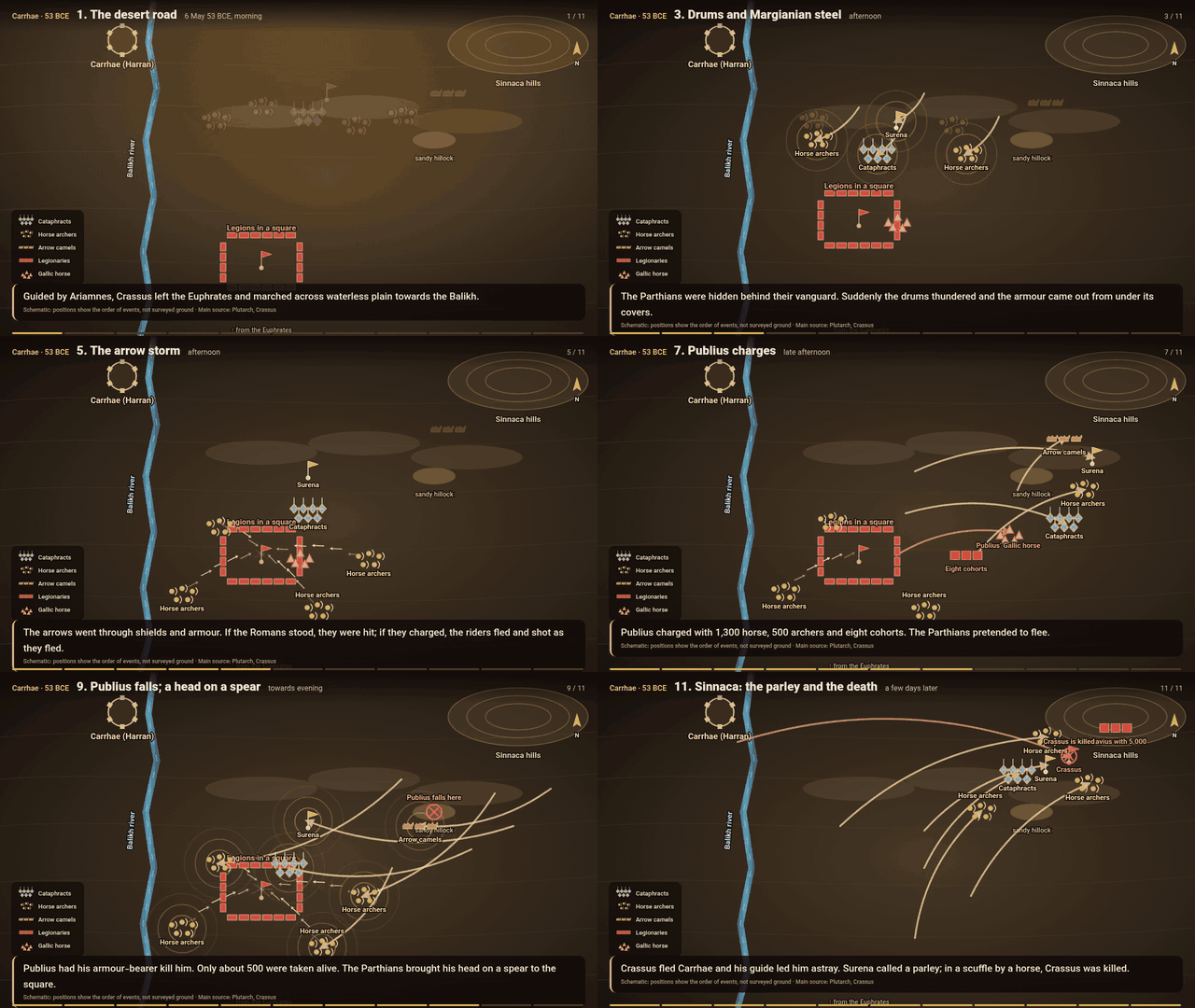
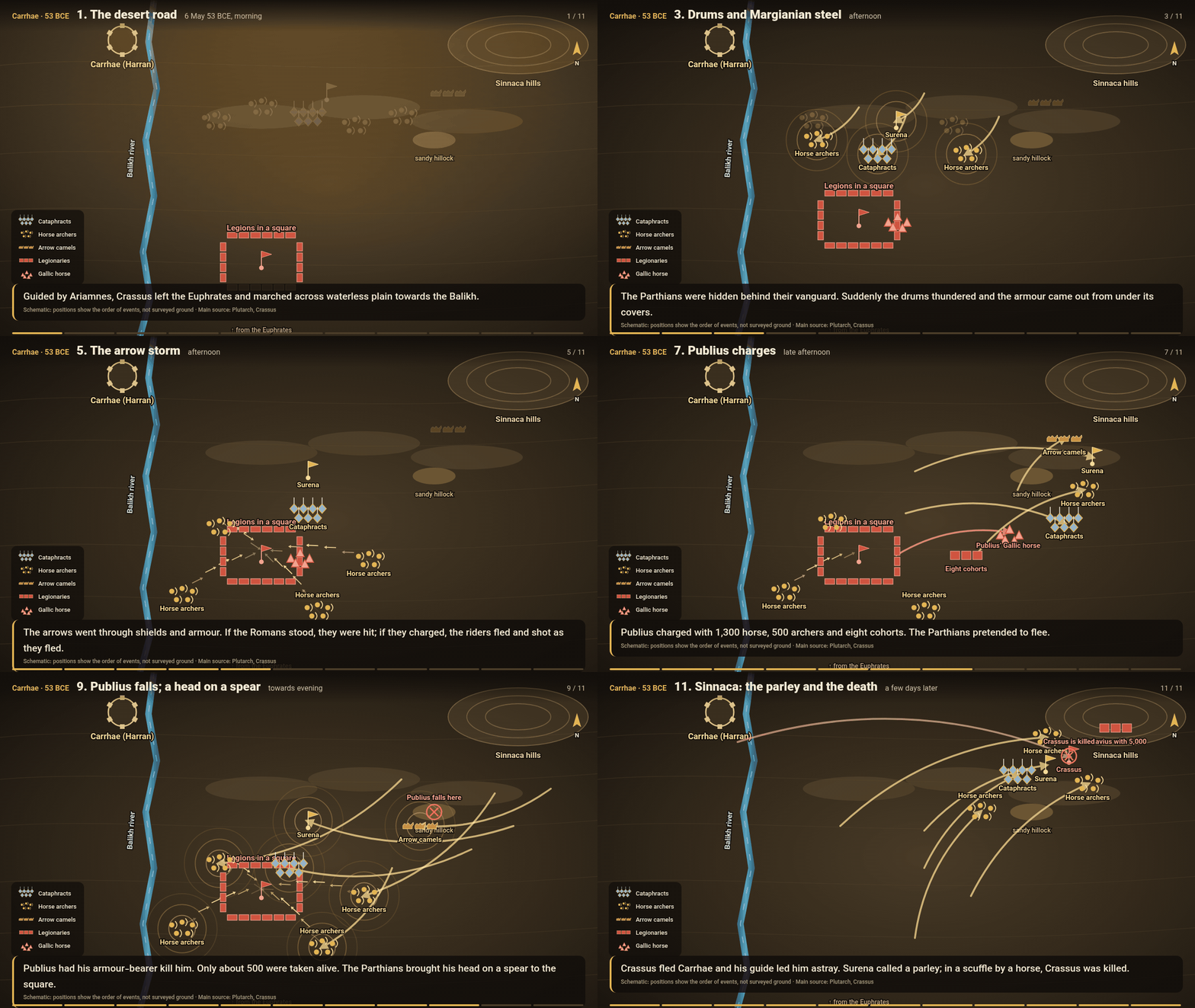
“For the Parthians do not encourage themselves to war with cornets and trumpets, but with a kind of kettle-drum, which they strike all at once in various quarters. With these they make a dead hollow noise like the bellowing of beasts, mixed with sounds resembling thunder”
“but when they presently understood that there were numerous camels loaded with arrows, and that when the first ranks had discharged those they had, they wheeled off and took more, Crassus seeing no end of it, was out of all heart”
The campaign map
Crassus crossed at Zeugma and chose the desert road; Orodes himself struck into Armenia so Artavasdes could not help; Surena stayed in Mesopotamia with the cavalry. The captives were taken to Merv, on the far side of Iran. Routes are sketches.
Campaignearly May 53 BCE1 of 8
Crassus crosses the Euphrates
Marcus Licinius Crassus, governor of Syria and one of Rome’s ruling triumvirs, crossed the Euphrates at Zeugma with seven legions, about 4,000 horse and 4,000 light infantry. His goal was Seleucia. The king of Armenia had urged the mountain route through Armenia; Crassus chose the desert route.
Certainty: ProbableThe size of Crassus’ army is disputed: Iranica (Shahbazi) about 42,000; Florus speaks of eleven legions.
Sources: Plutarch, tr. J. Dryden, rev. A. H. Clough, 1864 · A. Sh. Shahbazi, Encyclopaedia Iranica, 1990, updated 2013 · Cassius Dio, tr. E. Cary, 1914–1927
BattleCampaignBuildingAdministration & economyReligionArrow keys, Home/End and Space work.
The two armies: numbers and disputes
Rome: Crassus
| Unit | Figure | Source |
|---|---|---|
| Heavy infantry | 7 legions; about 34,000⚠ Florus speaks of eleven legions. | Plutarch 20; Iranica estimate |
| Cavalry | just under 4,000, incl. 1,000 Gauls | Plutarch 20 and 25 |
| Light infantry | about 4,000 | Plutarch 20 |
| Armenia (not on the field) | 6,000 horse came; 10,000 cuirassiers and 30,000 foot promised | Plutarch 19 |
| Arab and Osroenian allies | numbers unknown; left the field⚠ Deliberate treachery is unproven. | Plutarch 21–22; Iranica |
| Killed | 20,000 | Plutarch 31 (“it is generally said”) |
| Captured | 10,000, taken to Merv | Plutarch 31; Pliny 6.47 |
| Got back to Syria | about 10,000, incl. Cassius with 500 horse | Iranica (after Günther); Plutarch 29 |
Parthia: Surena
| Unit | Figure | Source |
|---|---|---|
| Cataphracts | about 1,000 | Plutarch 21 (“one thousand completely armed”); Iranica |
| Horse archers | about 9,000⚠ Plutarch gives the size of Surena’s retinue, not of the army on the field. | Iranica’s reconstruction from Plutarch’s “at least ten thousand horsemen” |
| Arrow camels | about 1,000 | Iranica; Plutarch 21 and 25 |
Every figure comes from Roman sources or modern reconstruction; no Parthian account of the battle survives. Shahbazi’s ratio of one to four is drawn from these same numbers.
Sources: Plutarch · A. Sh. Shahbazi · Florus · Pliny the Elder
Why the Parthians won
The bow: arrows that went through armour
Plutarch says the arrows came “out of strong bent bows”, passed through every kind of covering, hard and soft alike, and pinned men’s hands to their shields and their feet to the ground.
Modern scholars put this power down to the composite bow: wood, horn and sinew that hold a heavy draw in a length short enough for a rider. Plutarch does not describe how the bow was made; this explanation is modern.
Sources: Plutarch · N. L. Overtoom
Logistics: a thousand camels of arrows
Plutarch: once the archers had emptied their quivers they “wheeled off and took more”, and the Romans saw numerous camels loaded with arrows. Iranica puts the camels at about a thousand.
Shahbazi cites Tarn’s point that archers were useless without arrows, and calls Surena’s reliance on cavalry, in Mommsen’s phrase, a “brilliant idea”. Iranica says no one before Surena had organised a steady arrow supply on the field. That is what destroyed the Roman hope that the arrows would run out.
Sources: Plutarch · A. Sh. Shahbazi
Mobility against heavy infantry
Plutarch: if the Romans kept their ranks they were wounded, and if they charged, the enemy “threw their darts as they fled”. The cataphracts pinned the ranks so the Romans could not spread out.
The Roman square was safe against a cavalry charge but a dense target for arrows. Cataphracts and archers together left the Romans two bad choices: spread out and face the lance, or stay close and face the arrow. Roman cavalry and light infantry were too few to break the bind.
Sources: Plutarch · A. Sh. Shahbazi
Surena’s command
Plutarch says Surena was not yet thirty but had a great name for wisdom and sagacity, and that “by these qualities chiefly” he overthrew Crassus. He hid his army, frightened the enemy with drums, ringed them after a feint, and drew Publius away from his father by a pretended flight.
On the Roman side, the mountain route was refused, an unfamiliar guide was trusted, and no halt was made at the Balikh. Shahbazi says the “June” heat in the accounts is overstated, because the Roman calendar date was out of step with the real season; the battle was in fact in early May.
Sources: Plutarch · A. Sh. Shahbazi
Aftermath
May 53 BCE
The death of Crassus
Plutarch says Crassus was killed by a Parthian called Pomaxathres, or, in another version, that Pomaxathres only cut off his head and right hand. He adds that this is “conjecture rather than certain knowledge”. Iranica notes that cutting off the head and hand was the Parthian punishment for breakers of a pact.
“Crassus was killed by a Parthian, called Pomaxathres; others say, by a different man, and that Pomaxathres only cut off his head and right hand after he had fallen. But this is conjecture rather than certain knowledge, for those that were by had not leisure to observe particulars, and were either killed fighting about Crassus, or ran off at once to get to their comrades on the hill.”
Sources: Plutarch · A. Sh. Shahbazi
May 53 BCE
The cost
Plutarch gives the famous figure, but with “it is generally said”. Shahbazi, following Günther, says about ten thousand got back to Syria. Tarn called it one of the worst disasters which the Roman arms ever suffered.
“It is generally said, that in all twenty thousand men were slain, and ten thousand taken prisoners.”
Sources: Plutarch · A. Sh. Shahbazi
summer 53 BCE
A mock triumph at Seleucia
Plutarch says Surena dressed a prisoner, Caius Paccianus, who most resembled Crassus, in women’s clothes, set him on a horse and had him answer to “Crassus” and “Imperator”, with trumpeters and lictors on camels before him and the singing women of Seleucia chanting mocking songs.
Sources: Plutarch
summer 53 BCE
Crassus’ head and the Bacchae at the Armenian court
Orodes and Artavasdes had made peace and Pacorus, Orodes’ son, was betrothed to the Armenian king’s sister. Plutarch says Orodes knew Greek language and literature and Artavasdes himself wrote tragedies. When the head of Crassus arrived, a Greek actor, Jason of Tralles, was singing the Agave scene from Euripides’ Bacchae, in which a mother, in her frenzy, takes her son’s severed head for a hunting prize.
“When the head of Crassus was brought to the door, the tables were just taken away, and one Jason, a tragic actor, of the town of Tralles, was singing the scene in the Bacchae of Euripides concerning Agave. He was receiving much applause, when Sillaces coming to the room, and having made obeisance to the king, threw down the head of Crassus into the midst of the company.”
Sources: Plutarch · M. J. Olbrycht
c. 53/52 BCE
The execution of Surena
Not long after, Orodes had Surena killed. Plutarch gives envy as the motive; Olbrycht (Iranica) says the king probably wanted to free himself from the clan that had put him on the throne. The date and place are not recorded.
“Surena not long after was put to death by Hyrodes, out of mere envy to his glory”
Sources: Plutarch · M. J. Olbrycht
after 53 BCE
Ten thousand captives at Merv
Pliny says the captives from Crassus’ army were taken to Margiana (Merv), on the far side of Iran, some two thousand kilometres from the field. What became of them is unknown.
Sources: Pliny the Elder · A. Sh. Shahbazi
20 BCE
The standards come home
Thirty-three years later Phraates IV returned the standards and the surviving prisoners from the armies of Crassus and Antony in a diplomatic settlement. Augustus counted it a victory in his record of deeds and placed the standards in the temple of Mars Ultor.
“I compelled the Parthians to return to me the spoils and standards of three Roman armies, and as suppliants to seek the friendship of the Roman people. Furthermore I placed those standards in the sanctuary of the temple of Mars Ultor.”
Sources: Augustus · M. J. Olbrycht
Through the lens of liberty and property: Crassus’ wealth and the price of war
Crassus was the richest man in Rome, and Plutarch shows where the money came from: buying cheaply the estates of men Sulla had proscribed and killed, and buying burning houses whose owners sold them “for little, or nothing”. A fortune built on other people’s calamity and on state power went looking for military glory.
Plutarch says Crassus held that no man was rich who could not keep an army at his own cost. Cicero, as Iranica notes, saw “no cause for the war”: Parthia had not attacked Rome. Thirty thousand soldiers paid for this ambition with their lives or their freedom. On the other side, the victorious general was killed by his own king. Neither the property of a Roman citizen was safe from Sulla, nor the life of a Parthian general from his king’s envy.
“he made it his practice to buy houses that were on fire, and those in the neighborhood, which, in the immediate danger and uncertainty, the proprietors were willing to part with for little, or nothing; so that the greatest part of Rome, at one time or other, came into his hands.”
Sources: Plutarch · A. Sh. Shahbazi
Sources and historiography
Every continuous account of the battle is Roman. Plutarch, writing about 150 years later, gives the fullest one and his story must ultimately go back to survivors’ reports. Cassius Dio (3rd century CE) and Florus are shorter and follow the same frame. No Parthian account survives; the Iranian side reaches us only through its enemy.
So this page keeps three layers apart: what the sources say (quoted verbatim from the Dryden–Clough translation), what modern scholars infer (Shahbazi, Olbrycht, Debevoise, Tarn), and what the battle means today. Plutarch’s hostility to Surena and his sneer at Surena’s “effeminacy” belong to the Greco-Roman view of the “barbarian” and should be read with care.
Sources: Plutarch · Cassius Dio · Florus · A. Sh. Shahbazi · N. C. Debevoise
Legends, not history
Images


All photos are from Wikimedia Commons; licence and author were checked on each file page.
Bibliography
- Plutarch, tr. J. Dryden, rev. A. H. Clough, Life of Crassus, chs. 16–33 (1864) · link
The fullest account of Carrhae; per Iranica (Shahbazi) it rests on an unknown eyewitness, probably a Hellenised Mesopotamian.
- A. Sh. Shahbazi, Encyclopaedia Iranica, Carrhae (1990, updated 2013) · link
- M. J. Olbrycht, Encyclopaedia Iranica, Orodes II (2021) · link
- M. J. Olbrycht, Encyclopaedia Iranica, Phraates IV (2021) · link
- Cassius Dio, tr. E. Cary, Roman History 36.1–3, 37.5–7, 39.56, 40.12–30, 48.24–41, 49.19–33, 54.8, 55.10 (1914–1927)
- Florus, tr. E. S. Forster, Epitome of Roman History 1.46, 2.19–20 (1929)
- Pliny the Elder, tr. J. Bostock & H. T. Riley, Natural History 6.18 (6.47): Margiana (1855)
- Augustus, tr. T. Bushnell, Res Gestae Divi Augusti (The Deeds of the Divine Augustus) §§ 27, 29, 32–33 (1998) · link
Augustus’ own account of his deeds: official propaganda, not a neutral record.
- N. C. Debevoise, A Political History of Parthia (1938)
- N. L. Overtoom, Reign of Arrows: The Rise of the Parthian Empire in the Hellenistic Middle East (2020)
- T. S. Kawami, Monumental Art of the Parthian Period in Iran (Acta Iranica 26) (1987)
- H. H. Dubs, A Roman City in Ancient China (1957)
The origin of the “Romans of Liqian” theory: a modern idea not found in the ancient sources.
Orodes II, king at the time of CarrhaePhraates IV and the return of the standardsThe Arsacid dynasty