Arsacids (Parthians)
Orodes II
ارد دوم
Epithets and titles
- King of Kingsofficial titleon the coins: ΒΑΣΙΛΕΩΣ ΒΑΣΙΛΕΩΝSource: M. J. Olbrycht, “Orodes II”, Encyclopaedia Iranica (2021)
- Euergetesofficial title“Benefactor”; on the coinsSource: M. J. Olbrycht, “Orodes II”, Encyclopaedia Iranica (2021)
- Dikaiosofficial title“the Just”; on the coinsSource: M. J. Olbrycht, “Orodes II”, Encyclopaedia Iranica (2021)
- Epiphanesofficial title“Manifest (as a god)”; on the coinsSource: M. J. Olbrycht, “Orodes II”, Encyclopaedia Iranica (2021)
- Philhelleneofficial title“friend of the Greeks”; on the coinsSource: M. J. Olbrycht, “Orodes II”, Encyclopaedia Iranica (2021)
- Reign
- 58/57–37 BCE
- Dynasty
- Arsacids (Parthians)
- Persian page
- فارسی
Featured dossier
Orodes II: Carrhae, Surena and Parthia at its height
Orodes II came to the throne through parricide and a war with his brother, yet under him Parthia reached its height. In 53 BCE his general Surena, with an army made only of horsemen, destroyed the Roman Crassus at Carrhae, one of the heaviest defeats in Roman history. His son Pacorus took Syria and Judaea, then fell at Gindarus. Orodes killed Surena out of envy and was himself, according to Plutarch, killed by his son Phraates. Follow Carrhae on the animated battle diagram and the campaigns on the map.
- years of reign
- ~20
- Surena’s horsemen at Carrhae
- 10,000
- Roman dead and captured (Plutarch)
- 20,000 / 10,000
- camels loaded with arrows
- 1,000
Animated map: the life of Orodes II
Administration & economy58/57 BCE1 of 13
Parricide and two brothers
Orodes and his brother Mithridates killed their father Phraates III. Iranica says Orodes was linked to the Sūrēn clan and the eastern Sakas, who put him on the throne.
Certainty: Secure (contemporary source)
Sources: M. J. Olbrycht, Encyclopaedia Iranica, 2021 · Cassius Dio, tr. E. Cary, 1914–1927
BattleCampaignBuildingAdministration & economyReligionArrow keys, Home/End and Space work.
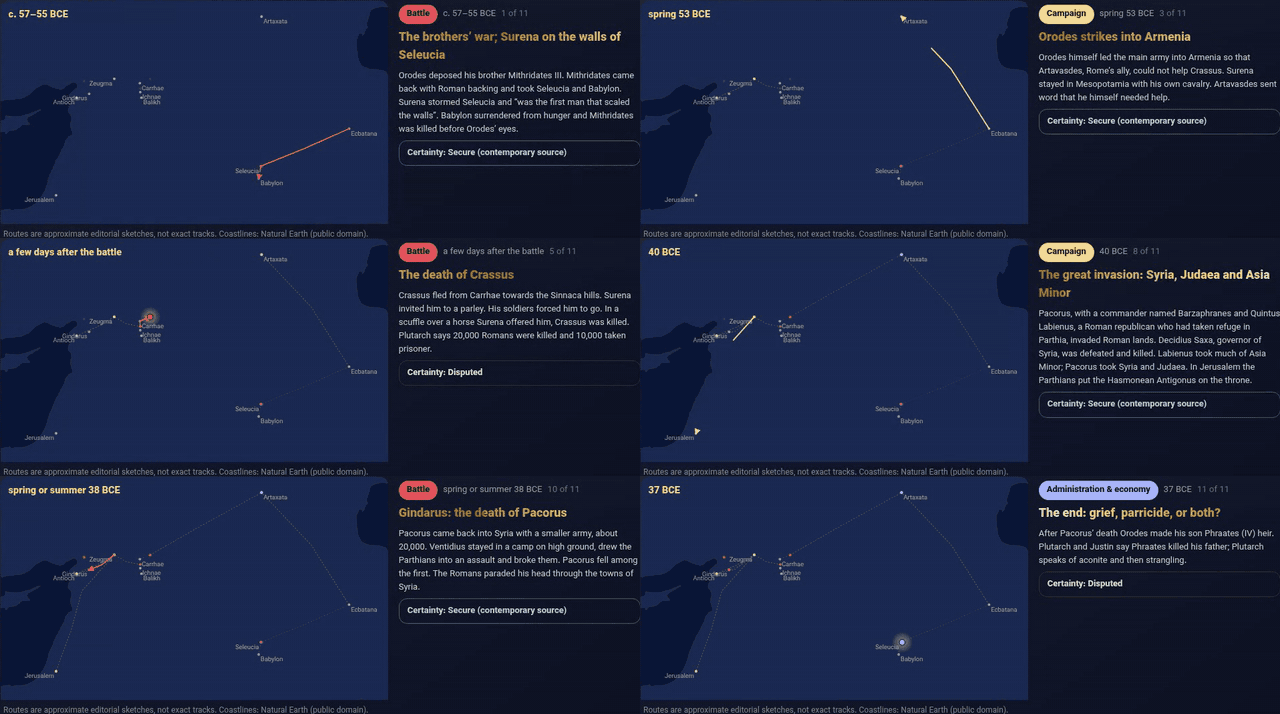
From Seleucia to Carrhae and Jerusalem, step by step (57–37 BCE)
The brothers’ war, Crassus’ campaign, Carrhae and Pacorus’ invasions of Syria. Each step says whether it is secure, probable or disputed. The narrative sources are mostly Roman; the routes are sketches. The step-by-step diagram of Carrhae is below the map.
Battlec. 57–55 BCE1 of 11
The brothers’ war; Surena on the walls of Seleucia
Orodes deposed his brother Mithridates III. Mithridates came back with Roman backing and took Seleucia and Babylon. Surena stormed Seleucia and “was the first man that scaled the walls”. Babylon surrendered from hunger and Mithridates was killed before Orodes’ eyes.
Certainty: Secure (contemporary source)
Sources: Justin, tr. J. S. Watson, 1853 · Plutarch, tr. J. Dryden, rev. A. H. Clough, 1864 · M. J. Olbrycht, Encyclopaedia Iranica, 2021
BattleCampaignBuildingAdministration & economyReligionArrow keys, Home/End and Space work.
Carrhae, step by step (schematic)
6 May 53 BCE and the days after · Schematic; exact positions are debated
Phase 1 / 6 · probable
The Romans in a square; Surena hidden
Crassus, his men tired from the march, halted only to eat in rank and drove on south. He drew the army up in a hollow square: Cassius on the wing by the river, Crassus in the centre, Publius on the other wing. Surena hid his main force behind the rises, and the cataphracts had covered their armour.
Iranica says Plutarch’s description of the Roman formation cannot be right in every detail; this sketch follows the reconstruction of Regling and Smith.
Plutarch, tr. J. Dryden, rev. A. H. Clough · A. Sh. Shahbazi, Encyclopaedia Iranica
ParthiansRomans
Three separate layers
Each section has three layers: “Historical evidence” is only what the sources say; “Philosophical interpretation” is our reading by the standard of property and liberty; “Modern cultural meaning”. Quotations come only from published translations, with references.
Historical evidencePhilosophical interpretationModern cultural meaning
Dossier · 1
Surena: his own story
We do not know his personal name. “Surena” is the name of his clan, the Sūrēn. Iranica (Olbrycht) says the clan had Dahae roots, its power base was in eastern Iran and Sakastan (Sistan), and its name (swren) appears on an ostracon from Shahr-e Qumis. Plutarch says his family had long held the right to crown the Parthian king.
Plutarch calls him the second man in the kingdom in wealth and birth and the first in courage: under thirty, with a thousand baggage camels and at least ten thousand horsemen of his own dependants and servants. He brought Orodes back from exile, stormed Seleucia, and at Carrhae, with an army of horsemen only, beat a force four times his size. After the victory he staged a mock “triumph” in Seleucia, parading a prisoner named Paccianus, who looked like Crassus, in women’s clothes. Not long after, Orodes had him killed.
Nor was this Surena an ordinary person, but in wealth, family, and reputation, the second man in the kingdom, and in courage and prowess the first, and for bodily stature and beauty no man like him. Whenever he traveled privately, he had one thousand camels to carry his baggage, two hundred chariots for his concubines, one thousand completely armed men for his life-guards, and a great many more light-armed; and he had at least ten thousand horsemen altogether, of his servants and retinue.
Surena at Carrhae: the full battle page

Shahbazi (Iranica) calls Surena’s reliance on cavalry a “brilliant idea” (Mommsen) and says no one before him had thought of an unending arrow supply. Olbrycht does not see the execution as mere envy: the king wanted to free himself from the mighty patron who had put him on the throne. Plutarch describes Surena’s painted face and hair “after the fashion of the Medes” with a hint of effeminacy; that is a Greek cliché about easterners.
Surena is the type of the hero whose merit was a threat to absolute power. A state where the victorious general’s life hangs on the king’s envy is afraid even of its best defenders. Where a person’s rights and life are not secure against the ruler’s will, talent either flees or is destroyed.
Sources: Plutarch, tr. J. Dryden, rev. A. H. Clough · M. J. Olbrycht, Encyclopaedia Iranica · A. Sh. Shahbazi, Encyclopaedia Iranica · T. S. Kawami
Dossier · 2
Carrhae: horse beats foot
Iranica, quoting Bivar, calls Carrhae “without doubt the most celebrated episode of Parthian history”. The main source is Plutarch, who, says Shahbazi, used the report of an unknown eyewitness, probably a Hellenised Mesopotamian. Surena’s army was about 10,000 horse: 1,000 armoured cataphracts and 9,000 horse archers, with a thousand camels carrying arrows. Facing them were seven legions, 4,000 horse and 4,000 light infantry.
For the Parthians do not encourage themselves to war with cornets and trumpets, but with a kind of kettle-drum, which they strike all at once in various quarters. With these they make a dead hollow noise like the bellowing of beasts, mixed with sounds resembling thunder… When they had sufficiently terrified the Romans with their noise, they threw off the covering of their armor, and shone like lightning in their breastplates and helmets of polished Margianian steel, and with their horses covered with brass and steel trappings.
Step 1 / 11 · 6 May 53 BCE, morning · probable
The desert road
Crassus turned down the advice of Artavasdes, king of Armenia, to come through the mountains, where Parthian cavalry was at a disadvantage. Guided by an Arab chief whom Plutarch calls Ariamnes, and whom scholars usually identify with Abgar of Osroene, he left the Euphrates for the open plain. Plutarch calls it “a sea of sand”: no tree, no water, no green herb.
That Ariamnes/Abgar deliberately led the Romans into a trap is Plutarch’s claim; Shahbazi (Iranica) treats the treachery as unproven.
Sources: Plutarch · A. Sh. Shahbazi
The full Carrhae page: map, numbers, aftermath
The old view, that the war was nothing but Crassus’ greed (Cicero: “no cause for the war”), should in Shahbazi’s view be dropped: a clash between Rome and Parthia had been coming for a century. He also says the treachery of Abgar of Osrhoene, whom the Roman sources blame, cannot be proved. The numbers are disputed too: Florus speaks of eleven legions.
Carrhae showed that the right tool on the right ground beats numbers. The other side of the story: an army that came to plunder a foreign land met people defending their own home.
Sources: Plutarch, tr. J. Dryden, rev. A. H. Clough · A. Sh. Shahbazi, Encyclopaedia Iranica · Florus, tr. E. S. Forster · N. L. Overtoom
Dossier · 3
The death of Crassus, as Plutarch tells it
Plutarch says the soldiers forced Crassus to go to the parley by threats. As he went he told his officers to tell everyone that “Crassus perished rather by the subtlety of his enemies, than by the disobedience of his countrymen”. Surena offered a horse with a golden bit; grooms forced Crassus into the saddle, his officers seized the bridle, and the fight began.
Crassus’ head and right hand were taken to Orodes in Armenia. There, at the feast that sealed Orodes’ peace with Artavasdes, an actor named Jason of Tralles was singing Agave’s scene from Euripides’ Bacchae; he took up the head in place of Pentheus’ and sang. Pomaxathres stood up and claimed the honour as his.
Crassus was killed by a Parthian, called Pomaxathres; others say, by a different man, and that Pomaxathres only cut off his head and right hand after he had fallen. But this is conjecture rather than certain knowledge, for those that were by had not leisure to observe particulars, and were either killed fighting about Crassus, or ran off at once to get to their comrades on the hill.
We’ve hunted down a mighty chase to-day, / And from the mountain bring the noble prey;
Plutarch himself says the details are “conjecture rather than certain knowledge”. Iranica (after Debevoise) says the Parthians may not have meant to kill Crassus. Dio has another story, that the Parthians poured molten gold into Crassus’ mouth; it is read as a symbol of his greed, not an eyewitness report.
The richest man in Rome invaded a foreign land for military glory and took thirty thousand soldiers down with him. A war begun for one man’s ambition is paid for by others.
Sources: Plutarch, tr. J. Dryden, rev. A. H. Clough · M. J. Olbrycht, Encyclopaedia Iranica · N. C. Debevoise · Cassius Dio, tr. E. Cary
Dossier · 4
Ten thousand prisoners in Merv
Iranica: the 10,000 Roman prisoners were settled in Margiana (Merv) (Pliny, Natural History 6.47). The Roman poet Horace complains bitterly that Crassus’ soldiers married “barbarian” wives. Some served in the Parthian army. When the standards were returned in 20 BCE only a few came back.
Settling prisoners on the eastern frontier gave Parthia both labour and frontier troops; it was an old Iranian policy.
The prisoners of Carrhae built new lives in a foreign land. The history of frontiers is always also a history of peoples mixing.
Sources: M. J. Olbrycht, Encyclopaedia Iranica · M. J. Olbrycht, Encyclopaedia Iranica · Pliny the Elder, tr. J. Bostock & H. T. Riley
Dossier · 5
Pacorus I: the invasion of Syria
Pacorus, Orodes’ eldest son, was junior king and struck coins with his youthful portrait. In 51 BCE he raided Syria with Osaces and Cassius drove him back. In 40 BCE, with the Roman Labienus and Barzaphranes, he took Syria and Judaea, and the Parthians reached Jerusalem and Gaza. Iranica says many in Syria and Judaea welcomed him warmly. In 38 BCE he fell at Gindarus.
Justin says that on hearing of Pacorus’ death Orodes for several days neither spoke nor ate; he seemed to see Pacorus and hear him.
In this interval, Pacorus, the Parthian king’s son, who was marching into Syria with a large army, was met by Ventidius, who gave him battle in the country of Cyrrhestica, slew a large number of his men, and Pacorus among the first. This victory was one of the most renowned achievements of the Romans, and fully avenged their defeats under Crassus…
Upon this, Ventidius, pouring forth the rest of his troops, put the whole force of the Parthians, with their king Pacorus, to the sword; nor did the Parthians, in any war, ever suffer a greater slaughter.
Iranica says that despite popular support Orodes and Pacorus overrated the situation. The Romans saw Gindarus as revenge for Carrhae; the heir’s death led to civil war in Parthia.
The support Pacorus found in Syria and Judaea shows that Roman rule, with its governors’ taxes and plunder, was not “freedom” for everyone. People usually accept the ruler who troubles their property and faith less.
Sources: M. J. Olbrycht, Encyclopaedia Iranica · Justin, tr. J. S. Watson · Plutarch, tr. J. Dryden, rev. A. H. Clough · Cassius Dio, tr. E. Cary · Encyclopaedia Iranica
Dossier · 6
The end of Orodes: two versions
Plutarch: after Pacorus’ death Orodes fell ill with dropsy; his son Phraates gave him aconite, but the poison cured the disease, so Phraates strangled his father. Justin too says Phraates killed his father and his thirty brothers. Dio denies the parricide and says Orodes died of grief and old age.
…for Surena not long after was put to death by Hyrodes, out of mere envy to his glory; and Hyrodes himself, having lost his son Pacorus, who was beaten in a battle with the Romans, falling into a disease which turned to a dropsy, had aconite given him by his second son, Phraates; but the poison working only upon the disease, and carrying away the dropsical matter with itself, the king began suddenly to recover, so that Phraates at length was forced to take the shortest course, and strangled him.

Iranica gives both versions. The story of a poison that cures sounds like a tale; but all the sources agree on the killing of the brothers.
A dynasty that does not settle succession by clear rules turns the throne into a prize for murder. Orodes came in by parricide and, in one version, went out by it.
Sources: Plutarch, tr. J. Dryden, rev. A. H. Clough · Justin, tr. J. S. Watson · Cassius Dio, tr. E. Cary · M. J. Olbrycht, Encyclopaedia Iranica
Synthesis
Orodes II was the king of Parthia’s greatest victory over Rome, but the victory was above all Surena’s, and Orodes killed him. His son Pacorus took Syria and lost it. Carrhae showed that Parthia was Rome’s equal; Gindarus showed that the balance would hold and that neither could swallow the other.
The sources are almost all Roman and see the Parthians through enemy eyes; yet even Plutarch does not hide his admiration for Surena.
Bibliography
- Plutarch, tr. J. Dryden, rev. A. H. Clough, Life of Crassus, chs. 16–33 (1864). https://www.gutenberg.org/ebooks/674The fullest account of Carrhae; per Iranica (Shahbazi) it rests on an unknown eyewitness, probably a Hellenised Mesopotamian.
- Plutarch, tr. J. Dryden, rev. A. H. Clough, Life of Antony, chs. 33–52 (1864). https://www.gutenberg.org/ebooks/674Based on the report of Dellius, Antony’s companion; Iranica notes a pro-Antony bias that blames the Armenian king.
- Justin, tr. J. S. Watson, Epitome of Pompeius Trogus, books 38–42 (books 40–44 online) (1853). https://www.attalus.org/translate/justin7.htmlA Roman digest of the lost history of Pompeius Trogus (1st century BCE); the most continuous account of the early Parthians, but Roman in outlook and full of “Scythian” clichés.
- Cassius Dio, tr. E. Cary, Roman History 36.1–3, 37.5–7, 39.56, 40.12–30, 48.24–41, 49.19–33, 54.8, 55.10 (1914–1927).
- Florus, tr. E. S. Forster, Epitome of Roman History 1.46, 2.19–20 (1929).
- Pliny the Elder, tr. J. Bostock & H. T. Riley, Natural History 6.18 (6.47): Margiana (1855).
- M. J. Olbrycht, Encyclopaedia Iranica, Orodes II (2021). https://www.iranicaonline.org/articles/orodes-ii/
- A. Sh. Shahbazi, Encyclopaedia Iranica, Carrhae (1990, updated 2013). https://www.iranicaonline.org/articles/carrhae-harran-town-in-mesopotamia-where-in-may-53-b/
- Encyclopaedia Iranica, Gindaros (2001). https://www.iranicaonline.org/articles/gindaros/
- M. J. Olbrycht, Encyclopaedia Iranica, Phraates IV (2021). https://www.iranicaonline.org/articles/phraates-iv/
- K. Schippmann, Encyclopaedia Iranica, Arsacids ii. The Arsacid dynasty (1986, updated 2016). https://www.iranicaonline.org/articles/arsacids-ii/
- N. C. Debevoise, A Political History of Parthia (1938).
- N. L. Overtoom, Reign of Arrows: The Rise of the Parthian Empire in the Hellenistic Middle East (2020).
- T. S. Kawami, Monumental Art of the Parthian Period in Iran (Acta Iranica 26) (1987).
- H. H. Dubs, A Roman City in Ancient China (1957). The origin of the “Romans of Liqian” theory: a modern idea not found in the ancient sources.
- D. Sellwood, An Introduction to the Coinage of Parthia, 2nd ed. (1980). The standard numbering of Parthian coins (“S”); some of its attributions have since been revised.
All photos are from Wikimedia Commons; licence and author were checked on each file page.
The Battle of Carrhae (53 BCE)Mithridates III, his brotherPhraates III, his fatherPhraates IV, his sonThe Arsacid dynasty