Featured dossier
Phraates IV: Antony’s defeat, Rome’s standards and Musa
Phraates IV took the throne by killing his brothers and reigned for 35 years. In 36 BCE he defeated Mark Antony’s great campaign in Media Atropatene. He then fought off Tiridates’ revolt and in 20 BCE gave the Carrhae standards back to Augustus without a battle. In the end his wife Musa, an Italian slave-girl, and their son Phraataces got rid of him. Follow Antony’s campaign on the map.
- years of reign
- 35
- Antony’s army (Plutarch)
- 100,000
- Antony’s losses
- 24,000
- days of retreat to the Araxes
- 27
Animated map: the reign of Phraates IV
Administration & economy37 BCE1 of 11
A throne won in blood
After Orodes’ death Phraates killed his brothers; Justin says all thirty, and even his own grown son. Many nobles fled. One of them, Monaeses, went over to Antony.
Certainty: ProbableThe “thirty brothers” are Justin’s. Dio mentions only the killing of his half-brothers by a Commagenian mother and of Antiochus of Commagene.
Sources: Justin, tr. J. S. Watson, 1853 · Plutarch, tr. J. Dryden, rev. A. H. Clough, 1864 · Cassius Dio, tr. E. Cary, 1914–1927 · M. J. Olbrycht, Encyclopaedia Iranica, 2021
BattleCampaignBuildingAdministration & economyReligionArrow keys, Home/End and Space work.
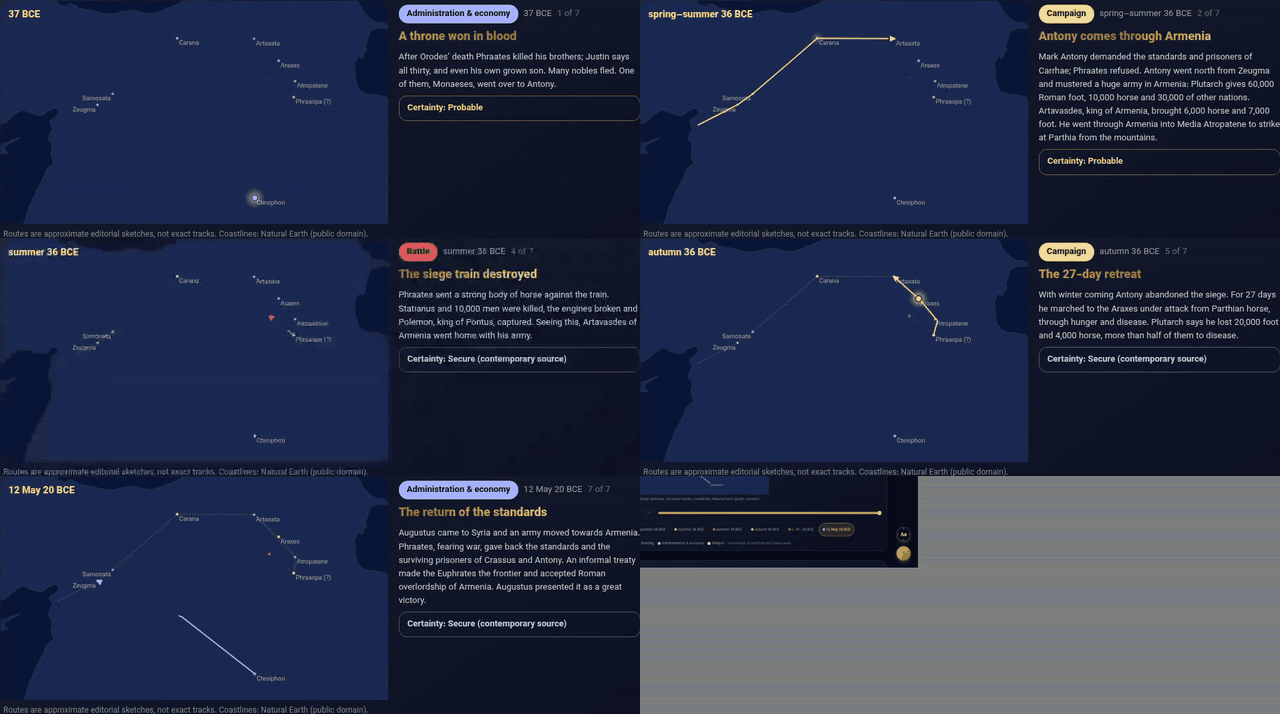
Antony’s campaign and the return of the standards (37–20 BCE)
The purge of the brothers, Antony’s march from Zeugma through Armenia to Phraaspa, the destruction of the siege train, the 27-day retreat, Tiridates’ revolt and the settlement of 20 BCE. Each step says whether it is secure, probable or disputed. The routes are sketches and Phraaspa’s site is unknown.
Administration & economy37 BCE1 of 7
A throne won in blood
After Orodes’ death Phraates killed his brothers; Justin says all thirty, and even his own grown son. Many nobles fled. One of them, Monaeses, went over to Antony.
Certainty: ProbableThe “thirty brothers” are Justin’s. Dio mentions only the killing of his half-brothers by a Commagenian mother and of Antiochus of Commagene.
Sources: Justin, tr. J. S. Watson, 1853 · Plutarch, tr. J. Dryden, rev. A. H. Clough, 1864 · Cassius Dio, tr. E. Cary, 1914–1927 · M. J. Olbrycht, Encyclopaedia Iranica, 2021
BattleCampaignBuildingAdministration & economyReligionArrow keys, Home/End and Space work.
Three separate layers
Each section has three layers: “Historical evidence” is only what the sources say; “Philosophical interpretation” is our reading by the standard of property and liberty; “Modern cultural meaning”. Quotations come only from published translations, with references.
Historical evidencePhilosophical interpretationModern cultural meaning
Dossier · 1
Antony’s campaign, 36 BCE
Antony wanted a Parthian victory to gain the upper hand in his rivalry with Octavian (the future Augustus). Instead of Crassus’ desert road he came through the mountains of Armenia and Media. He hurried and left his siege train behind; Phraates destroyed it, and Artavasdes of Armenia pulled out. Phraaspa held, and with winter ahead Antony retreated.
There appeared sixty thousand Roman foot, ten thousand horse, Spaniards and Gauls, who counted as Romans; and, of other nations, horse and foot, thirty thousand.
he had lost twenty thousand foot and four thousand horse, of which the better half perished, not by the enemy, but by diseases. Their march was of twenty-seven days from Phraata, during which they had beaten the Parthians in eighteen battles, though with little effect…
Chaumont (Iranica) says this defeat was hardly less ruinous for Rome than Carrhae, though the Romans remembered it less. Plutarch writes from the report of Dellius, one of Antony’s officers, and puts much of the blame on Artavasdes. Antony later seized Artavasdes by a trick and took him to Alexandria.
Parthia showed again that it could not be taken by war. With light horse and strikes at the rear, Phraates wore down an army three times his size without a pitched battle. The cost of one commander’s ambition was again paid by soldiers and by the villagers in his path.
Sources: Plutarch, tr. J. Dryden, rev. A. H. Clough · M. L. Chaumont, Encyclopaedia Iranica · Cassius Dio, tr. E. Cary
Dossier · 2
The standards: Augustus’ bloodless victory
In 20 BCE Phraates returned the standards taken from Crassus, Decidius Saxa and Antony, with the surviving prisoners. Augustus recorded it in his Res Gestae, put it on coins and on the breastplate of the Prima Porta statue, and laid the standards in the temple of Mars Ultor.
I compelled the Parthians to return to me the spoils and standards of three Roman armies, and as suppliants to seek the friendship of the Roman people. Furthermore I placed those standards in the sanctuary of the temple of Mars Ultor.
Whatever prisoners, accordingly, remained of the army of Crassus or Antonius throughout Parthia, were collected together, and sent, with the military standards that had been taken, to Augustus. In addition to this, the sons and grandsons of Phraates were delivered to Augustus as hostages; and thus Caesar effected more by the power of his name, than any other general could have done by his arms.

The Roman sources present it as Parthian submission (“as suppliants”); in fact it was a deal between equals: the Euphrates became the frontier, and in return Rome dropped Tiridates. Phraates had no need for war and made his throne safe.
Augustus’ propaganda called a diplomatic deal a “victory”. Peace between the two powers, which kept trade open from the Euphrates to China, served the people on both sides better than any battle.
Sources: Augustus, tr. T. Bushnell · Justin, tr. J. S. Watson · K. Schippmann, Encyclopaedia Iranica · M. J. Olbrycht, Encyclopaedia Iranica
Dossier · 3
Musa and the sons in Rome
Josephus says Thermusa (on the coins: Musa), an Italian slave-girl given by “Caesar”, won Phraates’ heart, became his lawful wife and persuaded him to send his legitimate sons to Rome to clear the way for her own son, Phraataces. Then Phraataces, with her help, killed his father. Augustus says in his Res Gestae that Phraates sent “all his sons and grandsons” to Italy without having been beaten in any war.
King Phrates of the Parthians, son of Orodes, sent all his sons and grandsons into Italy to me, though defeated in no war, but seeking our friendship through the pledges of his children.
When Phraates had had legitimate sons of his own, he had also an Italian maid-servant, whose name was Thermusa, who had been formerly sent to him by Julius Cæsar, among other presents. He first made her his concubine; but he being a great admirer of her beauty, in process of time having a son by her, whose name was Phraataces, he made her his legitimate wife, and had a great respect for her.

Some scholars see Musa as a Roman agent; that is a guess. Sending the sons can also be read as Phraates’ own plan: princes out of the rebels’ reach made the throne safer. The story of Phraataces marrying his mother may be his enemies’ propaganda.
The Parthian princes grew up in Rome, and from then on Rome repeatedly meddled in Parthia with “a king made in Rome”. Giving hostages bought today’s security at the price of foreign influence tomorrow.
Sources: Flavius Josephus, tr. W. Whiston · Augustus, tr. T. Bushnell · K. Schippmann, Encyclopaedia Iranica · M. J. Olbrycht, Encyclopaedia Iranica
Synthesis
Phraates IV was a ruthless but able king: he came to the throne by massacre, wore down Antony’s army without a pitched battle and bought a long peace with Rome by giving back the standards. But by sending his sons to Rome and giving Musa room, he opened the way to Roman meddling and succession wars.
The sources are again mostly Roman, shrinking Parthia’s victories and presenting its diplomacy as surrender.
Bibliography
- Plutarch, tr. J. Dryden, rev. A. H. Clough, Life of Antony, chs. 33–52 (1864). https://www.gutenberg.org/ebooks/674Based on the report of Dellius, Antony’s companion; Iranica notes a pro-Antony bias that blames the Armenian king.
- Justin, tr. J. S. Watson, Epitome of Pompeius Trogus, books 38–42 (books 40–44 online) (1853). https://www.attalus.org/translate/justin7.htmlA Roman digest of the lost history of Pompeius Trogus (1st century BCE); the most continuous account of the early Parthians, but Roman in outlook and full of “Scythian” clichés.
- Augustus, tr. T. Bushnell, Res Gestae Divi Augusti (The Deeds of the Divine Augustus) §§ 27, 29, 32–33 (1998). https://en.wikisource.org/wiki/The_Deeds_of_the_Divine_AugustusAugustus’ own account of his deeds: official propaganda, not a neutral record.
- Flavius Josephus, tr. W. Whiston, Antiquities of the Jews 13.14.3 (13.384–386); 18.2.4 (18.39–52) (1737). https://www.gutenberg.org/ebooks/2848
- Cassius Dio, tr. E. Cary, Roman History 36.1–3, 37.5–7, 39.56, 40.12–30, 48.24–41, 49.19–33, 54.8, 55.10 (1914–1927).
- M. J. Olbrycht, Encyclopaedia Iranica, Phraates IV (2021). https://www.iranicaonline.org/articles/phraates-iv/
- M. L. Chaumont, Encyclopaedia Iranica, Antony, Mark (1986, updated 2016). https://www.iranicaonline.org/articles/antony-mark-roman-gencral-ca/
- K. Schippmann, Encyclopaedia Iranica, Arsacids ii. The Arsacid dynasty (1986, updated 2016). https://www.iranicaonline.org/articles/arsacids-ii/
- M. J. Olbrycht, Encyclopaedia Iranica, Phraates V (Phraataces) (2021). https://www.iranicaonline.org/articles/phraates-v/
- N. C. Debevoise, A Political History of Parthia (1938).
- D. Sellwood, An Introduction to the Coinage of Parthia, 2nd ed. (1980). The standard numbering of Parthian coins (“S”); some of its attributions have since been revised.
All photos are from Wikimedia Commons; licence and author were checked on each file page.
Orodes II, his fatherPhraates V, his sonVonones I, his sonThe Arsacid dynasty