Featured dossier
Yazdegerd II: “the gentle king”, Avarayr and the war in the east
Yazdegerd II, son of Bahram Gur, reigned eighteen years. Persian and Arabic sources call him “the gentle”, Armenian and Syriac ones a persecutor. He tried to reimpose the Zoroastrian faith in Armenia; the result was Vardan Mamikonian’s rising and the battle of Avarayr in 451. He spent most of his years at Nishapur, at war with the Hephthalites.
- years of reign
- 18
- battle of Avarayr
- 451
Animated map: from Ctesiphon to Avarayr and Nishapur
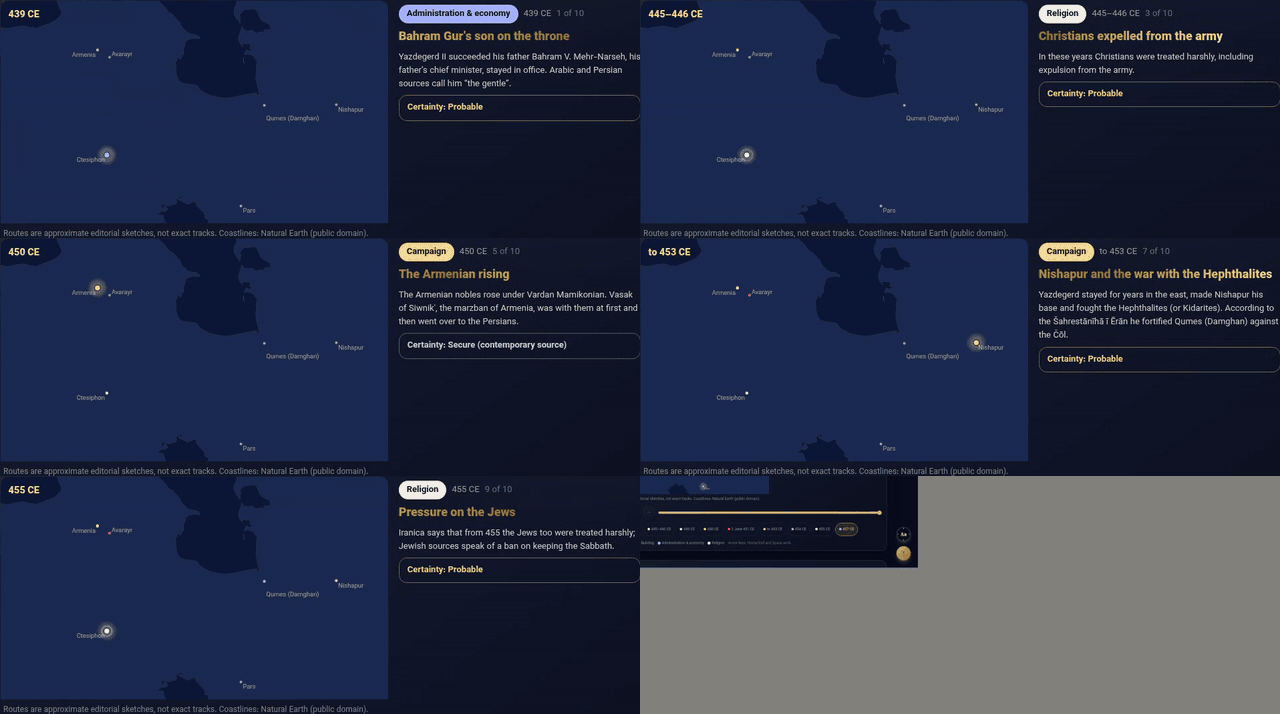
Administration & economy439 CE1 of 10
Bahram Gur’s son on the throne
Yazdegerd II succeeded his father Bahram V. Mehr-Narseh, his father’s chief minister, stayed in office. Arabic and Persian sources call him “the gentle”.
Certainty: ProbableThe epithet “gentle” comes in Arabic and Persian sources (Ḥamza of Isfahan: Yazdajerd al-Layyen; Ebn al-Balḵi: Yazdegerd-e Narm). Armenian and Syriac sources call him a persecutor. Daryaee (Iranica) explains the split by the two points of view: Zoroastrian and Christian.
BattleCampaignBuildingAdministration & economyReligionArrow keys, Home/End and Space work.
The reign of Yazdegerd II, step by step (439–457 CE)
The reign of Yazdegerd II as told by Iranica and the two Armenian historians Elishe and Łazar Pʿarpecʿi. The step-by-step diagram of the battle of Avarayr is below the map.
Administration & economy439 CE1 of 10
Bahram Gur’s son on the throne
Yazdegerd II succeeded his father Bahram V. Mehr-Narseh, his father’s chief minister, stayed in office. Arabic and Persian sources call him “the gentle”.
Certainty: ProbableThe epithet “gentle” comes in Arabic and Persian sources (Ḥamza of Isfahan: Yazdajerd al-Layyen; Ebn al-Balḵi: Yazdegerd-e Narm). Armenian and Syriac sources call him a persecutor. Daryaee (Iranica) explains the split by the two points of view: Zoroastrian and Christian.
BattleCampaignBuildingAdministration & economyReligionArrow keys, Home/End and Space work.
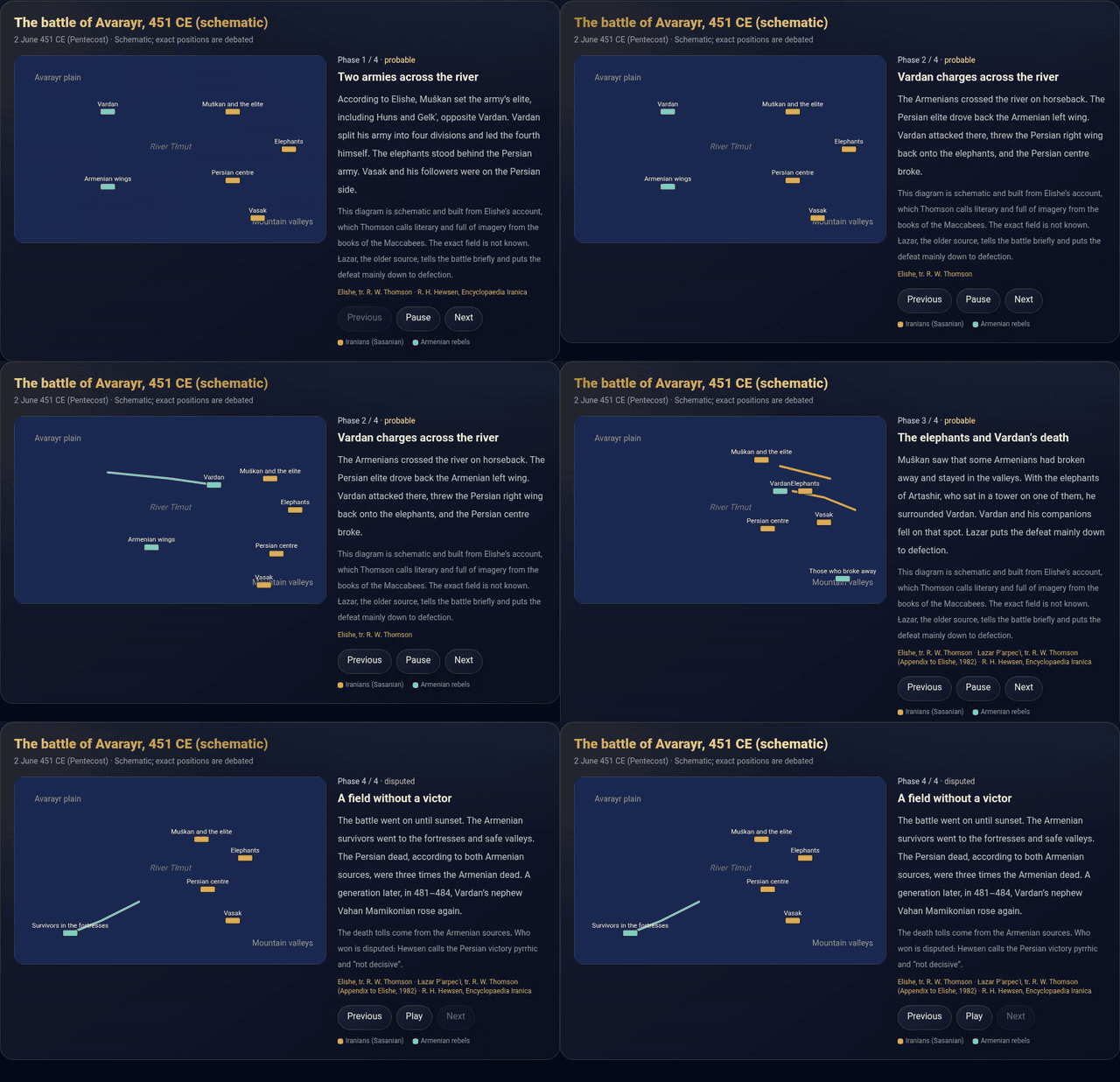
The battle of Avarayr, 451 CE (schematic)
2 June 451 CE (Pentecost) · Schematic; exact positions are debated
Phase 1 / 4 · probable
Two armies across the river
According to Elishe, Muškan set the army’s elite, including Huns and Gelkʿ, opposite Vardan. Vardan split his army into four divisions and led the fourth himself. The elephants stood behind the Persian army. Vasak and his followers were on the Persian side.
This diagram is schematic and built from Elishe’s account, which Thomson calls literary and full of imagery from the books of the Maccabees. The exact field is not known. Łazar, the older source, tells the battle briefly and puts the defeat mainly down to defection.
Elishe, tr. R. W. Thomson · R. H. Hewsen, Encyclopaedia Iranica
Iranians (Sasanian)Armenian rebels
Three separate layers
Each section has three layers: “Historical evidence” is only what the sources say; “Philosophical interpretation” is our reading by the standard of property and liberty; “Modern cultural meaning”. Quotations come only from published translations, with references.
Historical evidencePhilosophical interpretationModern cultural meaning
Dossier · 1
“Gentle” or persecutor?
Ḥamza of Isfahan calls him “Yazdajerd al-Layyen” and Ebn al-Balḵi “Yazdegerd-e Narm”, both meaning “the gentle”. A new legend appeared on his coins: “Mazda-worshipping majesty, the Kayanid” (mzdysn bgy kdy). According to Daryaee, this is the first time the title kay, the name of the legendary Kayanid kings, appears on coins.

Two portraits of one king come from two points of view: the Zoroastrian tradition praised a king who guarded the faith, and Christian writers saw the same king as a persecutor. Daryaee reads the title kay as a sign that Sasanian kingship was being tied to Kayanid history, the history that later appears in the Book of Kings and the Shahnameh.
“Gentle” to one group can be harsh to another. Every epithet should be read with the question: who gave it, and for whom?
Sources: T. Daryaee, Encyclopaedia Iranica
Dossier · 2
One faith for all?
In 445–446 Christians were expelled from the army. In 449 a decree in Mehr-Narseh’s name required the Armenians to return to the Zoroastrian faith. From 455 the Jews too were treated harshly.
Daryaee reads this policy as an attempt to unify the state and build a single identity, not only religious zeal. Armenia was the Roman–Persian border, and its Christianity drew it towards Rome. So faith policy and border policy were woven together.
His father Bahram V had accepted religious freedom in a treaty with Rome. Yazdegerd II went the other way: the state tried to decide people’s faith. The result was revolt, war and exile. Freedom of conscience, which frees people from fear of the state, would also have been cheaper for the state. This is our reading.
Sources: T. Daryaee, Encyclopaedia Iranica · R. H. Hewsen, Encyclopaedia Iranica
Dossier · 3
Avarayr: a field without a victor
On 2 June 451, Pentecost Sunday, on the plain of Avarayr southeast of modern Maku, by the river Tłmut (Zangmar), the Persian army under Muškan Niusałavurt fought Vardan Mamikonian’s Armenians. According to Elishe, 60,000 Armenians faced 200,000 Persians with the Immortals and elephants. Vasak of Siwnikʿ and his followers went over to the Persians. The elephants decided the battle, and Vardan and eight other generals were killed.
For neither side was victorious and neither side was defeated; but heroes attacked heroes and both sides went down to defeat.
But from the Persian army those who fell in the battle on that day, as has been accurately reckoned and told to us, confirmed by the Persian generals, were 3,544.

Both our sources are Armenian. Łazar wrote around 500 and puts the defeat mainly down to defection. Elishe, whom Thomson takes to be probably a 6th-century rewriting of Łazar, gives a long literary account whose imagery comes from the books of the Maccabees. The army sizes are exaggerated. Hewsen calls the Persian victory pyrrhic and “not decisive”: a generation later Vahan Mamikonian rose again, and Balash made peace with him and made him marzban of Armenia.
Avarayr shows that force can take a field but not a conscience. Persia took the field, but a generation later had to make peace with a leader of the same house and hand Armenia to him. This is our reading.
Sources: R. H. Hewsen, Encyclopaedia Iranica · R. W. Thomson, Encyclopaedia Iranica · Elishe, tr. R. W. Thomson · Łazar Pʿarpecʿi, tr. R. W. Thomson (Appendix to Elishe, 1982)
Dossier · 4
Vardan Mamikonian
Vardan, “Vardan the Red”, was head of the Mamikonian family, which held the command of the Armenian army (sparapet) by inheritance. He fell at Avarayr with most of the Armenian nobility. The Armenian Church venerates him as a saint.
Garsoïan (Iranica) says Vardan became in Armenian literature the martyr for the faith and the model of the “Christian Maccabees”, and the central figure of medieval Armenian history. So the picture we have of him was shaped by the literature after him. The Mamikonians were usually seen as partisans of Rome, so politics was in play too.
A hereditary command was one family’s privilege. But what Vardan fought for, a community’s freedom to keep its faith, is a right that belongs to everyone. The two should be seen apart.
Sources: N. Garsoïan, Encyclopaedia Iranica · R. H. Hewsen, Encyclopaedia Iranica
Dossier · 5
Nishapur and the war in the east
Daryaee says Yazdegerd made Nishapur his base and fought the Hephthalites until 453. According to the Šahrestānīhā ī Ērān he fortified Qumes (Damghan) against the Čōl. Sebeos says that in 454 Armenian nobles were taken to Khorasan.
The enemy is sometimes called the Hephthalites and sometimes the Kidarites; the names are not clear in the sources for this period. The eastern war, begun under Bahram Gur, did not end with Yazdegerd II and led on to Peroz’s wars.
A state fighting on two frontiers paid for it from people’s taxes. The pressure on religious minorities came in the same years. The more the state fought, the less it tolerated; this is our reading.
Sources: T. Daryaee, Encyclopaedia Iranica
Synthesis
Yazdegerd II has two faces: the “gentle king” of the Zoroastrian tradition and the persecutor of the Christian sources. Both come from one group’s point of view. What is clear is that he tried to unify the state through one faith, and Armenia paid the price at Avarayr.
Persia won Avarayr, but not decisively. A generation later the Armenians rose again and won freedom of religion.
Bibliography
- T. Daryaee, Encyclopaedia Iranica, Yazdegerd II (2000). https://www.iranicaonline.org/articles/yazdgerd-ii/
- R. H. Hewsen, Encyclopaedia Iranica, Avarayr (1987). https://www.iranicaonline.org/articles/avarayr/
- R. W. Thomson, Encyclopaedia Iranica, Ełišē (1998). https://www.iranicaonline.org/articles/elise/
- N. Garsoïan, Encyclopaedia Iranica, Mamikonean family (2000). https://www.iranicaonline.org/articles/mamikonean/
- Elishe, tr. R. W. Thomson, History of Vardan and the Armenian War (Harvard Armenian Texts and Studies 5) (1982). https://archive.org/details/eghishe-vardan-1982Thomson (Iranica) says Elishe’s book is probably a 6th-century rewriting of Łazar and is literary and elaborate. Numbers in brackets are pages of the Armenian edition.
- Łazar Pʿarpecʿi, tr. R. W. Thomson (Appendix to Elishe, 1982), The Armenian War according to Łazar Pʿarpecʿi (1982). https://archive.org/details/eghishe-vardan-1982Łazar wrote around 500. Thomson notes that the surviving text was rewritten between the 12th and 15th centuries.
- A. Sh. Shahbazi, Encyclopaedia Iranica, Hormozd III (2004). https://www.iranicaonline.org/articles/hormozd-iii/
All photos are from Wikimedia Commons; licence and author were checked on each file page.
Bahram Gur, his fatherHormizd III, his sonPeroz I, his sonThe Sasanian dynasty