Featured dossier
Peroz I: famine, the Hephthalites and the trench
Peroz I, son of Yazdegerd II, took the crown from his brother Hormizd by war. In his reign came a seven-year drought, and he abolished taxes. Twice he attacked the Hephthalites: the first time he was captured with his son Kavad, and the second time, in 484, he perished with his army. Procopius describes his death in a hidden trench.
- years of reign
- 25
- death in the Hephthalite war
- 484
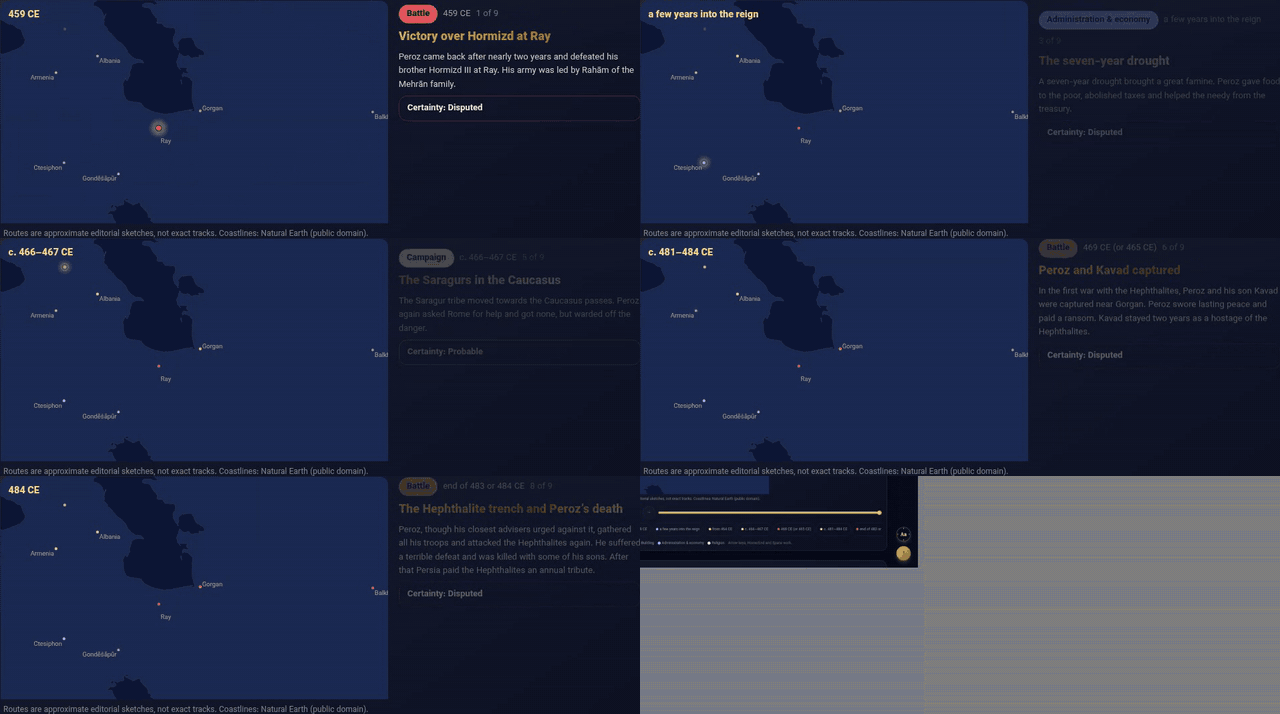
Animated map: from Ray to Balkh
Battle459 CE1 of 9
Victory over Hormizd at Ray
Peroz came back after nearly two years and defeated his brother Hormizd III at Ray. His army was led by Rahām of the Mehrān family.
Certainty: DisputedSchippmann says Peroz returned with Hephthalite troops and Persians under Rahām Mehrān. Christensen rejects Hephthalite help, and Shahbazi (Iranica, “Hormozd III”) calls the story a legend.
Sources: K. Schippmann, Encyclopaedia Iranica, 1999 · A. Sh. Shahbazi, Encyclopaedia Iranica, 2004
BattleCampaignBuildingAdministration & economyReligionArrow keys, Home/End and Space work.
The reign of Peroz, step by step (459–484 CE)
The reign of Peroz as told by Iranica (Schippmann) and Procopius. Steps that rest on Procopius alone are marked disputed. The step-by-step diagram of the trench is below the map.
Battle459 CE1 of 9
Victory over Hormizd at Ray
Peroz came back after nearly two years and defeated his brother Hormizd III at Ray. His army was led by Rahām of the Mehrān family.
Certainty: DisputedSchippmann says Peroz returned with Hephthalite troops and Persians under Rahām Mehrān. Christensen rejects Hephthalite help, and Shahbazi (Iranica, “Hormozd III”) calls the story a legend.
Sources: K. Schippmann, Encyclopaedia Iranica, 1999 · A. Sh. Shahbazi, Encyclopaedia Iranica, 2004
BattleCampaignBuildingAdministration & economyReligionArrow keys, Home/End and Space work.
The Hephthalite trench, 484 CE (schematic, after Procopius)
end of 483 or 484 CE · Schematic; exact positions are debated
Phase 1 / 4 · disputed
The trench and the salt of the oath
Procopius says the Hephthalite king dug a deep, wide trench across the plain and left only a neck the width of ten horses in the middle. He covered it with reeds and earth. He hung from the royal banner the salt over which Peroz had once sworn. Most of his army stayed behind the trench.
Only Procopius, writing about fifty years later, describes the trench. Iranica (Schippmann) confirms only a terrible defeat and the death of Peroz and “some” of his sons. The year (end of 483 or, more probably, 484) and the place (“near Balkh?”) are disputed. Procopius says “all his sons” died, but a little later says himself that Kavad, the youngest, survived.
Procopius, tr. H. B. Dewing (Loeb)
Iranians (Sasanian)Hephthalites
Three separate layers
Each section has three layers: “Historical evidence” is only what the sources say; “Philosophical interpretation” is our reading by the standard of property and liberty; “Modern cultural meaning”. Quotations come only from published translations, with references.
Historical evidencePhilosophical interpretationModern cultural meaning
Dossier · 1
The crown from a brother
After Yazdegerd II’s death Hormizd was crowned and Peroz fled. Nearly two years later he came back with an army led by Rahām Mehrān and defeated Hormizd at Ray. Armenian sources make Hormizd the elder, Persian sources Peroz.

Whether the Hephthalites helped Peroz is disputed. Schippmann reports it; Christensen rejects it, since in his view the Hephthalites had not yet reached Persia’s border; Shahbazi calls the story a legend. Ṭabari calls Peroz just and pious, which Schippmann reads as a sign that the priests were pleased with him.
A source that calls a king “just” often writes from the view of a group that gained from him. The same period also saw persecution of Christians and Jews.
Sources: K. Schippmann, Encyclopaedia Iranica · A. Sh. Shahbazi, Encyclopaedia Iranica
Dossier · 2
The seven-year drought
A few years into the reign a seven-year drought brought a great famine. According to Iranica (following Rawlinson and Nöldeke), Peroz gave food to the poor, abolished taxes and helped the needy from the treasury.

Schippmann warns that the reports may be exaggerated: in those same years Peroz was preparing for war. So the famine story, at least its scale, is disputed. Its Arabic and Persian telling also comes from the Sasanian tradition that praised the king.
Abolishing taxes in a famine means leaving bread in the hands of those who grew it. It shows that taxation, in hard times, could be the line between living and dying. This is our reading.
Sources: K. Schippmann, Encyclopaedia Iranica
Dossier · 3
The first Hephthalite war: Kavad captive
In the first war with the Hephthalites, Peroz and his son Kavad were captured near Gorgan. Peroz swore lasting peace and paid a ransom; Joshua the Stylite says twenty mule loads. Kavad stayed two years as a hostage. Ṭabari calls the Hephthalite king Aḵšonvār, and Ferdowsi Ḵošnavāz.
Perozes accordingly gave the pledges concerning the peace, and prostrated himself before his foe exactly as the Magi had suggested, and so, with the whole Median army intact, gladly retired homeward.
Procopius tells a story: the Hephthalites lured the Persians into a dead-end valley, and the Hephthalite king offered freedom if Peroz would prostrate himself before him. The priests told him to meet him at dawn and bow towards the rising sun. Only Procopius has this story. The year of the captivity is also disputed (469 or 465).
As a boy Kavad spent two years as a hostage of the Hephthalites. Later, when he lost the crown, he took refuge with the same Hephthalites and came back with their help. Hostage-taking between states made ties too, whether they meant it or not.
Sources: K. Schippmann, Encyclopaedia Iranica · Procopius, tr. H. B. Dewing (Loeb)
Dossier · 4
The trench of 484
Peroz, though his closest advisers urged against it, gathered all his troops and began a new war with the Hephthalites around 481. At the end of 483 or, more probably, in 484, in what is now Afghanistan (perhaps near Balkh), he was defeated and killed with some of his sons. Afterwards Persia paid the Hephthalites an annual tribute.
But the Persians, having no means of perceiving the stratagem, gave chase at full speed across a very level plain, possessed as they were by a spirit of fury against the enemy, and fell into the trench, every man of them, not alone the first but also those who followed in the rear.
This story, however, seems to me untrustworthy, because a man who found himself in such peril would have thought of nothing else; but I suppose that his ear was crushed in this disaster, and the pearl disappeared somewhere or other.
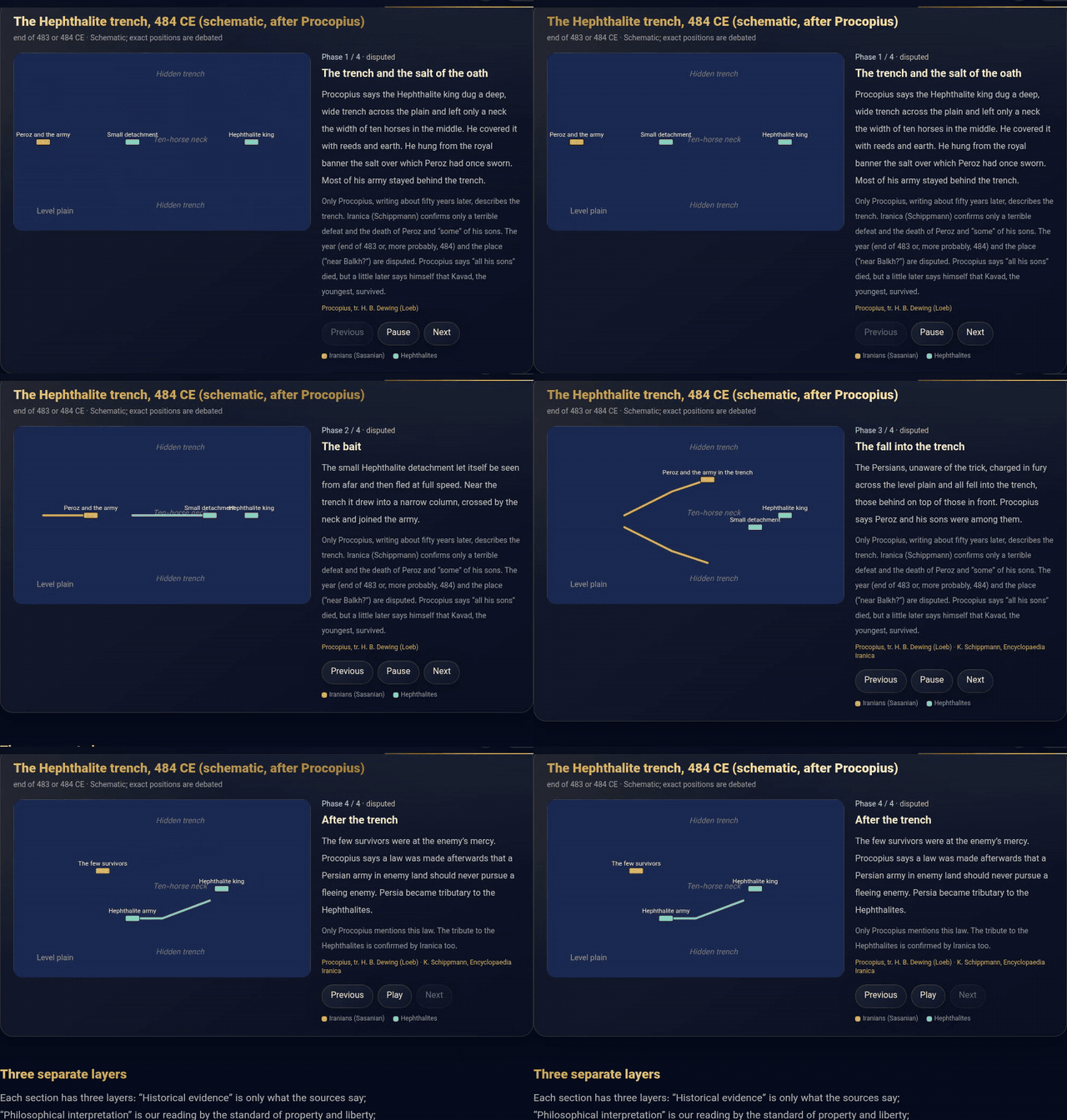
Procopius, about fifty years later, says the Hephthalites dug a hidden trench and the Persian army fell into it in pursuit. He also tells the story of Peroz’s pearl earring, but does not believe it himself. That Peroz had broken his oath, and that the Hephthalite king hung the salt of the oath on his banner, is Procopius’s Roman point of view. No other source we checked confirms the trench.
A king who twice staked everything on war against his advisers’ counsel left the bill to the people who paid the Hephthalites tribute for years. When the decision for war lies with one man, his defeat is everyone’s. This is our reading.
Sources: K. Schippmann, Encyclopaedia Iranica · Procopius, tr. H. B. Dewing (Loeb)
Dossier · 5
The church of Persia and the council of Gondēšāpūr
Under Peroz Christians and Jews were persecuted. At the same time Peroz supported the rise of Nestorianism. In 484 a council at Gondēšāpūr declared Nestorianism the doctrine of the Christian church of Persia.
A church whose doctrine differed from the Roman church looked less tied to Rome. So the king’s support for the Nestorians can be read as frontier policy too. This is our reading of Iranica’s report.
Here the state backed a doctrine to build political loyalty. Separating faith and state exists partly so that people’s belief does not become a tool of foreign policy.
Sources: K. Schippmann, Encyclopaedia Iranica
Synthesis
Peroz came to the throne by war and perished by war. In between came the seven-year famine, and the reports say he abolished taxes, though the scale of the disaster may be exaggerated.
His two wars with the Hephthalites made Persia tributary. The story of the trench and the pearl is Procopius’s, and this page shows it apart from Iranica’s report.
Bibliography
- K. Schippmann, Encyclopaedia Iranica, Fīrūz (Pērōz) I (1999). https://www.iranicaonline.org/articles/peroz/i-history/
- A. Sh. Shahbazi, Encyclopaedia Iranica, Hormozd III (2004). https://www.iranicaonline.org/articles/hormozd-iii/
- N. Garsoïan, Encyclopaedia Iranica, Mamikonean family (2000). https://www.iranicaonline.org/articles/mamikonean/
- Procopius, tr. H. B. Dewing (Loeb), History of the Wars 1.2–1.18 (1914). https://archive.org/details/procopius00procgoog
- Elishe, tr. R. W. Thomson, History of Vardan and the Armenian War (Harvard Armenian Texts and Studies 5) (1982). https://archive.org/details/eghishe-vardan-1982Thomson (Iranica) says Elishe’s book is probably a 6th-century rewriting of Łazar and is literary and elaborate. Numbers in brackets are pages of the Armenian edition.
All photos are from Wikimedia Commons; licence and author were checked on each file page.
Hormizd III, his brotherBalash, his brother and successorKavad I, his sonThe Sasanian dynasty