Featured dossier
Kavad I: Mazdak, exile and return
Kavad I, son of Peroz, came to the throne when the power of the Sasanian king was at its lowest. He supported the Mazdakite movement, was deposed and imprisoned, fled to the Hephthalites and returned with their help. He then fought Rome and, forty-three years after his first accession, handed his son Khosrow a powerful monarchy.
- years, with a three-year break
- 43
- times on the throne
- 2
- Amida taken
- 503
Animated map: from Ctesiphon to the Hephthalites and the Roman frontier
Administration & economy488 CE1 of 15
First reign
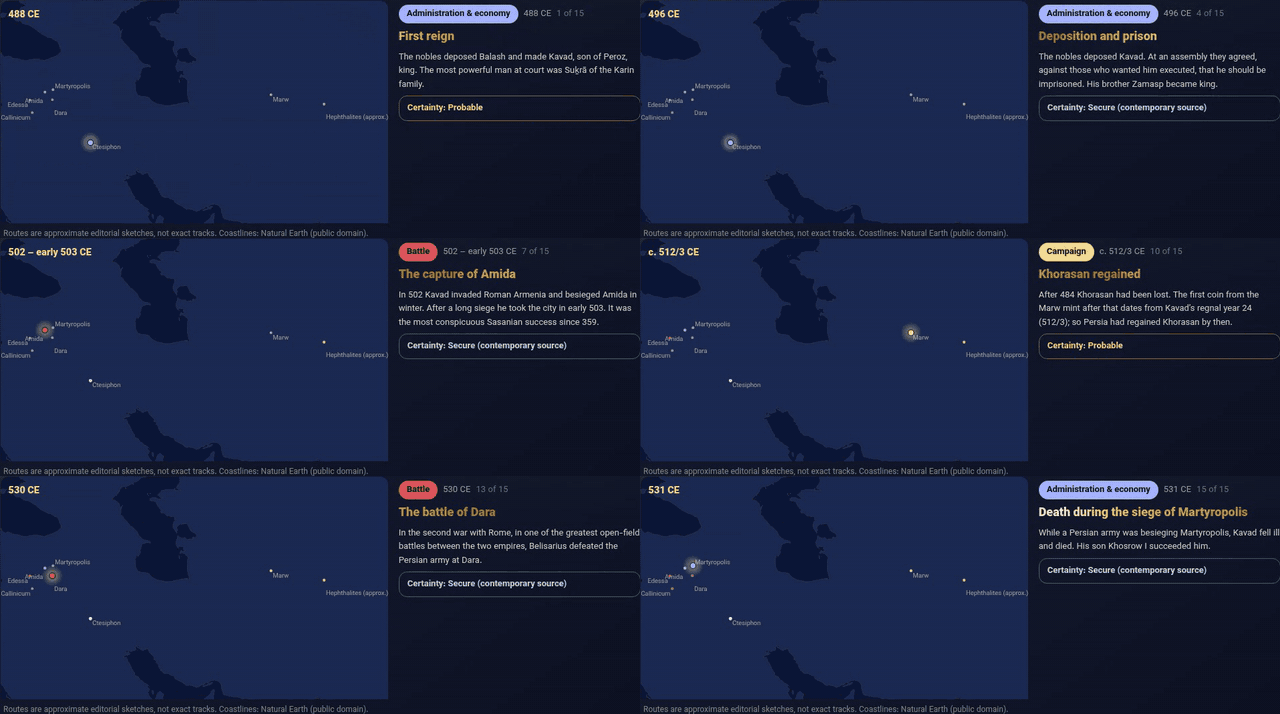
The nobles deposed Balash and made Kavad, son of Peroz, king. The most powerful man at court was Suḵrā of the Karin family.
Certainty: ProbableKavad’s age is disputed: Malalas and Ferdowsi make him over eighty at his death; Procopius says he was too young to fight in 484. Schindel prefers Procopius (born c. 473).
BattleCampaignBuildingAdministration & economyReligionArrow keys, Home/End and Space work.
The reign of Kavad, step by step (488–531 CE)
The reign of Kavad as told by Iranica (Schindel) and Procopius. Steps about the Mazdakites are marked disputed, since all the sources for them come from the movement’s enemies. Step-by-step diagrams of Dara and Callinicum are below the map.
Administration & economy488 CE1 of 15
First reign
The nobles deposed Balash and made Kavad, son of Peroz, king. The most powerful man at court was Suḵrā of the Karin family.
Certainty: ProbableKavad’s age is disputed: Malalas and Ferdowsi make him over eighty at his death; Procopius says he was too young to fight in 484. Schindel prefers Procopius (born c. 473).
BattleCampaignBuildingAdministration & economyReligionArrow keys, Home/End and Space work.
The battle of Dara, 530 CE (schematic, after Procopius)
530 CE · Schematic; exact positions are debated
Phase 1 / 4 · probable
The trench and the two lines
Near the gate of Dara the Romans dug a broken trench with many crossings. Cavalry stood on both wings outside it and Belisarius in the centre. Procopius counts the Romans at 25,000 and the Persians at 40,000. The Persian commander, the “mirranes” Perozes, sent word to prepare the bath of Dara for him the next day.
The details of the deployment and the army sizes come from Procopius alone. Schindel (Iranica) confirms only the outcome.
Procopius, tr. H. B. Dewing (Loeb)
Iranians (Sasanian)Romans
The battle of Callinicum, 531 CE (schematic, after Procopius)
April 531 CE · Schematic; exact positions are debated
Phase 1 / 4 · probable
The raid and the retreat
Kavad sent fifteen thousand men under Azarethes, and al-Mundhir, the Lakhmid king, led the way. They crossed the Euphrates and fell suddenly on Commagene. Belisarius followed, and the Persians, on their way home, were caught facing him by the Euphrates. It was the day before Easter.
The details of the deployment and the army sizes come from Procopius alone. Schindel (Iranica) confirms only the outcome.
Procopius, tr. H. B. Dewing (Loeb)
Iranians and LakhmidsRomans and Ghassanids
Three separate layers
Each section has three layers: “Historical evidence” is only what the sources say; “Philosophical interpretation” is our reading by the standard of property and liberty; “Modern cultural meaning”. Quotations come only from published translations, with references.
Historical evidencePhilosophical interpretationModern cultural meaning
Dossier · 1
Kavad and the Mazdakites
In Kavad’s first reign a religious and social movement named after its leader, Mazdak son of Bāmdād, grew strong, and Kavad supported it. Everything we know about it comes from enemies or outsiders: the Roman Procopius says Kavad brought in a law of “communal” women; the Syriac Joshua the Stylite, hostile to Kavad, says Kavad “re-established” the creed; and the Arabic and Persian tradition was written after Khosrow I’s victory over the Mazdakites. Procopius in the same passage wrongly names Kavad’s replacement Balash; the coins show Zamasp.
But as time went on Cabades became more high-handed in the administration of the government, and introduced innovations into the constitution, among which was a law which he promulgated providing that Persians should have communal intercourse with their women, a measure which by no means pleased the common people.
Our extant sources on the subject represent attempts by the victorious anti-Mazdakites to demonize Mazdak, so that little is known with certainty.

Scholars disagree sharply. Shahbazi speaks of a “Mazdakite revolution” that preached the distribution of wealth and the sharing of women and brought social anarchy. Kreyenbroek says our sources are the victors’ attempts to demonize Mazdak and calls the charge of common goods and women “improbable”; in his view Mazdak’s message was brotherhood and social justice within Zoroastrianism. Schindel says what the movement was, and how far Kavad believed in it or used it to enlarge his own power, is “impossible to find out”. Gaube even questions whether Mazdak existed, or at least whether he played the main role.
The sources cannot tell us whether the “sharing of property”, if it existed, was voluntary or forced. That difference is everything: giving freely is not the same as taking by force. On the other hand, the nobles’ estates were not “property” in the liberal sense either; they were a hereditary privilege backed by the state and by birth. So the story of Mazdak cannot simply be reduced to “property” against “sharing”. What is clear is that one state first backed a movement and then killed its followers; when the state is the judge of people’s beliefs, their fate hangs on the king’s interest. This is our reading.
Sources: N. Schindel, Encyclopaedia Iranica · A. Sh. Shahbazi, Encyclopaedia Iranica · P. G. Kreyenbroek, Encyclopaedia Iranica · Procopius, tr. H. B. Dewing (Loeb)
Dossier · 2
Deposition, exile and return
In 496 the nobles deposed Kavad. At an assembly they agreed that he should be imprisoned, against those who wanted him killed; his brother Zamasp became king. Kavad escaped, went to the Hephthalite court, married the Hephthalite king’s daughter and came back with his army in 498/9. Schindel says not much fighting took place. Zamasp was spared, though probably blinded, and Gušnaspdād, who had argued for Kavad’s death, was executed.
As a boy Kavad had been a hostage of the Hephthalites; now the same Hephthalites gave him back his crown. The date of the return comes only from Zamasp’s coins (regnal years 1 to 3) and the resumption of Kavad’s coinage from his regnal year 11. The Arabic and Persian tradition, Schindel notes, was written from the point of view of Khosrow’s court and must be read with care.
An assembly of nobles deposed the king and chose prison over death. It is a sign that in Sasanian Iran power did not lie with the king alone. But this “assembly” represented a few great families, not the people.
Sources: N. Schindel, Encyclopaedia Iranica · Procopius, tr. H. B. Dewing (Loeb)
Dossier · 3
Amida, 503
In 502 Kavad invaded Roman Armenia, struck at Theodosiopolis and in winter reached Amida. After a long siege he took the city in early 503. The same year a siege of Edessa failed. Amida was returned for an indemnity and in 506 a seven-year peace was concluded.
Cabades was pleased by this speech, and permitted no further slaughter, but he bade the Persians plunder the property and make slaves of the survivors, and he directed them to choose out for himself all the notables among them.
Schindel calls the capture of Amida the most conspicuous Sasanian success since 359, when Shapur II had taken the same city. The story of the old priest and Kavad’s order is Procopius’s.
The killing ended at an old man’s word, but the townspeople’s property was plundered and the survivors were enslaved. In war, the lives and goods of citizens become bargaining chips between two states.
Sources: N. Schindel, Encyclopaedia Iranica · Procopius, tr. H. B. Dewing (Loeb)
Dossier · 4
Dara, 530
The second war with Rome began in 528, allegedly because Rome would not back Khosrow’s succession. In 530, by the frontier fortress of Dara, one of the greatest open-field battles between the two empires was fought. It ended in a great Roman victory, but did not end the war.
For on that day the Persians had been defeated in battle by the Romans, a thing which had not happened for a long time.
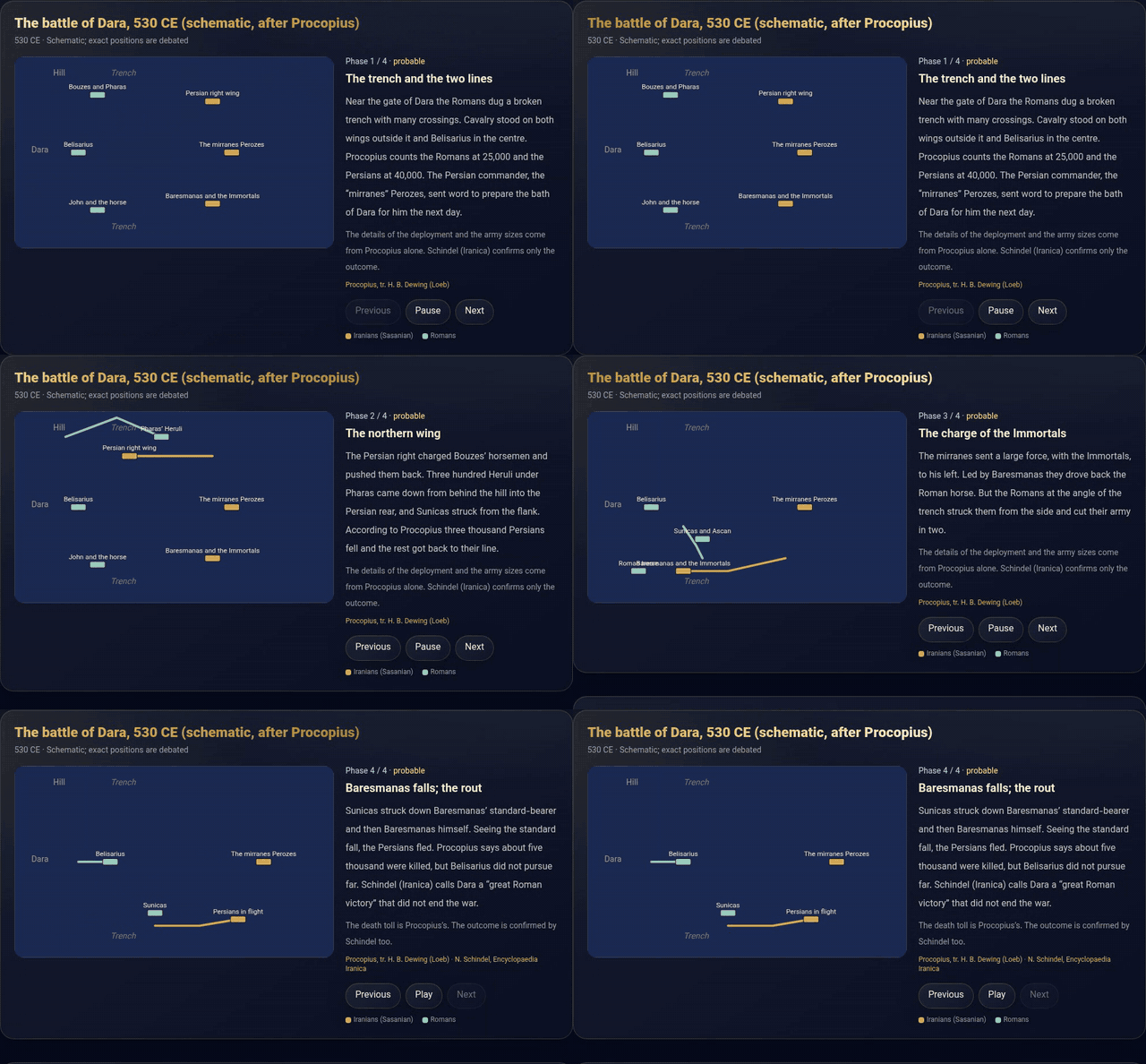

All the details of the battle, from the trench to the army sizes, come from Procopius. The diagram below follows his account and is schematic.
The king was not at this battle; a general named Perozes commanded. Wars that one man begins are paid for by others on the field.
Sources: N. Schindel, Encyclopaedia Iranica · Procopius, tr. H. B. Dewing (Loeb)
Dossier · 5
Callinicum, 531
In 531 Kavad sent another army. Under Azarethes and with the Lakhmid al-Mundhir, it defeated Belisarius by the Euphrates near Callinicum. But the victory was costly and no city was taken. Later that year, during the siege of Martyropolis, Kavad fell ill and died.
And Azarethes said that he had captured no fortress, but that he had conquered the Romans and Belisarius in battle.
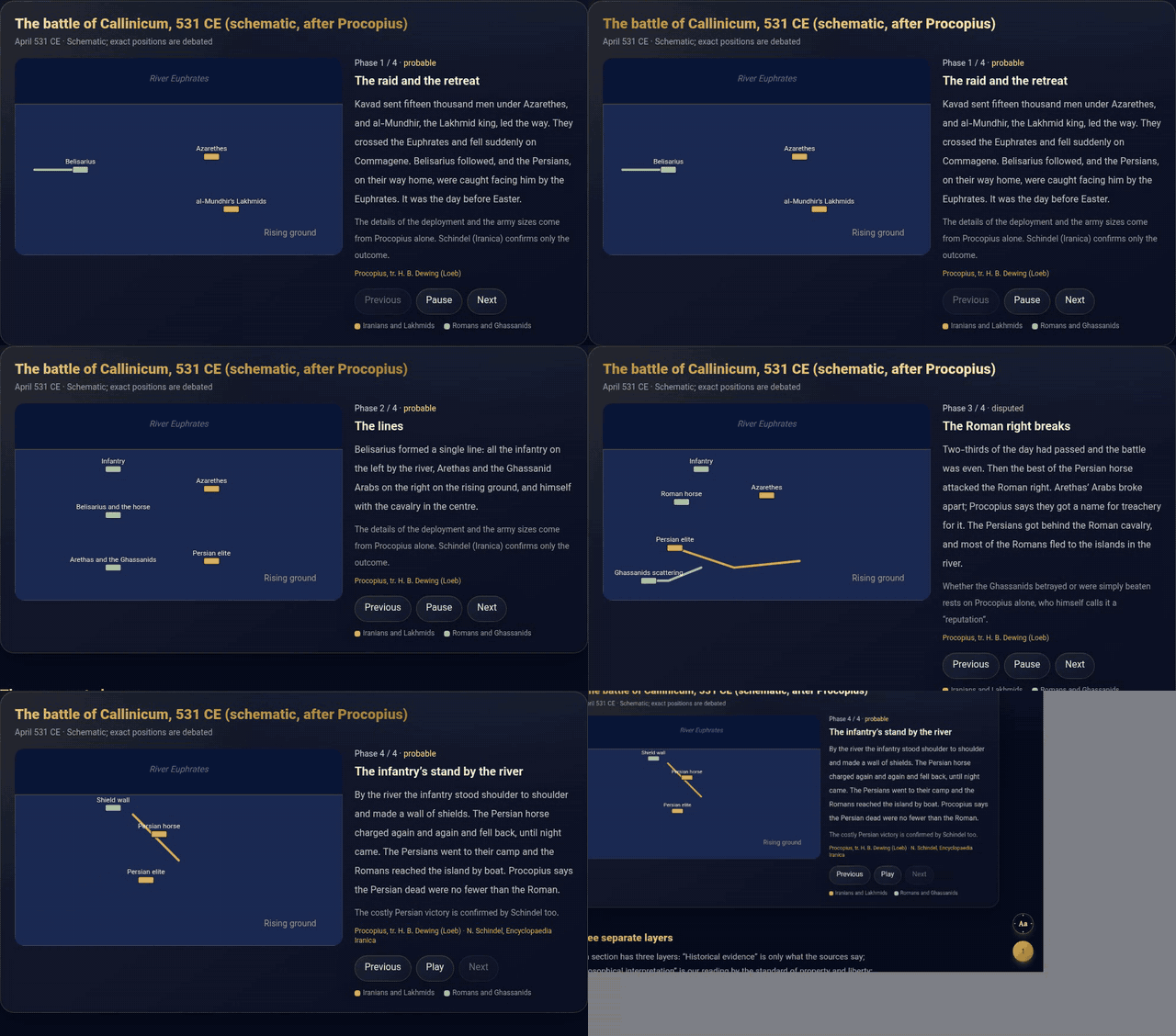
Procopius says that on campaign each Persian put an arrow in a basket and took it out on return, so the dead could be counted. Because many arrows were left, Kavad rebuked Azarethes for the victory. Only Procopius has this story.
The king counted a victory that took no city and cost many men as a failure. The account of a war is settled in soldiers’ lives, not in who holds the field.
Sources: N. Schindel, Encyclopaedia Iranica · Procopius, tr. H. B. Dewing (Loeb)
Dossier · 6
A strong crown and the first reforms
After his return Kavad dropped the Mazdakites and subdued the unruly nobles. According to Shahbazi he abolished the office of supreme commander and divided the army command among four spāhbeds. Schindel says it is certain that a cadastral survey was begun late in his reign and was still incomplete at his death. On it Khosrow I based a tax paid in money in three annual instalments.
Schindel notes that views differ on what these reforms meant. Whether the four spāhbeds were Kavad’s work or Khosrow’s is not agreed in the sources.
A land survey and a fixed money tax meant a farmer knew in advance what he owed. A predictable tax, even a heavy one, leaves less room for abuse than arbitrary levies on the harvest. This is our reading.
Sources: N. Schindel, Encyclopaedia Iranica · A. Sh. Shahbazi, Encyclopaedia Iranica
Synthesis
Kavad took a weak crown from the nobles and handed a strong one to Khosrow. In between he backed the Mazdakites, lost the throne, won it back with Hephthalite help, and then had the Mazdakites killed.
About the Mazdakites only their enemies’ voices reach us. This page names those voices and keeps the scholars’ dispute apart from our modern reading.
Bibliography
- N. Schindel, Encyclopaedia Iranica, Kawād I: reign (2013). https://www.iranicaonline.org/articles/kawad-i-reign/
- A. Sh. Shahbazi, Encyclopaedia Iranica, Sasanian dynasty (2005). https://www.iranicaonline.org/articles/sasanian-dynasty/
- P. G. Kreyenbroek, Encyclopaedia Iranica, Iran ix. Religions in Iran (1) Pre-Islamic (2006). https://www.iranicaonline.org/articles/iran-ix1-religions-in-iran/iran-ix-religions-in-iran-1-pre-islamic-1-1-overview/
- J. K. Choksy, Encyclopaedia Iranica, Jāmāsp I: reign (2008). https://www.iranicaonline.org/articles/jamasp-2/jamasp-i-reign/
- Procopius, tr. H. B. Dewing (Loeb), History of the Wars 1.2–1.18 (1914). https://archive.org/details/procopius00procgoog
All photos are from Wikimedia Commons; licence and author were checked on each file page.
Peroz I, his fatherBalash, his uncleZamasp, his brotherKhosrow I, his sonThe Sasanian dynasty