Sasanians
Khosrow I Anushirvan
خسرو یکم (انوشیروان)
Epithets and titles
- Anushirvananōšag-ruwānbyname (later or foreign)“of immortal soul”, a posthumous epithet that distinguished him from Khosrow IISource: Encyclopaedia Iranica, “Ḵosrow I”; C. J. Brunner, “Anōšag-ruwān”
- Reign
- 531–579 CE
- Dynasty
- Sasanians
- Persian page
- فارسی
Featured dossier
Khosrow I Anushirvan: taxes, war and the name “the Just”
Khosrow I, son of Kavad, reigned for forty-eight years. He rebuilt the tax system on a land survey, signed an “Endless Peace” with Rome and broke it, took Antioch, destroyed the Hephthalites with the Turks and sent a force to Yemen. Later tradition called him “Anushirvan the Just”; this page keeps the history apart from the legend.
- years of reign
- 48
- Antioch taken
- 540
- horsemen sent to Yemen
- 800
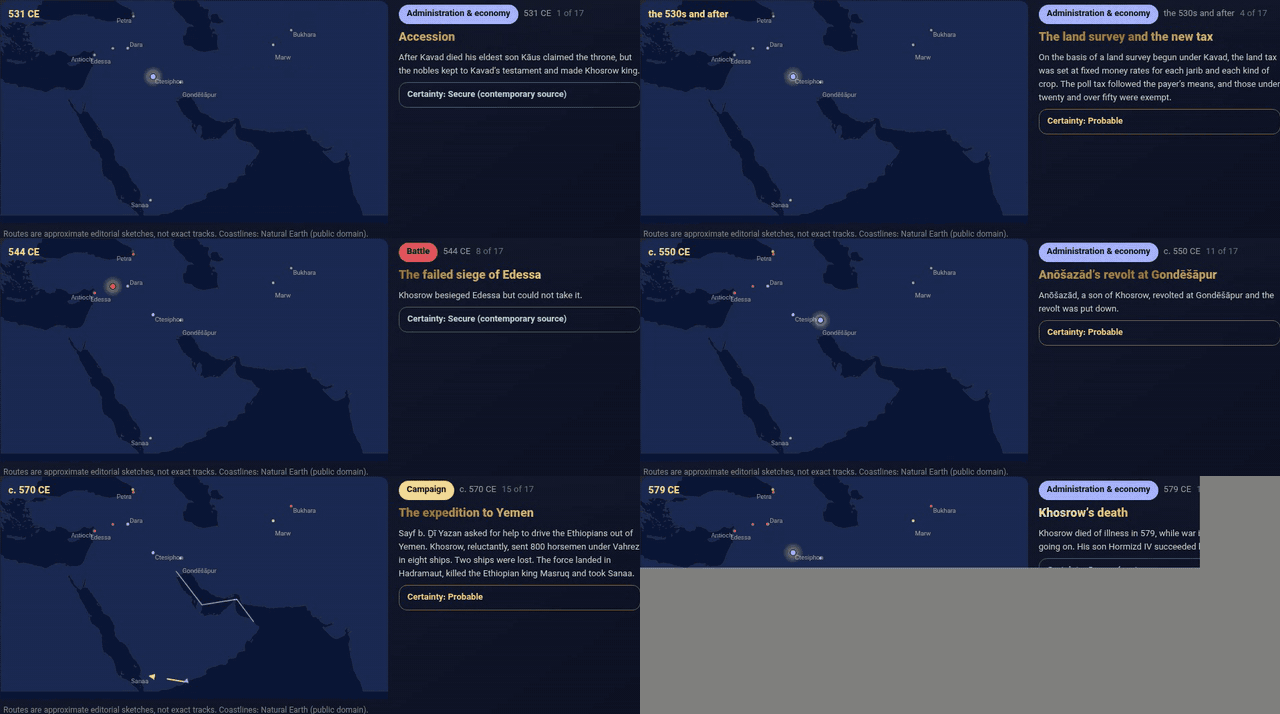
Animated map: from Antioch and Lazica to Bukhara and Yemen
Administration & economy531 CE1 of 17
Accession
After Kavad died his eldest son Kāus claimed the throne, but the nobles kept to Kavad’s testament and made Khosrow king.
Certainty: Secure (contemporary source)
Sources: A. Sh. Shahbazi, Encyclopaedia Iranica, 2005 · Procopius, tr. H. B. Dewing (Loeb), 1914
BattleCampaignBuildingAdministration & economyReligionFleet trackArrow keys, Home/End and Space work.
The reign of Khosrow I, step by step (531–579 CE)
The reign of Khosrow as told by Iranica (Rubin, Shahbazi, Bivar, Bosworth) and Procopius. The sea route to Yemen is schematic. A step-by-step diagram of the capture of Antioch is below the map.
Administration & economy531 CE1 of 17
Accession
After Kavad died his eldest son Kāus claimed the throne, but the nobles kept to Kavad’s testament and made Khosrow king.
Certainty: Secure (contemporary source)
Sources: A. Sh. Shahbazi, Encyclopaedia Iranica, 2005 · Procopius, tr. H. B. Dewing (Loeb), 1914
BattleCampaignBuildingAdministration & economyReligionFleet trackArrow keys, Home/End and Space work.
The capture of Antioch, 540 CE (schematic, after Procopius)
June 540 CE · Schematic; exact positions are debated
Phase 1 / 4 · probable
The ransom demand
Khosrow camped by the Orontes and asked ten centenaria of gold to withdraw. Six thousand soldiers from Lebanon had reached the city. Next day the people insulted Khosrow from the battlements and nearly shot his envoy.
The details of this step come from Procopius alone. He was not at Antioch, had his account from others, and was hostile to Khosrow. Shahbazi (Iranica) confirms only the capture, the plunder and the deportation.
Procopius, tr. H. B. Dewing (Loeb)
Iranians (Sasanian)Romans and the people of Antioch
Three separate layers
Each section has three layers: “Historical evidence” is only what the sources say; “Philosophical interpretation” is our reading by the standard of property and liberty; “Modern cultural meaning”. Quotations come only from published translations, with references.
Historical evidencePhilosophical interpretationModern cultural meaning
Dossier · 1
The land survey and the new tax
The tax reform began late in Kavad’s reign and Khosrow completed it. On the basis of a survey of all land, the land tax became a fixed money rate. According to Ṭabari, each jarib of wheat or barley paid one drahm, each jarib of vines eight drahms, each jarib of clover seven, and every four Persian date palms or six plain ones one drahm. The tax was paid in three or four instalments a year. Mobads acting as district judges could reduce or remit the tax in bad years, and any complaint could be taken to the royal chancery.
The poll tax followed the payer’s means, and everyone under twenty or over fifty, of every class, was exempt; but the upper classes kept their exemptions. Farmers who had lost their land in the Mazdakite turmoil were given it back, and the aim, Rubin says, was small farms rather than large estates. The cavalry were now paid in money from this revenue.
This new system, if efficiently applied, would enable a monarch to anticipate incomes and budget expenses.
It is Ḵosrow’s revised poll-tax which bears out, by the very nature of its progressive rates, according to the taxpayer’s means, his basic intention to devise a fundamentally fair system.

Scholars disagree about the reform. Grignaschi and those who followed him called the fixed rates oppressive for the farmer, since they ignored drought, war and changing harvests. Rubin answers that this ignores the almost unanimous positive verdict of the sources and forgets the remission mechanism. He distinguishes the reform as it worked under Khosrow from what it later became: corruption and decay.
Shahbazi says the reform broke the power base of the high nobility and brought the lesser gentry (dehqāns) closer to the crown. All our sources are later Arabic and Persian texts that go back to the Sasanian court tradition.
Seen through property rights, the reform has two faces. On one side, a tax known in advance, set by the size of the land rather than by the harvest, encourages the farmer to grow more, since whatever he makes above the fixed rate is his own. A survey and a register, if honestly kept, also mark the bounds of each person’s holding and tie the hands of the arbitrary official. Giving land back to dispossessed farmers was giving back what was theirs.
On the other side, the same register was a tool for taking more. Rubin writes that the system let the monarch anticipate income and budget expenses; it served the state first of all. Land still lay in the king’s shadow, and the nobles kept their exemptions. A clear rule is better than lawless force, but a rule that only the king writes and only the king can break is not a right in the modern sense. This is our reading.
Sources: Z. Rubin, Encyclopaedia Iranica · A. Sh. Shahbazi, Encyclopaedia Iranica
Dossier · 2
The Endless Peace, 532
Early in his reign Khosrow faced dissent at home and made peace with Justinian. Persia gave back its gains in Lazica and Rome its gains in Persarmenia. Rome agreed to pay 11,000 pounds of gold for the defence of the Caucasus passes. Dara stayed Roman, but no longer as army headquarters. After eight years this “endless” peace broke.
Thus, then, they concluded the so-called “endless peace,” when the Emperor Justinian was already in the sixth year of his reign.
Shahbazi says Justinian used the years of peace to fight in Italy and Africa and to strengthen his eastern defences, and this alarmed Khosrow. Gothic and Armenian envoys also urged him to war. To Rome the Caucasus money was “tribute”; to Persia it was Rome’s share in defending a common frontier.
A peace called “endless” lasted eight years. A treaty between two rulers lasts as long as their reckoning of gain and loss, not as long as its name.
Sources: A. Sh. Shahbazi, Encyclopaedia Iranica · A. Sh. Shahbazi, Encyclopaedia Iranica · Procopius, tr. H. B. Dewing (Loeb)
Dossier · 3
Antioch, 540
In 540 Khosrow broke the peace and invaded Syria. He took ransoms from cities, and when the people of Antioch refused to pay, he stormed the city. It was plundered and its people were taken to Persia. Khosrow built them a new town near Ctesiphon called Weh-Antioch-Khosrow, “Khosrow’s Better Antioch”, which people called Rumagān.
Procopius says Khosrow built them a bath and a hippodrome, fed them at public expense and called them “the king’s subjects”, so they answered to no governor. If another Roman slave fled to the town and someone there called him a kinsman, his owner could no longer take him back.
For to trample upon captives is not holy.
For he was the cleverest of all men at saying that which was not, and in concealing the truth.
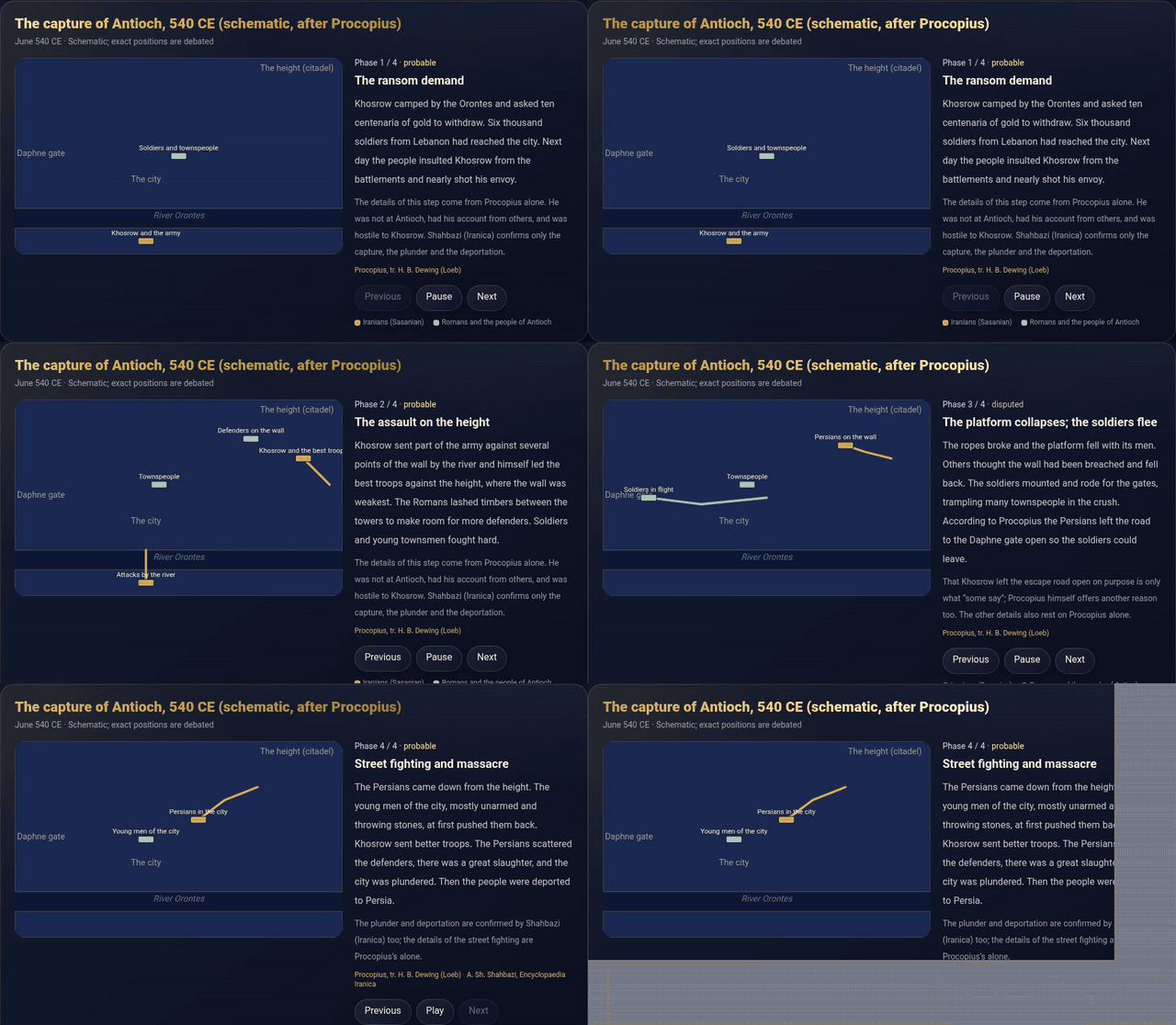
All the details of the battle come from Procopius, who was not there and was hostile to Khosrow. He quotes Khosrow’s words about mercy to captives and at once calls them lies. The diagram below follows his account and is schematic.
Citizens who did not pay the ransom lost their lives, their goods and their city. Yet in the new town a rule freed a runaway slave from his owner. The same king plundered people’s property and, to draw people to his town, gave some of them a privilege they did not have at home. This is our reading.
Sources: A. Sh. Shahbazi, Encyclopaedia Iranica · A. Sh. Shahbazi, Encyclopaedia Iranica · Procopius, tr. H. B. Dewing (Loeb)
Dossier · 4
The Lazic War
Lazica, on the eastern shore of the Black Sea (western Georgia today), was Persia’s road to that sea. In 541 the Lazi broke with Rome and called Khosrow in. He took the fortress of Petra. In the truce of 545 Lazica stayed Persian. In the fourth year of the truce Rome sent an army again, and a long war followed that lasted until the treaty of 562. In that treaty both sides gave up their gains.
The Romans, therefore, in terror, opened negotiations with the barbarians, and receiving from Chosroes pledges concerning their lives and their property, they surrendered to him both themselves and the city.
Shahbazi says the Persians were on the whole victorious and Rome paid 400 pounds of gold a year during the war. The main sources, Procopius and Agathias, are both Roman.
According to Procopius, at Petra Khosrow gave the Roman soldiers pledges for their lives and their property, and took nothing but the treasures of John, the Roman commander of the fort. A pledge that covered property too was rare in the wars of that age, and it is a striking contrast with the fate of Antioch.
Sources: A. Sh. Shahbazi, Encyclopaedia Iranica · A. Sh. Shahbazi, Encyclopaedia Iranica · Procopius, tr. H. B. Dewing (Loeb)
Dossier · 5
The Hephthalites, the Turks and Yemen
The Hephthalites had dominated eastern Iran for two generations; Peroz had died fighting them and Kavad had regained his throne with their help. Between 558 and 561 Khosrow allied with Sinjibu, khagan of the Turks, who had newly reached Central Asia. In a great battle near Bukhara the two powers crushed the Hephthalites and divided their lands along the Oxus. The Shahnameh calls the Hephthalite king Ghatfar and Ṭabari calls him Waraz. Soon afterwards the Turks themselves became Iran’s new eastern enemy.
Around 570 Sayf b. Ḏī Yazan asked for help to drive the Ethiopians out of Yemen. Khosrow hesitated, but sent 800 horsemen under Vahrez in eight ships. Two ships were lost. The force landed in Hadramaut, killed the Ethiopian king Masruq and took Sanaa. Sayf became a vassal king of Persia. After he was killed Vahrez returned with 4,000 men. Persian soldiers stayed in Yemen, and their sons by Arab mothers were called the Abnāʾ.
The date of the Hephthalites’ destruction is disputed: Bivar gives 558 to 561, while Shahbazi in one passage puts it after the treaty of 562. Accounts of the Yemen force differ too: in one it was made of prisoners; Rubin says it was recruited in Daylam, in the mountains of Gilan. Sayf’s story later became the core of a popular Arabic romance.
The alliance with the Turks removed an old enemy and made a new one. The Yemen expedition, Shahbazi says, threatened Rome’s sea trade. Wars are often fought over trade routes, but merchants and soldiers pay the price.
Sources: A. D. H. Bivar, Encyclopaedia Iranica · A. Sh. Shahbazi, Encyclopaedia Iranica · C. E. Bosworth, Encyclopaedia Iranica · Z. Rubin, Encyclopaedia Iranica
Dossier · 6
The Athenian philosophers and Gondēšāpur
After Justinian’s law of 529 barred non-Christian teachers, seven Neoplatonist philosophers, among them Damascius and Simplicius, came to Khosrow’s court. Agathias says they had heard Persia was the land of Plato’s “philosopher king”, but were disappointed and wanted to go home. Khosrow put a clause in the peace treaty that let them live out their lives at home in peace with their own beliefs.
Paul the Persian translated Aristotle’s logic for Khosrow and wrote in his preface that philosophy is superior to faith. John of Ephesus, who apologizes for praising a “Magian”, says Khosrow collected the religious books of all creeds to learn which were true. In this period Gondēšāpur was the scene of the revolt of Anōšazād, a son of Khosrow.
Chosroes has been praised and admired quite beyond his deserts not just by the Persians but even by some Romans.
Chosroes insisted on the inclusion of this point and made the ratification and continued observance of the truce conditional on its implementation.

Agathias openly opposes the praise of Khosrow: he says the king was admired “quite beyond his deserts” and his philosophy was superficial. He is a Christian Roman, and his verdict must be read with that in mind.
The story of a “university of Gondēšāpur” under Khosrow I comes from later sources. Richter-Bernburg (Iranica) calls Gondēšāpur’s fame in passing on Greek medicine “alleged”. The earliest testimony to medicine there dates from about 610, under Khosrow II, and its hospital is first mentioned in 765. So a great academy of Khosrow I at Gondēšāpur is an unproven claim.
Philosophers who fled their country for freedom of thought did not find it abroad either. Yet that same foreign king demanded, in a formal treaty, their freedom of conscience in their own land. Freedom of belief is freedom, even when an autocrat asks for it.
Sources: Agathias, tr. J. D. Frendo · A. Sh. Shahbazi, Encyclopaedia Iranica · L. Richter-Bernburg, Encyclopaedia Iranica
Dossier · 7
Borzuya and Kalila wa Dimna
Borzuya was a physician of the time of Khosrow I. In his preface to Kalila wa Dimna, which is his own, he says his father was a soldier and his mother came from a priestly family; he studied medicine and treated patients free, until doubts grew in him about religion and the conduct of religious leaders. He went to India and brought back the Pañcatantra and some other works to be put into Pahlavi; whether he made the translation himself or had another make it is unclear. Ibn al-Muqaffaʿ later translated it into Arabic, and from there Kalila wa Dimna reached many languages.

Khaleghi-Motlagh calls the attribution of Kalila to Bozorgmehr a “late Sasanian fabrication” and Christensen’s view that Borzuya and Bozorgmehr were one man baseless. Shahbazi says Borzuya’s preface, like Paul the Persian’s, shows reason placed above belief.
A book from India reached the world through Pahlavi and Arabic. Ideas know no borders unless someone closes them.
Sources: Dj. Khaleghi-Motlagh, Encyclopaedia Iranica · A. Sh. Shahbazi, Encyclopaedia Iranica
Dossier · 8
Chess
Chess grew out of old Indian board games. Its first certain mention in India dates from the 6th century, the time when it seems to have reached Iran. Three Pahlavi texts mention “chatrang”. Even so, Utas says, though it is probable chess was played in Iran at the end of the Sasanian period, the earliest certain evidence is from after the Islamic conquest. From Iran chess passed to the Arabs and then to Europe.

The Pahlavi text “Explanation of Chess” is set in Khosrow’s time, but Utas (Iranica) calls it “clearly legendary”. The mention of chess in the Kār-nāmag of Ardashir may also come from later editing.
A game that came from India passed with Persian names to the Arabs and from there to the world. A contest of wits instead of a contest on the battlefield may be this story’s best legacy.
Sources: B. Utas, Encyclopaedia Iranica
Dossier · 9
Justice: history and legend
The Arabic and Persian sources make Khosrow the model of justice and call him “the Just” (dādgar, ʿādel). In the Kār-nāmag of Anushirvan, which presents itself as his own account, justice is the act most pleasing to God and must apply alike to the weak and the mighty, the poor and the rich. The same text says Khosrow also weighed the customs of the Romans and Indians and adopted what was good.
We have not rejected anyone because they belonged to a different religion or people.
The Kār-nāmag comes from Khosrow’s court and is official praise. Nöldeke judged Khosrow “certainly one of the most efficient and best kings” the Iranians ever had. Yet the same king, according to Procopius, sacked Antioch and killed the plotters. Justice in the later sources is more an ideal of kingship than a record of one man’s life.
Justice that hangs on one king’s will leaves with him. The chain of justice is a legend, but its question is real: does the weakest person have a way to make power hear his complaint? The lasting answer to that question is a law the king himself stands under, not a bell the king may hear. This is our reading.
Sources: A. Sh. Shahbazi, Encyclopaedia Iranica · Nizam al-Mulk, tr. H. Darke · Nāme-ye Farhangestān (APLL)
Synthesis
Khosrow I rebuilt taxation on a land survey and fixed rates, reorganized the army with money pay, made peace with Rome and broke it, sacked Antioch, destroyed the Hephthalites with the Turks and brought Yemen under Persian rule.
Later tradition made him “Anushirvan the Just”: the king of the chain of justice, of chess and of Kalila. This page labels those stories as legend or tradition and keeps apart what contemporary sources, friendly or hostile, say.
Bibliography
- Z. Rubin, Encyclopaedia Iranica, Ḵosrow I ii. Reforms (2009). https://www.iranicaonline.org/articles/kosrow/kosrow-i-ii-reforms/
- A. Sh. Shahbazi, Encyclopaedia Iranica, Sasanian dynasty (2005). https://www.iranicaonline.org/articles/sasanian-dynasty/
- A. Sh. Shahbazi, Encyclopaedia Iranica, Byzantine-Iranian relations (1990). https://www.iranicaonline.org/articles/byzantine-iranian-relations/
- A. D. H. Bivar, Encyclopaedia Iranica, Hephthalites (2003). https://www.iranicaonline.org/articles/hephthalites/
- C. E. Bosworth, Encyclopaedia Iranica, Abnāʾ (1983). https://www.iranicaonline.org/articles/abna-term/
- L. Richter-Bernburg, Encyclopaedia Iranica, Gondēšāpur ii. History and medical school (2002). https://www.iranicaonline.org/articles/gondesapur/gondesapur-ii-history-and-medical-school/
- Dj. Khaleghi-Motlagh, Encyclopaedia Iranica, Borzūya (1989). https://www.iranicaonline.org/articles/borzuya-also-burzoe-a-physician-of-the-time-of-kosrow-i/
- B. Utas, Encyclopaedia Iranica, Chess i. The history of chess in Persia (1991). https://www.iranicaonline.org/articles/chess/chess-i-the-history-of-chess-in-persia/
- A. Sh. Shahbazi, Encyclopaedia Iranica, Hormozd IV (2004). https://www.iranicaonline.org/articles/hormozd-iv/
- Procopius, tr. H. B. Dewing (Loeb), History of the Wars 1.22–2.28 (1914). https://archive.org/details/procopius00procgoogProcopius was Belisarius’ secretary and hostile to Khosrow. He had his account of Antioch from others.
- Agathias, tr. J. D. Frendo, The Histories (CFHB 2A), book 2.28–2.31 (1975). https://archive.org/details/cfhb-11.1-nicetae-choniatae-historiaAgathias openly rejects the praise of Khosrow; his is the view of a Christian Roman.
- Nizam al-Mulk, tr. H. Darke, The Book of Government or Rules for Kings (Siyar al-muluk / Siyasat-nama), ch. 3 (1960). https://en.wikipedia.org/wiki/SiyasatnamaA mirror for princes of the 11th century, five hundred years after Khosrow.
- Nāme-ye Farhangestān (APLL), Consideration on the Story of Anūshiravān’s Chain of Justice in Persian Literature and Its Relation with Indian and Chinese Stories (n.d.). https://nf.apll.ir/article_253441_b87fe9216ebc4c8fa1f800aa60c21e78.pdf
All photos are from Wikimedia Commons; licence and author were checked on each file page.
Kavad I, his fatherHormizd IV, his sonBahram VI ChobinThe Sasanian dynasty