Featured dossier
Bahram Chobin: the general who saved Iran and took the crown
Bahram Chobin came from the Mehran family of Ray, one of the seven great houses. In 588–589 he crushed the Turkish and Hephthalite invasion in the east. Hormizd IV disgraced him and he rebelled. For a year he was king, the first from outside the Sasanian house. Then he was beaten by Khosrow II and a Roman army, took refuge with the Turks and was murdered. His story lived on in a Pahlavi romance that reached the Shahnameh.
- picked horsemen (reported)
- 12,000
- year of reign
- 1
- men with him in flight
- 4,000
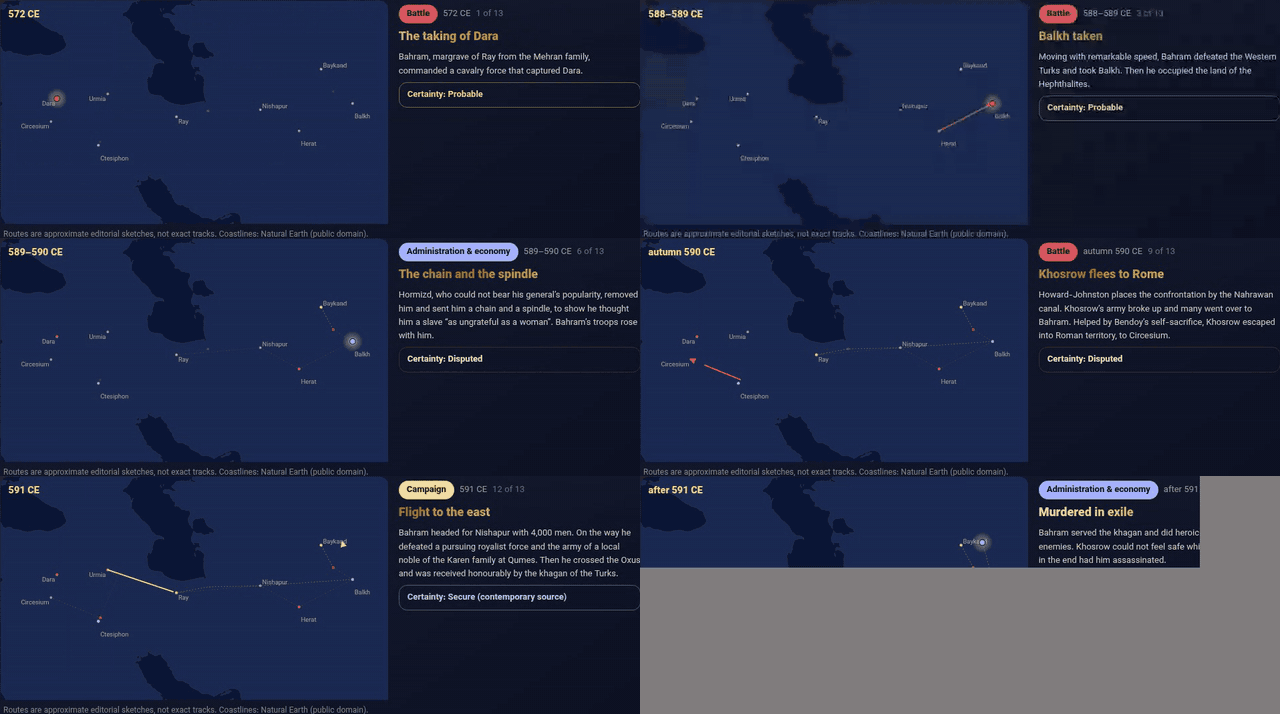
Map: the victory, revolt and flight of Bahram Chobin
Battle572 CE1 of 13
The taking of Dara
Bahram, margrave of Ray from the Mehran family, commanded a cavalry force that captured Dara.
Certainty: Probable
BattleCampaignBuildingAdministration & economyReligionArrow keys, Home/End and Space work.
Bahram Chobin, step by step (572–591 CE)
Bahram’s victories, revolt and flight as told by Iranica (Shahbazi, Howard-Johnston). The routes are schematic. The place of the final battle and the date of the coronation are disputed. A step-by-step diagram of the final battle is below the map.
Battle572 CE1 of 13
The taking of Dara
Bahram, margrave of Ray from the Mehran family, commanded a cavalry force that captured Dara.
Certainty: Probable
BattleCampaignBuildingAdministration & economyReligionArrow keys, Home/End and Space work.
The final battle of Bahram and Khosrow, 591 CE (schematic)
591 CE · Schematic; exact positions are debated
Phase 1 / 4 · probable
The armies gather
Khosrow came to Azarbaijan with 40,000 Roman troops. Over 12,000 Armenians under Mushel and 8,000 Iranians led by Bendoy and Bestam awaited him. Bahram left Ctesiphon with a much smaller army to arrive before they joined, but came too late.
The troop numbers come from the Chronicle of Seʿert and Sebeos, as cited by Shahbazi.
A. Sh. Shahbazi, Encyclopaedia Iranica
Bahram Chobin’s armyKhosrow II, Romans and Armenians
Three separate layers
Each section has three layers: “Historical evidence” is only what the sources say; “Philosophical interpretation” is our reading by the standard of property and liberty; “Modern cultural meaning”. Quotations come only from published translations, with references.
Historical evidencePhilosophical interpretationModern cultural meaning
Dossier · 1
Saving the east, 588–589
Late in 588, while the war with Rome went on, Hephthalites subject to the Western Turks invaded Khorasan and reached Badghis and Herat. The council of war made Bahram commander. He moved fast, defeated the Western Turks, took Balkh, crossed the Oxus and killed the Great Khagan of the Eastern Turks with his own arrow. Then he advanced to the Brazen Hold at Baykand near Bukhara.

Shahbazi says the Sasanian-based accounts must be corrected by Sebeos and by the work of Marquart and Czeglédy. The name “Saveh Shah” in the Shahnameh is wrong; Chinese records give the khagan another name. The 12,000 horsemen are a reported figure.
Bahram saved the land from invasion and was rewarded with disgrace. When a king drives out his greatest servants for fear of their popularity, no one sees their life or property as safe in his service.
Sources: A. Sh. Shahbazi, Encyclopaedia Iranica · A. Sh. Shahbazi, Encyclopaedia Iranica
Dossier · 2
A king from outside the Sasanian house
Bahram became king at Ctesiphon in 590 (at Nowruz 591, says Howard-Johnston). He claimed that Ardashir had usurped the Arsacid throne and that he was restoring the Arsacids’ right. He also used an apocalyptic belief: Zoroaster’s millennium was ending and a saviour, “Kay Bahram Varjavand”, was due. Many hailed him as that saviour. His coins are dated years 1 and 2.
Given time and opportunity to deal with internal problems, Bahrām would have probably achieved no less than Ardašīr I had done, but he was faced with too many odds.

Many nobles and priests chose the young Khosrow. Shahbazi gives several reasons for Bahram’s failure: the Roman army, the betrayal of his brother Gordoy, the capture of his family, the bureaucrats’ refusal to cooperate, the hostility of nobles unwilling to serve one of their equals, and his religious tolerance, which angered the priests. Khosrow answered with propaganda: he remitted half the year’s poll tax, gave riches to the fire temples and turned the prophecy round, so that Bahram became the “false pretender from Khorasan” and he himself “Parvez”, the victorious king.
The Sasanian crown rested on blood, not consent. Bahram showed that this basis could be challenged, but both sides sought legitimacy in lineage and prophecy, not in law or the people’s consent. Khosrow’s tax remission also shows that the tax burden was a tool in the contest for loyalty. This is our reading.
Sources: A. Sh. Shahbazi, Encyclopaedia Iranica · J. Howard-Johnston, Encyclopaedia Iranica
Dossier · 3
The final battle and flight
In return for territorial concessions, Khosrow obtained 40,000 Roman troops and came to Azarbaijan, where Mushel’s Armenians and the Iranians of Bendoy and Bestam awaited him. Bahram arrived too late with a smaller army. After three days of battle, Bendoy won his men over with promises of safety. Bahram fled east with 4,000 men, defeated a Karen army at Qumes and took refuge with the Turks. There he was murdered on Khosrow’s orders.
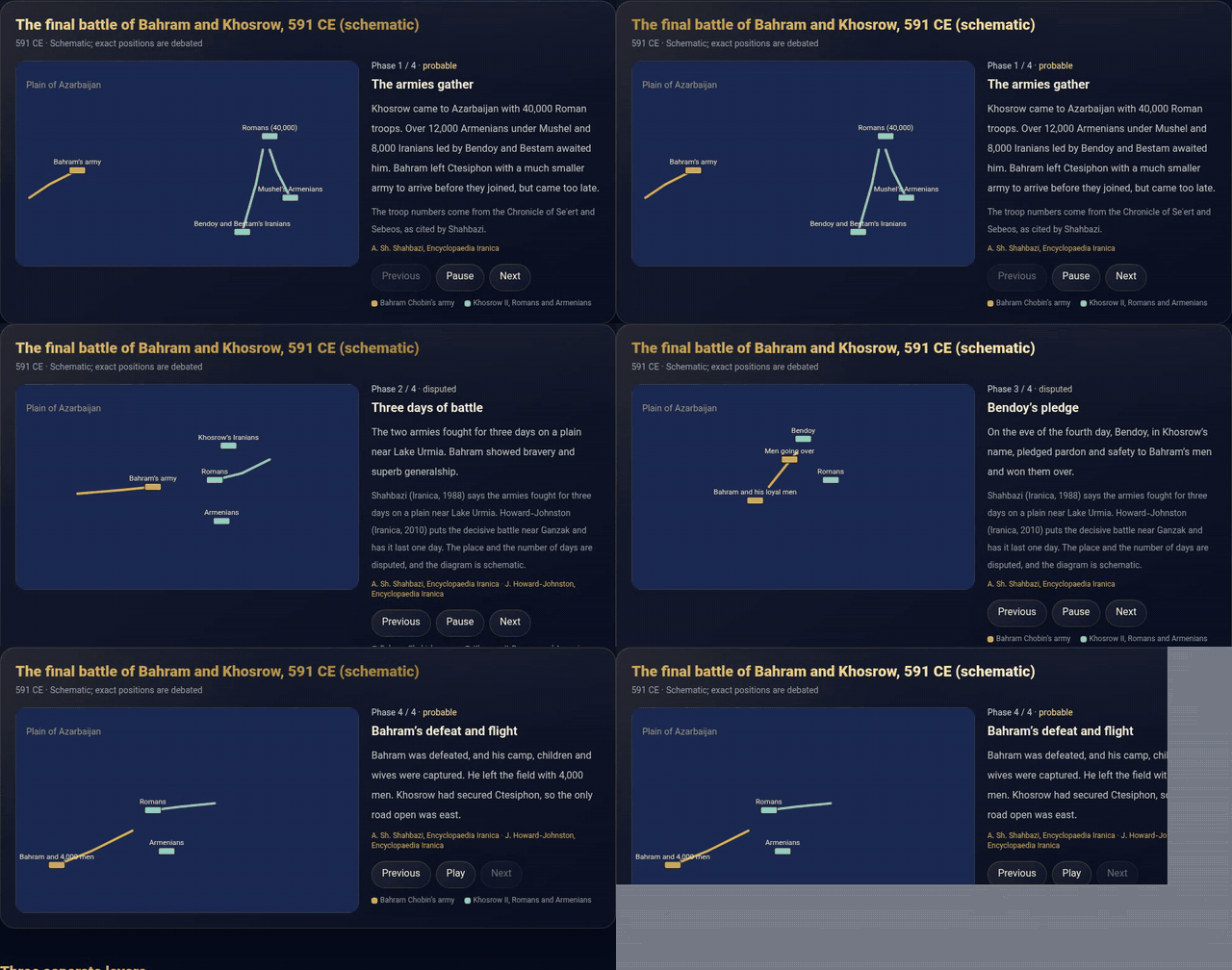
Shahbazi says it was not Khosrow but his superior Roman troops who defeated Bahram. The place and length of the battle are disputed: Howard-Johnston puts it near Ganzak and has it last one day. Bahram’s chivalry in letting Khosrow’s supporters leave unharmed turned against him.
The king of Iran won back his crown with a foreign army and at the price of territory. In a civil war between claimants, the people and the borders pay the bill.
Sources: A. Sh. Shahbazi, Encyclopaedia Iranica · J. Howard-Johnston, Encyclopaedia Iranica
Dossier · 4
The Bahram Chobin romance
Bahram’s memory lived on in a Pahlavi romance, the Bahrām Čōbīn-nāma. Jabala b. Sālem translated it into Arabic, and, mixed with another account favourable to Khosrow Parvez, it found its way into Dinavari, Ferdowsi, Balʿami and the Nehāyat al-arab. Arthur Christensen reconstructed its main form in 1907. Bahram was also credited with a manual on archery. The Samanids traced their descent to his son Noshrad.
The picture of Bahrām in the romance is that of an illustrious knight of kingly origins and noble disposition, a superb, highly educated and disciplinarian general, and a witty, just, and wise king.
The romance is literature, not a report. In it Bahram descends from the Arsacids and from Kay Arash. Shahbazi says it was written while Bahram’s memory was still alive, and its reflection in the Shahnameh counts as one of the masterpieces of Persian literature.
Two accounts of one man survived: the “lowly usurper” of Khosrow’s official history, and the “just hero” of the romance. A historian who reads only one has heard only the winner’s voice.
Synthesis
Bahram Chobin was the general who saved eastern Iran from the Turkish and Hephthalite invasion. Hormizd’s ingratitude drove him to revolt, and he was king for a year. The nobles, the priests and Khosrow’s Roman army defeated him, and he was murdered in exile. The official history called him a usurper and a Pahlavi romance made him a hero. The place of the final battle, the date of the coronation and the chain-and-spindle story are disputed.
Bibliography
- A. Sh. Shahbazi, Encyclopaedia Iranica, Bahrām VI Čōbīn (1988). https://www.iranicaonline.org/articles/bahram-the-name-of-six-sasanian-kings/bahram-vi/
- A. Sh. Shahbazi, Encyclopaedia Iranica, Hormozd IV (2004). https://www.iranicaonline.org/articles/hormozd-iv/
- J. Howard-Johnston, Encyclopaedia Iranica, Ḵosrow II (2010). https://www.iranicaonline.org/articles/khosrow-ii/
All photos are from Wikimedia Commons; licence and author were checked on each file page.
Hormizd IV, the king who disgraced himKhosrow IKhosrow II, his rivalThe Sasanian dynasty