Sasanians
Khosrow II Parviz
خسرو دوم (پرویز)
Epithets and titles
- ParvēzParvēzbyname (later or foreign)Source: J. Howard-Johnston, “Ḵosrow II”, Encyclopaedia Iranica
- Reign
- 590–628 CE
- Dynasty
- Sasanians
- Persian page
- فارسی
Featured dossier
Khosrow Parviz: to Egypt and Constantinople, and a sudden fall
Khosrow II, grandson of Khosrow Anushirvan, reigned for 38 years. He lost his throne and won it back with a Roman army. Ten years later he invaded Rome to avenge Maurice, took Syria, Jerusalem and Egypt, and reached the shore of the Bosporus. Then Heraclius struck into the heart of Iran. In the end his own people deposed and killed him. His story, with Shirin and his minstrel Barbad, lived on in Persian literature.
- years of reign
- 38
- Egypt taken
- 619
- days of the siege of Constantinople
- 10
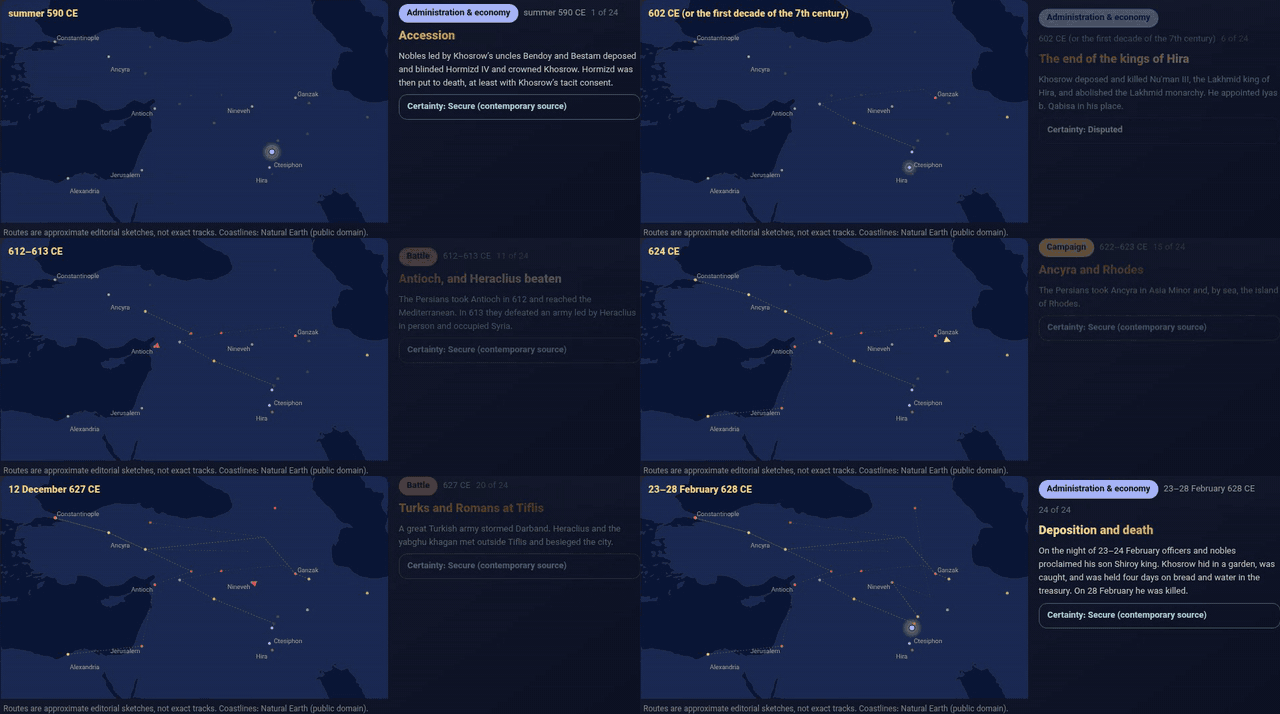
Animated map: from Circesium to Alexandria and Constantinople
Administration & economysummer 590 CE1 of 24
Accession
Nobles led by Khosrow’s uncles Bendoy and Bestam deposed and blinded Hormizd IV and crowned Khosrow. Hormizd was then put to death, at least with Khosrow’s tacit consent.
Certainty: Secure (contemporary source)
BattleCampaignBuildingAdministration & economyReligionArrow keys, Home/End and Space work.
Khosrow Parviz, step by step (590–628 CE)
The flight, the restoration and the great war of 603–628 as told by Howard-Johnston (Iranica). The routes are schematic. The events at Jerusalem, the date of Dhu Qar and the maker of Taq-e Bostan are disputed. A step-by-step diagram of Nineveh and Dastgerd is below the map.
Administration & economysummer 590 CE1 of 24
Accession
Nobles led by Khosrow’s uncles Bendoy and Bestam deposed and blinded Hormizd IV and crowned Khosrow. Hormizd was then put to death, at least with Khosrow’s tacit consent.
Certainty: Secure (contemporary source)
BattleCampaignBuildingAdministration & economyReligionArrow keys, Home/End and Space work.
Nineveh and Dastgerd, December 627 (schematic)
12 December 627 – 9 January 628 CE · Schematic; exact positions are debated
Phase 1 / 4 · probable
Shadowing
Heraclius crossed the Great Zab on 1 December, marched north and camped near Nineveh. Rahzad shadowed him from a distance, waiting for 3,000 guardsmen from the capital who had not arrived.
J. Howard-Johnston, Encyclopaedia Iranica
Rahzad’s armyHeraclius
Three separate layers
Each section has three layers: “Historical evidence” is only what the sources say; “Philosophical interpretation” is our reading by the standard of property and liberty; “Modern cultural meaning”. Quotations come only from published translations, with references.
Historical evidencePhilosophical interpretationModern cultural meaning
Dossier · 1
Flight to Rome and restoration
In 590 Bahram Chobin rebelled. Nobles led by Bendoy and Bestam, Khosrow’s uncles, deposed and blinded Hormizd IV and crowned Khosrow. Days later Bahram reached the Nahrawan and Khosrow fled to Rome. From Hierapolis he wrote to the Emperor Maurice, called himself his “son”, and in return for help gave up about half of Armenia and Iberia. In spring 591 the Roman army and his supporters beat Bahram near Ganzak.
He is a giant figure who towers over the Middle East in the last few decades before the coming of Islam.

Howard-Johnston says Khosrow’s part in his father’s blinding and death is unclear. The official version puts him in Azarbaijan at the time, to keep him clear of it. “Parviz” means “victorious”; the wings on his crown appeared after Ganzak. Five years later he had his uncles killed too.
The king won back his crown with a foreign army and at the price of territory. When power passes by “blood” and no law limits it, not even a father or an uncle is safe. This is our reading.
Sources: J. Howard-Johnston, Encyclopaedia Iranica · A. Sh. Shahbazi, Encyclopaedia Iranica
Dossier · 2
The great war of 603–628
In 602 Phocas killed Maurice. Khosrow went to war in the name of avenging him, with Maurice’s son Theodosius at his side. Dara fell in 604, Edessa in 609, Caesarea in 611 and Antioch in 612. In 614 Jerusalem was taken and the True Cross went to Ctesiphon. In 615 a Persian army stood facing Constantinople and the Roman Senate sued for peace. Khosrow refused. In 619 Egypt was taken. From 624 Heraclius struck into Azarbaijan and sacked Adur Gushnasp. In 626 the siege of Constantinople with the Avars failed, and Shahen’s army was destroyed.
Ḵosrow had gained far more than he could have dreamed of when he attacked in 603.


Howard-Johnston says that by 615 Khosrow had reached his declared war aim but chose to destroy Rome outright; perhaps so that all the settled lands would stand under one ruler against the Turks in the north and east. The Persian sources, the Shahnameh among them, almost ignore this war. The events at Jerusalem are disputed: Howard-Johnston speaks of an intervention “to stop a pogrom”, Christian accounts of a siege and a sack.
Twenty-four years of war were paid for by the taxpayers. Howard-Johnston says the military families complained of the losses and long years on distant fronts, the nobles of the king’s autocracy, the merchants of the blocking of trade, and everyone of rising taxes. Free trade and the security of property are the first victims of endless wars.
Dossier · 3
Nineveh and Dastgerd, 627–628
In 627 the Turks stormed Darband and Heraclius besieged Tiflis with the yabghu khagan. In autumn Heraclius turned south and crossed the Zagros from 16 October. On 12 December, near Nineveh, he defeated Rahzad’s army. On 23 December he crossed the Lesser Zab and Khosrow fled his palace at Dastgerd. On 9 January 200 elephants and the cut bridges of the Nahrawan kept him from the capital.
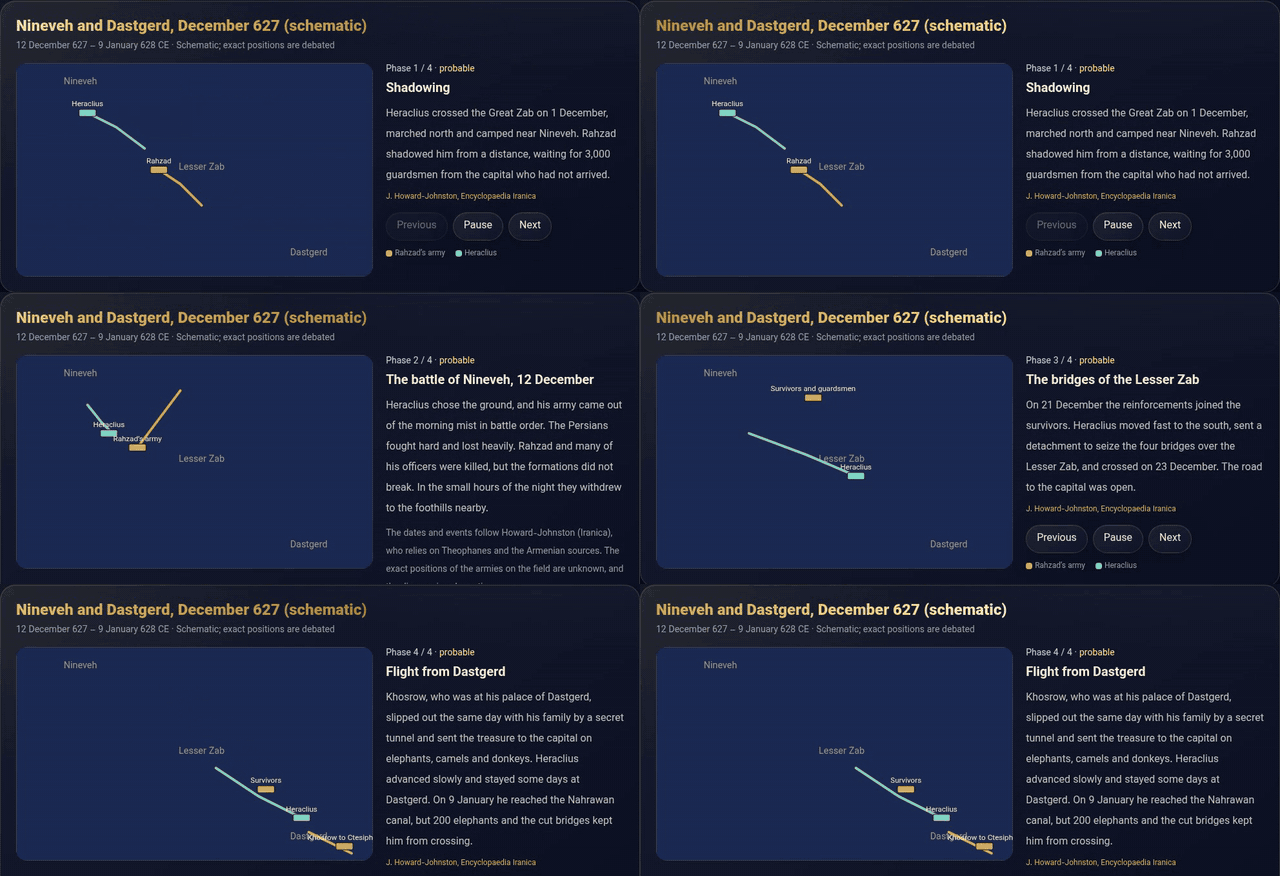
Howard-Johnston says Nineveh was decisive, but not because the Persian army was destroyed; its formations held. The real blow was political: from Dastgerd Heraclius offered peace “before the fire consumes everything”, Khosrow refused, and this deepened the rifts among the elite. The diagram below is schematic.
Khosrow fled Dastgerd but took his treasure with him. A king who leaves the land undefended and saves the treasure shows his subjects whom the state is for.
Dossier · 4
Nuʿman, Hira and Dhu Qar
From the third century the Lakhmid kings of Hira had guarded the Arab frontier for the Sasanians. In 602 Khosrow imprisoned and killed Nuʿman III and abolished the Lakhmid monarchy. Iyas b. Qabisa of the Tayyiʾ took his place. Some years later, near Kufa, a force of 2,000 Persians and 3,000 allied Arabs was beaten at Dhu Qar by the Bakr b. Waʾil (Shayban).
There are two Arab versions. In Abu ʿUbayda’s, Nuʿman refused Khosrow his daughter and died in prison. In Ibn al-Kalbi’s, which scholars prefer, the quarrel was over hostages and Qays b. Masʿud. The Persian sources are silent about Dhu Qar. The battle dates between 604 and 611, not 623/4 as tradition says, and its symbolic weight was inflated later. Howard-Johnston sees the abolition of the Lakhmids as a deliberate policy for the Roman war, not the result of a personal quarrel.
Khosrow replaced a living wall, allies who guarded the frontier for their own gain, with direct obedience. Thirty years later this unguarded frontier became the Arab armies’ road. Many scholars have seen this link, but its weight is hard to measure.
Sources: E. Landau-Tasseron, Encyclopaedia Iranica · al-Ṭabarī, tr. C. E. Bosworth · J. Howard-Johnston, Encyclopaedia Iranica
Dossier · 5
The large grotto of Taq-e Bostan
At Taq-e Bostan, near Kermanshah, a large vaulted hall was cut into the rock. On the back wall the king receives the ring of kingship between Ohrmazd and Anahita. Below stands an armoured horseman with lance and shield. On the side walls are two hunts: a boar hunt in the marshes, with the king in a boat, and a deer hunt in a royal park, left unfinished. Howard-Johnston says the work stopped suddenly when the tide of war turned, just as prepared surfaces at Bisotun and Naqsh-e Rostam stayed blank.
The rock cut monument at Ṭāq-e Bostān, the last attributable to the Sasanian period, is a magnificent expression of royal authority.


The maker is disputed. Most scholars attribute the grotto to Khosrow II. Some have argued for the reign of Peroz, and one for Khosrow I. The horseman’s identity is also unclear: perhaps the king himself, perhaps his fravashi or guardian spirit. Harper says it is not known whether all three parts were made at the same time.
The boar hunt shows clothes, textiles and gear in fine detail. It is a rare survival of craftsmen’s work, people whose names were lost but whose skill remains.
Sources: P. O. Harper, Encyclopaedia Iranica · J. Howard-Johnston, Encyclopaedia Iranica
Dossier · 6
Shirin
Shirin, a Christian woman from Khuzestan, was Khosrow’s most influential wife. She built a church and a monastery near the palace at Ctesiphon and obtained salaries for the clergy from the treasury. Khosrow credited St Sergius with her conceiving. Shirin made her son Mardanshah heir and pushed Shiroy, the son of another wife, out of the court.
Shirin’s origin is unclear: a Syriac chronicle calls her an Aramaean from near later Basra. The story of Maria, Maurice’s daughter and Khosrow’s Roman wife, Howard-Johnston calls false and Bosworth “very dubious”. Nezami later made Shirin an Armenian princess.
Shirin built churches with treasury money and turned the succession to her son. At an autocratic court, nearness to the king was the greatest capital. This contest over the succession later ended in the massacre of the brothers.
Sources: J. Howard-Johnston, Encyclopaedia Iranica · al-Ṭabarī, tr. C. E. Bosworth
Dossier · 7
Barbad
Barbad was the minstrel of Khosrow’s court. Most sources make him a native of Marv; a later tradition says Jahrom. The names of many of his tunes and melodies survive: by tradition, seven “Khosravani” modes, thirty airs (which Nezami names) and 360 melodies.
These numbers and names reach us through Islamic-era sources such as Nezami, written centuries after Barbad. No notation or sound of his survives.
Barbad sold his art in a market with a single buyer, the court. In such a market, reaching the king through one’s art, and getting past a rival, depended on luck and cunning.
Sources: A. Tafażżolī, Encyclopaedia Iranica
Dossier · 8
Deposition and death
The plot was begun by a retired general close to Shiroy. Twenty-two senior officers, two sons of Shahrbaraz and the son of a finance minister joined it. Envoys went to Heraclius at Shahrazur to make sure he would accept peace. On the night of 23–24 February 628 Shiroy was proclaimed king, the prisons were opened, and the palace guards went over. Khosrow hid in a garden and was taken without resistance. Shiroy was crowned on 25 February, had Mardanshah killed before his father’s eyes, and on 28 February had Khosrow killed too.
No one, it appears, was ready to fight for so discredited a šāhānšāh.
The Shahnameh blames Khosrow’s fall only on two disaffected magnates and leaves the Roman war out of the story. Howard-Johnston says this was deliberate. In the Khwaday-namag version Khosrow answers the charges one by one.
A king who ruled for 38 years fell in one night, and no one fought for him. Power built on fear and plunder has no support once the plunder runs out. All the gains of the war were handed back two years later.
Sources: J. Howard-Johnston, Encyclopaedia Iranica · N. Schindel, Encyclopaedia Iranica
Synthesis
Khosrow Parviz won back his crown with a Roman army and then brought Rome to the edge of destruction: he took Syria, Jerusalem and Egypt, and his army stood facing Constantinople. But in 615 he refused peace, and the failure of 626, Heraclius’ invasion and Nineveh brought him down. His own nobles deposed and killed him. Shirin and Barbad lived on in Persian literature. The events at Jerusalem, the date of Dhu Qar and the maker of Taq-e Bostan are disputed.
Bibliography
- J. Howard-Johnston, Encyclopaedia Iranica, Ḵosrow II (2010). https://www.iranicaonline.org/articles/khosrow-ii/
- A. Sh. Shahbazi, Encyclopaedia Iranica, Bahrām VI Čōbīn (1988). https://www.iranicaonline.org/articles/bahram-the-name-of-six-sasanian-kings/bahram-vi/
- P. O. Harper, Encyclopaedia Iranica, Art in Iran v. Sasanian art (1986). https://www.iranicaonline.org/articles/art-in-iran-v-sasanian/
- E. Landau-Tasseron, Encyclopaedia Iranica, Ḏū Qār (1996). https://www.iranicaonline.org/articles/du-qar/
- A. Tafażżolī, Encyclopaedia Iranica, Bārbad (1988). https://www.iranicaonline.org/articles/barbad-minstrel/
- N. Schindel, Encyclopaedia Iranica, Kawād II (2022). https://www.iranicaonline.org/articles/kawad-ii/
- al-Ṭabarī, tr. C. E. Bosworth, The History of al-Ṭabarī V: The Sāsānids, the Byzantines, the Lakhmids, and Yemen (Albany) (1999). https://archive.org/details/vol.-5.-the-sasanids-the-byzantines-the-lakhmids-and-yemen
All photos are from Wikimedia Commons; licence and author were checked on each file page.
Hormizd IV, his fatherBahram Chobin, his rivalKavad II, the son who overthrew himBoran, his daughterThe Sasanian dynasty