Sasanians
Bahram V (Bahram Gur)
بهرام پنجم (بهرام گور)
Epithets and titles
- Gōrgōrbyname (later or foreign)“Onager [hunter]”, from a famous onager huntSource: O. Klíma, “Bahrām V Gōr”, Encyclopaedia Iranica
- Reign
- 420–438 CE
- Dynasty
- Sasanians
- Persian page
- فارسی
Featured dossier
Bahram Gur: the king from Hira, the hunt and the legend
Bahram V, son of Yazdegerd I, grew up at the Arab court of Hira and took the crown from the nobles with an Arab army. In the east he won a great victory, and with Rome he made a treaty that gave Iran’s Christians freedom of religion. He is one of the most loved kings of Persian literature: the Shahnameh and Nizami’s Haft Peykar tell many stories of him. This page keeps history and legend apart.
- years of reign
- 18
- war with Rome
- 421
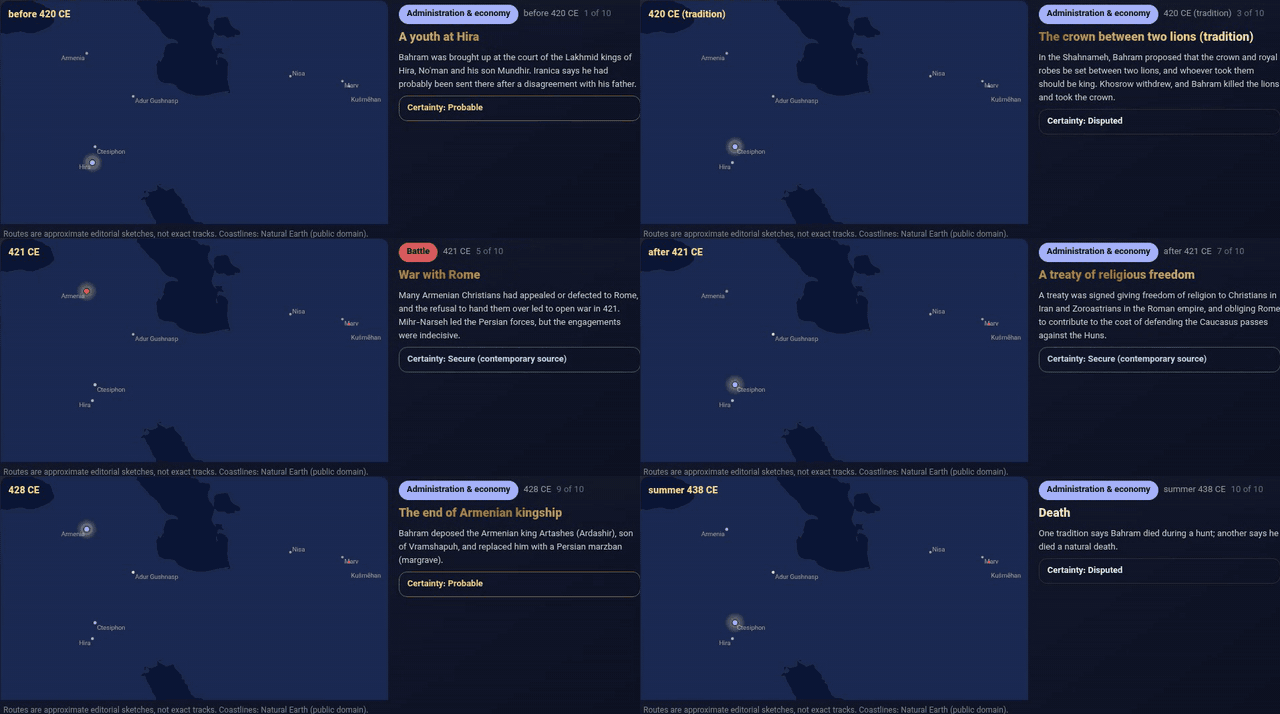
Animated map: from Hira to Kušmēhan
Administration & economybefore 420 CE1 of 10
A youth at Hira
Bahram was brought up at the court of the Lakhmid kings of Hira, Noʿman and his son Mundhir. Iranica says he had probably been sent there after a disagreement with his father.
Certainty: Probable
Sources: O. Klíma, Encyclopaedia Iranica, 1988 · C. E. Bosworth, Encyclopaedia Iranica, 2003
BattleCampaignBuildingAdministration & economyReligionArrow keys, Home/End and Space work.
From Hira to Marv and Armenia, step by step (420–438 CE)
Bahram V’s reign as told by Iranica and Procopius. Steps that come from the Shahnameh are marked as tradition. The step-by-step diagram of the eastern campaign is below the map.
Administration & economybefore 420 CE1 of 10
A youth at Hira
Bahram was brought up at the court of the Lakhmid kings of Hira, Noʿman and his son Mundhir. Iranica says he had probably been sent there after a disagreement with his father.
Certainty: Probable
Sources: O. Klíma, Encyclopaedia Iranica, 1988 · C. E. Bosworth, Encyclopaedia Iranica, 2003
BattleCampaignBuildingAdministration & economyReligionArrow keys, Home/End and Space work.
The eastern campaign: Nisa, Marv, Kušmēhan (schematic)
soon after 420 CE · Schematic; exact positions are debated
Phase 1 / 4 · secure
Narseh stays as regent
An enemy had invaded eastern Iran. Bahram left his brother Narseh as regent and set out with the army.
The route Nisa, Marv, Kušmēhan is from Iranica (Klíma); army positions are editorial and schematic. North is at the top.
O. Klíma, Encyclopaedia Iranica
Iranians (Sasanian)Eastern invaders (Huns?)
Three separate layers
Each section has three layers: “Historical evidence” is only what the sources say; “Philosophical interpretation” is our reading by the standard of property and liberty; “Modern cultural meaning”. Quotations come only from published translations, with references.
Historical evidencePhilosophical interpretationModern cultural meaning
Dossier · 1
A youth at Hira
Bahram’s mother was said to be Shushandukht, daughter of the Jewish exilarch. Bahram grew up at the court of the Lakhmid kings of Hira, Noʿman and his son Mundhir. Iranica (Bosworth) says Hira was a meeting point of three cultures: Sasanian Persia, Nestorian Christianity and Arabian paganism.
Klíma says Bahram had “probably” been sent to Hira after a disagreement with his father. The Shushandukht story is “was said to”. That Bahram reached the throne with Arab help shows how close the Lakhmid–Sasanian bond was.
Bahram grew up where several faiths and languages lived side by side. Perhaps the religious-freedom treaty after the war of 421 was not unrelated to that experience; this is our reading, not a report of the sources.
Sources: O. Klíma, Encyclopaedia Iranica · C. E. Bosworth, Encyclopaedia Iranica · A. Sh. Shahbazi, Encyclopaedia Iranica
Dossier · 2
The crown from the nobles: history and the lions legend
History (Klíma): the nobles meant to keep Yazdegerd’s sons from the throne. They killed Shapur, the eldest, and made Khosrow king. Bahram came to Ctesiphon with Mundhir’s army. The nobles negotiated and accepted him, on condition that he right his father’s misrule. He left the administration to his father’s officials, above all Mihr-Narseh, the grand minister.

The lions story appears in the Shahnameh and other Sasanian-based sources. Iranica calls it “Persian tradition”. Mundhir’s army was Bahram’s real backing; the lions story tells the same victory in the language of divine favour.
The nobles accepted Bahram on a condition: to right his father’s misrule. This is the nearest thing to a “contract” between ruler and elite in this period. But the people were not a party to it; the pact was between the king and the nobles.
Sources: O. Klíma, Encyclopaedia Iranica · A. Sh. Shahbazi, Encyclopaedia Iranica
Dossier · 3
The eastern war: Hephthalites or Kidarites?
Soon after his accession an enemy invaded eastern Iran. Bahram left Narseh as regent, went from Nisa via Marv to Kušmēhan, fell upon the enemy and won. From the booty he made offerings to the fire temple of Adur Gushnasp, and made Narseh governor of Khorasan.
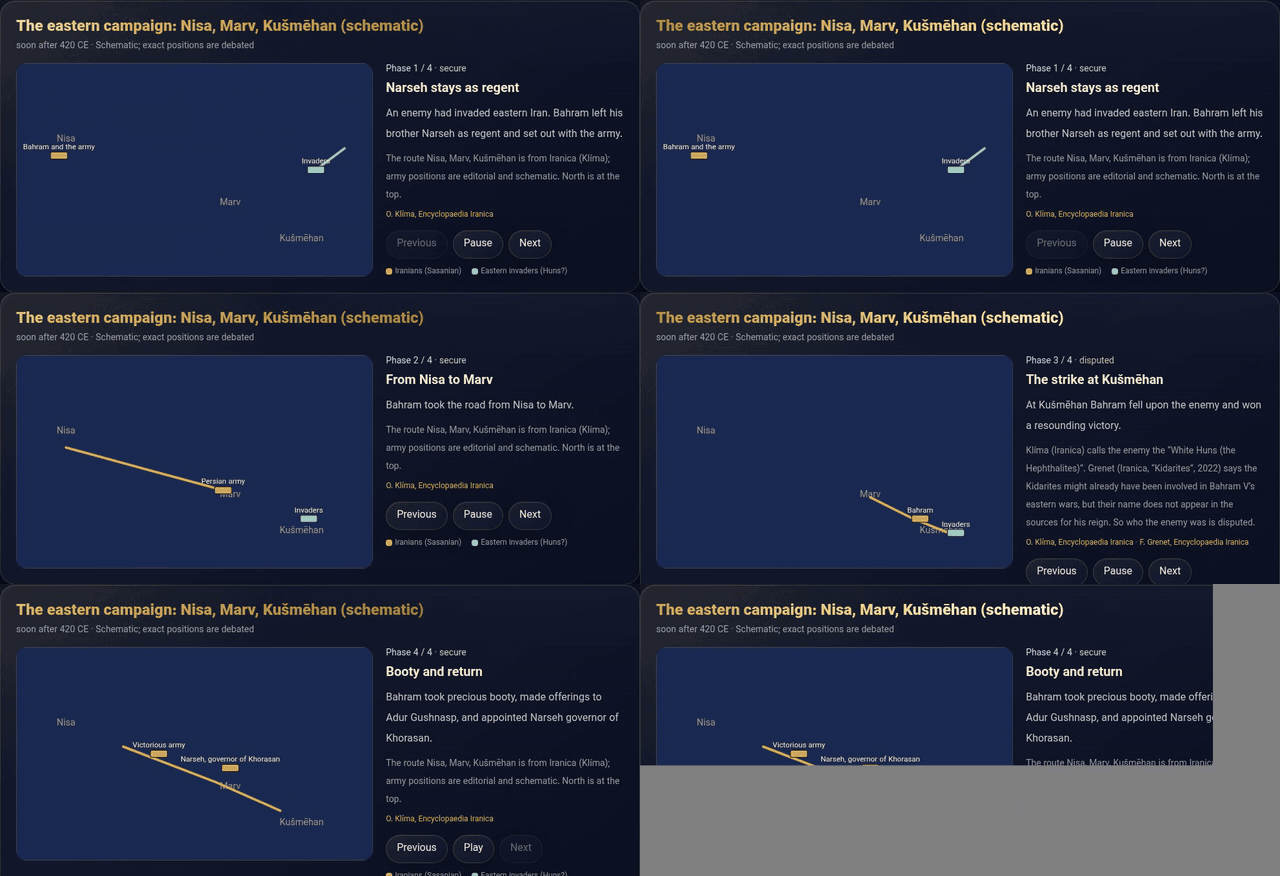

Klíma (1988) calls the enemy the “White Huns (the Hephthalites)”. Grenet (2022) is more careful: the Kidarites “might have been already involved” in Bahram’s eastern wars, “but their name does not appear” in the sources for his reign. So the enemy’s name is disputed; this page calls them “eastern invaders”.
The war booty went to a fire temple, not to those in the east whose homes and goods were lost in the invasion. The victory was defensive, but its wealth was shared between the king and the faith.
Sources: O. Klíma, Encyclopaedia Iranica · F. Grenet, Encyclopaedia Iranica
Dossier · 4
The war of 421 and the treaty of religious freedom
Many Armenian Christians had appealed or defected to Rome, and the refusal to hand them over led to war in 421. Mihr-Narseh commanded the Persian army, but the engagements were indecisive. A treaty followed: Christians in Iran and Zoroastrians in Rome had freedom of religion, and Rome contributed to defending the Caucasus passes against the Huns. Bahram then deposed the Armenian king and appointed a Persian marzban.
as he approached the Median army, solitary as he was, he leapt down from his horse, and advanced on foot toward Vararanes
one condition, however, he added, that neither party should construct any new fortification in his own territory in the neighbourhood of the boundary line between the two countries
Procopius has another story: the Roman general Anatolius walked on foot to Bahram, and Bahram, struck by the respect, turned back and granted peace. Dewing dates this to 441, when the Persian king was Yazdegerd II; so the date and king of the story are disputed.
A treaty guaranteeing religious freedom on both sides is rare in the ancient world. But this freedom was agreed by two states for each other’s minorities; it was not yet an individual right, but a concession in a bargain between two powers.
Sources: O. Klíma, Encyclopaedia Iranica · Procopius, tr. H. B. Dewing (Loeb)
Dossier · 5
Bahram Gur in literature: the Shahnameh and the Haft Peykar
Iranica (Klíma) says Bahram remitted taxes and debts at festivals, raised musicians in rank and brought thousands of Indian minstrels (luris) into Iran. He loved hunting; his name Gōr, “onager”, is said to come from his shooting of a wondrous wild ass. These made him one of the most popular kings in Iranian history. No monument of his survives.


Nizami’s Haft Peykar (late 12th century, c. 1197) is a romanticized biography of Bahram. According to de Blois (Iranica), Nizami, as often happens, mislocates Hira in Yemen. The seven domes and seven princesses, the shepherd and his dog, and Bahram’s vanishing into a cave are all story. De Blois says the book’s message is justice: Bahram becomes a true hero only by leaving the pleasures of the domes and hearing the complaints of the victims of tyranny.
In the Haft Peykar an evil minister empties the treasury, and the king restores justice only by hearing seven victims of tyranny. The 12th-century poet says what we know today: a ruler busy with pleasure leaves the people’s property in the hands of his officials.
Sources: O. Klíma, Encyclopaedia Iranica · F. de Blois, Encyclopaedia Iranica
Synthesis
Bahram Gur has two lives. In history he was a prince raised at Hira who took the crown from the nobles with an Arab army, won in the east, and made a treaty with Rome that accepted religious freedom on both sides. In literature he is the onager hunter, the lover of seven princesses and a king who in the end chooses justice.
His historical sources are few and mostly later. Wherever the Shahnameh or the Haft Peykar speaks, this page calls it tradition.
Bibliography
- O. Klíma, Encyclopaedia Iranica, Bahrām V Gōr (1988). https://www.iranicaonline.org/articles/bahram-the-name-of-six-sasanian-kings/bahram-v/
- A. Sh. Shahbazi, Encyclopaedia Iranica, Yazdegerd I (2003). https://www.iranicaonline.org/articles/yazdegerd-i/
- C. E. Bosworth, Encyclopaedia Iranica, Ḥira (2003). https://www.iranicaonline.org/articles/hira/
- F. Grenet, Encyclopaedia Iranica, Kidarites (2022). https://www.iranicaonline.org/articles/kidarites/
- F. de Blois, Encyclopaedia Iranica, Haft Peykar (2002). https://www.iranicaonline.org/articles/haft-peykar/
- Procopius, tr. H. B. Dewing (Loeb), History of the Wars 1.2–1.18 (1914). https://archive.org/details/procopius00procgoog
All photos are from Wikimedia Commons; licence and author were checked on each file page.
Yazdegerd I, his fatherYazdegerd II, his successorThe Sasanian dynasty