Achaemenids
Darius II (Ochus, “Nothos”)
داریوش دوم
Epithets and titles
- Nothos (the Bastard)Nóthosbyname (later or foreign)because he was Artaxerxes I’s son by a Babylonian concubine, not by the queenSource: Manetho fr. 70, tr. W. G. Waddell (note on P. Baden 4 no. 59); R. Schmitt, “Artaxerxes I”, Encyclopaedia Iranica
- Reign
- 423–405/404 BCE
- Dynasty
- Achaemenids
- Persian page
- فارسی
Featured dossier
Darius II: the King’s money and the end of the Peloponnesian War
Artaxerxes I’s son by a Babylonian woman, who came from Hyrcania, put his half-brother to death in ashes and ruled a rebellious empire for nineteen years. Through treaties that called the lands of Asia “the King’s country”, he paid for Sparta’s fleet and defeated Athens. The Murašû tablets in Babylonia and the Elephantine papyri in Egypt show land, credit, petitions and religious freedom up close. Follow his life in order and the Ionian War on the animated map, with evidence, interpretation and modern meaning in three separate layers.
- years of reign (Babylonian documents)
- 19
- treaties with Sparta (412–411)
- 3
- recorded revolts
- 6+
- a sailor’s daily pay on Cyrus’ money
- 4 obols
Animated map: the life of Darius II
Administration & economybefore 424 BCE1 of 17
Ochus, satrap of Hyrcania
Ochus, Artaxerxes I’s son by Cosmartidene, a Babylonian woman, was satrap of Hyrcania and married his half-sister Parysatis, Artaxerxes’ daughter by another Babylonian woman (Ctesias).
Certainty: Probable
Sources: Ctesias of Cnidus (via Photius’ epitome), c. 390 BCE; tr. J. H. Freese 1920 · H. Sancisi-Weerdenburg, Encyclopaedia Iranica, 1994
BattleCampaignBuildingAdministration & economyReligionArrow keys, Home/End and Space work.
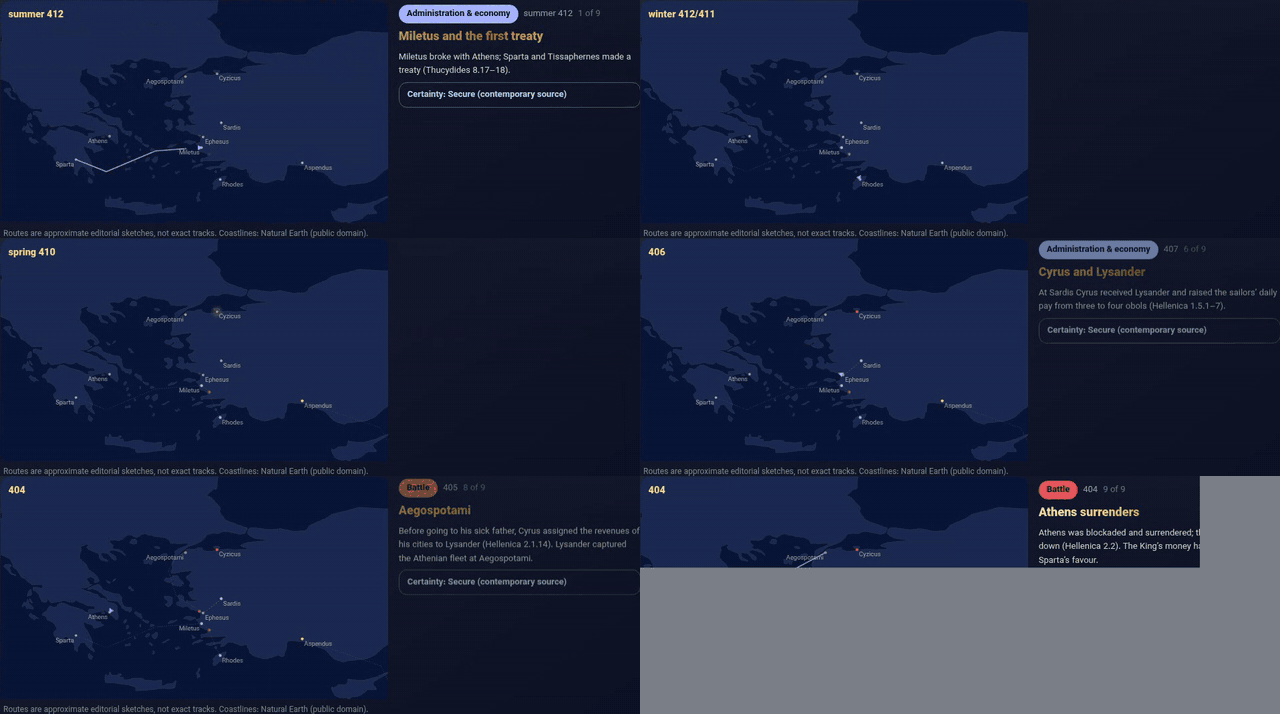
The Ionian War on the King’s money, step by step (412–404 BCE)
From the treaty of Miletus to the surrender of Athens. The dashed blue line is the fleet’s track. Each step says whether it is secure, probable or disputed. The sources, Thucydides and Xenophon, are both Greek.
Administration & economysummer 4121 of 9
Miletus and the first treaty
Miletus broke with Athens; Sparta and Tissaphernes made a treaty (Thucydides 8.17–18).
Certainty: Secure (contemporary source)
Sources: Thucydides, tr. R. Crawley, 1874
BattleCampaignBuildingAdministration & economyReligionFleet trackArrow keys, Home/End and Space work.
Three separate layers
Each section has three layers: “Historical evidence” is only what the sources say; “Philosophical interpretation” is our reading by the standard of property and liberty; “Modern cultural meaning”. Quotations come only from published translations, with references.
Historical evidencePhilosophical interpretationModern cultural meaning
Dossier · 1
A life in order
Ochus was Artaxerxes I’s son by a Babylonian woman and satrap of Hyrcania. In the winter of 424/423, after his father’s death and the killing of Xerxes II, he defeated Sogdianus with the backing of the cavalry and the satraps and took the name Darius. The Babylonian documents count him king from early 423.
His reign was full of revolts: Arsites, Pissouthnes, Amorges, Terituchmes, Media and the Cadusians. From 412, with his money and through Tissaphernes and then Cyrus the Younger, he made Sparta the winner of its war with Athens. In Egypt the destruction of the Elephantine temple (410) signalled unrest that ended in secession after his death. He died at Babylon in 405/404.

Ctesias shows Darius II as a weak king in Parysatis’ hands. Iranica warns that this picture comes above all from our dependence on Greek sources.
A government should be judged by its own documents, contracts and letters, not only by its rivals’ stories.
Sources: Ctesias of Cnidus (via Photius’ epitome) · M. W. Stolper · Thucydides, tr. R. Crawley · Xenophon, tr. H. G. Dakyns · A. E. Cowley · H. Sancisi-Weerdenburg, Encyclopaedia Iranica
Dossier · 2
Name and epithet: Ochus, Darius, “Nothos”
His personal name is Ochus in the Greek sources and Umakuš in Babylonian; the Old Persian form may have been *Vauka (Schmitt). Darius was a throne name. The Greeks called him Nothos, “the Bastard”, because his mother was not the queen; Iranica notes that the epithet appears late, in Pausanias (6.5.7).
“Bastard” is a Greek moral verdict based on Greek marriage rules; at the Achaemenid court a son of a non-queen could also become king.
The labels others pin on rulers often reveal the labellers’ values more than the facts.
Sources: H. Sancisi-Weerdenburg, Encyclopaedia Iranica · M. W. Stolper
Dossier · 3
Parysatis: queen and landholder
Parysatis, Darius’ half-sister and wife, was the mother of Artaxerxes II and Cyrus the Younger. The Greek sources show a cruel schemer. But the Murašû tablets show her owning large estates in Babylonia whose land her stewards leased out; Iranica notes that discussions of her “pernicious influence” take little account of her wealth and landholdings.
Parysatis’ power was not only in the harem; it rested on independent property and income. Court women’s property rights underpinned their political role.
Economic independence is a precondition of political independence, for women too.
Sources: M. W. Stolper · H. Sancisi-Weerdenburg, Encyclopaedia Iranica · Ctesias of Cnidus (via Photius’ epitome) · Plutarch, tr. B. Perrin
Dossier · 4
The Murašû archive: service land, leases and loans
The Murašû family at Nippur leased service land, granted to groups (ḫatru) in return for military service and taxes, supplied water, seed and oxen, and paid the holders’ dues. Stolper showed that mortgages on such land rose in Darius II’s second year, and that names of Darius’ supporters given by Ctesias appear in these tablets.
Service land was not full property: the holder could not sell it, but could lease and pledge it. When war costs rose, this limited right led to debt and the loss of land.
Where ownership is conditional on service to the state, every political crisis becomes a smallholders’ debt crisis.
Sources: M. W. Stolper · H. Sancisi-Weerdenburg, Encyclopaedia Iranica
Dossier · 5
Revolts: Arsites, Pissouthnes, Amorges and others
Ctesias records the revolt of Arsites, the king’s full brother, with Artyphius son of Megabyzus; the revolt of Pissouthnes at Sardis, put down by Tissaphernes by buying off his mercenaries; a coup attempt by the eunuch Artoxares; and the affair of Terituchmes, the king’s son-in-law. Amorges, son of Pissouthnes, held out in Caria with Athenian support until he was captured at Iasos in 412. Xenophon adds a Median revolt (409/408). Iranica sees many of these as the work of satraps whose families had ruled one region for generations.
Satrapies had become hereditary: satraps had their own mercenaries and revenues. The king held the empire with money, promises of safety (often broken) and by setting satraps against each other.
When a government repeatedly breaks its word, no settlement lasts and every revolt is fought to the death.
Sources: Ctesias of Cnidus (via Photius’ epitome) · Thucydides, tr. R. Crawley · Xenophon, tr. H. G. Dakyns · H. Sancisi-Weerdenburg, Encyclopaedia Iranica · D. M. Lewis
Dossier · 6
The Ionian War: the treaties with Sparta
In 412 three treaties were made between Sparta and the King, all quoted by Thucydides (8.18, 8.37, 8.58). The King paid for the fleet and Sparta conceded him the Greek cities of Asia. Before that a “Peace of Epilycus” (424/423) may have been made between Athens and Darius (Andocides 3.29), broken when Athens backed Amorges. In 408/407 the embassy of Boeotius went to Susa.
The country of the King in Asia shall be the King’s, and the King shall treat his own country as he pleases.
Whatever country or cities the King has, or the King’s ancestors had, shall be the king’s
In the third treaty the lands of Asia are “the King’s country”, which he may treat “as he pleases”: the most exact statement of the idea that the country is the king’s private estate. The Greek cities, which had paid tribute to Athens, now paid it to the King; their freedom was sold in a deal between two powers.
A treaty that moves peoples between powers like property is not a peace but a division of spoils.
Sources: Thucydides, tr. R. Crawley · Xenophon, tr. H. G. Dakyns · D. M. Lewis · P. Briant
Dossier · 7
Cyrus the Younger and the King’s money
In 408/407 Darius made his younger son Cyrus, still a youth, commander of the western forces. Cyrus befriended the Spartan Lysander, raised the sailors’ pay and, before going to his sick father, assigned him the revenues of his cities. The fleet built with this money beat Athens at Aegospotami (405).
The King’s money, not his soldiers’ spears, ended the Peloponnesian War. But the same Spartan connection gave Cyrus the base for his later revolt.
A power that buys influence abroad with money also breeds a rival at home who controls that money.
Sources: Xenophon, tr. H. G. Dakyns · Xenophon, tr. H. G. Dakyns · D. M. Lewis
Dossier · 8
Elephantine: Passover, temple and petition
The Jewish and Aramaean garrison on Elephantine island at Egypt’s southern border left archives of contracts, dowries, house sales and lawsuits in Aramaic. In Darius’ year 5 (419/418) the “Passover letter” reports a royal order to Arsames concerning the festival of unleavened bread. In 410 the priests of Khnum, with Vidranga’s connivance, destroyed the temple of Yahu. In 407 the community petitioned the governor of Judah and received an answer recommending rebuilding with meal-offering and incense (not burnt sacrifice).

These documents show that a religious minority in the empire could own property, make contracts, litigate and appeal to higher officials. The temple’s destruction also shows that this protection depended on local officials and failed when the satrap was away.
Property rights and religious freedom that depend only on a local official’s goodwill are fragile; courts and general rules are needed.
Sources: A. E. Cowley · B. Porten et al. · E. Bresciani, Encyclopaedia Iranica
Dossier · 9
The beginning of the loss of Egypt
Iranica notes signs of trouble in Egypt in 410, the prelude to a successful revolt in 404. Amyrtaeus of Sais, the only king of Manetho’s 28th dynasty, broke Egypt away from the end of Darius’ reign or the beginning of Artaxerxes II’s; a papyrus from Elephantine is dated “year 5 of Amyrtaeus”.

Egypt was the richest satrapy; its loss showed that tribute taken by force stops at the centre’s first weakness.
Loyalty not built on mutual benefit does not last even by force.
Sources: H. Sancisi-Weerdenburg, Encyclopaedia Iranica · Manetho, tr. W. G. Waddell · E. Bresciani, Encyclopaedia Iranica · P. Briant
Dossier · 10
Buildings and tomb
All of Darius II’s inscriptions concern building: he built at Susa (D2Sa, D2Sb, both fragmentary). One of the three uninscribed tombs at Naqsh-e Rostam is ascribed to him; he was the last Achaemenid buried there (Iranica).
Few inscriptions are not necessarily a sign of weakness; mostly they show how little Iranian evidence survives for this reign.
Absence of evidence is not evidence of absence; the historian must say what is not known.
Dossier · 11
Death and succession
In his illness Darius summoned his two sons (Xenophon, Anabasis 1.1.1–2). The elder, Arsaces, became Artaxerxes II. Parysatis thought Cyrus, “born in the purple”, more fit; the quarrel led to Cyrus’ revolt and Cunaxa (401).
Once again a succession without a rule: one king, two sons, a mother with a preference, and a mercenary army in Asia Minor.
Institutions that leave the transfer of power to personal choice bequeath civil war.
Sources: Xenophon, tr. H. G. Dakyns · R. Schmitt, Encyclopaedia Iranica · Plutarch, tr. B. Perrin
Synthesis: a king who won with money
Darius II began with a succession war, ruled through repeated revolts and won, with money rather than campaigns, the Achaemenids’ greatest diplomatic victory in the west: the Greek cities of Asia became “the King’s country” again.
Through the lens of property rights his reign has two faces. In the treaties, the country is the king’s private estate. Yet in the archives of Nippur and Elephantine ordinary people, from Babylonian smallholders to Jewish soldiers, lease land, borrow, sell houses and write petitions. The security of those rights depended on local rules and officials, and where these failed, so did the rights.
Bibliography
- Ctesias of Cnidus (via Photius’ epitome), Persica, §§ 44–64 (c. 390 BCE; tr. J. H. Freese 1920). A Greek physician at the court of Artaxerxes II; full of court romance and unreliable, but almost the only source for the successions of 424–423.
- Thucydides, tr. R. Crawley, History of the Peloponnesian War, book 8 (1874). Contemporary and Athenian; preserves the texts of the three Sparta–King treaties.
- Xenophon, tr. H. G. Dakyns, Hellenica (1890–1897). https://www.gutenberg.org/ebooks/1174
- Xenophon, tr. H. G. Dakyns, Anabasis (1890–1897). https://www.gutenberg.org/ebooks/1170An eyewitness, but a Greek mercenary and a partisan of Cyrus the Younger.
- Plutarch, tr. B. Perrin, Life of Artaxerxes (Loeb) (1926). A 2nd-century CE moral biography built on Ctesias, Dinon and Xenophon.
- A. E. Cowley, Aramaic Papyri of the Fifth Century B.C. (nos. 21, 30–33) (1923).
- B. Porten et al., The Elephantine Papyri in English (1996). The standard translation of the Aramaic Elephantine documents.
- E. Bresciani, Encyclopaedia Iranica, Elephantine (1998). https://www.iranicaonline.org/articles/elephantine/
- M. W. Stolper, Entrepreneurs and Empire: The Murašû Archive, the Murašû Firm, and Persian Rule in Babylonia (1985).
- M. W. Stolper, The death of Artaxerxes I, Archäologische Mitteilungen aus Iran 16 (1983).
- Manetho, tr. W. G. Waddell, Manetho (Loeb), frr. 72–75 (1940).
- H. Sancisi-Weerdenburg, Encyclopaedia Iranica, Darius iv. Darius II (1994). https://www.iranicaonline.org/articles/darius-iv/
- R. Schmitt, Encyclopaedia Iranica, Artaxerxes II (1986). https://www.iranicaonline.org/articles/artaxerxes-ii/
- D. M. Lewis, Sparta and Persia (1977).
- P. Briant, From Cyrus to Alexander: A History of the Persian Empire (2002).
- A. Kuhrt, The Persian Empire: A Corpus of Sources from the Achaemenid Period (2007).
All photos are from Wikimedia Commons; licence and author were checked on each file page.
Artaxerxes I, his fatherSogdianusArtaxerxes II, his sonThe Achaemenid dynasty