Achaemenids
Artaxerxes II (“Mnemon”)
اردشیر دوم
Epithets and titles
- Mnemon (the Mindful)Mnḗmōn / Memorbyname (later or foreign)“Mindful”; first attested in PlutarchSource: Plutarch, Artaxerxes 1.1, tr. B. Perrin; Encyclopaedia Iranica, “Artaxerxes II”
- Reign
- 405/404–359/358 BCE
- Dynasty
- Achaemenids
- Persian page
- فارسی
Featured dossier
Artaxerxes II: Cunaxa, the King’s Peace and the longest Achaemenid reign
The elder son of Darius II, whose brother Cyrus the Younger marched against him with ten thousand Greek mercenaries and fell at Cunaxa. With money and a fleet he beat Sparta at Cnidus and, through the King’s Peace, took back the Greek cities of Asia; but he lost Egypt and faced the Satraps’ Revolt. He reigned 46 years. Follow Cyrus’ march and the retreat of the Ten Thousand on the animated map, with evidence, interpretation and modern meaning in three separate layers.
- years of reign (Babylonian documents)
- 46
- Greek mercenaries with Cyrus
- 10,000
- the King’s Peace
- 387/386
- failed campaigns to Egypt
- 2
Animated map: the life of Artaxerxes II
Administration & economy405/404 BCE1 of 14
Coronation at Pasargadae and Cyrus’ plot
Arsaces, the elder son of Darius II and Parysatis, became king as Artaxerxes by his father’s wish. Cyrus the Younger plotted against him at the coronation at Pasargadae; the plot failed, but at Parysatis’ request he was pardoned and sent back to his satrapy.
Certainty: ProbableThe plot story comes from Ctesias and Plutarch; Xenophon only says Cyrus was accused.
Sources: Ctesias of Cnidus (via Photius’ epitome), c. 390 BCE; tr. J. H. Freese 1920 · Plutarch, tr. B. Perrin, 1926 · Xenophon, tr. H. G. Dakyns, 1890–1897 · R. Schmitt, Encyclopaedia Iranica, 1986
BattleCampaignBuildingAdministration & economyReligionArrow keys, Home/End and Space work.
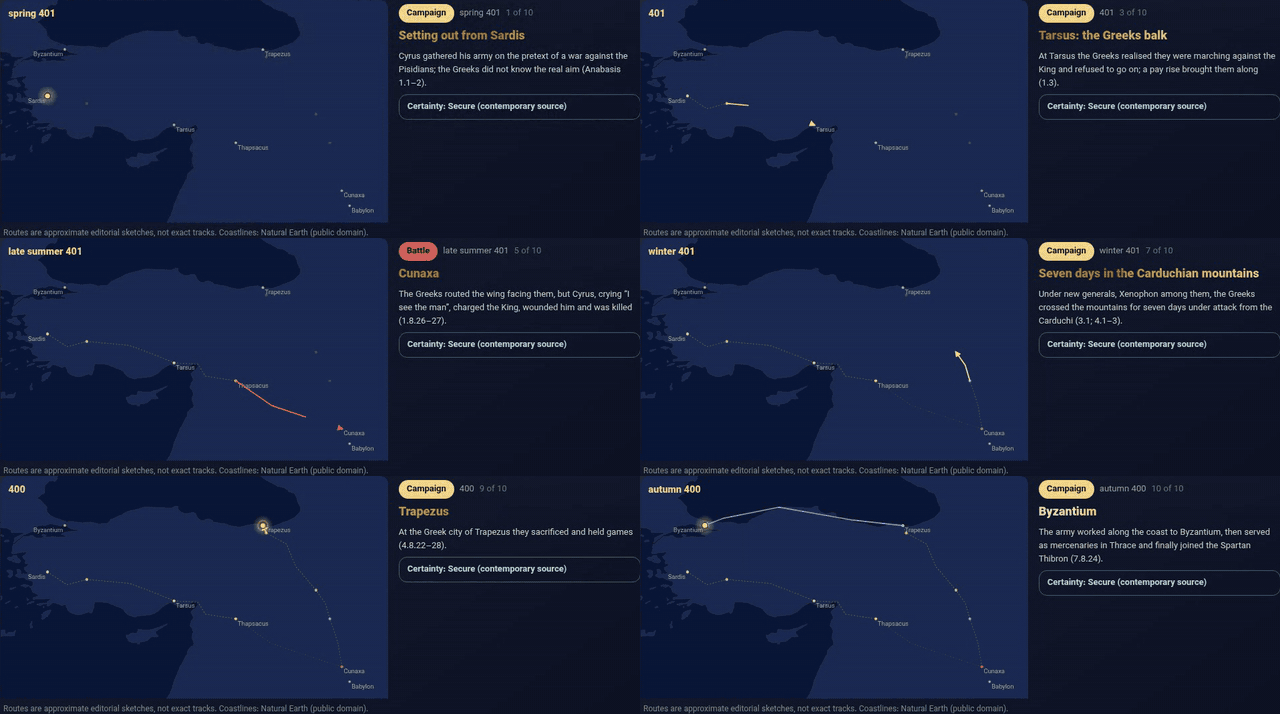
Cyrus’ march and the retreat of the Ten Thousand, step by step (401–400 BCE)
From Sardis to Cunaxa and from Cunaxa to Byzantium, as told in Xenophon’s Anabasis. The dashed blue line is the sea route. Xenophon marched with this army and was a partisan of Cyrus.
Campaignspring 4011 of 10
Setting out from Sardis
Cyrus gathered his army on the pretext of a war against the Pisidians; the Greeks did not know the real aim (Anabasis 1.1–2).
Certainty: Secure (contemporary source)
BattleCampaignBuildingAdministration & economyReligionFleet trackArrow keys, Home/End and Space work.
Three separate layers
Each section has three layers: “Historical evidence” is only what the sources say; “Philosophical interpretation” is our reading by the standard of property and liberty; “Modern cultural meaning”. Quotations come only from published translations, with references.
Historical evidencePhilosophical interpretationModern cultural meaning
Dossier · 1
A life in order
Arsaces, the elder son of Darius II and Parysatis, was born before his father’s accession, c. 453 or 445. In 405/404 he became king by his father’s wish and took the name Artaxerxes. His brother Cyrus the Younger plotted at the coronation, rebelled in 401 with ten thousand Greek mercenaries and was killed at Cunaxa.
Then came the war with Sparta (400–394), the naval victory of Cnidus (394), the King’s Peace (387/386), victory over Evagoras of Cyprus (381), two failed campaigns to Egypt and one against the Cadusii, and the Satraps’ Revolt (c. 368–358). After 46 years, the longest Achaemenid reign, he died in 359/358.

Iranica calls him weak and easily influenced, though at times cruel, and credits his successes mostly to able men around him: Tissaphernes, Pharnabazus, Autophradates and his son Ochus. This verdict, too, rests largely on Greek sources.
A state that lasts more than half a century through money and diplomacy rather than great victories shows that power is not measured only on the battlefield.
Sources: Xenophon, tr. H. G. Dakyns · Xenophon, tr. H. G. Dakyns · Plutarch, tr. B. Perrin · R. Schmitt, Encyclopaedia Iranica
Dossier · 2
Name and epithet: Arsaces, Artaxerxes, “Mnemon”
Ctesias gives his personal name as Arsaces or Arsicas, Dinon as Oarses. Greek authors from Plutarch on call him Mnemon, “Remembering, having a good memory”; the Old Persian form may survive in Hesychius’ gloss abiataka, “mnemona among the Persians” (Iranica).
What the epithet meant is unclear: remembering favours, perhaps, or grudges. Plutarch praises him as just and mild.
Epithets that come from outside are the narrators’ verdict more than the ruler’s own name.
Sources: Ctesias of Cnidus (via Photius’ epitome) · Plutarch, tr. B. Perrin · R. Schmitt, Encyclopaedia Iranica
Dossier · 3
Cyrus the Younger and Cunaxa
Cyrus, “born in the purple” and favoured by Parysatis as the fitter heir, was restored to his western satrapy after his pardon. In 401, on the pretext of a war against the Pisidians, he raised an army including ten thousand Greek mercenaries, plentiful since the end of the Peloponnesian War, and marched from Sardis almost to Babylon. At Cunaxa the Greeks routed the wing facing them, but Cyrus was killed charging straight at the King.
Darius and Parysatis had two sons: the elder was named Artaxerxes, and the younger Cyrus.
I see the man
Xenophon was an eyewitness but a partisan of Cyrus; Ctesias was in the King’s camp. Accounts of who killed Cyrus disagree: Iranica names a Carian soldier, and the official record gave the deed to the King.
A succession without rules turns a mercenary army into the tool of a family war; whoever pays the soldiers buys their obedience.
Sources: Xenophon, tr. H. G. Dakyns · Ctesias of Cnidus (via Photius’ epitome) · Diodorus Siculus, tr. C. H. Oldfather / C. B. Welles · Plutarch, tr. B. Perrin · R. Schmitt, Encyclopaedia Iranica
Dossier · 4
The march of the Ten Thousand
After Cunaxa Tissaphernes invited the Greek generals to a parley and seized them. The Greeks chose new generals, Xenophon among them, and reached the Black Sea through the Carduchian mountains and snowbound Armenia. On Mount Theches they shouted “The sea! the sea!” and went on from Trapezus to Byzantium.
The sea! the sea!
The Greeks, and Iranica following Plutarch, read the army’s escape as a sign of the empire’s weakness. Yet the King had achieved his main aim: his rival was dead and the leaderless army left his lands.
A body of free men who chose their own commanders and decided together crossed a foreign land; Xenophon makes this the lesson of his book.
Sources: Xenophon, tr. H. G. Dakyns · Plutarch, tr. B. Perrin · R. Schmitt, Encyclopaedia Iranica
Dossier · 5
Sparta, Cnidus and the King’s Peace
Sparta, which had backed Cyrus, fought in Asia Minor from 400. Persia answered with money and a fleet under Conon of Athens; in 394 the Spartan fleet was destroyed at Cnidus. In 387/386 Tiribazus read the King’s rescript to the Greek envoys at Sardis: the King’s Peace, or Peace of Antalcidas.
The king, Artaxerxes, deems it just that the cities in Asia, with the islands of Clazomenae and Cyprus, should belong to himself; the rest of the Hellenic cities he thinks it just to leave independent, both small and great, with the exception of Lemnos, Imbros, and Scyros, which three are to belong to Athens as of yore. Should any of the parties concerned not accept this peace, I, Artaxerxes, will war against him or them with those who share my views. This will I do by land and by sea, with ships and with money.
The text is not a peace between equals but a decree: the King “deems it just”, and will fight whoever refuses “with ships and with money”. The cities of Asia became the King’s and the autonomy of the rest was guaranteed by him. It was the Achaemenids’ greatest political victory in Greece and needed no battle.
When an outside power “guarantees” other people’s freedom, that freedom depends on its will.
Sources: Xenophon, tr. H. G. Dakyns · Diodorus Siculus, tr. C. H. Oldfather / C. B. Welles · R. Schmitt, Encyclopaedia Iranica
Dossier · 6
Egypt, Cyprus and the Cadusii
Egypt had broken away from the start of his reign. The campaign of 389–387 failed; the great expedition of 374–373, with Iphicrates’ Athenian mercenaries, failed through the commanders’ quarrel. The King himself campaigned against the Cadusii and came back empty-handed. On the other hand the war with Evagoras of Cyprus ended in victory in 381.

The empire could still raise money and mercenaries, but without unified command money did not turn into victory.
Ample resources are wasted without effective institutions.
Sources: Diodorus Siculus, tr. C. H. Oldfather / C. B. Welles · Plutarch, tr. B. Perrin · R. Schmitt, Encyclopaedia Iranica · P. Briant
Dossier · 7
The Satraps’ Revolt
Satrapies had become partly hereditary. About 368–358 several western satraps, from Egypt to Bithynia, formed a coalition and struck their own coins; Datames in Cappadocia and Ariobarzanes in Phrygia were the most prominent. Autophradates, once among the King’s most loyal men, and Pharaoh Tachos joined them; Tachos, faced with a rising at home, surrendered to the King. The revolt was put down and some rebels were pardoned and restored.

Pardoning and restoring rebels shows that the King could not rule without these local houses; the empire was more a web of bargains than a centralised state.
Striking coins is a sign of sovereignty; wherever local power has its own money, it will want its own independence.
Sources: Diodorus Siculus, tr. C. H. Oldfather / C. B. Welles · R. Schmitt, Encyclopaedia Iranica · P. Briant
Dossier · 8
The court: Parysatis, Stateira, Atossa and the heirs
According to Ctesias and Plutarch, Parysatis and Queen Stateira were enemies and Parysatis poisoned Stateira c. 400. The King then married his daughter Atossa. His eldest son Darius, made heir, was executed for conspiracy; Ochus removed two other brothers and succeeded as Artaxerxes III.
These stories come from Greek court literature and their details cannot be tested. But the general pattern, brothers killed over the crown, recurs in every Achaemenid succession.
Where there is no clear rule for transferring power, the family becomes the battlefield.
Sources: Ctesias of Cnidus (via Photius’ epitome) · Plutarch, tr. B. Perrin · Justin, tr. J. S. Watson · R. Schmitt, Encyclopaedia Iranica
Dossier · 9
Susa, Ecbatana and Anahita
Artaxerxes II’s inscriptions concern building. At Susa he rebuilt Darius’ audience hall, burnt in the time of Artaxerxes I (A2Sa); at Ecbatana he left further inscriptions (A2Ha, A2Hb, A2Hc). He is the first king to name Anahita and Mithra alongside Ahuramazda; Berossus says that under him statues of Anaitis were set up throughout the empire.
My ancestor Darius [I the Great] made this audience hall [apadana], but during the reign of my grandfather Artaxerxes, it was burnt down; but, by the grace of Ahuramazda, Anahita, and Mithra, I reconstructed this audience hall. May Ahuramazda, Anahita, and Mithra protect me against all evil, and may they never destroy nor damage what I have built.
this hall [apadana] I built, by the grace of Ahuramazda, Anahita, and Mithra. May Ahuramazda, Anahita, and Mithra protect me against evil, and may they never destroy nor damage what I have built.
Naming Anahita and Mithra may mark the official acceptance of cults already popular. The Arsacids later claimed descent from this Arsaces/Artaxerxes.
A government that accepts its people’s beliefs, rather than imposing one creed, gains a broader base.
Sources: Artaxerxes II, inscription A2Sa (after P. Lecoq 1997) · Artaxerxes II, inscription A2Ha (after P. Lecoq 1997) · R. Schmitt, Encyclopaedia Iranica
Synthesis: an empire of money and bargains
Artaxerxes II has no great land victory except Cunaxa, yet he held the empire for 46 years and, through money and diplomacy, made Greece submit to his arbitration. Against that, he lost Egypt and his satraps pushed to the edge of independence.
Through the lens of liberty and property, the King’s Peace teaches a clear lesson: the cities of Asia changed hands like property between powers, and the others’ autonomy, being the King’s gift, could be taken back at his will. King and satraps bargained with each other; the people of the cities were not party to the bargain.
Bibliography
- Xenophon, tr. H. G. Dakyns, Anabasis (1890–1897). https://www.gutenberg.org/ebooks/1170An eyewitness, but a Greek mercenary and a partisan of Cyrus the Younger.
- Xenophon, tr. H. G. Dakyns, Hellenica (1890–1897). https://www.gutenberg.org/ebooks/1174
- Ctesias of Cnidus (via Photius’ epitome), Persica, §§ 44–64 (c. 390 BCE; tr. J. H. Freese 1920). A Greek physician at the court of Artaxerxes II; full of court romance and unreliable, but almost the only source for the successions of 424–423.
- Plutarch, tr. B. Perrin, Life of Artaxerxes (Loeb) (1926). A 2nd-century CE moral biography built on Ctesias, Dinon and Xenophon.
- Diodorus Siculus, tr. C. H. Oldfather / C. B. Welles, Library of History, books 12–17 (Loeb) (1946–1963). A 1st-century BCE historian; his dates are sometimes displaced.
- Justin, tr. J. S. Watson, Epitome of Pompeius Trogus, books 5, 10–11 (1853). https://www.attalus.org/translate/justin10.html
- Artaxerxes II, inscription A2Sa (after P. Lecoq 1997), Livius.org: A2Sa (online). https://www.livius.org/sources/content/achaemenid-royal-inscriptions/a2sa/
- Artaxerxes II, inscription A2Ha (after P. Lecoq 1997), Livius.org: A2Ha (online). https://www.livius.org/sources/content/achaemenid-royal-inscriptions/a2ha/
- Manetho, tr. W. G. Waddell, Manetho (Loeb), frr. 72–75 (1940).
- R. Schmitt, Encyclopaedia Iranica, Artaxerxes II (1986). https://www.iranicaonline.org/articles/artaxerxes-ii/
- P. Briant, From Cyrus to Alexander: A History of the Persian Empire (2002).
- A. Kuhrt, The Persian Empire: A Corpus of Sources from the Achaemenid Period (2007).
All photos are from Wikimedia Commons; licence and author were checked on each file page.
Darius II, his fatherArtaxerxes III, his sonThe Achaemenid dynasty