Featured dossier
Artaxerxes III: Sidon, the reconquest of Egypt and the revival of the empire
The son of Artaxerxes II who reached the throne by killing his brothers, brought the rebel satraps to heel, saw Sidon burn and recovered Egypt after some sixty years. He reunited the empire, but was poisoned by Bagoas, four years before Alexander came. Follow his campaigns on the animated map, with evidence, interpretation and modern meaning in three separate layers.
- years of reign
- 21
- years of Egyptian independence ended
- ~60
- Egypt reconquered
- 343/342
- years before Alexander
- 4
Animated map: the life of Artaxerxes III
Administration & economyNovember 359 BCE1 of 10
Ochus becomes Artaxerxes III
Ochus, son of Artaxerxes II and Stateira, became king as Artaxerxes. The Babylonian era counts his reign from November 359; Polyaenus (7.17) says he hid his father’s death for ten months. According to Justin he killed his brothers, sisters and other rivals.
Certainty: ProbableCurtius’ “80 brothers in one day” (10.5.23) is rhetorical.
Sources: R. Schmitt, Encyclopaedia Iranica, 1986 · Justin, tr. J. S. Watson, 1853
BattleCampaignBuildingAdministration & economyReligionArrow keys, Home/End and Space work.
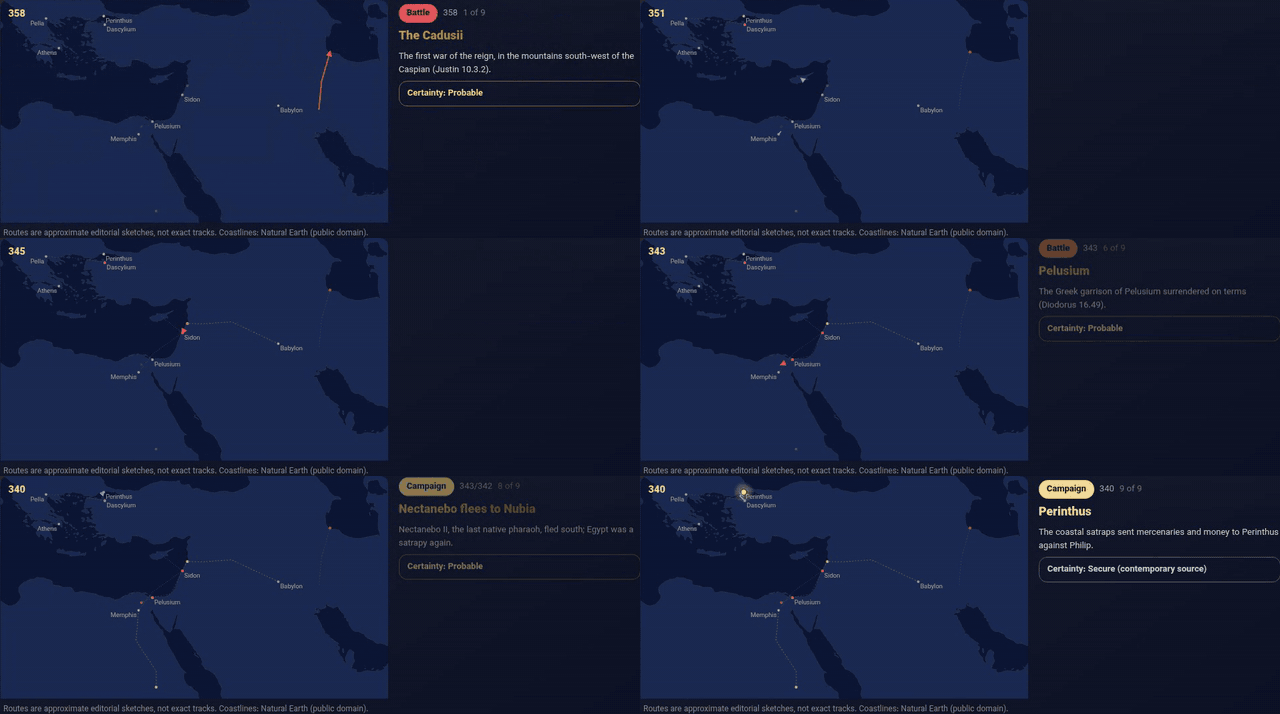
From the Cadusii to Egypt, step by step (358–340 BCE)
The satraps’ revolt, the destruction of Sidon, the reconquest of Egypt and help for Perinthus. The dashed blue line is a sea route. Most of the narrative is Diodorus, whose dates are sometimes displaced.
Battle3581 of 9
The Cadusii
The first war of the reign, in the mountains south-west of the Caspian (Justin 10.3.2).
Certainty: Probable
Sources: Justin, tr. J. S. Watson, 1853 · R. Schmitt, Encyclopaedia Iranica, 1986
BattleCampaignBuildingAdministration & economyReligionFleet trackArrow keys, Home/End and Space work.
Three separate layers
Each section has three layers: “Historical evidence” is only what the sources say; “Philosophical interpretation” is our reading by the standard of property and liberty; “Modern cultural meaning”. Quotations come only from published translations, with references.
Historical evidencePhilosophical interpretationModern cultural meaning
Dossier · 1
A life in order
Ochus, son of Artaxerxes II and Stateira, took part c. 361 in a campaign against Egypt and received the surrender of Pharaoh Tachos. He removed his brothers to secure the succession and became king as Artaxerxes in 359/358. He fought the Cadusii, brought the rebel western satraps to heel, ended the Phoenician revolt with the destruction of Sidon and in 343/342 recovered Egypt after some sixty years. In 338 he was poisoned by Bagoas.

Iranica calls him energetic, crafty and strong-minded, a king who “revived the old empire of Darius”; Greek sources call him cruel and violent, but also a fair judge (Diodorus 16.49.6).
Central power can be rebuilt by force, but when everything hangs on one man, everything falls with his death.
Sources: R. Schmitt, Encyclopaedia Iranica · Diodorus Siculus, tr. C. H. Oldfather / C. B. Welles · Justin, tr. J. S. Watson
Dossier · 2
Name: Ochus and Artaxerxes
His personal name was Ochus, Babylonian Umakuš, the same as Darius II’s; Artaxerxes was his throne name. Greek writers mostly call him Ochus.
No well-known contemporary epithet, of praise or blame, is attested; what survives are later verdicts on his violence.
Where there is no source, inventing an epithet is a kind of forgery.
Sources: R. Schmitt, Encyclopaedia Iranica
Dossier · 3
Ending the Satraps’ Revolt: dismiss the mercenaries
Artaxerxes III ordered the western satraps to dismiss their Greek mercenaries (scholium on Demosthenes 4.19). Orontes submitted; Artabazus, helped by the Athenian Chares, fled to Macedon. By threat of war the king made Athens drop Artabazus. The actual restoration of order was done by generals, above all Mentor of Rhodes.
Ordering the mercenaries dismissed struck at the satraps’ power base, their private armies. Yet the king too won with Greek generals and mercenaries; dependence on hired soldiers did not end, it moved to the centre.
A state monopoly of force, unless bound by law, only moves the danger.
Sources: Diodorus Siculus, tr. C. H. Oldfather / C. B. Welles · R. Schmitt, Encyclopaedia Iranica · P. Briant
Dossier · 4
Sidon: revolt, betrayal and fire
In 351 Syria, Phoenicia and Cyprus revolted under Tennes, king of Sidon, with Nectanebo’s support. Diodorus says the cause was the arrogance of the Persian satraps and commanders at Sidon. The neighbouring satraps achieved nothing; the king came from Babylon himself. Tennes betrayed the city and the Sidonians, who had earlier burned their ships so that no one could flee, set the city ablaze with themselves inside. The king then had Tennes killed too.
Diodorus’ account is dramatic and his figures exaggerated, but the pattern is clear: a rich city that had borne heavy dues and abuse revolted, and its destruction was a warning to others.
A government whose officials drive thriving cities to revolt, and which then destroys them, burns its own capital.
Sources: Diodorus Siculus, tr. C. H. Oldfather / C. B. Welles · R. Schmitt, Encyclopaedia Iranica
Dossier · 5
The reconquest of Egypt
After an earlier failure, the king led a large army to Egypt in person. Pelusium and Bubastis fell and Egypt was a satrapy again after some sixty years; Pherendates was made satrap and Nectanebo II fled to Nubia. The Persians plundered widely; Diodorus says Bagoas carried off the ancient temple records and sold them back to the priests for huge sums (16.51.2).

Aelian’s story that the king killed the Apis bull and the Egyptians called him “the ass” (4.8) is hostile Egyptian tradition and cannot be taken as evidence. But the plunder and the resale of records show what the reconquest rested on: taking, not keeping.
When a conqueror holds a society’s records and memory hostage and sells them back, rule has become extortion.
Sources: Diodorus Siculus, tr. C. H. Oldfather / C. B. Welles · R. Schmitt, Encyclopaedia Iranica · P. Briant
Dossier · 6
The Greeks, Philip and Perinthus
Artaxerxes sought the friendship of Athens, Sparta and Macedon. About 351 he invited Athens and Sparta to join his Egyptian war; both declined but professed friendship; Thebes and Argos sent troops. He made a treaty of friendship with Philip II. But when Philip besieged Perinthus in 340, the king ordered his satraps to help the city. Alexander later cited this in a letter to Darius III.
For you sent aid to the Perinthians, who were dealing unjustly with my father; and Ochus sent forces into Thrace, which was under our rule.
Arrian gives the text of Alexander’s letter, but Badian warns that documents quoted in the Greek sources are usually fictitious; the letter shows Alexander’s propaganda case more than a record.
A pretext for war can always be found; what matters is who writes the story.
Sources: Diodorus Siculus, tr. C. H. Oldfather / C. B. Welles · Arrian, tr. E. J. Chinnock · R. Schmitt, Encyclopaedia Iranica · E. Badian, Encyclopaedia Iranica
Dossier · 7
The Persepolis palace and tomb
Artaxerxes III built a palace on the south-western part of the Persepolis terrace, attested by his inscription A3Pa on a stairway; an Akkadian tablet of his was also found at Susa. One of the two Kuh-e Rahmat tombs at Persepolis is ascribed to him.
Renewed building at Persepolis was a token of revived royal authority.
Buildings attest power, not the consent of the governed.
Sources: R. Schmitt, Encyclopaedia Iranica
Dossier · 8
Bagoas and the end
Bagoas, the Egyptian-born chiliarch who had served in the conquest of Egypt, poisoned the king according to Diodorus (17.5.3–4) and killed all his sons except the youngest, Arses, who reigned about two years. Bisthanes, another son of Artaxerxes III, came to meet Alexander in 330 (Arrian 3.19.4).
Iranica judges the king’s early death a serious misfortune for the Persian kingdom: four years later Alexander crossed into Asia.
Power built on fear is vulnerable to its closest courtier.
Sources: Diodorus Siculus, tr. C. H. Oldfather / C. B. Welles · Arrian, tr. E. J. Chinnock · R. Schmitt, Encyclopaedia Iranica · P. Lecoq, Encyclopaedia Iranica
Synthesis: revival by force
Artaxerxes III reunited the empire that had been coming apart under his father: the satraps were tamed, Phoenicia submitted and Egypt returned. In holding the frontiers it was the most successful Achaemenid reign since Xerxes.
But his tools were force, killing and plunder. The thriving cities of Sidon and Egypt were destroyed or looted, and even the temples’ records were held to ransom. An empire resting on fear rather than on the security of its people’s lives and property shook when one man was murdered by his courtier, and a few years later collapsed before Alexander.
Bibliography
- Diodorus Siculus, tr. C. H. Oldfather / C. B. Welles, Library of History, books 12–17 (Loeb) (1946–1963). A 1st-century BCE historian; his dates are sometimes displaced.
- Justin, tr. J. S. Watson, Epitome of Pompeius Trogus, books 5, 10–11 (1853). https://www.attalus.org/translate/justin10.html
- Arrian, tr. E. J. Chinnock, The Anabasis of Alexander (1884). https://www.gutenberg.org/ebooks/46976Based on Ptolemy and Aristobulus, Alexander’s companions; the Macedonian view.
- Quintus Curtius Rufus, tr. J. C. Rolfe, History of Alexander (Loeb) (1946). A 1st-century CE Roman; rhetorical, but sometimes drawing on sources sympathetic to Darius.
- Plutarch, tr. B. Perrin, Life of Artaxerxes (Loeb) (1926). A 2nd-century CE moral biography built on Ctesias, Dinon and Xenophon.
- R. Schmitt, Encyclopaedia Iranica, Artaxerxes III (1986). https://www.iranicaonline.org/articles/artaxerxes-iii/
- P. Lecoq, Encyclopaedia Iranica, Arses (1986). https://www.iranicaonline.org/articles/arses-greek-rendering-of-an-old-persian-name-used-as-a-hypocoristic/
- E. Badian, Encyclopaedia Iranica, Darius v. Darius III (1994). https://www.iranicaonline.org/articles/darius-v/
- P. Briant, From Cyrus to Alexander: A History of the Persian Empire (2002).
- A. Kuhrt, The Persian Empire: A Corpus of Sources from the Achaemenid Period (2007).
All photos are from Wikimedia Commons; licence and author were checked on each file page.
Artaxerxes II, his fatherArtaxerxes IV (Arses), his sonDarius IIIThe Achaemenid dynasty