Featured dossier
Darius III: Issus, Gaugamela and the end of the Achaemenids
A king of obscure origin put on the throne by Bagoas two years before Alexander came. He was beaten at Issus and Gaugamela, lost his family as captives and was killed in golden fetters by his own companions. Only his enemies told his story; here we separate the evidence, the Alexander historians’ verdict and modern scholars’ rereading. Follow the 334–330 campaign on the animated map and the two battles step by step.
- years of reign
- 6
- great battles: Granicus, Issus, Gaugamela
- 3
- surviving Persian royal inscriptions
- 0
- age at death (Arrian)
- ~50
Animated map: the life of Darius III
Administration & economyc. 380 BCE1 of 11
An obscure origin
According to Arrian (3.22.6) he was about fifty when he died. Even in antiquity his origin was obscure. Diodorus calls him a son of Arsames and grandson of Ostanes, a son of Darius II; Badian takes this as the official version adopted at his accession. Babylonian documents give his personal name as Artašata.
Certainty: DisputedA link to the royal house is probable but not close; Justin calls him an obscure figure.
Sources: Arrian, tr. E. J. Chinnock, 1884 · Diodorus Siculus, tr. C. H. Oldfather / C. B. Welles, 1946–1963 · Justin, tr. J. S. Watson, 1853 · E. Badian, Encyclopaedia Iranica, 1994
BattleCampaignBuildingAdministration & economyReligionArrow keys, Home/End and Space work.
Alexander’s campaign and the end of the kingdom, step by step (334–330 BCE)
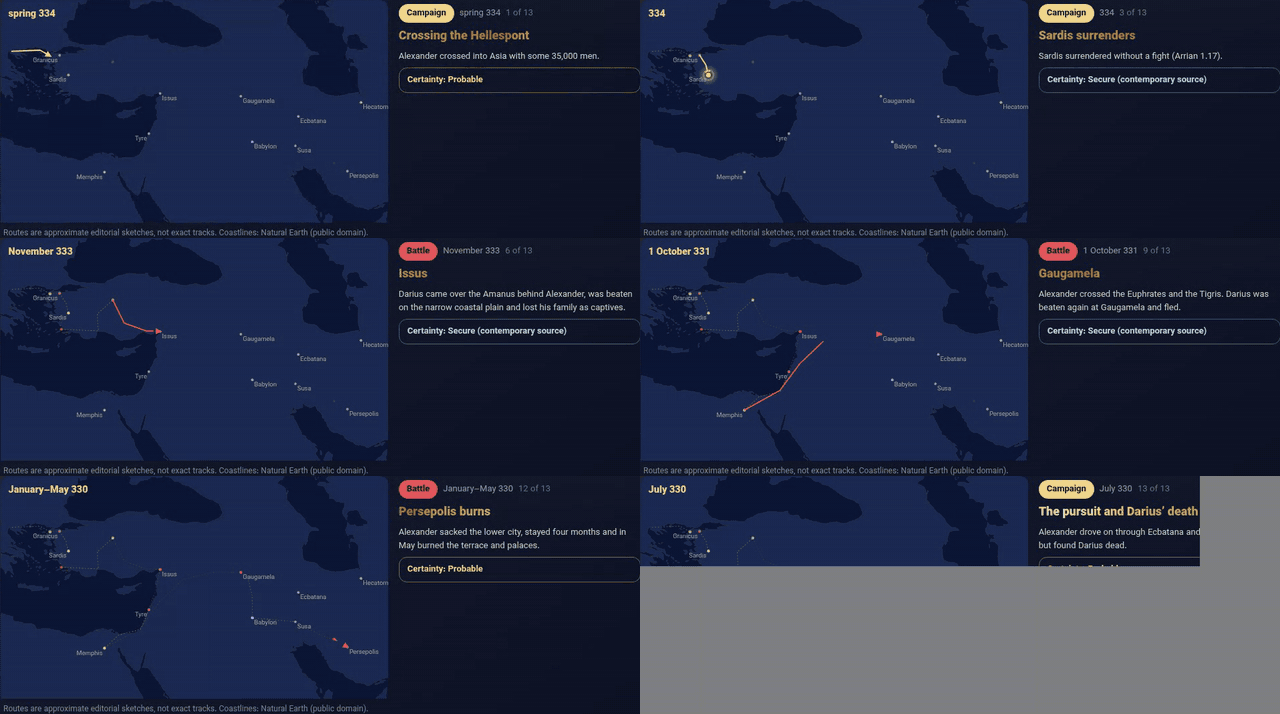
From the Hellespont to Hecatompylus. All the narrative sources are Alexander historians writing centuries later; the routes are sketches.
Campaignspring 3341 of 13
Crossing the Hellespont
Alexander crossed into Asia with some 35,000 men.
Certainty: ProbableArmy figures in the sources range from 30,000 to 48,000.
Sources: Arrian, tr. E. J. Chinnock, 1884 · Diodorus Siculus, tr. C. H. Oldfather / C. B. Welles, 1946–1963
BattleCampaignBuildingAdministration & economyReligionArrow keys, Home/End and Space work.
Issus, step by step (schematic)
November 333 BCE · Schematic; exact positions are debated
Phase 1 / 3 · probable
Deployment: either side of the Pinarus
Darius stood north of the river: heavy cavalry on his right by the sea, Greek mercenaries in the centre, the king behind them. Alexander came from the south: Parmenio on the left by the sea, Alexander with the Companion cavalry on the right.
Which modern stream is the Pinarus, and the size of the Persian army, are both debated; the ancient figures are greatly exaggerated.
Arrian, tr. E. J. Chinnock · Quintus Curtius Rufus, tr. J. C. Rolfe · E. Badian, Encyclopaedia Iranica
PersiansGreeks
Gaugamela, step by step (schematic)
1 October 331 BCE · Schematic; exact positions are debated
Phase 1 / 3 · probable
Deployment: the Persian line overlaps
Darius in the centre, with scythed chariots and elephants in front; Bessus with the Bactrian cavalry on the left; Mazaeus on the right. The Persians had stood under arms all night. Alexander on the right, Parmenio on the left, and a second line against encirclement.
The Persian army figures in the sources (up to a million) are fantastic.
Arrian, tr. E. J. Chinnock · Quintus Curtius Rufus, tr. J. C. Rolfe · E. Badian, Encyclopaedia Iranica
PersiansGreeks
Three separate layers
Each section has three layers: “Historical evidence” is only what the sources say; “Philosophical interpretation” is our reading by the standard of property and liberty; “Modern cultural meaning”. Quotations come only from published translations, with references.
Historical evidencePhilosophical interpretationModern cultural meaning
Dossier · 1
Sources: a king told only by his enemies
No Persian royal inscription or monument of Darius III survives. There are a few Babylonian documents, including the Uruk king list, an astronomical diary interpreted as dating Gaugamela and Alexander’s entry into Babylon, and astronomical observations that give his personal name. Everything else comes from Alexander historians writing centuries later: Diodorus, Arrian, Curtius, Plutarch and Justin. The only useful visual source, Badian says, is the Alexander Mosaic from Pompeii.

These sources built Darius mainly as a foil to Alexander. Any verdict on his character must allow for that.
When only the victor writes history, we must ask what the defeated would have said.
Sources: E. Badian, Encyclopaedia Iranica · A. J. Sachs, H. Hunger · Arrian, tr. E. J. Chinnock · Quintus Curtius Rufus, tr. J. C. Rolfe · Diodorus Siculus, tr. C. H. Oldfather / C. B. Welles
Dossier · 2
A life in order
Born c. 380, with a distant link to the royal house. In Artaxerxes III’s Cadusian war he won fame in single combat and became satrap of Armenia; later perhaps head of the royal courier service. He married Stateira, a royal princess. In 336 Bagoas put him on the throne, and Darius soon disposed of him. After the Granicus (334), Issus (333) and Gaugamela (331) he was killed by his own companions in July 330.
Badian shows how his weak legitimacy shaped his choices: he distrusted powerful commanders and built no unified command in the west.
A ruler unsure of his legitimacy keeps capable people at a distance, and everyone pays the price.
Sources: E. Badian, Encyclopaedia Iranica · Justin, tr. J. S. Watson · Diodorus Siculus, tr. C. H. Oldfather / C. B. Welles · Arrian, tr. E. J. Chinnock
Dossier · 3
Name: Codomannus, Artašata, Darius
Justin (10.3) is the only Greek or Latin source to give his earlier name, Codomannus. Babylonian documents write his personal name Ar-ta-šá-a-ta, probably Old Persian *Artašiyāta, “happy in Arta”. Darius was the throne name he took at his accession.
Choosing the name Darius claimed a link to the great founder, and with it legitimacy.
Names are tools of legitimacy; every new regime chooses a past for itself.
Sources: Justin, tr. J. S. Watson · E. Badian, Encyclopaedia Iranica
Dossier · 4
Issus: a narrow plain and a calculated flight?
In 334–333 Darius raised an army with unprecedented speed and by October 333 was crossing the Taurus; exploiting a failure of Alexander’s intelligence, he appeared at his rear. But he fought on the coastal plain of Issus, where his superior cavalry could not envelop the enemy’s left. Alexander routed the king; Darius escaped before the battle was over and his mother, wife and children were captured.
Greek historians charged him with cowardice, though bravery is his best-attested quality. Badian thinks it more probable that he kept his head and understood that the only chance of saving the kingdom lay in saving himself, since there was no successor who could command allegiance.
A system that hangs everything on one life forces its leader to choose between honour and the country’s survival.
Sources: Arrian, tr. E. J. Chinnock · Quintus Curtius Rufus, tr. J. C. Rolfe · Diodorus Siculus, tr. C. H. Oldfather / C. B. Welles · E. Badian, Encyclopaedia Iranica
Dossier · 5
Negotiation: equal or subject?
After Issus, while Tyre held out for a year, Darius offered peace: the cession of large territories, recognition of Alexander as an equal, a large ransom for his family and a marriage alliance. Alexander rejected everything and demanded that Darius recognise him as his superior. Arrian gives Alexander’s reply as a letter.
But for the future, whenever you send to me, send to me as the king of Asia, and do not address to me your wishes as to an equal
Badian warns that the documents quoted in Greek sources are “as usual fictitious”. The letter should be read as the historian’s statement of Alexander’s position, not as a record. Badian also explains why Alexander could not accept: after a peace, Darius would be free to attack when he chose.
When one side demands total submission, negotiation is no longer negotiation.
Sources: Arrian, tr. E. J. Chinnock · Quintus Curtius Rufus, tr. J. C. Rolfe · E. Badian, Encyclopaedia Iranica
Dossier · 6
Gaugamela: home ground, the same result
Darius lacked enough Greek mercenaries, so he improved his native troops’ equipment on the Greek model. He had superior cavalry, elephants and scythed chariots, and levelled the plain of Gaugamela, north of Arbela, for the chariots. Alexander did not attack by night and kept the Persians standing to arms until morning. On 1 October 331 the Persian cavalry succeeded against Parmenio, but Alexander charged through a gap at Darius in the centre and the line broke.
Badian: by deciding to wait for the attack, Darius gave up the initiative. A Babylonian astronomical diary confirms the date; it is one of the few points where the Greek narrative can be checked against a non-Greek record.
Superior numbers and wealth without discipline and flexibility do not bring victory.
Sources: Arrian, tr. E. J. Chinnock · Quintus Curtius Rufus, tr. J. C. Rolfe · Diodorus Siculus, tr. C. H. Oldfather / C. B. Welles · A. J. Sachs, H. Hunger · E. Badian, Encyclopaedia Iranica
Dossier · 7
The end: golden fetters
Darius went to Ecbatana to gain time; Alexander took Babylon, Susa and Persepolis and in May 330 burned the palaces of Persepolis. As Alexander approached, Darius moved east with a few nobles and a small force. Bessus and Nabarzanes bound him in golden fetters and, near Hecatompylus, left him stabbed before Alexander arrived. Bessus took the tiara and the name Artaxerxes.
This king was a man pre-eminently effeminate and lacking in self-reliance in military enterprises; but as to civil matters he never exhibited any disposition to indulge in arbitrary conduct; nor indeed was it in his power to exhibit it.

Badian suggests that Alexander’s haste to reach Darius alive, and the conspirators’ determination to prevent it, imply that Darius was ready to acknowledge Alexander as his superior and so give him legitimacy. This is a conjecture; the sources do not say so.
When a ruling elite weighs loyalty against its own interests, a king without an army becomes his companions’ hostage.
Sources: Arrian, tr. E. J. Chinnock · Quintus Curtius Rufus, tr. J. C. Rolfe · E. Badian, Encyclopaedia Iranica
Dossier · 8
Persian perspective vs the Alexander historians
The Alexander historians, Arrian especially, call Darius cowardly and “effeminate” and set him against Alexander’s heroism. Yet Arrian admits he was not arbitrary in civil matters. Curtius sometimes draws on sources more sympathetic to Darius. Badian takes bravery as his best-attested quality and shows that many of his choices, from the flight at Issus to the negotiations, were rational given his weak legitimacy and the lack of a successor.
No contemporary Persian view survives; what we call the “Persian perspective” is scholars’ reconstruction from Babylonian documents and a critical reading of the Greek sources. The Alexander Mosaic, a Roman work probably after a Greek painting, shows Darius turning anxiously towards his men, not a heedless fugitive.
Fair history means separating evidence from verdict and asking what each narrator stood to gain from his story.
Sources: Arrian, tr. E. J. Chinnock · Quintus Curtius Rufus, tr. J. C. Rolfe · E. Badian, Encyclopaedia Iranica
Synthesis: the end of a personal empire
Darius III was a brave king, inexperienced in high command, who came to power with weak legitimacy and faced one of history’s greatest generals. He lost Issus and Gaugamela, but the story of his cowardice owes more to the Alexander historians than to the evidence.
Through the lens of liberty and property his fall has a structural lesson: an empire in which everything, from command to legitimacy, hung on one life collapsed when that man was defeated. Arrian himself concedes that this king was not arbitrary in civil matters; but a structure that tied people’s rights to the king’s will had no institutions to stand after him.
Bibliography
- Arrian, tr. E. J. Chinnock, The Anabasis of Alexander (1884). https://www.gutenberg.org/ebooks/46976Based on Ptolemy and Aristobulus, Alexander’s companions; the Macedonian view.
- Quintus Curtius Rufus, tr. J. C. Rolfe, History of Alexander (Loeb) (1946). A 1st-century CE Roman; rhetorical, but sometimes drawing on sources sympathetic to Darius.
- Diodorus Siculus, tr. C. H. Oldfather / C. B. Welles, Library of History, books 12–17 (Loeb) (1946–1963). A 1st-century BCE historian; his dates are sometimes displaced.
- Plutarch, tr. B. Perrin, Life of Alexander (Loeb) (1919).
- Justin, tr. J. S. Watson, Epitome of Pompeius Trogus, books 5, 10–11 (1853). https://www.attalus.org/translate/justin10.html
- A. J. Sachs, H. Hunger, Astronomical Diaries and Related Texts from Babylonia, vol. I (diary −330 = BM 36761) (1988). A contemporary Babylonian record; it notes Gaugamela from Babylon’s side.
- E. Badian, Encyclopaedia Iranica, Darius v. Darius III (1994). https://www.iranicaonline.org/articles/darius-v/
- P. Lecoq, Encyclopaedia Iranica, Arses (1986). https://www.iranicaonline.org/articles/arses-greek-rendering-of-an-old-persian-name-used-as-a-hypocoristic/
- P. Briant, Darius in the Shadow of Alexander (2015). How Darius III was constructed by his conquerors’ historians.
- P. Briant, From Cyrus to Alexander: A History of the Persian Empire (2002).
- A. Kuhrt, The Persian Empire: A Corpus of Sources from the Achaemenid Period (2007).
All photos are from Wikimedia Commons; licence and author were checked on each file page.
Artaxerxes IV (Arses), his predecessorBessus (Artaxerxes V)Artaxerxes III, his patronThe Achaemenid dynasty