Achaemenids
Artaxerxes I Longimanus
اردشیر یکم (درازدست)
Epithets and titles
- Longhand (Longimanus)Makrócheir / Longimanusbyname (later or foreign)per Plutarch “because his right hand was longer than his left”; Pollux reads it as a symbol of “far-reaching power”Source: Plutarch, Artaxerxes 1.1, tr. B. Perrin; R. Schmitt, “Artaxerxes I”, Encyclopaedia Iranica
- Great King, King of Kingsxšāyaθiya vazraka, xšāyaθiya xšāyaθiyānāmofficial titlethe official style Artaxerxes used in his own inscriptionsSource: Artaxerxes I, inscription A1Pa (Livius.org, after Lecoq)
- Reign
- 465–424/423 BCE
- Dynasty
- Achaemenids
- Persian page
- فارسی
Featured dossier
Artaxerxes Longhand: Great King, forty years between war and peace
The son of Xerxes who, after his father’s murder, took the throne by killing his brother and Artabanus, and whom the Greeks called “Long-handed”. He crushed the Egyptian revolt and the Athenian fleet, made peace with Athens according to Diodorus, sheltered Themistocles, sent Ezra and Nehemiah to Jerusalem (in the biblical account) and finished the Hall of a Hundred Columns. The Murašû archive from his reign is the best evidence for land, leases and credit in the Achaemenid world. Follow his life in order and the western war and peace on the animated map, with evidence, interpretation and modern meaning in three separate layers. Wherever the sources conflict, we say so.
- years of reign (Babylonian documents)
- 41
- years of the Egyptian war (Thucydides)
- 6
- Murašû archive tablets
- ~730
- kings in the year after his death
- 3
Animated map: the life of Artaxerxes I
Administration & economyAugust–December 465 BCE1 of 14
Accession through blood
After Xerxes’ murder Artaxerxes, the youngest son of Xerxes and Amestris, killed his elder brother Darius and then Artabanus (Diodorus 11.69; Ctesias). His first regnal year in the Babylonian reckoning begins in December 465. Josephus calls him “Cyrus”; his name before he became king is unknown.
Certainty: ProbableThe dates come from Babylonian documents; the details of the plot from late, conflicting Greek sources.
Sources: BM 32234 (LBAT *1419), tr. C. B. F. Walker, Walker 1997 · Diodorus Siculus, tr. C. H. Oldfather, 1946–1950 · Ctesias of Cnidus (via Photius’ epitome), tr. J. H. Freese, 1920 · Justin, tr. J. S. Watson, 1853 · R. Schmitt, Encyclopaedia Iranica, 1986
BattleCampaignBuildingAdministration & economyReligionArrow keys, Home/End and Space work.
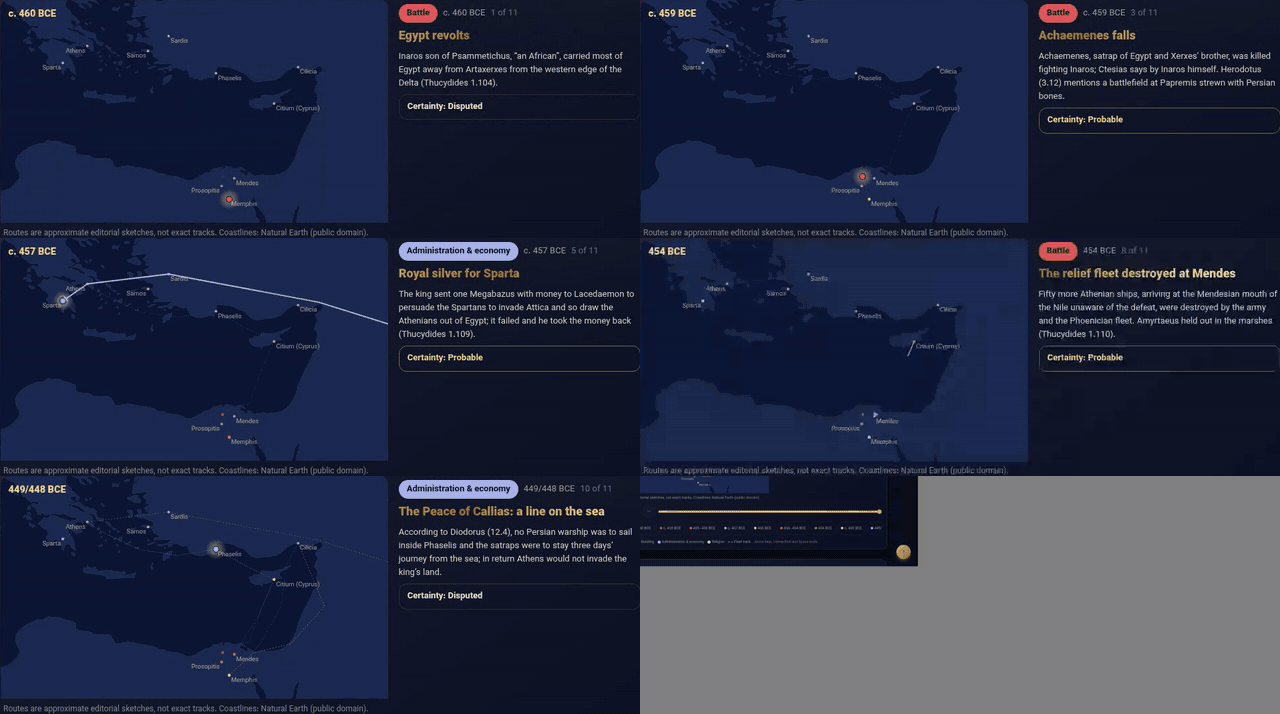
War and peace in the west, step by step (460–439 BCE)
From the Egyptian revolt and the Athenian fleet to the Peace of Callias and Samos. The coloured line is the army’s route and the dashed blue line the fleet’s. Each step says whether it is secure, probable or disputed. The spine is Thucydides, an Athenian.
Battlec. 460 BCE1 of 11
Egypt revolts
Inaros son of Psammetichus, “an African”, carried most of Egypt away from Artaxerxes from the western edge of the Delta (Thucydides 1.104).
Certainty: DisputedStart dates from 463 to 460 are proposed.
Sources: Thucydides, tr. Thomas Hobbes, 1843 · R. Schmitt, Encyclopaedia Iranica, 1986 · P. Briant, 2002
BattleCampaignBuildingAdministration & economyReligionFleet trackArrow keys, Home/End and Space work.
Three separate layers
Each section has three layers: “Historical evidence” is only what the sources say; “Philosophical interpretation” is our reading by the standard of property and liberty; “Modern cultural meaning”. Quotations come only from published translations, with references.
Historical evidencePhilosophical interpretationModern cultural meaning
Dossier · 1
A life in order: from his father’s murder to the chaos after his death
Artaxerxes (Old Persian Artaxšaçā, “whose rule is through truth/arta”) was the son of Xerxes and Amestris and the youngest brother. No birth year is recorded. In August 465 his father was murdered and he came to the throne after killing his brother Darius and then Artabanus; his first regnal year at Babylon is counted from December 465.
The early years: the Bactrian revolt (465–464), the arrival of the Athenian Themistocles at court, and from about 460 the revolt of Inaros in Egypt with Athenian help, ended by Megabyzus at Prosopitis in 454. From 454 the Murašû archive at Nippur begins.
The middle years: Cimon at Cyprus (c. 450) and, according to Diodorus, the Peace of Callias (449/448); the revolt of Megabyzus in Syria (per Ctesias); Nehemiah’s mission (445); Samos (440–439). At Persepolis he completed the Hall of a Hundred Columns.
The end: his last Babylonian date is month 11 of year 41 (early 423) (Stolper 1983). Within less than a year after him, Xerxes II, Sogdianus and finally Darius II took the throne.

Artaxerxes started no great war and won no great territory; for forty years he held the empire with money, diplomacy and selective repression. It may be the least colourful and yet one of the steadiest Achaemenid reigns after Darius.
A reign that began with a brother’s killing and ended with a son’s shows that outward stability without a rule of succession is fragile.
Sources: R. Schmitt, Encyclopaedia Iranica · BM 32234 (LBAT *1419), tr. C. B. F. Walker · M. W. Stolper · Diodorus Siculus, tr. C. H. Oldfather · Ctesias of Cnidus (via Photius’ epitome), tr. J. H. Freese · Thucydides, tr. Thomas Hobbes · P. Briant
Dossier · 2
Name and epithet: “Longhand” and “Great King”
Yes: Artaxerxes I is called “Longhand”: Greek Makrocheir, Latin Longimanus, New Persian Ardašīr-e derāzdast. According to Iranica the epithet first appears in Plutarch, who says it was “because his right hand was longer than his left”. Pollux (2.151) takes it symbolically, as “far-reaching power”. A Greek papyrus from Egypt (cited by Waddell in his Manetho) also calls him “the Long-handed”.
He did not use the nickname himself. His official style in inscription A1Pa is xšâyathiya vazraka “great king”, xšâyathiya xšâyathiyânâm “king of kings”, xšâyathiya dahyûnâm paruzanânâm “king of countries with all kinds of men”, and “king in this earth far and wide”.
The first Artaxerxes, preeminent among the kings of Persia for gentleness and magnanimity, was surnamed Longimanus, because his right hand was longer than his left, and was the son of Xerxes; the second Artaxerxes, the subject of this Life, was surnamed Memor, or Mindful, and was the grandson of the first by his daughter Parysatis.

Epithets come in two kinds: the official style the king chose (“great king, king of kings”) and the nickname others gave, often centuries later (“Longhand”). The first is a claim of power, the second popular memory or legend. They should not be confused.
In Persian, “long-handed” still suggests a power whose reach is everywhere: exactly what individual liberty needs protection from.
Sources: Plutarch, tr. B. Perrin · R. Schmitt, Encyclopaedia Iranica · Manetho, fr. 70 (Africanus), tr. W. G. Waddell · Artaxerxes I, inscription A1Pa (after P. Lecoq 1997)
Dossier · 3
The accession crisis and the Bactrian revolt
The Greek sources (Ctesias, Diodorus 11.69, Justin 3.1) all make Artabanus, commander of the guard, Xerxes’ murderer and the young Artaxerxes his tool for killing his brother Darius; Artaxerxes then killed Artabanus. The Babylonian tablet BM 32234, however, names the killer as “his son”. Manetho counts a seven-month reign for Artabanus.
Another brother, Hystaspes, was satrap of Bactria (Diodorus). Bactria revolted and was subdued in two battles (Ctesias).
Whether Artaxerxes was deceived or, as the Babylonian tablet allows us to suspect, involved himself, the outcome is the same: the crown changed hands in the palace, by the sword. When the country is the king’s personal estate, succession is a fight over an inheritance.
A clear, pre-agreed rule for transferring power is one of the great institutional inventions, because it turns a succession war into a procedure.
Sources: Ctesias of Cnidus (via Photius’ epitome), tr. J. H. Freese · Diodorus Siculus, tr. C. H. Oldfather · Justin, tr. J. S. Watson · BM 32234 (LBAT *1419), tr. C. B. F. Walker · Manetho, fr. 70 (Africanus), tr. W. G. Waddell · R. Schmitt, Encyclopaedia Iranica
Dossier · 4
The revolt of Inaros and the six-year war in Egypt
Around 460 Inaros son of Psammetichus raised most of Egypt and called in the Athenians with the fleet they had at Cyprus. Achaemenes, the satrap and the king’s uncle, was killed. The Athenians took two parts of Memphis and besieged the White Wall (Thucydides 1.104).
The king first tried to buy a Spartan invasion of Attica; it failed. Then Megabyzus came with an army and a Phoenician fleet, besieged the Greeks on Prosopitis for a year and a half and drained the channel. Fifty Athenian relief ships were also destroyed at the Mendesian mouth (Thucydides 1.109–110). Inaros, in Thucydides, was crucified; in Ctesias he surrendered under a promise of safety and was killed five years later on Amestris’ orders.
Thus was the army of the Grecians lost after six years’ war…
The Egyptian war shows the king trying the cheaper tool first: money to buy the enemy’s enemy. When that failed, the army came. The revolt was at heart about taxation and self-rule; the empire took Egypt back, but the satrapy stayed restless to the end of the dynasty.
The promise of safety given to Inaros and broken (per Ctesias) is a reminder that a ruler’s word, without an independent court behind it, is worth only as long as the ruler wishes.
Sources: Thucydides, tr. Thomas Hobbes · Ctesias of Cnidus (via Photius’ epitome), tr. J. H. Freese · Diodorus Siculus, tr. C. H. Oldfather · R. Schmitt, Encyclopaedia Iranica · P. Briant
Dossier · 5
Cyprus, the Peace of Callias and a frontier on the sea
Around 450 the Athenian Cimon died besieging Citium on Cyprus (Thucydides 1.112). Diodorus (12.4) says that Artaxerxes then sought peace and Callias son of Hipponicus made a treaty for Athens.
Thucydides says nothing of such a treaty and Theopompus in the 4th century called it a forgery; some scholars accept a formal treaty, others only a de facto understanding. Afterwards the satraps still meddled in the affairs of the Asian Greeks, as Pissuthnes did in the Samian revolt (440).
All the Greeks cities of Asia are to live under laws of their own making; the satraps of the Persians are not to come nearer to the sea than a three days’ journey and no Persian warship is to sail inside of Phaselis or the Cyanean Rocks; and if these terms are observed by the king and his generals, the Athenians are not to send troops into the territory over which the king is ruler.
If Diodorus’ terms are right, the Greek cities of Asia were for the first time recognised as living “under laws of their own making”. The king did not grant this autonomy; the Athenian fleet won it. In the ancient world a right without force to defend it did not last.
The Callias debate is a good lesson in method: a late text, the silence of a closer source, and scholars who still disagree. We quote the terms, not a certainty.
Sources: Diodorus Siculus, tr. C. H. Oldfather · Thucydides, tr. Thomas Hobbes · R. Schmitt, Encyclopaedia Iranica · P. Briant
Dossier · 6
The court: Amestris, Megabyzus and the royal family
The only known queen was Damaspia, and the only legitimate son Xerxes II. Iranica, following Ctesias, lists seventeen sons by concubines, among them Sogdianus (by Alogune), Arsites (by Cosmartidene) and Ochus, the later Darius II, by a Babylonian woman; Parysatis, Ochus’ wife, was the king’s daughter by Andria.
According to Ctesias, the queen mother Amestris wielded great influence and broke Megabyzus’ promise to Inaros. Megabyzus revolted, beat two royal armies and reconciled; later he shot before the king at a lion hunt, was exiled to Curtae and returned by feigning leprosy.
In Ctesias, the fate of generals and rebels hangs on their standing with the women and eunuchs of the court, not on law. Even if the details are fiction, the overall picture fits a system in which security of life and property depends on proximity to the king.
Much of the modern image of the “oriental harem” comes from these Greek sources; they need the same caution as Herodotus.
Sources: Ctesias of Cnidus (via Photius’ epitome), tr. J. H. Freese · R. Schmitt, Encyclopaedia Iranica · P. Briant
Dossier · 7
Themistocles and the revenues of three cities
Themistocles, victor of Salamis, exiled by Athens, took refuge with Artaxerxes (Thucydides 1.137). He learned Persian for a year, and the king then gave him the revenues of three cities: Magnesia, worth fifty talents a year, for bread, Lampsacus for wine and Myus for meat (1.138). Iranica says he governed these cities. He died at Magnesia.
the king having bestowed upon him Magnesia which yielded him fifty talents by the year for his bread, and Lampsacus for his wine (for this city was in those days thought to have store of wine), and the city of Myus for his meat.
This gift sharpens the property lens: the king saw cities as his estate, whose revenues he could hand to anyone he liked. The people of Magnesia paid their dues not to a public body but to the king’s guest. Property in this system was not built from below; it was granted, and revocable, from above.
The same logic lives wherever public resources are a ruler’s “gift” to his circle. The liberal question is always: whose revenue is it?
Sources: Thucydides, tr. Thomas Hobbes · R. Schmitt, Encyclopaedia Iranica · P. Briant
Dossier · 8
Ezra and Nehemiah: the biblical tradition
The Book of Ezra (7:7) says Ezra the scribe went to Jerusalem in the seventh year of “Artaxerxes” with a royal letter. The Book of Nehemiah says Nehemiah, the king’s cupbearer, received leave in Artaxerxes’ twentieth year (445 if Artaxerxes I) to rebuild Jerusalem’s walls, and governed for twelve years.
This is a religious tradition. The text does not say which Artaxerxes. For Nehemiah most scholars accept Artaxerxes I; for Ezra many prefer 398 and Artaxerxes II. The authenticity of the quoted decrees is also debated.
And it came to pass in the month Nisan, in the twentieth year of Artaxerxes the king, that wine was before him: and I took up the wine, and gave it unto the king.
If we accept the story, the empire let a local community order itself under its own religious law and wall its city: the Achaemenid habit of recognising local law to keep tribute and loyalty flowing. It was conditional autonomy, not a right.
This is how Artaxerxes’ name survived in Jewish and Christian tradition; most people know him from the Bible, not from Persepolis.
Sources: The Bible, King James Version · R. Schmitt, Encyclopaedia Iranica · P. Briant
Dossier · 9
The Murašû archive: land, service, leases and credit
In 1893 the archive of a family firm was found at Nippur: about 730 tablets (Stolper 1985 counts 879 tablets and fragments), from 454 to 404 BCE and mostly 440–416. The first text is from March 454. The principals were Enlil-šumu-iddin and later Rēmūt-Ninurta.
The land system: the king assigned land to groups called ḫaṭru; a typical unit was “bow land” (bīt qašti), whose holder had to send a soldier or pay for one. Larger estates belonged to princes and Persian nobles.
The Murašûs were middlemen: they leased land from holders and sub-leased it to cultivators, supplied water, tools and animals, collected rents and taxes, and lent to holders burdened with service and taxes. The loans were secured on the land, and so they came to control mortgaged fields, even estates of Persian nobles. No title deeds (land sales) appear in the archive, and trade in goods is not recorded.

This is the key property evidence of Artaxerxes’ reign, and it cuts both ways. On one side there was a lively market in leases, loans and written contracts with witnesses and seals; on the other, land was not the holder’s property but a grant held for service that could not be sold. The burden of service and tax drove small holders into debt and their land in effect passed to the firm. Contract existed; free ownership did not.
When the state is the ultimate landowner and loads its burdens onto the farmer, capital flows to those close to the apparatus. The Murašû pattern, a middleman between the state and the producer, is familiar in many economies today.
Sources: M. W. Stolper · M. W. Stolper · G. Cardascia · G. van Driel · P. Briant
Dossier · 10
The Hundred-Column Hall, inscriptions and the tomb
Artaxerxes completed the Hall of a Hundred Columns (Throne Hall) begun by Xerxes; inscription A1Pa attests it. He is probably the king in the hall’s audience reliefs. His name is also on silver dishes (A1I). At Susa, after the Apadana burned, he built a small palace.
His tomb is taken to be one of the four rock tombs at Naqsh-e Rostam, beside Darius’; apart from Darius’ tomb they are uninscribed, so the attribution is inferred.
A great god is Ahuramazda, who created this earth, who created that heaven, who created man, who created happines for man, who made Artaxerxes king, one king for many, one leader for all. I am Artaxerxes, the great king, the king of kings, the king of countries with all kinds of men, the king in this earth far and wide, the son of king Xerxes, the grandson of Darius, the Achaemenid. Artaxerxes the great king says: by the grace of Ahuramazda, my father, king Xerxes, built this palace. After that, I built [it]. May Ahuramazda and the gods preserve me, my kingdom, and what I have built.


A1Pa repeats his father’s and grandfather’s formula almost word for word. The repetition is deliberate: legitimacy comes from continuity. “Happiness for man” is the god’s creation, but it is the king who is “one leader for all”; order defines liberty, not the other way round.
The fallen columns of the Hundred-Column Hall are now World Heritage; its inscription reminds us that even a less famous builder has a large share in what we call Persepolis.
Sources: Artaxerxes I, inscription A1Pa (after P. Lecoq 1997) · R. Schmitt, Encyclopaedia Iranica · A. Kuhrt
Dossier · 11
Death and the year of chaos: Xerxes II, Sogdianus, Darius II
Artaxerxes’ last Babylonian date (BM 33342) is day 29 of month 11 of year 41 (Stolper 1983). Diodorus gives the reign 40 years, Manetho 41 and Ctesias 42.
According to Ctesias, Xerxes II, the only legitimate son, was killed 45 days after his father’s death by Sogdianus. Ochus, satrap of Hyrcania and husband of Parysatis, overthrew Sogdianus and became Darius II; the Greeks called him Nothos, “the Bastard”. Manetho gives Xerxes II two months and Sogdianus seven.
Forty years of outward calm ended with three kings in one year. The stability of Artaxerxes’ reign rested on the man, not on an institution that outlived him.
A society that entrusts property and succession to public rules does not collapse with the death of one man.
Sources: M. W. Stolper · Ctesias of Cnidus (via Photius’ epitome), tr. J. H. Freese · Manetho, fr. 70 (Africanus), tr. W. G. Waddell · Diodorus Siculus, tr. C. H. Oldfather · R. Schmitt, Encyclopaedia Iranica
The long-handed king: a reach that touched everything
Artaxerxes I came to the throne through blood and for forty years held the empire more by money and diplomacy than by war: he recovered Egypt, reached a frontier on the sea with Athens, granted favours to Greek exiles and local communities, and completed Persepolis.
Through a property-and-liberty lens his reign has two faces. The Murašû archive shows a lively market in contracts, leases and loans; but land was a grant held for service, cities were revenues the king gave away, and local autonomy a conditional favour. The king’s “long hand” brought order, and it was the king who drew the boundaries of property.
Bibliography
- Thucydides, tr. Thomas Hobbes, The History of the Grecian War, book 1 (Bohn edition) (1843). Contemporary and the most careful Greek source for the Egyptian war, but from the Athenian side.
- Herodotus, tr. A. D. Godley, The Histories 3.12 (Loeb) (1920).
- Ctesias of Cnidus (via Photius’ epitome), tr. J. H. Freese, Persica, §§ 33–50 (1920). A Greek physician at the court of Artaxerxes II; full of court romance and unreliable, but the only continuous account of the court.
- Diodorus Siculus, tr. C. H. Oldfather, Library of History, books 11–12 (Loeb) (1946–1950). A 1st-century BCE historian; his dates for this period are sometimes displaced.
- Justin, tr. J. S. Watson, Epitome of Pompeius Trogus, book 3.1 (1853). https://www.attalus.org/translate/justin9.html
- Manetho, fr. 70 (Africanus), tr. W. G. Waddell, Manetho (Loeb Classical Library) (1940).
- Plutarch, tr. B. Perrin, Life of Artaxerxes 1.1 (Loeb) (1926).
- Artaxerxes I, inscription A1Pa (after P. Lecoq 1997), Livius.org: A1Pa (online). https://www.livius.org/sources/content/achaemenid-royal-inscriptions/a1pa/
- The Bible, King James Version, Ezra 7; Nehemiah 1–2 (1611). A religious text and the Judean community’s own account; its dating is debated.
- R. Schmitt, Encyclopaedia Iranica, Artaxerxes I (1986). https://www.iranicaonline.org/articles/artaxerxes-i/
- M. W. Stolper, Entrepreneurs and Empire: The Murašû Archive, the Murašû Firm, and Persian Rule in Babylonia (1985).
- M. W. Stolper, Fifth century Nippur: texts of the Murašûs and from their surroundings, Journal of Cuneiform Studies 53 (2001).
- M. W. Stolper, The death of Artaxerxes I, Archäologische Mitteilungen aus Iran 16 (1983).
- G. Cardascia, Les archives des Murašû (1951).
- G. van Driel, The Murašûs in context, JESHO 32 (1989).
- P. Briant, From Cyrus to Alexander: A History of the Persian Empire (2002).
- A. Kuhrt, The Persian Empire: A Corpus of Sources from the Achaemenid Period (2007).
- BM 32234 (LBAT *1419), tr. C. B. F. Walker, A Babylonian lunar-eclipse tablet recording Xerxes’ murder (Walker 1997).
All photos are from Wikimedia Commons; licence and author were checked on each file page.
Xerxes I, his fatherDarius the Great, his grandfatherThe Achaemenid dynasty