Achaemenids
Xerxes I
خشایارشا
Epithets and titles
- Great King, King of Kingsxšāyaθiya vazraka, xšāyaθiya xšāyaθiyānāmofficial titlethe official style Xerxes used in his own inscriptionsSource: Daiva inscription XPh, tr. R. G. Kent (Livius.org)
- Reign
- 486–465 BCE
- Dynasty
- Achaemenids
- Persian page
- فارسی
Featured dossier
Xerxes I: builder of the Gate of All Nations and the great war with Greece
Son of Darius and grandson of Cyrus, he held the empire together, put down revolts in Egypt and Babylon, brought Persepolis to its peak and invaded Greece in 480 BCE. Follow his life in order, watch the Greek war step by step on the animated map and in diagrams of Thermopylae and Salamis, then weigh his reign through the lens of property rights and individual liberty, with evidence, interpretation and modern meaning in three separate layers. Wherever a story is Greek or disputed, we say so.
- years of reign
- 21
- warships, per Herodotus
- 1,207
- to cross the Hellespont (Hdt 7.56)
- 7 days
- murdered in the palace (BCE)
- 465
Animated map: the life of Xerxes
Administration & economyc. 518 BCE1 of 15
Born a king’s son
Xerxes (Old Persian Xšaya-ṛšā, “ruling over heroes”) was the son of Darius I and Atossa, daughter of Cyrus the Great, so both Achaemenid lines met in him. His birth year is estimated from Herodotus, who says he was born after Darius became king.
Certainty: ProbableNo birth record survives; 519 and 518 are both proposed.
Sources: Herodotus, tr. A. D. Godley, 1920–1925 · Encyclopaedia Iranica, 2000, updated 2012 · P. Briant, 2002
BattleCampaignBuildingAdministration & economyReligionArrow keys, Home/End and Space work.
The Greek war, step by step (499–479 BCE)
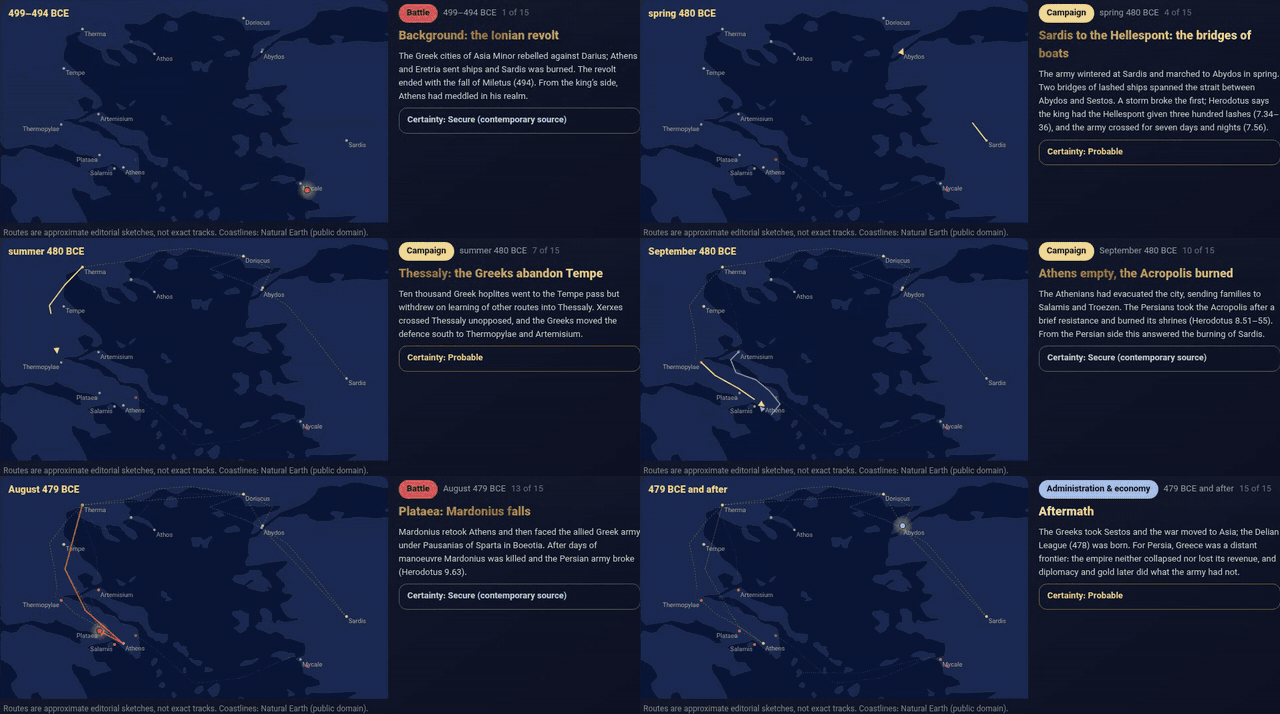
The coloured line is the army’s route and the dashed blue line the fleet’s. Each step says whether it is secure, probable or disputed. Almost every detail comes from Herodotus, a Greek writing half a century later; we treat his numbers as his claim.
Battle499–494 BCE1 of 15
Background: the Ionian revolt
The Greek cities of Asia Minor rebelled against Darius; Athens and Eretria sent ships and Sardis was burned. The revolt ended with the fall of Miletus (494). From the king’s side, Athens had meddled in his realm.
Certainty: Secure (contemporary source)
Sources: Herodotus, tr. A. D. Godley, 1920–1925 · P. Briant, 2002
BattleCampaignBuildingAdministration & economyReligionFleet trackArrow keys, Home/End and Space work.
Thermopylae, step by step
Aug/Sept 480 BCE, three days · Schematic; exact positions are debated
Phase 1 / 3 · probable
Days 1–2: the pass holds
The Greeks stood behind the Phocian wall at the narrowest point. Assaults by Medes, Cissians and then the “Immortals” were thrown back in a gap that cancelled the advantage of numbers (7.210–212).
The ancient shoreline ran much closer to the mountain; silt from the Spercheios has since pushed it back.
Herodotus, tr. A. D. Godley · J. F. Lazenby
PersiansGreeks
Salamis, step by step
September 480 BCE, one night and a day · Schematic; exact positions are debated
Phase 1 / 4 · disputed
Night: sealing the strait
After Sicinnus brought Themistocles’ message, the Persian fleet moved up from Phalerum overnight to close the escape routes, and infantry landed on Psyttaleia (8.75–76).
Whether an Egyptian squadron blocked the western exit, or the whole fleet deployed in the channel, is unclear (Tuplin).
Herodotus, tr. A. D. Godley · C. J. Tuplin
PersiansGreeks
Three separate layers
Each section has three layers: “Historical evidence” is only what the sources say; “Philosophical interpretation” is our reading by the standard of property and liberty; “Modern cultural meaning”. Quotations come only from published translations, with references.
Historical evidencePhilosophical interpretationModern cultural meaning
Dossier · 1
A life in order: from heir to murder
Born c. 518 BCE to Darius and Atossa, he was chosen over his elder half-brother Artobazanes (Herodotus 7.2–3); in inscription XPf he says his father made him “the greatest after himself”. Babylonian evidence shows him, as crown prince, with a residence at Babylon.
He acceded in November 486, crushed the Egyptian revolt in 486–484 and two Babylonian revolts around 484. Then came the preparations for Greece (483–481), the invasion of 480 and the defeat of 479. After that the Greek sources thin out and the Persian ones speak mostly of building: the Gate of All Nations, the Hadish, the Apadana, the start of the Hall of a Hundred Columns, and work at Susa and Van.
Around 466 Persia lost to Athens at the Eurymedon. In August 465 Xerxes was murdered by Artabanus, commander of the guard, and Artaxerxes I took the throne. A tomb at Naqsh-e Rostam is attributed to him.


Of a 21-year reign, two years of war in Greece have made almost his entire image, because the Greeks wrote and the Persians did not. Sancisi-Weerdenburg showed that Xerxes’ “personality” (wrathful, capricious, defeated) is largely a construct of Greek literature rather than of the evidence.
His murder in the palace illustrates the rule of every system that makes power a personal possession: succession becomes a hidden war inside the palace, and lawlessness at the top flows downward.
Sources: Herodotus, tr. A. D. Godley · Livius.org (after R. G. Kent, Old Persian, 1953) · Encyclopaedia Iranica · P. Briant · H. Sancisi-Weerdenburg · A. Kuhrt
Dossier · 2
The murder of Xerxes: before and after
The late court: after 479 Xerxes built mostly at Persepolis and Susa. His sons were Darius (the eldest and crown prince), Hystaspes (satrap of Bactria) and Artaxerxes (the youngest, “but a boy” according to Justin); their mother was Amestris. The most powerful man at court was Artabanus, “an Hyrcanian by birth” and “captain of the royal body-guard” in Diodorus. The Persian title of this office is usually taken to be hazarapat (Greek chiliarch).
Four versions survive. Ctesias (via Photius): Artabanus and the eunuch Aspamitres killed the king and persuaded Artaxerxes that his brother Darius had done it; Darius was put to death “although he vehemently denied”. Diodorus (11.69): Artabanus, with Mithridates the eunuch and chamberlain, entered the bedchamber at night and killed the king, then turned Artaxerxes against Darius. Justin (3.1): Artabanus came “accompanied by his seven stout sons”; Darius was found asleep and killed. Aristotle (Politics 5.1311b): Artabanus had hanged Darius against Xerxes’ order and killed the king fearing the charge.
Afterwards Artabanus’ plot against Artaxerxes was betrayed and he was killed: by the cuirass trick in Justin, in a struggle in Diodorus, and in Ctesias in a battle in which three of his sons fell (Aspamitres was “exposed in the trough”). Manetho counts a reign of seven months for Artabanus. Then Hystaspes, or another satrap, revolted in Bactria and was beaten in two battles.
The date: BM 32234, an astronomical report on the lunar eclipse of 5 June 465, notes that Xerxes was murdered by “his son” in the month Ab, i.e. about 4–8 August 465 (Stolper 1988). Artaxerxes’ first regnal year in Babylonian lists begins in December 465.
Artabanus, an Hyrcanian by birth, who enjoyed the greatest influence at the court of King Xerxes and was captain of the royal body-guard, decided to slay Xerxes and transfer the kingship to himself. He communicated the plot to Mithridates the eunuch, who was the king’s chamberlain…
Artapanes killed Xerxes fearing the charge about Darius, because he had hanged him when Xerxes had ordered him not to but he had thought that he would forgive him because he would forget, as he had been at dinner.
On the fourteenth(?) day of the month Ab, Xerxes — his son murdered him.
All the Greek versions are late and read like court romance: the scheming eunuch, the deceived son, the cuirass trick. The only contemporary document, the Babylonian tablet, speaks of “his son” and does not fit them; it may mean Artaxerxes, the crown prince Darius, or reflect an official story. What is certain is the pattern: in a system where power and property belong to the king’s person, succession has no transparent rule and is settled by violence.
Today the murder of Xerxes is known more from plays and novels than from the Babylonian tablet. Its small lesson is one of method: before believing a gripping story, find the one contemporary document.
Sources: Ctesias of Cnidus (via Photius’ epitome) · Diodorus Siculus · Justin, tr. J. S. Watson · Aristotle, tr. H. Rackham · Manetho, fr. 70 (Africanus), tr. W. G. Waddell · BM 32234 (LBAT *1419), tr. C. B. F. Walker · M. W. Stolper · A. Kuhrt · P. Briant · Encyclopaedia Iranica
Dossier · 3
Egypt and Babylon: repression and the destruction myth
Herodotus (7.7) says Xerxes laid Egypt under a “much harder slavery” than Darius had and made his brother Achaemenes satrap. At Babylon, Bel-shimanni and Shamash-eriba proclaimed themselves king; documents dated by their reigns survive.
Greek tradition says Xerxes carried off the golden statue of Bel. Kuhrt and Sherwin-White (1987) showed there is no evidence that Esagila was destroyed or the cult of Marduk stopped, and that the picture came from misreading Greek sources. Waerzeggers (2003/4) found that the archives of families tied to northern Babylonian institutions, aligned with the revolt, end abruptly while others continue.
The evidence points to targeted repression: those tied to the revolt lost estates and offices, not Babylon as a whole. That is the imperial method: property is secure only as long as political loyalty holds.
The “temple-burning Xerxes” legend shows how a story can be repeated for two thousand years. The right question is always: where is the document?
Sources: Herodotus, tr. A. D. Godley · A. Kuhrt and S. Sherwin-White · C. Waerzeggers · A. Kuhrt · P. Briant
Dossier · 4
The great war with Greece
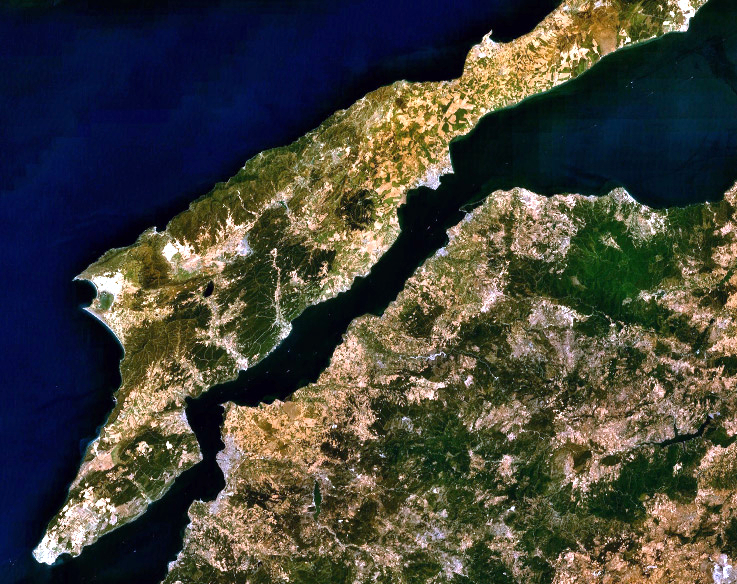
Its roots lay in the Ionian revolt (499–494) and Athens’ help to the rebels, and the defeat at Marathon (490) left the score unsettled. Xerxes prepared for three years: the Athos canal, supply depots in Thrace, and two bridges of boats over the Hellespont.
In spring 480 he marched from Sardis, crossed the Hellespont, reviewed the army at Doriscus and passed through Thrace, Macedon and Thessaly. In August/September he forced Thermopylae by turning it over the mountain while the fleet fought at Artemisium. He took an empty Athens and burned the Acropolis. In September his fleet was beaten at Salamis.
The king returned to Asia and left Mardonius behind. Mardonius fell at Plataea in August 479, and in the same days the Persian fleet burned at Mycale. The Greeks took Sestos and the war moved to Asia.
No Persian account of the war survives. The Daiva inscription lists “Yaunâ, those who dwell on this side of the sea and those who dwell across the sea” among his lands but say nothing of battle. Every detail of the narrative is Greek and has to be read through that lens.
I was moved to compassion when I considered the shortness of all human life, since of all this multitude of men not one will be alive a hundred years from now.
Foreigner, go tell the Spartans that we lie here obedient to their commands.
Whenever Xerxes, as he sat beneath the mountain opposite Salamis which is called Aegaleos, saw one of his own men achieve some feat in the battle, he inquired who did it, and his scribes wrote down the captain’s name with his father and city of residence.

From the Persian side the campaign answered Athens’ meddling and pushed the frontier to where the king saw himself as guardian of order. From the Greek side it was the defence of self-governing cities against a king who demanded earth and water. Both views are right by their own sources; the outcome is clear: cities whose citizens fought for their own homes and property beat a larger army of subjects.
For Europe the Greek war became a founding myth of “freedom against despotism”. For Iranians today it is more useful to know the story without the myth: a capable king, an organised army, and a defeat that came not from Persian weakness but from narrows, storms and the motivation of defenders.
Sources: Herodotus, tr. A. D. Godley · Aeschylus · G. Cawkwell · J. F. Lazenby · P. Briant · C. J. Tuplin · Livius.org (after R. G. Kent, Old Persian, 1953)
Dossier · 5
The army: Herodotus’ figures and modern estimates
Herodotus’ claim: a land army of 1,700,000 (7.60) and a fleet of 1,207 warships (7.89); with crews and followers, those brought as far as Thermopylae numbered 5,283,220 (7.186). Aeschylus likewise sets twelve hundred-odd Persian ships against roughly three hundred Greek at Salamis.
Modern view: no serious scholar accepts Herodotus’ figure. The main argument is logistics: water, fodder and bread for millions were impossible in mountainous Greece. Scholars such as Lazenby, Cawkwell, Briant and Kuhrt each give much lower estimates by different methods, and they do not agree; we do not print a single “right” number. Some treat the fleet figure as closer to reality, since ships could be counted from city contingents.
…the total of the whole land army was shown to be one million and seven hundred thousand.
Here four thousand from the Peloponnese once fought three million.
The huge figures had a literary function: the bigger the enemy, the more glorious the victory of free citizens. The real Achaemenid army, with a Persian and Median core and contingents of subject peoples, was the tool of a taxing state; its size came from its capacity to collect tribute.
Learning the difference between a source’s claim and a scholar’s estimate may be the most important historical lesson of this war.
Sources: Herodotus, tr. A. D. Godley · Aeschylus · J. F. Lazenby · G. Cawkwell · P. Briant · A. Kuhrt · C. J. Tuplin
Dossier · 6
Economy, tribute and taxation
Xerxes kept Darius’ tribute system. The Persepolis Fortification and Treasury tablets show the ration and payment machine working into his reign. The Daiva inscription says the lands “bore me tribute”. The Greek campaign was a huge expense met from that tribute, from compulsory labour (the Athos canal) and from ships levied on subject cities.
They bore me tribute. What was said to them by me, that they did. My law, that held them…

Fixed tribute beats arbitrary plunder, but it is still a forced transfer of property. When a distant war is funded by forced labour and requisitioned ships, millions pay for one man’s decision.
A state that can tax without consent can also go to war without consent. The link still holds.
Sources: Xerxes, Daiva inscription (XPh), tr. after R. G. Kent · A. Kuhrt · P. Briant · Herodotus, tr. A. D. Godley
Dossier · 7
Markets, roads and the royal post
The Royal Road and its stations worked throughout his reign. Herodotus describes the royal post that carried the news of Salamis to Susa (8.98). The daric and siglos coins introduced by Darius circulated in the west of the empire.
These are stopped neither by snow nor rain nor heat nor darkness from accomplishing their appointed course with all speed.
Roads and coins were built for the king, but merchants benefited too. A safe road is a public good that even a tribute state can supply.
Herodotus’ sentence on the Persian couriers is carved over the New York post office: an Iranian legacy few Iranians know.
Sources: Herodotus, tr. A. D. Godley · P. Briant · A. Kuhrt
Dossier · 8
Religion and the Daiva inscription
Inscription XPh, known from stone slabs from Persepolis and Pasargadae, is his main religious text. It names neither the rebel land nor the sanctuary. In the same period the Persepolis tablets show the royal administration issuing rations for Elamite and other gods as well.
And among these countries there was a place where previously demons (daiva) were worshipped. Afterwards, by the grace of Ahuramazda I destroyed that sanctuary of demons, and I proclaimed: ‘The demons shall not be worshipped!’ Where previously the demons were worshipped, there I worshipped Ahuramazda at the proper time and in the proper manner.

There are two readings. One takes the text as a report of a real event and Xerxes as less tolerant than Cyrus or Darius. The other (Sancisi-Weerdenburg) reads it as formal royal rhetoric that equates rebellion with “the Lie” and daiva worship, as Darius did at Bisotun. The tablets, which show plural cults, support the second reading.
Even on the second reading, the text shows political power claiming to decide which worship is legitimate. Freedom of conscience means no king has that right.
Sources: Xerxes, Daiva inscription (XPh), tr. after R. G. Kent · H. Sancisi-Weerdenburg · A. Kuhrt · P. Briant
Dossier · 9
Law and command
XPh uses the word data (law): “my law, that held them”. Inscription XPl, almost a copy of Darius’ Naqsh-e Rostam text (DNb), presents the king as lover of what is right, enemy of the Lie, and one who does not wish the strong to wrong the weak nor the weak the strong. The Van inscription uses the same language of continuity with his father.

The ideal that neither the strong wrong the weak nor the weak the strong approaches the rule of law. But a law that is “my law”, flowing from the king’s will, can change with that will. That is the line between rule by law and the rule of law.
A constitution that binds the ruler too is exactly what these inscriptions lack.
Sources: Xerxes, Daiva inscription (XPh), tr. after R. G. Kent · Livius.org (after R. G. Kent, Old Persian, 1953) · A. Kuhrt · P. Briant
Dossier · 10
Individual freedoms
Within the empire, private property, contracts and markets continued (for instance in Babylonian archives), and cities and communities kept their own laws and cults. Against this stood forced labour, levies and tribute, and anyone associated with revolt risked property and life. The sources say nothing of individual liberty against the king.
Freedom in the Achaemenid empire was freedom “while loyal”: broad in daily life but unguaranteed against the state. The Greeks were running another experiment at the time: citizens who voted in assembly and fought for their own homes. That experiment too excluded slaves and women.
A fair comparison is not “Greek freedom versus Persian slavery” but a question of guarantees: what separates a person’s property and conscience from the will of power?
Sources: A. Kuhrt · P. Briant · C. Waerzeggers · Herodotus, tr. A. D. Godley
Dossier · 11
Xerxes in others’ stories
Aeschylus’ Persians (472 BCE) staged the defeat from the Persian court; Herodotus (c. 430) made Xerxes a great king undone by hubris and bad advisers. Ctesias offers court stories of little reliability.
Jewish and Christian tradition identifies the Ahasuerus of the Book of Esther with Xerxes; the name match is accepted, but most scholars do not take the Esther story as history. The film 300 (2006) made Xerxes a giant and the Persians monsters, a distortion that matches neither Herodotus nor the Persian evidence.
My men have become women, and my women men.


Every story needed Xerxes for something: Aeschylus to warn Athens, Herodotus to teach about hubris, the Esther tradition for a tale of deliverance, Hollywood for an Eastern “other”. His own inscriptions present him only as his father’s continuator.
An Iranian today can see Xerxes as neither hero nor monster, but a real king who built, fought, lost and was murdered in his palace; and seeing him that way is itself an exercise in free thought.
Sources: Aeschylus · Herodotus, tr. A. D. Godley · R. Rollinger · Ctesias of Cnidus (via Photius’ epitome) · H. Sancisi-Weerdenburg · Encyclopaedia Iranica
A king whose story others wrote
Xerxes kept his father’s empire intact, quelled revolts by targeted repression and built the grandest gates and palaces at Persepolis. The defeat in Greece did not shake the empire, but it fixed his image forever.
Through a property-and-liberty lens, the main lesson is that a tribute state can provide order, roads and coin, but when every decision rests with one man, that man can carry the wealth of millions into a distant war, and his succession can end in blood. On the other side, small cities showed that people defending their own homes and property can be stronger than a larger army.
Bibliography
- Herodotus, tr. A. D. Godley, The Histories (Loeb Classical Library), books 7–9 (1920–1925). http://www.perseus.tufts.edu/hopper/text?doc=Perseus:text:1999.01.0126The main source for the war: Greek, written about half a century later. We treat his numbers and speeches as his account, not as records.
- Aeschylus, Persians (first staged at Athens, 472 BCE) (472 BCE). The only surviving contemporary source; an Athenian play, not a history.
- Ctesias of Cnidus (via Photius’ epitome), Persica, books 12–13 (c. 390 BCE). A Greek physician at the court of Artaxerxes II; notoriously unreliable and at odds with Herodotus in places.
- Diodorus Siculus, Library of History, book 11 (1st c. BCE).
- Xerxes, Daiva inscription (XPh), tr. after R. G. Kent, Livius.org: XPh (Kent 1953). https://www.livius.org/sources/content/achaemenid-royal-inscriptions/xph/
- Livius.org (after R. G. Kent, Old Persian, 1953), Achaemenid royal inscriptions: XPa, XPl, XV (1953 / online). https://www.livius.org/sources/content/achaemenid-royal-inscriptions/
- Encyclopaedia Iranica, Xerxes (ii. Xerxes I) (2000, updated 2012). https://www.iranicaonline.org/articles/xerxes/
- R. Rollinger, Herodotus vii. Xerxes according to Herodotus, Encyclopaedia Iranica (2003). https://www.iranicaonline.org/articles/herodotus-vii/
- C. J. Tuplin, Salamis, Encyclopaedia Iranica (2006). https://www.iranicaonline.org/articles/salamis/
- P. Briant, From Cyrus to Alexander: A History of the Persian Empire (2002).
- A. Kuhrt, The Persian Empire: A Corpus of Sources from the Achaemenid Period (2007).
- A. Kuhrt and S. Sherwin-White, Xerxes’ destruction of Babylonian temples, Achaemenid History II (1987).
- C. Waerzeggers, The Babylonian revolts against Xerxes and the “end of archives”, Archiv für Orientforschung 50 (2003/2004).
- G. Cawkwell, The Greek Wars: The Failure of Persia (2005).
- J. F. Lazenby, The Defence of Greece, 490–479 BC (1993).
- H. Sancisi-Weerdenburg, The personality of Xerxes, king of kings (1989).
- Justin, tr. J. S. Watson, Epitome of Pompeius Trogus, book 3.1 (1853). https://www.attalus.org/translate/justin9.htmlA Latin epitome of the 2nd–3rd century CE; late.
- Aristotle, tr. H. Rackham, Politics 5.1311b (Loeb) (1944).
- Manetho, fr. 70 (Africanus), tr. W. G. Waddell, Manetho (Loeb Classical Library) (1940).
- BM 32234 (LBAT *1419), tr. C. B. F. Walker, A Babylonian lunar-eclipse tablet recording Xerxes’ murder (in Kuhrt 2007; Sachs and Hunger, ADART V no. 4) (Walker 1997). The only contemporary Babylonian witness to the murder.
- M. W. Stolper, Some ghost facts from Achaemenid Babylonian texts, Journal of Hellenic Studies 108 (1988).
- British Museum, Collection online: Achaemenid objects and the Xerxes material (online). https://www.britishmuseum.org/collection
All photos are from Wikimedia Commons; licence and author were checked on each file page.
Darius the Great, his fatherThe Persepolis archivesThe Achaemenid dynasty