Arsacids (Parthians)
Artabanus IV
اردوان چهارم
- Reign
- c. 213–224 CE
- Dynasty
- Arsacids (Parthians)
- Persian page
- فارسی
Featured dossier
Artabanus IV: Caracalla’s deceit, victory at Nisibis, and the end at Hormozgan
The last Great King of the Arsacids. Artabanus rose against his brother Vologases VI and became, in Rome’s eyes, the king of Parthia. According to Herodian, the emperor Caracalla came in 216 CE to marry his daughter and at the wedding feast fell on the unarmed guests. A year later Artabanus came for revenge and, after a three-day battle at Nisibis, forced Macrinus to pay a great indemnity. But the real danger was in Persis: in 224 CE Ardashir defeated and killed him at Hormozgan. Four and a half centuries of Arsacid rule came to an end.
- years of reign
- ~11
- days of battle at Nisibis (Herodian)
- 3
- denarii paid by Rome (Iranica)
- 50 million
- years of Arsacid rule
- ~475
Animated map: the life of Artabanus IV
Administration & economyc. 213 CE1 of 8
Brother against brother
Iranica: Artabanus, the younger son of Vologases V, rose against his brother Vologases VI about 213 CE. His drachms were struck at Ecbatana (Hamadan), which the marker follows.
Certainty: ProbableHis exact base is not stated in the sources; Ecbatana is only where the coins shown here were struck.
Sources: K. Schippmann, Encyclopaedia Iranica, 1986, updated 2016 · D. Sellwood, 1980
BattleCampaignBuildingAdministration & economyReligionArrow keys, Home/End and Space work.
From Arbela to Nisibis and Hormozgan, step by step (213–224 CE)
The brothers’ war, Caracalla’s deceit, the battle of Nisibis and Ardashir’s rise to the battle of Hormozgan. Each step says whether it is secure, probable or disputed. The narrative sources are Roman (Herodian) or written centuries later (Tabari, via Iranica); the routes are sketches. The step-by-step diagram of Nisibis is below the map.
Administration & economyc. 213 CE1 of 7
Brother against brother
Iranica: Artabanus, the younger son of Vologases V, rose against his brother Vologases VI about 213 CE. His drachms were struck at Ecbatana (Hamadan), which the marker follows.
Certainty: ProbableHis exact base is not stated in the sources; Ecbatana is only where the coins shown here were struck.
Sources: K. Schippmann, Encyclopaedia Iranica, 1986, updated 2016 · D. Sellwood, 1980
BattleCampaignBuildingAdministration & economyReligionArrow keys, Home/End and Space work.
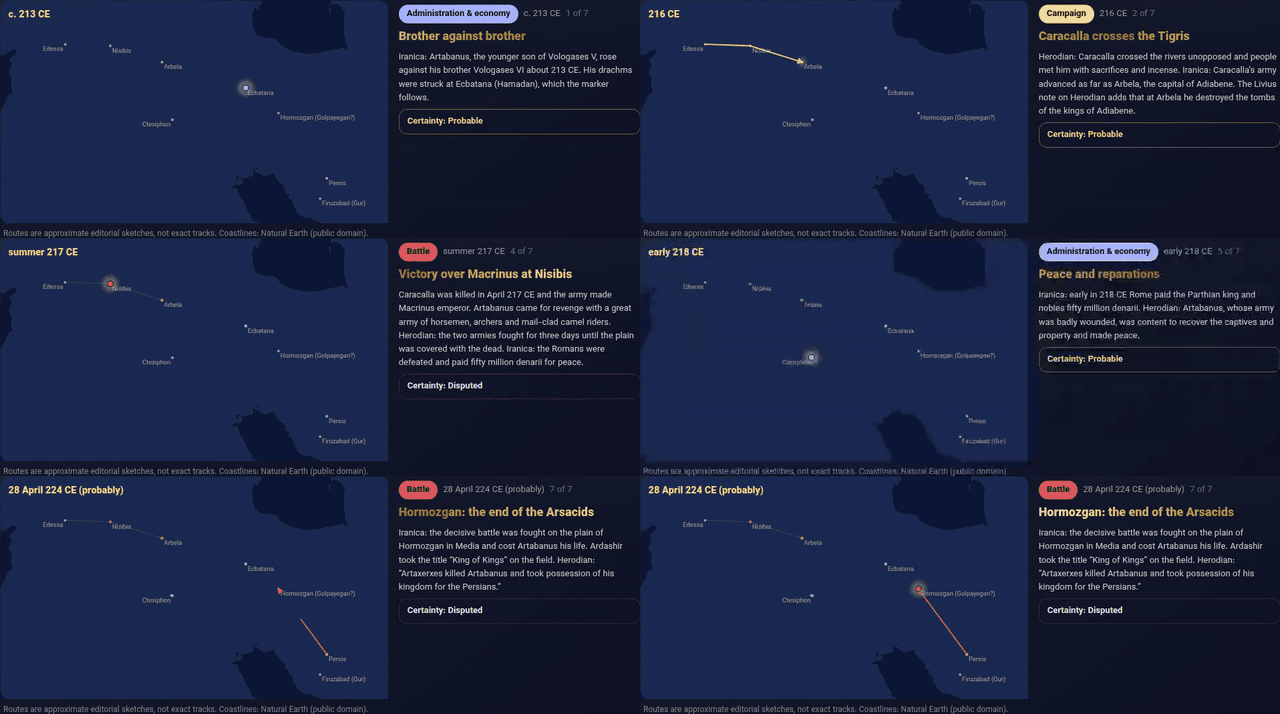
Nisibis, step by step (schematic)
summer 217 CE, three days · Schematic; exact positions are debated
Phase 1 / 4 · probable
The charge at sunrise
Artabanus appeared at sunrise. The Parthians saluted the sun, as was their custom, charged with a great shout and shot their arrows. Macrinus put his cavalry and Moorish javelin men on the wings and light troops in the gaps of the line.
Only Herodian describes the battle; positions are editorial and schematic.
ParthiansRomans
Three separate layers
Each section has three layers: “Historical evidence” is only what the sources say; “Philosophical interpretation” is our reading by the standard of property and liberty; “Modern cultural meaning”. Quotations come only from published translations, with references.
Historical evidencePhilosophical interpretationModern cultural meaning
Dossier · 1
Caracalla’s proposal (216 CE)
Herodian, a contemporary: Caracalla wanted the title “Parthicus” and to report to Rome that he had conquered the whole East, “even though there was peace everywhere”. So he wrote to Artabanus with costly gifts asking for his daughter: Rome and Parthia were the greatest empires in the world, Roman infantry and Parthian horse archers complemented each other, and Parthian spices and cloth and Roman metals would no longer be smuggled. Artabanus at first refused, then agreed. The Parthians came to the feast without horses or bows, and at a signal the Romans fell on them. Artabanus barely escaped.
Iranica gives another version: Artabanus turned the request down, and that gave Caracalla his pretext for war. The request itself, Iranica says, is clear evidence that Artabanus was then the king. Caracalla got as far as Arbela but achieved no decisive victory.
Since the Parthians produced spices and excellent textiles and the Romans metals and manufactured articles, these products would no longer be scarce and smuggled by merchants; rather, when there was one world under one supreme authority, both peoples would enjoy these goods and share them in common.
Then the signal was given, and Caracalla ordered his army to attack and massacre the spectators.

The two versions do not agree: in one the king accepts and is tricked; in the other he refuses and war follows. Herodian likes to dramatize, and the massacre at the feast is in his account alone. Still, both versions agree on one thing: Caracalla started a war without cause. Herodian himself has Macrinus say: “We provoked him by breaking the treaty, and in a time of complete peace we started a war.”
Caracalla’s letter paints a fine picture of free trade between two empires: goods would no longer be “scarce and smuggled”. Yet the same letter was cover for a trick. A promise of free markets from a man who does not keep treaties is worthless; trade rests on trust, and trust rests on keeping one’s word.
Sources: Herodian, tr. E. C. Echols · K. Schippmann, Encyclopaedia Iranica
Dossier · 2
Nisibis (217 CE)
Caracalla was killed in April 217 CE and the army, after two days without an emperor, chose Macrinus. Herodian: Artabanus came for revenge with a great army, strong cavalry, archers and mail-clad soldiers who threw spears from camels. The battle lasted three days. The Parthians did heavy damage with arrows and spears; the Romans brought down horses and camels with a feigned retreat and caltrops. On the third day the Parthians tried to outflank the Romans, who widened their front. In the end Macrinus sent peace terms and promised to return the captives and property.
Iranica: the Parthians demanded Rome’s withdrawal from Mesopotamia and restitution for the damage. Macrinus refused, the war went on, and the Romans were defeated at Nisibis, as the peace terms show: early in 218 CE Rome paid the Parthian king and nobles fifty million denarii in cash and gifts.
On the first and second days the two armies fought from morning until evening, and when night put an end to the fighting, each side withdrew to its own camp, claiming the victory.
We provoked him by breaking the treaty, and in a time of complete peace we started a war.
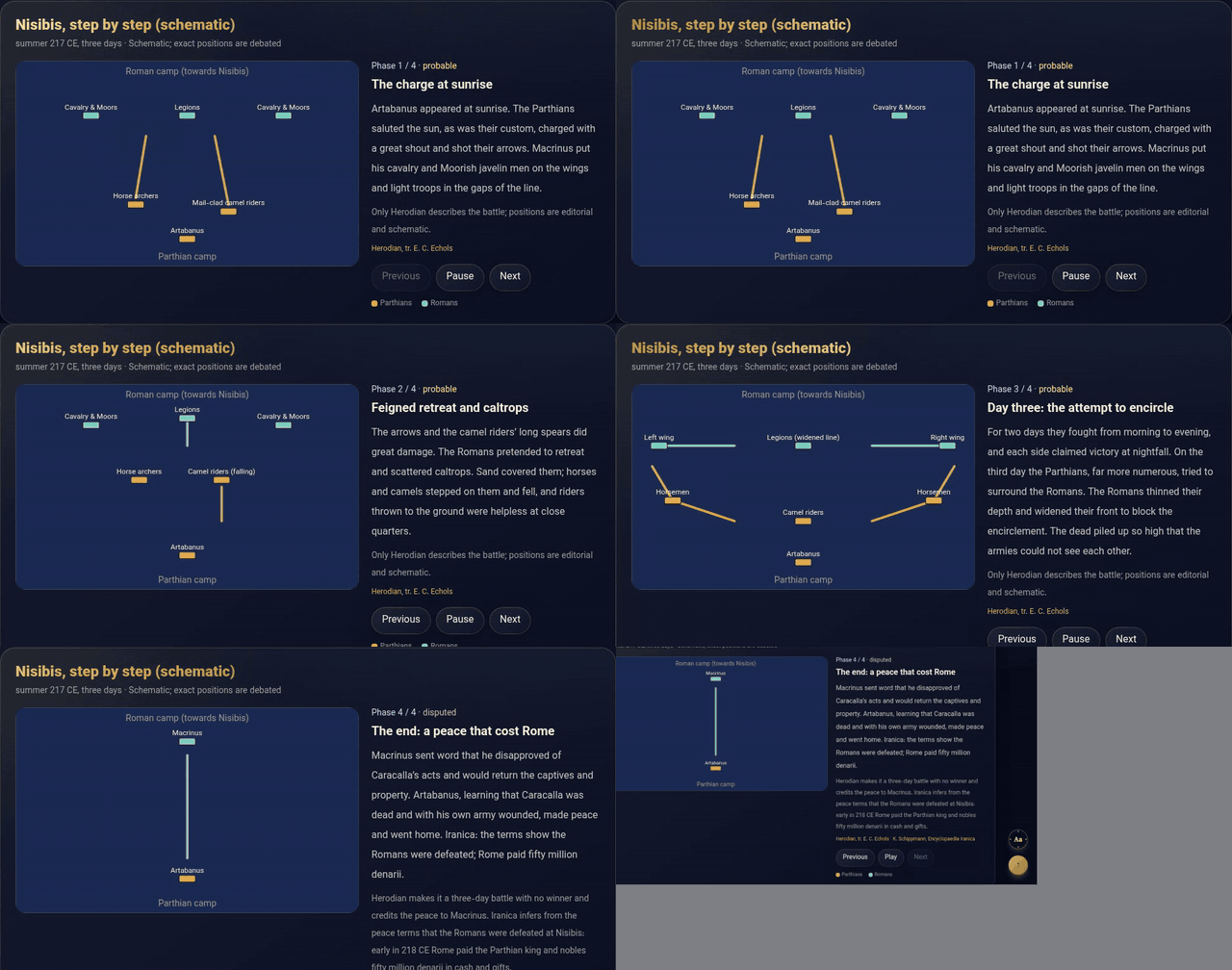
Herodian, a Roman, calls the battle a draw. But a winning army does not pay reparations; Iranica infers from this that the victory was Artabanus’. It was the last great Arsacid victory over Rome. The diagram below shows the battle step by step, schematically and on Herodian’s account alone.
Artabanus came for revenge but made peace once the captives and property were returned. A war begun by deceit ended with restitution: as close to justice as that age came.
Sources: Herodian, tr. E. C. Echols · K. Schippmann, Encyclopaedia Iranica
Dossier · 3
Hormozgan (224 CE)
Iranica (Schippmann): Ardashir, a minor vassal in Persis, from about 220 CE took neighbouring and more distant lands such as Kerman. When Artabanus moved against him it was too late. The decisive battle, “probably” on 28 April 224 CE near modern Golpayegan, between Isfahan and Nahavand, cost the Parthian Great King his life.
Iranica (Wiesehöfer): the battle was on the plain of Hormozgan in Media. A detailed account was probably written for the official Sasanian history and is likely Tabari’s ultimate source. Ardashir had the scene carved in a relief at Firuzabad and took the title “King of Kings” on the battlefield. Iranica treats Tabari’s story of letters between Ardashir and Artabanus as a literary dramatization of Ardashir’s claim to the throne. Herodian says only that Ardashir killed Artabanus.
For a long time the empire remained in his own family, down to Artabanus in our time; then Artaxerxes killed Artabanus and took possession of his kingdom for the Persians.

Iranica says Ardashir could not have won without “a widespread mood of discontent with the Parthian régime”: many nobles and local rulers joined him. Two Arsacid kings, Artabanus and Vologases VI, were fighting each other. Some sources date Ardashir’s formal coronation at Ctesiphon to 226 CE, and Hatra and Arsacid Armenia resisted him for years.
The Arsacid kingdom was a league of houses and provinces, each with its share and its rights. When the kings fought over the throne and the nobles saw their interest elsewhere, the league fell apart. The Sasanians built a more centralized state; the price was less freedom for the provinces.
Sources: K. Schippmann, Encyclopaedia Iranica · J. Wiesehöfer, Encyclopaedia Iranica · Herodian, tr. E. C. Echols
Synthesis
Artabanus IV took the kingdom from his brother, survived Caracalla’s deceit and made Rome pay reparations after Nisibis: the last great Arsacid victory. But in those same years Ardashir was gathering strength in Persis, and in 224 CE Artabanus was killed at Hormozgan. With him four and a half centuries of Arsacid rule came to an end.
Bibliography
- Herodian, tr. E. C. Echols, History of the Roman Empire 3.9, 4.10–11, 4.14–15, 6.2 (1961). https://www.livius.org/sources/content/herodian-s-roman-history/A contemporary, but more rhetorical than exact; he sometimes confuses names and the order of events.
- K. Schippmann, Encyclopaedia Iranica, Arsacids ii. The Arsacid dynasty (1986, updated 2016). https://www.iranicaonline.org/articles/arsacids-ii/
- J. Wiesehöfer, Encyclopaedia Iranica, Ardašīr I i. History (1986, updated 2011). https://www.iranicaonline.org/articles/ardasir-i/
- D. Sellwood, An Introduction to the Coinage of Parthia, 2nd ed. (1980). The standard numbering of Parthian coins (“S”); some of its attributions have since been revised.
All photos are from Wikimedia Commons; licence and author were checked on each file page.
Vologases VI, his brotherVologases V, his fatherThe Arsacid dynastyArdashir I (Sasanian)