Sasanians
Ardashir I
اردشیر یکم (بابکان)
Epithets and titles
- PāpakānPāpakānpatronymicson of PāpakSource: J. Wiesehöfer, “Ardašīr I”, Encyclopaedia Iranica
- Reign
- 224–240/242 CE
- Dynasty
- Sasanians
- Persian page
- فارسی
Featured dossier
Ardashir son of Pāpak: from Istakhr to an empire
Ardashir, son of Pāpak, rose from a local family in Persis. On 28 April 224 CE he defeated Artabanus IV on the plain of Hormozgan and founded the Sasanian empire, which lasted four centuries. He built the round city of Ardashir-Khwarrah (Firuzabad), showed his kingship carved in the rock at Naqsh-e Rostam as a gift from Ohrmazd, and fought Rome over the “lands of the ancestors”. The tale of his youth and flight in the Kār-nāmag is legend, and the date of the Letter of Tansar, which is linked to him, is disputed.
- battle of Hormozgan
- 28 Apr 224
- cities in his name (Tabari’s list)
- 8
- investiture reliefs
- 3
- years of his dynasty
- 400+
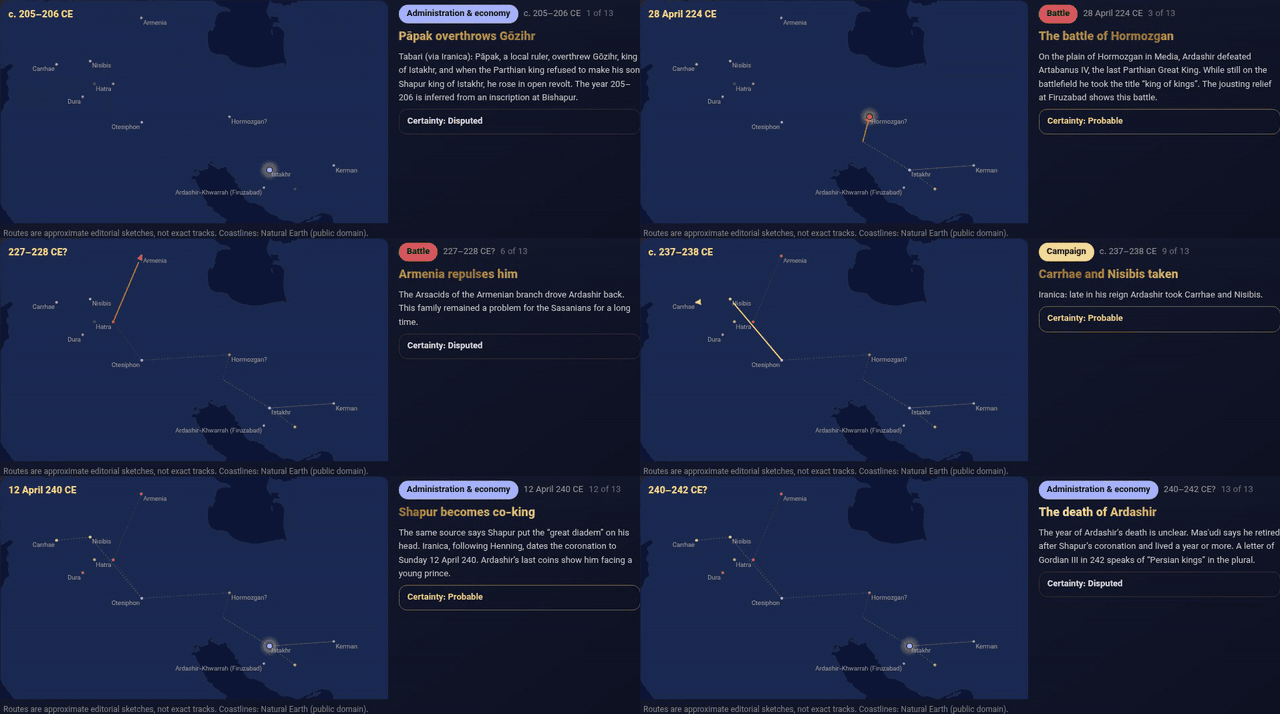
Animated map: from Persis to the Roman frontier
Administration & economyc. 205–206 CE1 of 13
Pāpak overthrows Gōzihr
Tabari (via Iranica): Pāpak, a local ruler, overthrew Gōzihr, king of Istakhr, and when the Parthian king refused to make his son Shapur king of Istakhr, he rose in open revolt. The year 205–206 is inferred from an inscription at Bishapur.
Certainty: DisputedThe year 205–206 is the start of an era in the Bishapur inscription. Iranica thinks it “all the more probable” that it marks Pāpak’s revolt, but its meaning is still debated.
Sources: J. Wiesehöfer, Encyclopaedia Iranica, 1986, updated 2011
BattleCampaignBuildingAdministration & economyReligionArrow keys, Home/End and Space work.
From Istakhr to Hatra, step by step (205–242 CE)
Pāpak’s revolt, Ardashir’s rise in Persis, the victory at Hormozgan and his wars with Rome and Hatra. Each step says whether it is secure, probable or disputed. Most of the story of the early years was written down centuries later, by Tabari and others; the routes are sketches.
Administration & economyc. 205–206 CE1 of 13
Pāpak overthrows Gōzihr
Tabari (via Iranica): Pāpak, a local ruler, overthrew Gōzihr, king of Istakhr, and when the Parthian king refused to make his son Shapur king of Istakhr, he rose in open revolt. The year 205–206 is inferred from an inscription at Bishapur.
Certainty: DisputedThe year 205–206 is the start of an era in the Bishapur inscription. Iranica thinks it “all the more probable” that it marks Pāpak’s revolt, but its meaning is still debated.
Sources: J. Wiesehöfer, Encyclopaedia Iranica, 1986, updated 2011
BattleCampaignBuildingAdministration & economyReligionArrow keys, Home/End and Space work.
Three separate layers
Each section has three layers: “Historical evidence” is only what the sources say; “Philosophical interpretation” is our reading by the standard of property and liberty; “Modern cultural meaning”. Quotations come only from published translations, with references.
Historical evidencePhilosophical interpretationModern cultural meaning
Dossier · 1
Rising from Persis: Pāpak and Sāsān
There are three accounts of Ardashir’s ancestry. Tabari makes Pāpak a son of Sāsān. Shapur’s inscription on the Kaʿba-ye Zardošt calls Sāsān a “lord” but does not call him Pāpak’s father. The Kār-nāmag says Sāsān descended from Dārā (Darius III), that Pāpak gave him his daughter, and that Ardashir was their child. Pāpak is known from Ardashir’s coins. Shapur, the elder son, also became king, but after the deaths of father and brother Ardashir took the lead and by 224 ruled Persis, Khuzestan and Kerman.


Iranica says some accept Tabari’s version, while others suppose that Ardashir was adopted by Pāpak, or that Sāsān, like Achaemenes, was only the famous ancestor of the house. Descent from Dārā is more a claim to legitimacy than a piece of news. Iranica adds that the revolt could not have succeeded without widespread discontent with Parthian rule.
Sasanian power began with one fortress and one local town, not with an ancient right. A dynasty that later called itself chosen by the gods came to the throne by revolting against its own lawful overlord.
Sources: J. Wiesehöfer, Encyclopaedia Iranica · Shapur I, ŠKZ (Kaʿba-ye Zardošt), tr. R. N. Frye
Dossier · 2
Hormozgan, 224 CE
The decisive battle between the Parthians and the Sasanians was fought on the plain of Hormozgan in Media on 28 April 224. Artabanus IV was killed. While still on the battlefield Ardashir took the title king of kings, which marked his accession; he also began a new era from this year. Ardashir showed the battle in the great jousting relief at Firuzabad.
Artabanus IV and the battle of Hormozgan
Iranica suspects that an official account of the battle was written for the Sasanian royal history and that Tabari drew on it in the end. So our story is the victor’s story. The exchange of letters between Ardashir and Artabanus that Tabari reports is, Iranica says, more a literary dramatization.
One battle on one day passed the rule of Iran from one house to another. For the farmer and the merchant, the real question was how much of their labour the new ruler would take.
Sources: J. Wiesehöfer, Encyclopaedia Iranica
Dossier · 3
Ardashir-Khwarrah: the round city
Nearly all sources, from the Kār-nāmag to Tabari and the Muslim geographers, credit Ardashir with founding the city of Gur. Its name was Ardashir-Khwarrah (“the glory of Ardashir”), and in the 10th century ʿAżod-al-Dawla renamed it Firuzabad. The city had an exact plan: a circle with twenty radial and several ring streets, a wall of stamped clay, a ditch 35 m wide and an outer wall. In the centre an inner circle held the official buildings. Ardashir-Khwarrah became one of the five kūras (districts) of Fars. Tabari lists eight cities founded by Ardashir, the first being Ardashir-Khwarrah.


Iranica notes that Iranian kings could found or rename towns only on royal land (dastkart). So city building was tied to the king’s ownership of the land. Iranica also warns that crediting all eight cities to Ardashir himself needs care.
A city built from one plan at one man’s command is a sign of power, not of a market. Free cities grow out of people’s trade; Ardashir-Khwarrah grew from the king’s will and the king’s land.
Sources: D. Huff, Encyclopaedia Iranica · J. Wiesehöfer, Encyclopaedia Iranica
Dossier · 4
Naqsh-e Rostam: kingship as Ohrmazd’s gift
Ardashir carved three investiture reliefs: at Firuzabad, Naqsh-e Rajab and Naqsh-e Rostam. At Naqsh-e Rostam the king and Ohrmazd are both mounted, and Ohrmazd hands Ardashir the ring of kingship. Two figures lie fallen under the horses’ hooves. An inscription in Middle Persian, Parthian and Greek names the two riders.
This is the image of the Mazda-worshipping lord, Ardaxšīr, king of kings of the Iranians, whose lineage is from the gods, son of the lord, king Pābag
This is the image of the Lord, Ohrmazd

The figure under Ardashir’s horse is usually taken to be Artabanus IV, and the one under Ohrmazd’s horse to be Ahriman. If so, the message is clear: the king’s victory over his rival matches the god’s victory over evil. The relief was cut beside the tombs of the Achaemenid kings; its place is itself a claim to their legacy.
When power is called a gift of god, it becomes hard to question. A ruler who thinks himself chosen by heaven sees no need for the consent of the people.
Sources: Ardashir I, ANRm, tr. T. Daryaee (Sasanika) · J. Wiesehöfer, Encyclopaedia Iranica
Dossier · 5
The Kār-nāmag: legend, not history
The Kār-nāmag ī Ardašīr ī Pābagān is a short prose work in Middle Persian. Its only independent manuscript was copied in 1322 in Gujarat. If Frantz Grenet’s reconstruction is right, the present text took shape after 706, nearly five centuries after Ardashir.
Iranica (Cereti) says the story draws on older Iranian lore and that some of its features echo the legend of Cyrus the Great. So it should be read as a tale in praise of the founder, not as a record of events.
Legends do not tell us what happened, but they tell us what rulers wanted people to believe: that kingship is a fortune sent from heaven, not something taken by force.
Sources: C. G. Cereti, Encyclopaedia Iranica
Dossier · 6
The Letter of Tansar: Ardashir’s document or a sixth-century work?
The Letter of Tansar is the reply of Ardashir’s chief priest to Gušnasp, king of Tabaristan, who had complained about Ardashir’s conduct. The original Middle Persian text is lost. Ibn al-Muqaffaʿ put it into Arabic, and Ibn Isfandiyar in the 13th century turned the Arabic into Persian. The letter puts people in four estates: priests, warriors, scribes and working people, and counts the fourth as “tillers of land and herders of cattle and merchants”. According to the letter, passing from one estate to another is only for someone of outstanding ability.
Assuredly there shall be no passing from one to another unless in the character of one of us outstanding capacity is found.
The truth is that after Darius each of the "kings of the peoples" built his own fire-temple. This was pure innovation, introduced by them without the authority of kings of old.
Whether or not this letter can be regarded as an authentic document of the time of Ardasir has been a matter for discussion since the beginning of the present century.
The date of the letter is disputed. Christensen and Minovi held it to be a work of the age of Khosrow I in the 6th century, written in Ardashir’s name to make Khosrow’s reforms look ancient. Darmesteter and Boyce take it to be in the main from Ardashir’s time, with 6th-century additions. Herzfeld identified Tansar with Kartir. Iranica (Wiesehöfer) uses the letter for Ardashir’s religious policy, but says Boyce’s view on the persecution of image shrines is “strongly disputed”.
A society in which each person’s place is fixed by birth narrows the freedom to choose one’s work. The letter even calls the family fire temples set up by the “kings of the peoples” an “innovation” made without the authority of the kings of old: the right to practise religion, too, belongs to the king.
Sources: M. Boyce (tr.) · J. Wiesehöfer, Encyclopaedia Iranica
Dossier · 7
Ardashir and Rome: the “lands of the ancestors”
In 230 Ardashir invaded Roman Mesopotamia and besieged Nisibis. Herodian, a contemporary, says he wanted all the lands that had once belonged to the Persians. Severus Alexander answered in 231–233; the outcome is unclear and no treaty was made. Years later Ardashir took Carrhae and Nisibis (c. 237–238) and in 240 conquered Hatra.
He asserted that it was therefore proper for him to recover for the Persians the kingdom which they had formerly possessed.
Iranica says the Sasanian claim was probably not as precise as Herodian suggests, but the Romans understood its aim correctly. Tabari also reports Ardashir saying that he had risen to avenge Dārā on Alexander. Iranica notes that the Parthians had sometimes made similar claims; the Sasanians used it with more success.
The claim to “ancestral lands” is an old excuse for war. Its price was paid by the frontier peoples whose cities changed hands again and again between two empires.
Sources: Herodian, tr. E. C. Echols · J. Wiesehöfer, Encyclopaedia Iranica
Synthesis
Ardashir rose from a local ruler in Persis to king of kings and founded a dynasty that lasted more than four centuries. The contemporary evidence is thin: coins, reliefs and short inscriptions, plus Herodian and Dio. Most of his story was written down centuries later by Tabari and the Kār-nāmag. He centralized power, built cities on royal land and showed kingship as a gift of Ohrmazd. These became the base of a strong state, but a state in which people’s place was fixed by birth and by the king’s will.
Bibliography
- J. Wiesehöfer, Encyclopaedia Iranica, Ardašīr I i. History (1986, updated 2011). https://www.iranicaonline.org/articles/ardasir-i/
- Ardashir I, ANRm, tr. T. Daryaee (Sasanika), Inscription on the investiture relief at Naqsh-e Rostam (n.d.). https://sites.uci.edu/sasanika/ardaxsir-ohrmazd-naqs-e-rostam-anrm-ab/
- Herodian, tr. E. C. Echols, History of the Roman Empire 6.2–6.6 (1961). https://www.livius.org/sources/content/herodian-s-roman-history/
- M. Boyce (tr.), The Letter of Tansar (Serie Orientale Roma 38) (1968). https://archive.org/details/TheLetterOfTansarTranslatedByMaryBoyceSurvives only through Ibn Isfandiyar’s Persian translation (13th century) of Ibn al-Muqaffaʿ’s Arabic version.
- C. G. Cereti, Encyclopaedia Iranica, Kār-nāmag ī Ardašīr ī Pābagān (2011). https://www.iranicaonline.org/articles/karnamag-i-ardasir/
- D. Huff, Encyclopaedia Iranica, Fīrūzābād (1999). https://www.iranicaonline.org/articles/firuzabad/
- Shapur I, ŠKZ (Kaʿba-ye Zardošt), tr. R. N. Frye, The Inscription of Shapur I at Naqsh-e Rustam in Fars, in The History of Ancient Iran, Appendix 4 (1984). https://sites.uci.edu/sasanika/sapur-is-inscription-kaba-ye-zartost-skz/Shapur’s own account of his wars, in Middle Persian, Parthian and Greek, on the walls of the Kaʿba-ye Zardošt. Contemporary, but royal propaganda.
- A. Henrichs & L. Koenen (via Iranica), Cologne Mani Codex 18 (1970–1975). A Greek life of Mani; it dates Shapur’s crowning and the fall of Hatra. Used here only through Iranica.
- A. Sh. Shahbazi, Encyclopaedia Iranica, Šāpur I: History (2002, updated 2018). https://www.iranicaonline.org/articles/shapur-i/
All photos are from Wikimedia Commons; licence and author were checked on each file page.
Artabanus IV, the last Parthian Great KingShapur I, his sonThe Sasanian dynasty