Featured dossier
Shapur I: three Roman emperors and the Kaʿba-ye Zardošt inscription
Shapur, son of Ardashir, was crowned in his father’s lifetime and reigned for thirty years. He fought Rome in three campaigns: at Misiche (244) Gordian III was killed and Philip bought peace; at Barbalissos (252/253) a Roman army was destroyed and Antioch fell; and in 260, near Edessa, the emperor Valerian was taken prisoner. Shapur wrote this down in a trilingual inscription on the Kaʿba-ye Zardošt and carved it at Naqsh-e Rostam and Bishapur. He settled thousands of Roman captives in Iranian cities. In his time Mani preached his religion freely.
- Roman emperors in his reliefs
- 3
- denarii for Philip’s peace (Shapur’s claim)
- 500,000
- towns and forts in the inscription’s lists
- 73
- Valerian captured (CE)
- 260
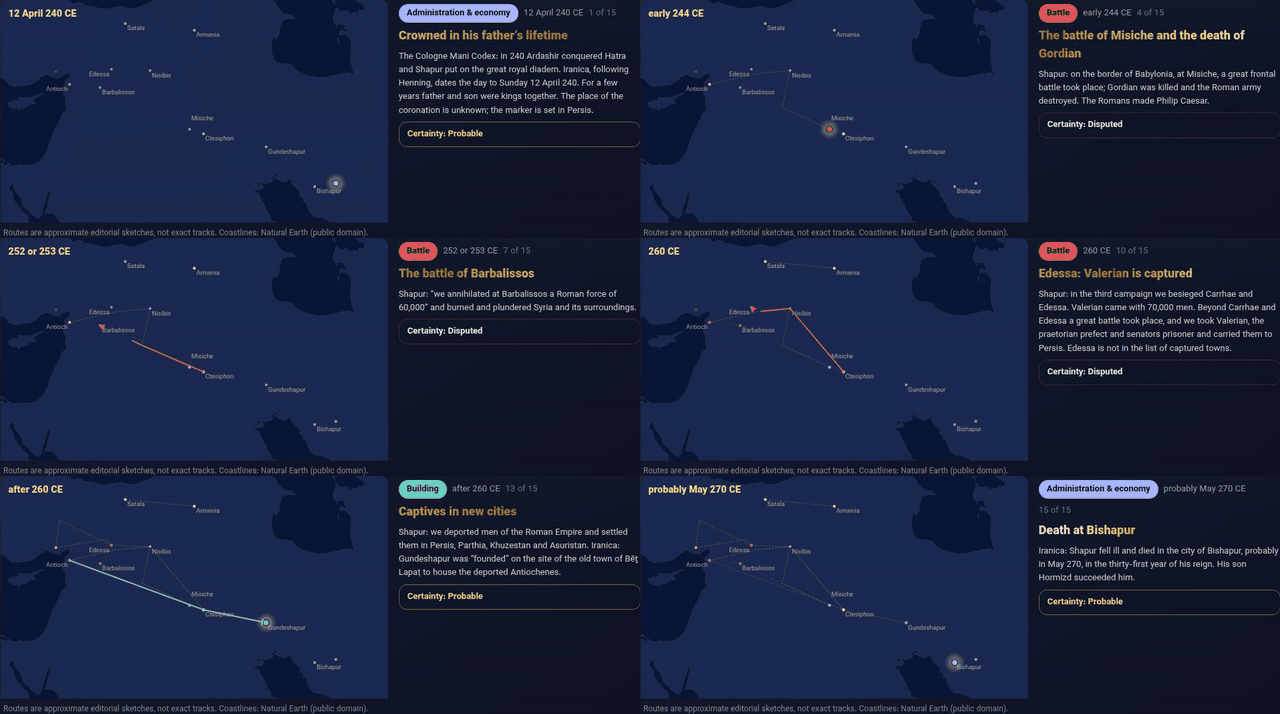
Animated map: Shapur’s three campaigns
Administration & economy12 April 240 CE1 of 15
Crowned in his father’s lifetime
The Cologne Mani Codex: in 240 Ardashir conquered Hatra and Shapur put on the great royal diadem. Iranica, following Henning, dates the day to Sunday 12 April 240. For a few years father and son were kings together. The place of the coronation is unknown; the marker is set in Persis.
Certainty: Probable
Sources: A. Henrichs & L. Koenen (via Iranica), 1970–1975 · A. Sh. Shahbazi, Encyclopaedia Iranica, 2002, updated 2018
BattleCampaignBuildingAdministration & economyReligionArrow keys, Home/End and Space work.
From Misiche to Edessa, step by step (240–270 CE)
Shapur’s three campaigns as told in his own inscription, beside what the Romans and Iranica say. Each step says whether it is secure, probable or disputed; the routes are sketches. The step-by-step diagram of the battle of Edessa is below the map.
Administration & economy12 April 240 CE1 of 15
Crowned in his father’s lifetime
The Cologne Mani Codex: in 240 Ardashir conquered Hatra and Shapur put on the great royal diadem. Iranica, following Henning, dates the day to Sunday 12 April 240. For a few years father and son were kings together. The place of the coronation is unknown; the marker is set in Persis.
Certainty: Probable
Sources: A. Henrichs & L. Koenen (via Iranica), 1970–1975 · A. Sh. Shahbazi, Encyclopaedia Iranica, 2002, updated 2018
BattleCampaignBuildingAdministration & economyReligionArrow keys, Home/End and Space work.
Edessa, 260 CE, step by step (schematic)
260 CE · Schematic; exact positions are debated
Phase 1 / 4 · secure
The siege of Carrhae and Edessa
In his third campaign Shapur besieged Carrhae and Edessa.
Only Shapur’s inscription (and a few short Roman notices) mention the battle; no tactical account survives. Positions are editorial and schematic.
Shapur I, ŠKZ (Kaʿba-ye Zardošt), tr. R. N. Frye
Iranians (Sasanian)Romans
Three separate layers
Each section has three layers: “Historical evidence” is only what the sources say; “Philosophical interpretation” is our reading by the standard of property and liberty; “Modern cultural meaning”. Quotations come only from published translations, with references.
Historical evidencePhilosophical interpretationModern cultural meaning
Dossier · 1
The Kaʿba-ye Zardošt inscription: Shapur in his own words
Shapur wrote the account of his wars and religious foundations in Middle Persian, Parthian and Greek on the walls of the Kaʿba-ye Zardošt at Naqsh-e Rostam. Scholars call it ŠKZ, or the Res Gestae Divi Saporis. Since 1940 it has been possible to set the Roman account of the wars beside Shapur’s own. The inscription also names the fires Shapur founded for his own soul and for his family.
I, the Mazda worshipping lord Shapur, king of kings of Iran and non-Iran, whose lineage is from the Gods, son of the Mazda worshipping divinity Ardashir, king of kings of Iran, whose lineage is from the Gods, grandson of king Papak, am ruler of Iranshahr
We ordered it written so that whoever comes after us may know this fame, heroism and power of us.

The text is contemporary and first-hand, but it is official propaganda. Shapur mentions no defeat and makes his enemies’ numbers large. Even so, its lists of towns and provinces are very precise and broadly match the Roman sources. Iranica (Shahbazi) says the inscription and the reliefs agree with the Roman sources that there were three campaigns.
Shapur himself says why he wrote: so that those who came after would know his fame and power. Royal inscriptions are records of power, not of people’s lives; to hear the voice of the burned towns we have to look elsewhere.
Sources: Shapur I, ŠKZ (Kaʿba-ye Zardošt), tr. R. N. Frye · A. Sh. Shahbazi, Encyclopaedia Iranica
Dossier · 2
Misiche, 244 CE: Gordian and Philip
According to Shapur, Gordian III raised a force “in all of the Roman Empire” and marched on Asuristan (Babylonia). At Misiche, on the border of Babylonia, a great battle took place; Gordian was killed and the Roman army destroyed. Philip the Arab, the new emperor, paid 500,000 denarii and made peace. Shapur renamed Misiche Peroz-Shapur (“victorious is Shapur”).
On the border of Babylonia at Misikhe, a great 'frontal'battle occurred. Gordian Caesar […] was killed and the Roman force was destroyed. And the Romans made Philip Caesar. Then Philip Caesar came to us for terms, and to ransom their lives, gave us 500,000 denars, and became tributary to us. And for this reason we have renamed Misikhe Peroz-Shapur.
The Roman account is different. The official life of Gordian says he was winning and Philip had him removed by a plot; Zosimus says he was killed deep in enemy land; Zonaras that he fell from his horse and died. None of these can be accepted outright. What both sides accept is that Philip paid and made peace.
Shapur proudly carved in stone the money he took “to ransom their lives”. In the wars of kings, even a soldier’s life is a commodity to be bought and sold.
Sources: Shapur I, ŠKZ (Kaʿba-ye Zardošt), tr. R. N. Frye · A. Sh. Shahbazi, Encyclopaedia Iranica
Dossier · 3
Barbalissos and Antioch: the second campaign
Shapur says that Caesar “lied again and did wrong to Armenia”, so he attacked the Roman Empire and destroyed a force of 60,000 at Barbalissos on the Euphrates. He then names 37 towns and forts, from Anatha and Dura to Antioch, and Satala in Cappadocia. Iranica: after Barbalissos Shapur divided his forces, and his son Hormizd-Ardashir invaded Lesser Armenia and Cappadocia.
And Caesar lied again and did wrong to Armenia. Then we attacked the Roman Empire and annihilated at Barbalissos a Roman force of 60,000
a total of 37 towns with surroundings.
The year of Barbalissos (252 or 253) and the year Antioch fell (253 or 256) are disputed. Iranica speaks of several campaigns in 253–256 that the inscription merges into one. The figure of 60,000 should be taken as the victor’s claim.
“We burned, ruined and pillaged” comes again and again in this inscription. For the people of the Syrian towns this war was neither victory nor defeat, but the loss of their homes and property.
Sources: Shapur I, ŠKZ (Kaʿba-ye Zardošt), tr. R. N. Frye · A. Sh. Shahbazi, Encyclopaedia Iranica
Dossier · 4
Edessa, 260 CE: the capture of Valerian
In his third campaign Shapur besieged Carrhae and Edessa. Valerian came with a force of 70,000. “Beyond Carrhae and Edessa” a great battle took place, and Shapur took Valerian, the praetorian prefect and senators prisoner and carried them to Persis. He then plundered Syria, Cilicia and Cappadocia and names 36 more towns. Edessa is not on the list; Iranica (Lieu) says Shapur had to bribe his way past the garrison of Edessa on his way back, so the city either held out or was in his hands only briefly.
In the third campaign, when we attacked Carrhae and Urhai [Edessa] and were besieging Carrhae and Edessa Valerian Caesar marched against us. He had with him a force of 70,000
And beyond Carrhae and Edessa we had a great battle with Valerian Caesar. We made prisoner ourselves with our own hands Valerian Caesar and the others, chiefs of that army, the praetorian prefect, senators; we made all prisoners and deported them to Persis.
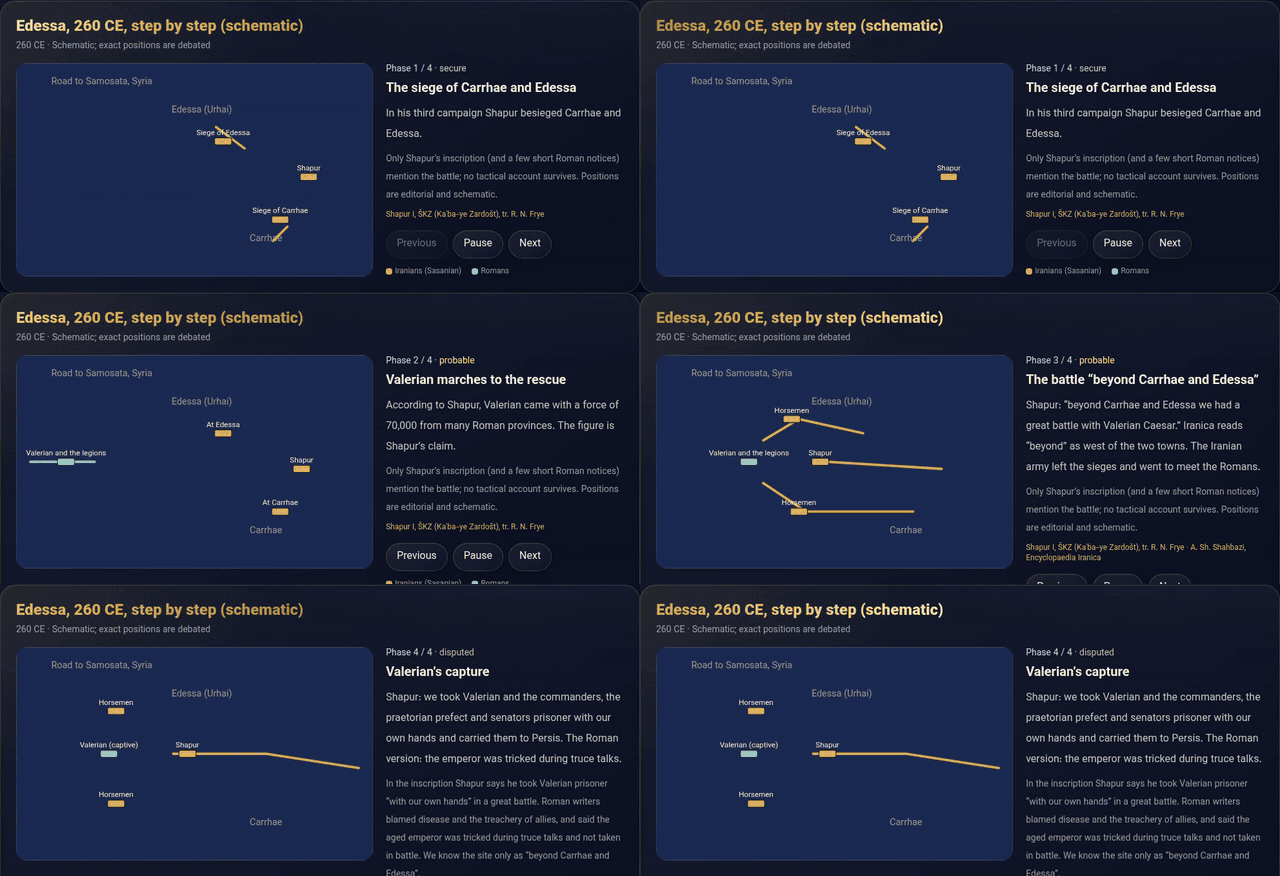
This was Rome’s greatest humiliation in its wars with Iran: for the first time a Roman emperor fell alive into enemy hands. Roman writers blamed disease and the treachery of allies and said Valerian was tricked during truce talks. Iranica (Shahbazi) sees this as an effort to soften the humiliation. The reliefs show Valerian unfettered and in his regalia, which does not fit the Roman stories of his degradation.
An emperor who had come with 70,000 soldiers from across the Roman world became a captive himself. Power built on force can fall in a single day to greater force.
Sources: Shapur I, ŠKZ (Kaʿba-ye Zardošt), tr. R. N. Frye · A. Sh. Shahbazi, Encyclopaedia Iranica · S. N. C. Lieu, Encyclopaedia Iranica
Dossier · 5
Captives and new cities
Shapur says he deported men of the Roman Empire and settled them in Persis, Parthia, Khuzestan and Asuristan, on the domains of his father and ancestors. Iranica: Gundeshapur was built on the site of the old town of Bēṯ Lapaṭ, near Dezful, for the Antiochene captives; Misiche became Peroz-Shapur; Abarshahr was renamed Nēv-Shapur (Nishapur); and Shapur built the city of Bishapur in Persis.
And men of the Roman Empire, of non-Iranians, we deported. We settled them in the Empire of Iran in Persis, Parthia, Khuzistan, in Babylonia and in other lands where there were domains of our father, grandfathers and of our ancestors.
Iranica (Shahbazi): the Roman deportees were mainly artisans and skilled workers and helped to revive Iran’s towns, industries and farming. Many were Christians; no longer persecuted, they multiplied in Khuzestan, Persis and eastern Iran and built churches and monasteries. This is also why Shapur used the new title “king of kings of Ērān and Anērān”. This part of the story rests mostly on later sources, such as the Chronicle of Seert.
The inscription counts people as booty: they were “deported” and “settled”, on the king’s land. They did not own themselves; they were the king’s property. The prosperity of the new cities rested on the labour of people who had no choice.
Sources: Shapur I, ŠKZ (Kaʿba-ye Zardošt), tr. R. N. Frye · A. Sh. Shahbazi, Encyclopaedia Iranica · E. J. Keall, Encyclopaedia Iranica
Dossier · 6
Naqsh-e Rostam and Bishapur: triumph in stone
Shapur carved his victories in several reliefs. At Naqsh-e Rostam the king is mounted, Philip kneels before him and Valerian stands. At Bishapur II Gordian lies under the horse, Philip kneels and the king holds Valerian by the wrist. The largest, Bishapur III, shows the king and the three emperors in the centre, four rows of mounted nobles behind the king and four rows of tribute-bearers before him.


These reliefs are displays of triumph, not exact reports: all three emperors appear together in one scene, though the events were sixteen years apart. Iranica notes that Valerian is always shown unfettered and in regalia.
Naqsh-e Rostam lies beside the tombs of Darius and the other Achaemenid kings. Shapur set his triumph next to the ancestors whose heir he wanted to be seen as; in the hands of power, history becomes a tool of legitimacy.
Sources: A. Sh. Shahbazi, Encyclopaedia Iranica · E. J. Keall, Encyclopaedia Iranica
Dossier · 7
Mani and Shapur’s religious tolerance
Mani, founder of Manichaeism, was born in 216 and preached his religion openly from 240. He wrote a book in Middle Persian in Shapur’s name (the Šābuhragān), and under the king’s protection his missionaries spread through the empire and beyond. Iranica (Shahbazi): Shapur’s religious tolerance benefited all his subjects: Christians, Jews and Manichaeans. Kartir says Shapur favoured the Zoroastrians and that priests went with his army to Rome.
Bahram I and the death of Mani

Iranica says Mani failed to convert Shapur; their views were irreconcilable and Shapur saw himself as God’s instrument. Manichaean sources, however, speak of the king’s conversion. Either way, Mani stayed free while Shapur lived; after him, as Kartir rose, things changed.
Shapur’s tolerance came not from law but from the king’s will. A religious freedom that depends on one man ends with that man’s death, and that is what happened under Bahram I.
Sources: W. Sundermann, Encyclopaedia Iranica · A. Sh. Shahbazi, Encyclopaedia Iranica
Synthesis
Shapur I did what no Parthian king had done: he killed one Roman emperor (by his own account), took tribute from another and captured a third. He wrote it in stone in three languages so that later generations would know. But the same inscription speaks of burned towns and deported people who were counted as the king’s property. His religious tolerance was real, but because it did not rest on law it ended with his death.
Bibliography
- Shapur I, ŠKZ (Kaʿba-ye Zardošt), tr. R. N. Frye, The Inscription of Shapur I at Naqsh-e Rustam in Fars, in The History of Ancient Iran, Appendix 4 (1984). https://sites.uci.edu/sasanika/sapur-is-inscription-kaba-ye-zartost-skz/Shapur’s own account of his wars, in Middle Persian, Parthian and Greek, on the walls of the Kaʿba-ye Zardošt. Contemporary, but royal propaganda.
- A. Sh. Shahbazi, Encyclopaedia Iranica, Šāpur I: History (2002, updated 2018). https://www.iranicaonline.org/articles/shapur-i/
- S. N. C. Lieu, Encyclopaedia Iranica, Edessa (1997). https://www.iranicaonline.org/articles/edessa/
- E. J. Keall, Encyclopaedia Iranica, Bīšāpūr (1989). https://www.iranicaonline.org/articles/bisapur/
- W. Sundermann, Encyclopaedia Iranica, Mani (2009). https://www.iranicaonline.org/articles/mani-founder-manicheism/
- A. Henrichs & L. Koenen (via Iranica), Cologne Mani Codex 18 (1970–1975). A Greek life of Mani; it dates Shapur’s crowning and the fall of Hatra. Used here only through Iranica.
All photos are from Wikimedia Commons; licence and author were checked on each file page.
Ardashir I, his fatherHormizd I, his sonBahram I, his sonNarseh, his sonThe Sasanian dynasty