Featured dossier
Yazdegerd III: the last Sasanian king of kings
Yazdegerd III, grandson of Khosrow II, became king in 632 and ended the succession crisis. But in those same years Arab Muslim armies reached Iraq. After Qadisiyyah Ctesiphon fell, and after Nahavand the Iranian plateau lay open. Yazdegerd fled east from city to city and was killed near Marw in 651. His sons Peroz and Narseh found refuge at the Chinese court.
- years of reign
- 19
- of tax revenue lost with Iraq
- ~⅓
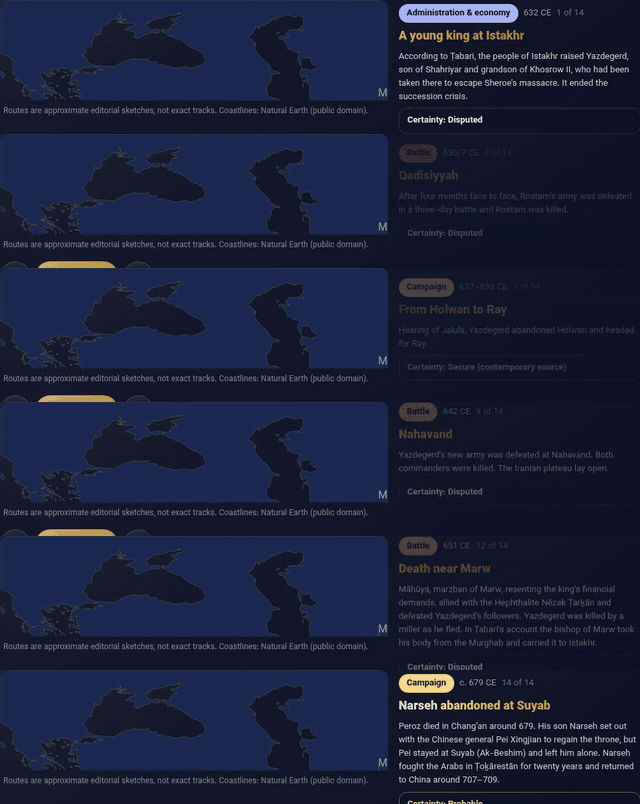
Animated map: from Ctesiphon to Marw
Administration & economy632 CE1 of 14
A young king at Istakhr
According to Ṭabari, the people of Istakhr raised Yazdegerd, son of Shahriyar and grandson of Khosrow II, who had been taken there to escape Sheroe’s massacre. It ended the succession crisis.
Certainty: DisputedHis age is given as eight, sixteen or twenty-one. Bosworth thinks eight more likely, since his coins show him beardless until his tenth year.
Sources: al-Ṭabarī, tr. C. E. Bosworth, 1999 · M. Morony, Encyclopaedia Iranica, 1986
BattleCampaignBuildingAdministration & economyReligionArrow keys, Home/End and Space work.
Yazdegerd III, step by step (632–651 CE)
The wars and Yazdegerd’s flight as told by Morony (Iranica). The routes are schematic. The dates of Qadisiyyah and Nahavand and the manner of Yazdegerd’s death are disputed. Diagrams of Qadisiyyah and Nahavand are below the map.
Administration & economy632 CE1 of 14
A young king at Istakhr
According to Ṭabari, the people of Istakhr raised Yazdegerd, son of Shahriyar and grandson of Khosrow II, who had been taken there to escape Sheroe’s massacre. It ended the succession crisis.
Certainty: DisputedHis age is given as eight, sixteen or twenty-one. Bosworth thinks eight more likely, since his coins show him beardless until his tenth year.
Sources: al-Ṭabarī, tr. C. E. Bosworth, 1999 · M. Morony, Encyclopaedia Iranica, 1986
BattleCampaignBuildingAdministration & economyReligionArrow keys, Home/End and Space work.
Qadisiyyah (schematic)
636/7 CE (disputed) · Schematic; exact positions are debated
Phase 1 / 4 · probable
Four months face to face
Rostam crossed the Euphrates with thirty elephants and camped at Qadisiyyah behind the Nahr al-ʿAtiq. Saʿd b. Abi Waqqāṣ waited at the fort of ʿUdhayb and the village of Qadis for reinforcements.
The exact positions of the armies are unknown; the diagram is schematic.
M. Morony, Encyclopaedia Iranica
Sasanian armyArab Muslim army
Nahavand (schematic)
642 CE (or 639–641) · Schematic; exact positions are debated
Phase 1 / 4 · probable
Yazdegerd’s new army
Yazdegerd raised a major army in the Jebāl and sent it to Nahavand to block any Muslim advance and possibly retake Iraq.
The exact positions of the armies are unknown; the diagram is schematic.
M. Morony, Encyclopaedia Iranica · C. E. Bosworth, Encyclopaedia Iranica
Sasanian armyArab Muslim army
Three separate layers
Each section has three layers: “Historical evidence” is only what the sources say; “Philosophical interpretation” is our reading by the standard of property and liberty; “Modern cultural meaning”. Quotations come only from published translations, with references.
Historical evidencePhilosophical interpretationModern cultural meaning
Dossier · 1
Qadisiyyah
After Ḵāled b. al-Walid’s raid of 633, the Persians won the Battle of the Bridge (634) but lost at Buwayb (635). Then ʿOmar sent Saʿd b. Abi Waqqāṣ. Rostam son of Farrukh Hormizd faced him at Qadisiyyah with a large army and thirty elephants. After four months a three-day battle was fought; Rostam was killed and his army collapsed.
Lewental argued (pp. 315-26) that, although subsequent memory has telescoped the conquest of Iran into this one battle, Qādesiya was not conclusive
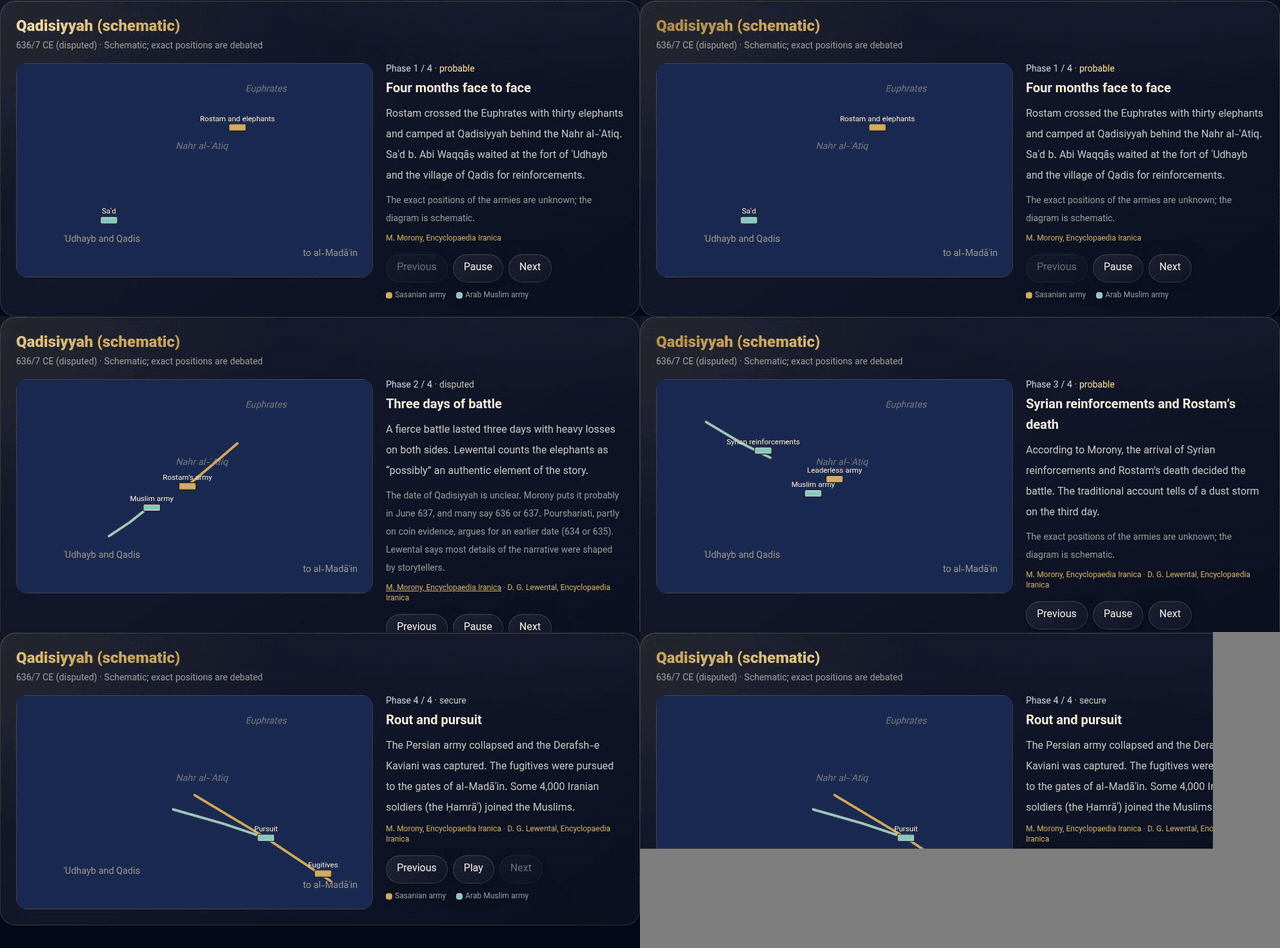
Lewental says storytellers shaped most details; Ṭabari gives the battle 167 pages. In his view later memory telescoped the conquest of Iran into this one battle, although Qadisiyyah was not conclusive: Jalula and Nahavand followed, and Iran resisted stiffly for years. Saddam Hussein used the name Qadisiyyah as propaganda in the Iran–Iraq war.
Morony lists the explanations offered for the fall: class and religious strife, the absence of popular support for an elitist regime, conflict among the nobles, dynastic instability and the cost of the long war with Byzantium. Some 4,000 Iranian soldiers joined the victors. A state its people see no gain in keeping stands alone on the hard day. This is our reading.
Sources: M. Morony, Encyclopaedia Iranica · D. G. Lewental, Encyclopaedia Iranica
Dossier · 2
The fall of Ctesiphon
After Qadisiyyah Saʿd reached al-Madāʾin. The garrison of Vēh-Ardašīr, on the west bank of the Tigris, abandoned it and cut the floating bridge, but the Muslims forded the river. Yazdegerd sent his family to Holwan and fled. Saʿd captured most of the royal treasure, and the people in the White Palace surrendered in return for tribute.

Morony says Iraq was the most important part of the empire: the capital, the apex of the administration and about one-third of annual tax revenue. With it went the royal treasure and many soldiers and nobles.
A state that draws its revenue from one fertile plain collapses when it loses that plain.
Sources: M. Morony, Encyclopaedia Iranica
Dossier · 3
Nahavand
Yazdegerd raised a new army in the Jebāl and sent it to Nahavand. ʿOmar combined the Kufan and Basran forces under al-Noʿmān b. Moqarren. The battle lasted several days; al-Noʿmān and the Persian commander, Mardānšāh son of Hormoz, were both killed. The Muslim victory opened the Iranian plateau.
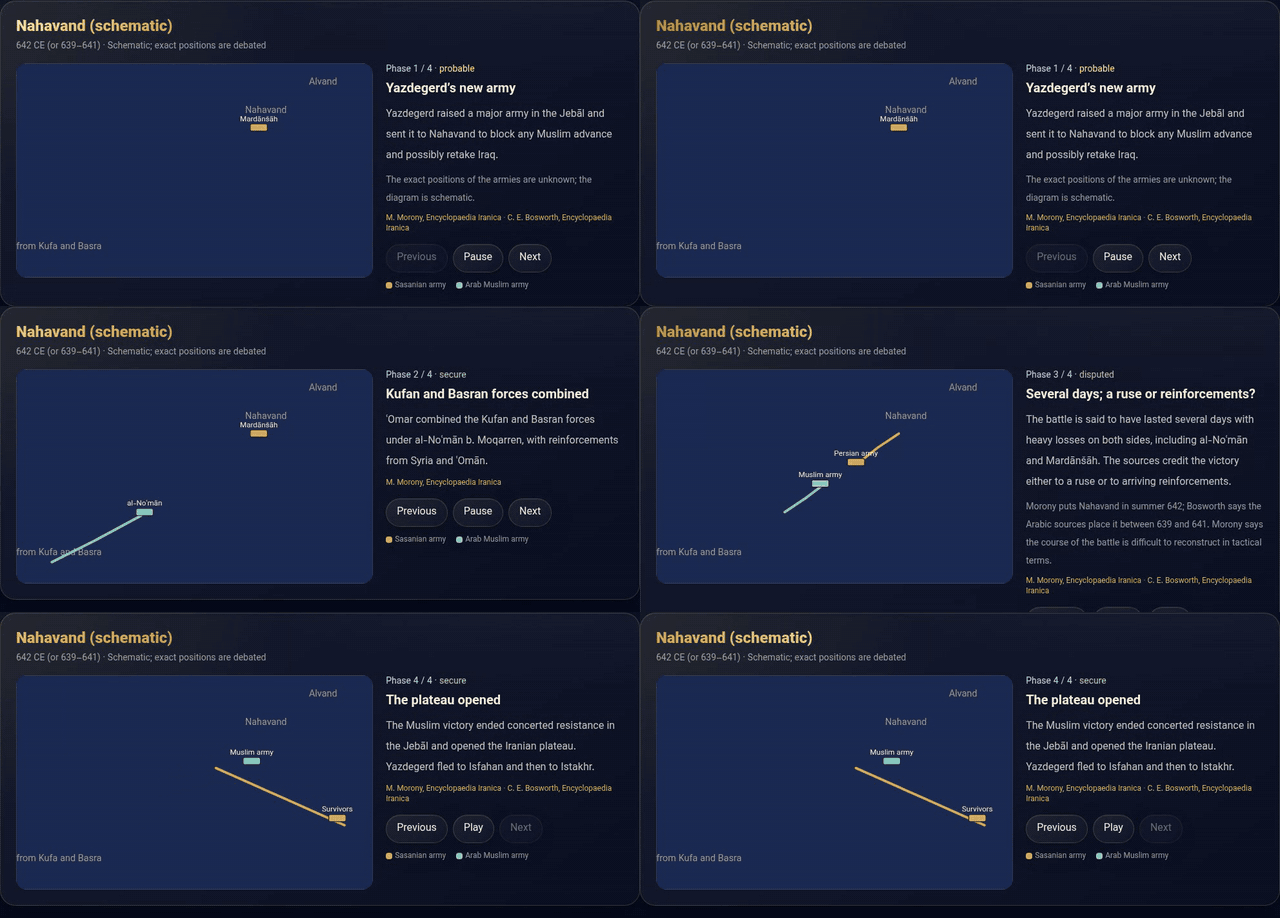
Morony says the course of the battle is difficult to reconstruct in tactical terms; the sources credit a ruse or arriving reinforcements. Its date is disputed too. The diagram below is schematic.
After Nahavand the cities surrendered one by one on tribute terms. In the terms for Ray and Azarbaijan, Morony says, fire temples were not to be destroyed nor the people killed or enslaved. Terms that secured life and property for tribute looked more useful to many people than fighting for a fleeing king.
Sources: M. Morony, Encyclopaedia Iranica · C. E. Bosworth, Encyclopaedia Iranica
Dossier · 4
Flight east and death near Marw
Yazdegerd went from Isfahan to Istakhr and Gur, then to Kerman and Sistan, and finally to Marw. Morony says that, impecunious and arrogant with a large retinue, he alienated the marzban of Kerman and lost the governor of Sistan by demanding tax arrears. Māhūya, marzban of Marw, allied with the Hephthalite Nēzak Ṭarḵān. Yazdegerd was killed by a miller as he fled.
The Magian priest (mawbadh) said to him, “That is not yours to do. You know that religion and kingship are twins; one of them cannot stand without the other. If you do [this deed], you will defile all that is most sacred.”
Ṭabari himself says there is “a difference of opinion regarding the cause of his murder” and gives several versions: the Turks were called in or not, the miller killed him for his belongings or on Mahawayh’s orders. In one, a priest warns Mahawayh that “religion and kingship are twins”. In Ṭabari’s account the Christian bishop of Marw took his body from the river and buried it at Istakhr.
The last king was undone not by the enemy but by his own governor, who refused him money. A king who can no longer give security but still demands taxes loses his subjects’ support. This is our reading.
Sources: M. Morony, Encyclopaedia Iranica · al-Ṭabarī, tr. R. S. Humphreys
Dossier · 5
Peroz and Narseh in China
Peroz, Yazdegerd’s son, went to Ṭoḵārestān. According to the Xin Tangshu he established himself in Sistan with help from its rulers; the Tang court recognised him in 661 as head of the “Persian Area Command” with its capital at Zaranj, and in 662 titled him “King of Persia”. Around 663 the Arabs defeated him, and he came to Chang’an in 673–674 and again in 675. In 677 he obtained permission to build a “Persian temple”, probably a Christian church, and he died around 679. His beheaded statue, identified by a Chinese inscription, still stands at Gaozong’s tomb at Qianling. His son Narseh set out with the general Pei Xingjian, but Pei abandoned him at Suyab. Narseh fought in Ṭoḵārestān for twenty years and returned to China around 707–709, where he died.

Compareti says the Jiu Tangshu confuses Peroz and Narseh and the Xin Tangshu is more reliable. He sees Pei Xingjian’s real mission as taking Suyab from the Turks; China had diplomatic contacts with the Arabs since 651. Embassies under the name “Persia” reached Chang’an until 755.
Great powers use exiles as long as they are useful. The Sasanian prince received titles, not armies.
Sources: M. Compareti, Encyclopaedia Iranica
Synthesis
Yazdegerd III inherited an empire exhausted by the Byzantine war, plague and succession wars. After Qadisiyyah and Nahavand, with Iraq and the plateau lost, he fled from city to city and was killed near Marw in 651. With him the Sasanian monarchy ended, though his sons bore the title “King of Persia” in China. The dates of the battles and the manner of his death are disputed.
Bibliography
- M. Morony, Encyclopaedia Iranica, Arab ii. Arab conquest of Iran (1986). https://www.iranicaonline.org/articles/arab-ii/
- D. G. Lewental, Encyclopaedia Iranica, Qādesiya, battle of (2014). https://www.iranicaonline.org/articles/qadesiya-battle/
- C. E. Bosworth, Encyclopaedia Iranica, Nehāvand (2017). https://www.iranicaonline.org/articles/nehavand/
- al-Ṭabarī, tr. R. S. Humphreys, The History of al-Ṭabarī XV: The Crisis of the Early Caliphate (Albany), pp. 78–90 (1990).
- al-Ṭabarī, tr. C. E. Bosworth, The History of al-Ṭabarī V: The Sāsānids, the Byzantines, the Lakhmids, and Yemen (Albany) (1999). https://archive.org/details/vol.-5.-the-sasanids-the-byzantines-the-lakhmids-and-yemen
- M. Compareti, Encyclopaedia Iranica, China xv. The last Sasanians in China (2009). https://www.iranicaonline.org/articles/china-xv-the-last-sasanians-in-china/
All photos are from Wikimedia Commons; licence and author were checked on each file page.
Khosrow II, his grandfatherAzarmidokht and the claimants, before himThe Sasanian dynasty