Arsacids (Parthians)
Vologases I
بلاش یکم
- Reign
- c. 51–77/79 CE
- Dynasty
- Arsacids (Parthians)
- Persian page
- فارسی
Featured dossier
Vologases I: the king who won Armenia for his house and shared it with Rome
Son of Vonones II and, Tacitus says, of a “Greek concubine”. He became king when his brothers stood aside and put his brother Tiridates on the throne of Armenia. For over ten years he fought and bargained with Rome over Armenia, forced a Roman army to surrender at Rhandeia in 62 CE, and finally reached a compromise that brought half a century of peace: Tiridates, an Arsacid prince, received the crown of Armenia from Nero’s hands in Rome in 66 CE. Zoroastrian tradition later credited a king “Valaxš” with collecting the Avesta.
- years of reign
- ~27
- Roman surrender at Rhandeia (CE)
- 62
- Tiridates crowned in Rome (CE)
- 66
Map: from Ctesiphon to Armenia
Administration & economy51 CE1 of 9
Accession
Tacitus: Vologases became king “by the retirement of his brothers”. He gave his brother Pacorus Media Atropatene and meant Armenia for Tiridates.
Certainty: Secure (contemporary source)Iranica says it is unclear whether Vonones II reigned before him or he succeeded Gotarzes directly.
Sources: Tacitus, tr. A. J. Church & W. J. Brodribb, 1876 · K. Schippmann, Encyclopaedia Iranica, 1986, updated 2016
BattleCampaignBuildingAdministration & economyReligionArrow keys, Home/End and Space work.
Three separate layers
Each section has three layers: “Historical evidence” is only what the sources say; “Philosophical interpretation” is our reading by the standard of property and liberty; “Modern cultural meaning”. Quotations come only from published translations, with references.
Historical evidencePhilosophical interpretationModern cultural meaning
Dossier · 1
The son of a Greek concubine
Tacitus says Vologases was, on his mother’s side, the son of a Greek concubine and became king when his brothers stood aside. He put Pacorus over Media Atropatene and meant Armenia for Tiridates. So the three sons of Vonones II held three thrones.
Vologeses was king of the Parthians; on the mother’s side, he was the offspring of a Greek concubine, and he obtained the throne by the retirement of his brothers.

Tacitus describes the brothers’ “retirement” as bloodless, which is rare in Parthian history. Giving provinces to brothers continued Artabanus II’s policy: power kept in the family, but shared out.
Sharing power among brothers, instead of killing them, made the succession calmer. Where power is spread, rivals have less need to fight.
Sources: Tacitus, tr. A. J. Church & W. J. Brodribb · K. Schippmann, Encyclopaedia Iranica
Dossier · 2
Armenia: ten years of war and bargaining
Tacitus says Vologases would not let his brother Tiridates lose the kingdom he had given him, or hold it as a gift from a foreign power. The first campaign failed in winter and disease. Then his son Vardanes’ revolt and the revolt of Hyrcania tied his hands, and Corbulo took Artaxata. In 62 CE Vologases surrounded Paetus’ army at Rhandeia and the Romans left Armenia.
For Vologeses would not allow his brother Tiridates to be deprived of a kingdom which he had himself given him, or to hold it as a gift from a foreign power.
Vologeses, however, sent a message to Corbulo, requiring him to remove the fortresses on the further bank of the Euphrates, and to leave the river to be, as formerly, the boundary between them.
Tacitus says Vologases hesitated to fight Rome and “felt reverence for a hitherto unbroken treaty”. After victory, instead of pressing on, he was flexible: he asked for the Euphrates to stay the border and accepted that Tiridates take his crown from Rome. Scholars such as Dąbrowa see this as calculated policy, not weakness.
The Rhandeia compromise gave both sides something: Parthia chose Armenia’s king, Rome crowned him. Fifty years of peace followed, and peace means trade and secure property.
Sources: Tacitus, tr. A. J. Church & W. J. Brodribb · K. Schippmann, Encyclopaedia Iranica · E. Dąbrowa
Dossier · 3
The crown at the foot of Nero’s statue
Tacitus describes the scene: Parthian cavalry with their banners on one side, Roman legions with their eagles on the other, and between them a statue of Nero on a chair of state. Tiridates sacrificed, took off his crown and set it at the statue’s foot. Three years later, in 66 CE, he received it in Rome from Nero himself.
In the midst, on a tribunal, was a chair of state, and on the chair a statue of Nero. To this Tiridates advanced, and having slain the customary victims, he removed the crown from his head, and set it at the foot of the statue.
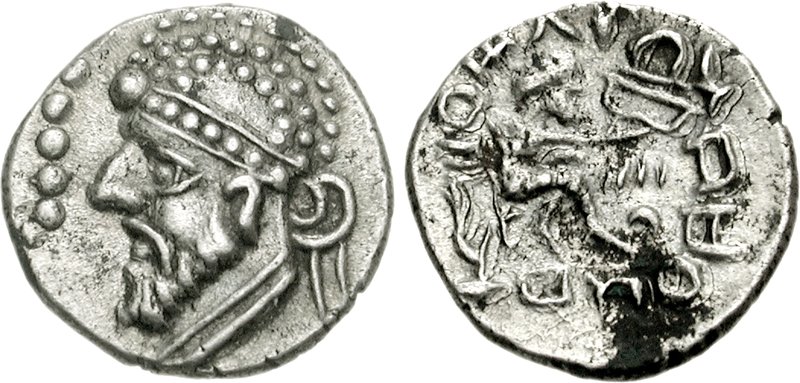
The Romans saw this as Parthia humbled; Tacitus says the soldiers thought Tiridates was going to Rome “little better than a prisoner”. But the real result was that the Arsacid house stayed in Armenia for centuries. Each side told the victory its own way.
A show of power is not the same as real power. A compromise that saves both sides’ face lasts longer than a victory that humiliates one.
Sources: Tacitus, tr. A. J. Church & W. J. Brodribb · K. Schippmann, Encyclopaedia Iranica
Dossier · 4
Vardanes II: the son who rebelled
Tacitus has a single sentence: just as Rome was preparing for war, Vologases’ son Vardanes rose against him and the Parthians left Armenia. Seleucia coins in the name of Vardanes II show he was recognized in Babylonia for at least a few years, c. 55–58 CE.
There rose up at this crisis a rival to Vologeses in his son Vardanes, and the Parthians quitted Armenia, apparently intending to defer hostilities.
We know nothing of Vardanes II’s motive or fate. Some suppose the Hyrcanian revolt a few years later was linked to him; that is only a guess.
A son’s revolt against his father shows that even sharing power within the family could not calm the succession when there was no clear rule for it.
Sources: Tacitus, tr. A. J. Church & W. J. Brodribb · D. Sellwood
Dossier · 5
Vologases and the Avesta: a later tradition
The Denkard, a ninth-century Zoroastrian book, says an Arsacid king named “Valaxš” (Vologases) had the scattered fragments of the Avesta collected, both written and oral. Kellens in Iranica counts this as the first attempt at restoring the Avesta, which the Sasanians continued.
The text does not say which Vologases. Identifying him with Vologases I is a modern guess, and five Arsacid kings bore the name. Some scholars think the story itself was made up by the Sasanians to give their own collection an older pedigree. Religious motifs on Vologases I’s coins, such as a fire altar, make the guess stronger but do not prove it.
Keeping an oral tradition alive is the work of the community that carries it. Whether or not Vologases did it, the Avesta survived because people and priests memorized it for centuries.
Sources: J. Kellens, Encyclopaedia Iranica
Synthesis
Vologases I was one of the longest-reigning Parthian kings. He ended the war with Rome with a compromise: Armenia stayed in the Arsacid house and Rome kept its face. His son’s revolt and the revolt of Hyrcania show that home was not quiet. Crediting him with collecting the Avesta is a later tradition, not an established fact.
Bibliography
- Tacitus, tr. A. J. Church & W. J. Brodribb, Annals 6.31–44, 11.8–10, 12.10–14, 12.44–51, 13.6–9, 13.34–41, 14.23–26, 15.1–31 (1876). https://en.wikisource.org/wiki/The_Annals_(Tacitus)The fullest account of Parthia in the first century CE; a Roman view from the capital, with harsh moral judgements on “barbarians”.
- K. Schippmann, Encyclopaedia Iranica, Arsacids ii. The Arsacid dynasty (1986, updated 2016). https://www.iranicaonline.org/articles/arsacids-ii/
- J. Kellens, Encyclopaedia Iranica, Avesta i. Survey of the history and contents of the book (1987). https://www.iranicaonline.org/articles/avesta-holy-book/
- E. Dąbrowa, La politique de l’État parthe à l’égard de Rome, d’Artaban II à Vologèse I (ca 11 – ca 79 de n. è.) (1983).
- D. Sellwood, An Introduction to the Coinage of Parthia, 2nd ed. (1980). The standard numbering of Parthian coins (“S”); some of its attributions have since been revised.
All photos are from Wikimedia Commons; licence and author were checked on each file page.
Vonones II, his fatherPacorus II, his sonGotarzes IIThe Arsacid dynasty