Arsacids (Parthians)
Gotarzes II
گودرز دوم
- Reign
- c. 40–51 CE
- Dynasty
- Arsacids (Parthians)
- Persian page
- فارسی
Featured dossier
Gotarzes II: the king who cut off his Roman rival’s ears
Vardanes’ rival and successor. He first ruled “Hyrcania”, the lands east of the Caspian Gates, and after Vardanes’ murder all Parthia. The nobles complained of his tyranny to Rome and brought in Meherdates, a grandson of Phraates IV. Gotarzes beat him in 49 CE and cut off his ears. A relief at Bisotun naming a “Gotarzes” may commemorate this victory.
- year of victory over Meherdates (CE)
- 49
- year of death (CE)
- 51
Map: from Hyrcania to Bisotun
Administration & economyc. 40 CE1 of 6
A claim to the throne
Boyce: Gotarzes, another son of Artabanus, bid for the throne and foiled Vardanes’ siege of Seleucia. A rare coin of his reads in Greek: “King of kings, of Arsaces called Gotarzes, (son) of Artabanus”.
Certainty: DisputedIranica (Schippmann), following Le Rider, has Vardanes as Artabanus’ direct successor (c. 39–45 CE); Kahrstedt, Hanslik and others put Gotarzes first. Boyce makes Gotarzes a son of Artabanus and half-brother of Vardanes; Schippmann a “nephew” of Artabanus.
Sources: M. Boyce, Encyclopaedia Iranica, 2001, updated 2014 · Tacitus, tr. A. J. Church & W. J. Brodribb, 1876
BattleCampaignBuildingAdministration & economyReligionArrow keys, Home/End and Space work.
Three separate layers
Each section has three layers: “Historical evidence” is only what the sources say; “Philosophical interpretation” is our reading by the standard of property and liberty; “Modern cultural meaning”. Quotations come only from published translations, with references.
Historical evidencePhilosophical interpretationModern cultural meaning
Dossier · 1
“The despotism of Gotarzes”
Tacitus gives the Parthian envoys’ speech to the Roman senate: Gotarzes was unbearable to nobles and people alike, had killed near and distant kin, even pregnant wives and children, and, “slothful at home and unsuccessful in war”, used cruelty to hide his weakness.
Already brothers, relatives, and distant kin had been swept off by murder after murder; wives actually pregnant, and tender children were added to Gotarzes’ victims, while, slothful at home and unsuccessful in war, he made cruelty a screen for his feebleness.

This is the speech of Gotarzes’ enemies, before the Roman senate, to justify intervention. Even so, the report of killing kin fits what we know of Artabanus II and other Arsacids.
Nobles who turn to a foreign power against their own king show that there was no way to limit power at home. Such intervention led less to freedom than to war.
Sources: Tacitus, tr. A. J. Church & W. J. Brodribb · M. Boyce, Encyclopaedia Iranica
Dossier · 2
Meherdates, the Roman-bred king
Claudius sent Meherdates off with advice on moderate rule. Cassius, governor of Syria, escorted him to the Euphrates. Meherdates lost time at Edessa, went on through Armenia and Adiabene and found Gotarzes at Mount Sambulos. Tacitus describes a cult of Hercules on this mountain: the god tells the priests in a dream to equip horses with full quivers for the hunt, and the horses come back at night with empty quivers.
Gotarzes meantime was offering vows to the local divinities on a mountain called Sambulos, with special worship of Hercules, who at a stated time bids the priests in a dream equip horses for the chase and place them near his temple.
Gotarzes taunted him with being no kinsman of his or of the Arsacids, but a foreigner and a Roman, and having cut off his ears, bade him live, a memorial of his own clemency, and a disgrace to us.

Tacitus’ “Hercules” is probably the Greek name for an Iranian god, perhaps Verethragna (Bahram). That identification is modern, not Tacitus’.
The king Rome sent to the Parthians, with no real support at home, was soon left alone. Power imposed from outside does not last.
Sources: Tacitus, tr. A. J. Church & W. J. Brodribb · M. Boyce, Encyclopaedia Iranica
Dossier · 3
The “Gotarzes” relief at Bisotun
At Bisotun, beside the relief attributed to Mithridates II, a Parthian relief shows a rider charging with a lance, with Nike, the goddess of victory, above him. A Greek inscription names him “Gotarzes Geopothros”. Herzfeld took it as Gotarzes II’s victory over Meherdates; Chaumont rejected the identification.
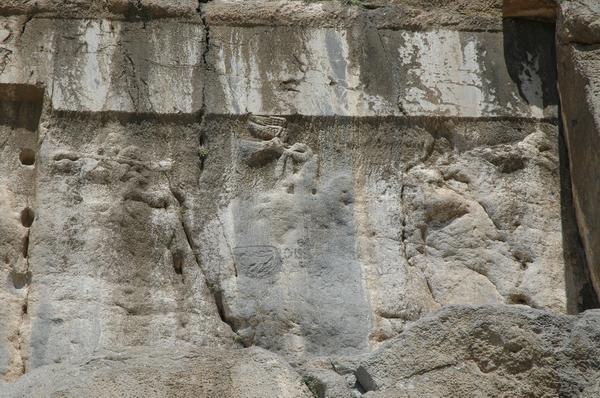
Boyce notes the link between this name and Gōdarz and Gēv in the Shahnameh. That link is legend, not historical evidence: the later epic may have kept Parthian names.
A relief once made by a king’s order is now everyone’s heritage. Guarding it, and debating its meaning freely, is society’s work, not the state’s alone.
Sources: M. Boyce, Encyclopaedia Iranica · K. Schippmann, Encyclopaedia Iranica
Synthesis
Gotarzes II reached the throne through war with his brother and kept it by beating Rome’s candidate. His picture was drawn by his enemies before the Roman senate; the coins, and perhaps the Bisotun relief, are the only traces of his own.
Bibliography
- Tacitus, tr. A. J. Church & W. J. Brodribb, Annals 6.31–44, 11.8–10, 12.10–14, 12.44–51, 13.6–9, 13.34–41, 14.23–26, 15.1–31 (1876). https://en.wikisource.org/wiki/The_Annals_(Tacitus)The fullest account of Parthia in the first century CE; a Roman view from the capital, with harsh moral judgements on “barbarians”.
- K. Schippmann, Encyclopaedia Iranica, Arsacids ii. The Arsacid dynasty (1986, updated 2016). https://www.iranicaonline.org/articles/arsacids-ii/
- M. Boyce, Encyclopaedia Iranica, Gōdarz i. Historical figures (2001, updated 2014). https://www.iranicaonline.org/articles/godarz/godarz-i-historical-figures/
- D. Sellwood, An Introduction to the Coinage of Parthia, 2nd ed. (1980). The standard numbering of Parthian coins (“S”); some of its attributions have since been revised.
All photos are from Wikimedia Commons; licence and author were checked on each file page.
Vardanes I, his rivalVonones II, his successorThe Arsacid dynastyBisotun: the mountain, relief and inscription