Elam (Shutrukid dynasty)
Shutruk-Nakhunte
شوتروکناخونته
Epithets and titles
- King of Anshan and Susaofficial titlehis official style in his inscriptionsSource: Elamite inscription on the Naram-Sin stele (Louvre Sb 4), tr. M. Van De Mieroop, A History of the Ancient Near East (2015), p. 199
- Beloved servant of Inshushinakofficial titleSource: Elamite inscription on the Naram-Sin stele (Louvre Sb 4), tr. M. Van De Mieroop, A History of the Ancient Near East (2015), p. 199
- Who has enlarged the kingdomofficial titleSource: Elamite inscription on the Naram-Sin stele (Louvre Sb 4), tr. M. Van De Mieroop, A History of the Ancient Near East (2015), p. 199
- Lord of the land of Elamofficial titleSource: Elamite inscription on the Naram-Sin stele (Louvre Sb 4), tr. M. Van De Mieroop, A History of the Ancient Near East (2015), p. 199
- Reign
- c. 1184–1155 BCE
- Dynasty
- Elam (Shutrukid dynasty)
- Persian page
- فارسی
Featured dossier
Shutruk-Nakhunte: the king who brought Hammurabi’s Code to Susa
King of Anshan and Susa and founder of the Shutrukid dynasty. In 1158 BCE he raided Babylonia and brought the Naram-Sin stele, the Code of Hammurabi and the Manishtushu statues to Susa. Three thousand years later they were found there; today they are in the Louvre. Follow the raid on the animated map and read the inscription he wrote on his trophies.
- BCE, the raid on Babylon
- 1158
- Mesopotamian masterpieces now in the Louvre that he took to Susa
- 3
- sons who became king
- 3
- years between the Naram-Sin stele and his inscription
- ~1000
Animated map: life and reign
Administration & economyc. 1184 BCE1 of 8
King of Anshan and Susa
Shutruk-Nakhunte, son of Hallutush-Inshushinak, came to the throne and founded a new dynasty. He called himself “king of Anshan and Susa”: king of the Fars highlands and the Khuzestan plain together.
Certainty: ProbableYears are schematic. His reign is usually put at c. 1184–1155 BCE; Vallat dates the whole dynasty c. 1210–1100 BCE.
Sources: F. Vallat, Encyclopaedia Iranica, 1998, updated 2016 · D. T. Potts, 1999 · F. W. König, 1965
BattleCampaignBuildingAdministration & economyReligionArrow keys, Home/End and Space work.
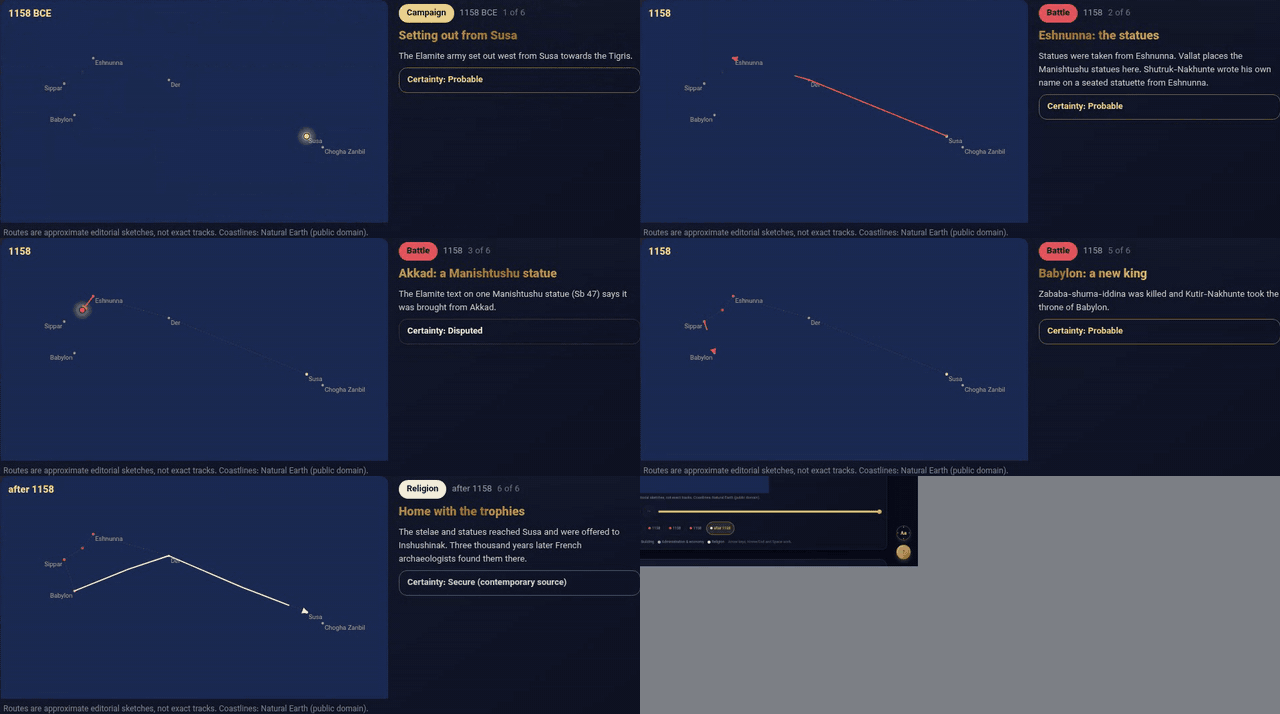
The raid on Babylonia in 1158 BCE, step by step
From Susa to Sippar and Babylon and home with the trophies. The order of cities and the routes are sketches; the sources give only the city names.
Campaign1158 BCE1 of 6
Setting out from Susa
The Elamite army set out west from Susa towards the Tigris.
Certainty: ProbableThe exact route is unknown; the lines are sketches.
Sources: F. Vallat, Encyclopaedia Iranica, 1998, updated 2016 · D. T. Potts, 1999
BattleCampaignBuildingAdministration & economyReligionArrow keys, Home/End and Space work.
Three separate layers
Each section has three layers: “Historical evidence” is only what the sources say; “Philosophical interpretation” is our reading by the standard of property and liberty; “Modern cultural meaning”. Quotations come only from published translations, with references.
Historical evidencePhilosophical interpretationModern cultural meaning
Dossier · 1
Sources: a king who wrote on his trophies
Most of what we know of Shutruk-Nakhunte comes from his own inscriptions. He wrote them in Elamite on the stelae and statues he brought from Mesopotamia to Susa. König (1965) collected these texts. The rest comes from Babylonian sources and the “Berlin letter”, a much later copy.

His chronology is disputed. Most books put his reign at c. 1184–1155 BCE. Vallat dates the whole Shutrukid dynasty c. 1210–1100 BCE. The only fairly firm date is the raid on Babylon in 1158 BCE.
When a king writes his own story, we must ask what he left out: no text survives from the people who hauled the trophies or suffered the raids.
Sources: F. W. König · D. T. Potts · F. Vallat, Encyclopaedia Iranica · J. van Dijk
Dossier · 2
Life and reign in order
1. Son of Hallutush-Inshushinak. There is no evidence that his father was king, so Shutruk-Nakhunte may have seized power and founded a new line.
2. He is said to have married a daughter of Meli-Shipak, the Kassite king of Babylon.
3. He moved inscriptions from abandoned Chogha Zanbil to Susa and made Susa the centre again.
4. In 1158 BCE he raided Mesopotamia: Akkad, Sippar, Eshnunna and Babylon. He killed the king of Babylon and put his son Kutir-Nakhunte in his place.
5. He offered the trophies to Inshushinak at Susa and wrote his name on them.
6. He died c. 1155 BCE. Three sons, Kutir-Nakhunte, Shilhak-Inshushinak and Hutelutush-Inshushinak, reigned after him.
Vallat sees the Shutrukid age as Susa’s second flowering: wealth from these campaigns let the kings rebuild Susa’s temples in splendour.
A capital’s splendour is often built on wealth taken from somewhere else.
Sources: F. Vallat, Encyclopaedia Iranica · D. T. Potts · D. T. Potts
Dossier · 3
Titles: what did he call himself?
In the inscription on the Naram-Sin stele he calls himself “beloved servant of Inshushinak”, “king of Anshan and Susa”, “who has enlarged the kingdom”, “who takes care of the lands of Elam” and “lord of the land of Elam”. No source gives him any later byname such as “the Great” or “the Conqueror”.
I am Shutruk-Nahhunte, son of Hallutush-Inshushinak, beloved servant of the god Inshushinak, king of Anshan and Susa, who has enlarged the kingdom, who takes care of the lands of Elam, the lord of the land of Elam. When the god Inshushinak gave me the order, I defeated Sippar. I took the stele of Naram-Sin and carried it off, bringing it to the land of Elam. For Inshushinak, my god, I set it as an offering.
“King of Anshan and Susa” was an old title revived by the Middle Elamite kings: a claim to unite highland and lowland. “Who has enlarged the kingdom” shows he defined himself by his conquests.
Titles tell us how a ruler wished to be seen, not how he was.
Sources: M. Van De Mieroop · F. Vallat, Encyclopaedia Iranica · F. W. König
Dossier · 4
The Berlin letter and the claim to Babylon
The kings of Elam and the Kassites of Babylon had intermarried for generations. The “Berlin letter” is an Akkadian letter preserved in a later Babylonian copy. In it an Elamite king lists all these marriages and says the throne of Babylon is his by right. His name is lost.
Vallat suggests the writer may have been Shutruk-Nakhunte, and that the 1158 raid may have followed Babylon’s rejection of the claim. The link is a conjecture.
A claim of “hereditary right” to other people’s land is one of the oldest excuses for war.
Sources: J. van Dijk · F. Vallat, Encyclopaedia Iranica · D. T. Potts
Dossier · 5
The raid of 1158: Sippar, Akkad, Eshnunna, Babylon
In 1158 BCE Shutruk-Nakhunte raided Mesopotamia. He says himself that he defeated Sippar at Inshushinak’s command. Vallat says he also raided Akkad, Babylon and Eshnunna. He killed the Kassite king Zababa-shuma-iddina and set his son Kutir-Nakhunte on the throne of Babylon.
The raid was more about trophies and prestige than lasting conquest. The trophies stood for the victory of Elam’s god and king over Mesopotamia.
Plundering a people’s monuments steals their memory; yet these very trophies are what preserved the monuments for us.
Sources: F. Vallat, Encyclopaedia Iranica · M. Van De Mieroop · D. T. Potts
Dossier · 6
The trophies and the inscriptions he added
The Naram-Sin stele: the victory stele of Naram-Sin, king of Akkad, c. 2250 BCE. Shutruk-Nakhunte did not erase the old text. He added an Elamite inscription on the mountain of the stele, saying he had brought it from Sippar and offered it to Inshushinak.
The Code of Hammurabi: a basalt stele 225 cm high, found at Susa in 1901–1902. Near the bottom, seven columns of the laws were smoothed away in antiquity. Scheil (1902) guessed that Shutruk-Nakhunte had the space cleared for his own text, which was never carved.
The Manishtushu statues: king of Akkad, c. 2270 BCE. One of them (Sb 47) bears an Elamite text saying it came from Akkad; Vallat has the Manishtushu statues come from Eshnunna.
I am Shutruk-Nahhunte, son of Hallutush-Inshushinak, beloved servant of the god Inshushinak, king of Anshan and Susa, who has enlarged the kingdom, who takes care of the lands of Elam, the lord of the land of Elam. When the god Inshushinak gave me the order, I defeated Sippar. I took the stele of Naram-Sin and carried it off, bringing it to the land of Elam. For Inshushinak, my god, I set it as an offering.


Points in dispute: that Shutruk-Nakhunte had the Code’s columns erased is only a guess. That the Code came from Sippar is Roth’s suggestion. Whether the Manishtushu statues came from Akkad or Eshnunna is unclear.
Today these works are in the Louvre. French archaeologists found them at Susa and took them to Paris under the agreement for “division of finds”. The question of who owns heritage has stayed alive from 1158 BCE to today.
Sources: F. W. König · D. T. Potts · M. Van De Mieroop · V. Scheil · M. T. Roth · P. O. Harper, J. Aruz, F. Tallon (eds.) · Musée du Louvre · F. Vallat, Encyclopaedia Iranica
Dossier · 7
Family and succession
Kutir-Nakhunte, the eldest son, took the throne of Babylon in 1158. After his father died he became king of Elam and ended the Kassite dynasty by deposing Enlil-nadin-ahi. His reign was short.
Shilhak-Inshushinak, his brother, succeeded him. He left many inscriptions and built or restored many temples.
Hutelutush-Inshushinak, the last king of the dynasty, sometimes called himself “son of Shutruk-Nakhunte, Kutir-Nakhunte and Shilhak-Inshushinak”.
Vallat (1985) proposes that Hutelutush-Inshushinak was a son of Shutruk-Nakhunte by his own daughter, Nahhunte-utu. This reading is disputed. The numbering of Kutir-Nakhunte (II or III) also differs between books.
When power passes within one family, the law of succession is family law, not the people’s law.
Sources: F. Vallat, Encyclopaedia Iranica · F. Vallat
Synthesis: plunder, memory and property
Shutruk-Nakhunte was a warrior king who founded a new dynasty, made Susa the heart of Elam again and, with the raid of 1158, sealed the end of the Kassite dynasty. We know him mostly from the texts he wrote on his own trophies.
Through the lens of property his story cuts both ways. He took other cities’ monuments by force and put his name on them. But because he kept them and left the old texts, the Code of Hammurabi and the Naram-Sin stele survived for us. Property moved by force moves memory with it.
Bibliography
- F. Vallat, Encyclopaedia Iranica, Elam i. The history of Elam (1998, updated 2016). https://www.iranicaonline.org/articles/elam-i/Our main account of the Shutrukid dynasty; dates the dynasty c. 1210–1100 BCE.
- D. T. Potts, The Archaeology of Elam: Formation and Transformation of an Ancient Iranian State (pp. 232–237) (1999). The standard archaeology of Elam; discusses Shutruk-Nakhunte’s trophies and their inscriptions.
- F. W. König, Die elamischen Königsinschriften (Archiv für Orientforschung, Beiheft 16) (1965). The corpus of Elamite royal inscriptions, including the texts Shutruk-Nakhunte added to his trophies.
- M. Van De Mieroop, A History of the Ancient Near East, ca. 3000–323 BC, 3rd ed. (p. 199) (2015). English translation of Shutruk-Nakhunte’s inscription on the Naram-Sin stele.
- D. T. Potts, Elamites and Kassites in the Persian Gulf, Journal of Near Eastern Studies 65.2, pp. 111–119 (2006). https://doi.org/10.1086/504986
- J. van Dijk, Die dynastischen Heiraten zwischen Kassiten und Elamern, Orientalia 55, pp. 159–170 (1986). Publication of the “Berlin letter”: an Elamite king claims the throne of Babylon through Kassite marriages.
- F. Vallat, Hutelutuš-Inšušinak et la famille royale élamite, Revue d’Assyriologie 79, pp. 43–50 (1985).
- V. Scheil, Textes élamites-sémitiques, 2e série (Mémoires de la Délégation en Perse 4) (1902). https://archive.org/details/mmoires04franuoftFirst edition of the Code of Hammurabi; Scheil guessed that Shutruk-Nakhunte had the erased columns cleared for his own text.
- M. T. Roth, Law Collections from Mesopotamia and Asia Minor (SBL Writings from the Ancient World 6) (1995; 2nd ed. 1997).
- P. O. Harper, J. Aruz, F. Tallon (eds.), The Royal City of Susa: Ancient Near Eastern Treasures in the Louvre (1992). https://archive.org/details/RoyalCityofSusaAncientNearEasternTreasuresintheLouvre
- Musée du Louvre, Code de Hammurabi, Sb 8 (collections record) (online). https://collections.louvre.fr/en/ark:/53355/cl010174436Found at Susa in 1901–1902 in Jacques de Morgan’s excavation; came to the Louvre through the post-excavation division of finds.
All photos are from Wikimedia Commons; licence and author were checked on each file page.
Untash-Napirisha, builder of Chogha ZanbilShilhak-Inshushinak, his sonThe Elamite dynasty