Featured dossier
Reza Shah: coup, new state and abdication
A Cossack officer who came to power in the coup of 1921 and became shah in 1925. He built an army, courts, a railway and a university, and at the same time crushed his opponents. In 1941, after Iran was occupied, he abdicated in favour of his son.
- reign (1925–1941)
- 16 years
- building the Trans-Iranian Railway (1927–1938)
- 11 years
- students a year to Europe, from 1928
- 100
- abdication
- 16 Sep 1941
Animated map: life and events
Campaign21 February 1921 CE1 of 15
The coup of 1921
Sayyed Zia al-Din Tabatabai and Reza Khan Mirpanj marched with the Cossacks from Qazvin and took Tehran. Britain’s role is disputed.
Certainty: DisputedThe Iranica chronology says the British General Ironside discussed a coup with Reza Khan in Qazvin. Ferrier, in the same encyclopaedia, calls the extent of British complicity “a moot issue”: he accepts Ironside’s personal encouragement, not official British support.
Sources: E. Yarshater, Encyclopaedia Iranica, online edition · R. W. Ferrier, Encyclopaedia Iranica, 1985, updated 2016
BattleCampaignBuildingAdministration & economyReligionArrow keys, Home/End and Space work.
From coup to abdication (1921–1941 CE)
The coup, the unification of the country, the railway and the occupation of 1941. Movement lines are sketches.
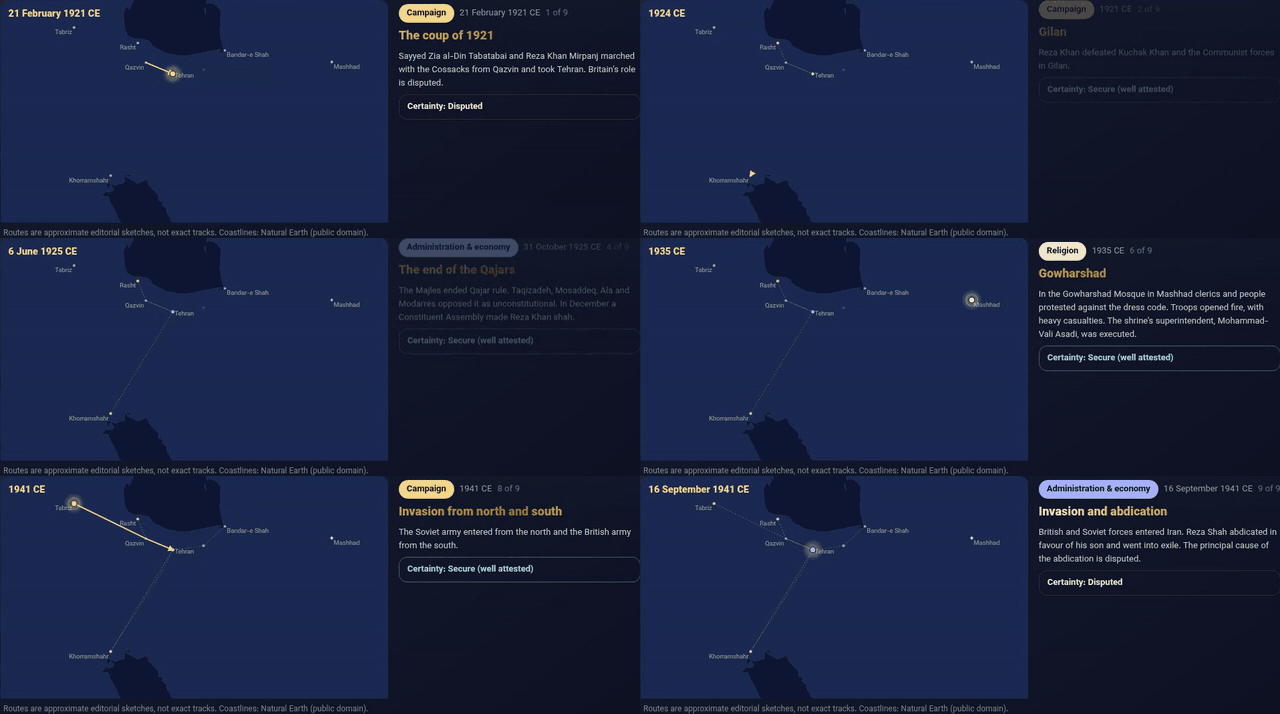
Campaign21 February 1921 CE1 of 9
The coup of 1921
Sayyed Zia al-Din Tabatabai and Reza Khan Mirpanj marched with the Cossacks from Qazvin and took Tehran. Britain’s role is disputed.
Certainty: DisputedThe Iranica chronology says the British General Ironside discussed a coup with Reza Khan in Qazvin. Ferrier, in the same encyclopaedia, calls the extent of British complicity “a moot issue”: he accepts Ironside’s personal encouragement, not official British support.
Sources: E. Yarshater, Encyclopaedia Iranica, online edition · R. W. Ferrier, Encyclopaedia Iranica, 1985, updated 2016
BattleCampaignBuildingAdministration & economyReligionArrow keys, Home/End and Space work.
Three separate layers
Each section has three layers: “Historical evidence” is only what the sources say; “Philosophical interpretation” is our reading by the standard of property and liberty; “Modern cultural meaning”. Quotations come only from published translations, with references.
Historical evidencePhilosophical interpretationModern cultural meaning
Dossier · 1
From Cossack officer to shah
Reza Khan was an officer of the Cossack division. In the 1921 coup he took Tehran with Sayyed Zia, then became minister of war and, in 1923, prime minister.
In 1924 he tried to declare a republic, but the ulama opposed it and he withdrew. In October 1925 the Majles deposed the Qajars, and in December a Constituent Assembly made him shah.
The extent of British complicity in the coup d’état of Sayyed Żīāʾ-al-dīn Ṭabāṭabāʾī and of Reżā Khan is a moot issue.
the Pahlavis are the only ones whose power from the beginning was not tribally based but instead depended on the instrumentalities of the state institutions.


The sources disagree on Britain’s role: the Iranica chronology reports Ironside discussing the coup with Reza Khan, and Ferrier does not accept official British support. We leave the question open.
Sheikh-ol-Islami, in the article “Army”, writes that unlike earlier dynasties the Pahlavis’ power rested not on a tribe but on the institutions of the state.
This is our reading: the parliament created by the constitution itself chose the new dynasty; the four deputies who objected show that the step was contested even on the day.
Sources: E. Yarshater, Encyclopaedia Iranica · E. Yarshater, Encyclopaedia Iranica · R. W. Ferrier, Encyclopaedia Iranica · M. J. Sheikh-ol-Islami, Encyclopaedia Iranica
Dossier · 2
The new state: railway, courts, university
In his sixteen-year reign new courts were built, the capitulations were abolished, the Trans-Iranian Railway (1927–1938) was laid with money from taxes on sugar and tea, and the University of Tehran opened in 1935.
Sheikholeslami (article “Administration”) writes that the railway cost a sum nearly equal to a decade of oil revenue.
It is difficult to find in the long Persian history another monarch, with the possible exception of Cyrus, Darius I, and the Sasanid Ardašir I, who achieved so much in so little time.

Yarshater judges his record very large. The same author writes that the shah’s dictatorial behaviour subverted the results of the Constitutional movement. We give both judgements under the author’s name.
This is our reading: many institutions Iranians know today, such as the University of Tehran and the north–south railway, were built in this period; but the state that built them did not ask the people.
Sources: E. Yarshater, Encyclopaedia Iranica · A. Sheikholeslami, Encyclopaedia Iranica
Dossier · 3
Repression, dress and the veil
Teymurtash (1933) was murdered in prison on the shah’s orders and Modarres (1937) in police custody. In 1935 a protest against the dress law in the Gowharshad Mosque in Mashhad ended with troops firing and heavy casualties.
In 1936 the queen and the shah’s daughters appeared unveiled at a public ceremony, and the chador was banned.
Even Yarshater, who praises his record, writes of the “autocratic arbitrariness” that stifled free criticism in his later years, when fear of him replaced the earlier admiration. Our sources give no death toll for Gowharshad; we do not invent one.
This is our reading: unveiling and the dress law are still among the most argued-over acts of the period; to some a sign of women’s freedom, to others of state force over private life.
Sources: E. Yarshater, Encyclopaedia Iranica · E. Yarshater, Encyclopaedia Iranica
Dossier · 4
Land, state and household
Yarshater writes that the shah acquired large estates in Mazandaran and that the price his agents paid “proved little short of confiscatory”. The Iranica chronology records that from 1951 Mohammad Reza Shah returned most of these lands to their original owners at a low price.
Sheikholeslami writes that the bureaucracy stood within the framework of the Majles on the surface, but in practice was an extension of the Pahlavi household.
Superficially, the bureaucracy existed within the framework set by the Majlis; in practice, it was an extension of the Pahlavi household.
This is our reading: in this period the line between the state’s property and the shah’s property grew faint. The same state that ended foreigners’ privileges let the shah take peasants’ land at a nominal price.
This is our reading: the question “whose is the state’s property?” outlived him and returned again and again in later periods.
Sources: E. Yarshater, Encyclopaedia Iranica · A. Sheikholeslami, Encyclopaedia Iranica · E. Yarshater, Encyclopaedia Iranica
Dossier · 5
Invasion, abdication and exile
In 1941 Britain and the Soviet Union occupied Iran. Reza Shah abdicated in favour of his son on 16 September, was exiled to Mauritius and then Johannesburg, and died in 1944.
His body was brought back to Iran in 1950. The Iranica chronology records that his mausoleum was demolished after the revolution of 1979.
The principal cause of the abdication of Reżā Shah in favor of his eldest son is disputable, but it was not a premeditated act of British policy
Ferrier calls the principal cause of the abdication “disputable”, but does not see it as premeditated British policy. The army that was the base of his power did not hold against the invasion.
This is our reading: judgement of Reza Shah is still divided today; we have set out both sides with their sources and leave the final verdict to the reader.
Sources: E. Yarshater, Encyclopaedia Iranica · E. Yarshater, Encyclopaedia Iranica · R. W. Ferrier, Encyclopaedia Iranica
Synthesis: a strong state, a weak parliament
Reza Shah built a centralised state with an army, courts, schools and a railway, and broke the power of the tribes and the privileges of foreigners. Yarshater judges this a record with few equals.
The same sources say he killed or jailed opponents, emptied the Majles of force and took large estates for himself. When Iran was occupied in 1941 his army did not hold and he was forced to abdicate.
Bibliography
- E. Yarshater, Encyclopaedia Iranica, Iran ii. Iranian history (2) Islamic period, page 5: the coup of 1921 and Reza Shah (2004). https://www.iranicaonline.org/articles/iran-ii2-islamic-period-page-5/The spine of the Reza Shah page: the coup, the reforms, his character and his errors. Yarshater’s tone is admiring, so we set the criticism in other Iranica articles beside it.
- E. Yarshater, Encyclopaedia Iranica, Iran ii. Iranian history (2) Islamic period, page 6: Mohammad Reza Shah (2004). https://www.iranicaonline.org/articles/iran-ii2-islamic-period-page-6/The Second World War, Reza Shah’s abdication and the reign of Mohammad Reza Shah.
- E. Yarshater, Encyclopaedia Iranica, Chronology of Iranian History, Part 2 (1834–1932) (online edition). https://www.iranicaonline.org/articles/chronology-of-iranian-history-part-2/Year-by-year events from the 1921 coup to the cancellation of the D’Arcy concession.
- E. Yarshater, Encyclopaedia Iranica, Chronology of Iranian History, Part 3 (1933–1973) (online edition). https://www.iranicaonline.org/articles/chronology-of-iranian-history-part-3/The 1933 oil agreement, Gowharshad, unveiling, the abdication and the reign of Mohammad Reza Shah.
- R. W. Ferrier, Encyclopaedia Iranica, Anglo-Iranian Relations iii. Pahlavi period (1985, updated 2016). https://www.iranicaonline.org/articles/anglo-iranian-relations-iii/Britain’s role in the 1921 coup, the 1933 oil agreement and the 1941 abdication; it calls both the coup question and the abdication’s cause open to dispute.
- M. J. Sheikh-ol-Islami, Encyclopaedia Iranica, Army vi. Pahlavi period (1986, updated 2018). https://www.iranicaonline.org/articles/army-vi/The modern army, the Cossack division and the gendarmerie.
- A. Sheikholeslami, Encyclopaedia Iranica, Administration in Iran vii. Pahlavi period (1983, updated 2018). https://www.iranicaonline.org/articles/administration-vii-pahlavi/The bureaucracy, the railway and the state’s relation to the Pahlavi household; a more critical view than Yarshater’s.
- E. Yarshater, Encyclopaedia Iranica, Chronology of Iranian History, Part 4 (1974–1999) (online edition). https://www.iranicaonline.org/articles/chronology-of-iranian-history-part-4/The Rastakhiz party, the imperial calendar and a day-by-day account of the revolution of 1978–1979.
- M. J. Gasiorowski, Encyclopaedia Iranica, Coup d’état of 1332 Š./1953 (1993). https://www.iranicaonline.org/articles/coup-detat-1953/Mosaddeq’s premiership, oil nationalisation and the coup of 19 August 1953, drawing on British and American records.
All photos are from Wikimedia Commons; licence and author were checked on each file page.