Featured dossier
Naser al-Din Shah: Amir Kabir, tobacco and the road to the constitution
He reigned for nearly fifty years. Reform began with his chief minister Amir Kabir and stalled with his murder; the concessions he granted to foreigners led to the Tobacco protest, and he himself was assassinated in 1896. Ten years later, under his son Mozaffar al-Din Shah, the Constitutional Revolution created the Majles.
- reign (1848–1896)
- 48 years
- Amir Kabir in office
- 3 years
- in sanctuary at the British legation, Aug 1906
- 14,000
- First Majles opens
- 7 Oct 1906
Animated map: life and events
Administration & economySeptember 1848 CE1 of 12
The crown prince becomes shah
Mohammad Shah died while the sixteen-year-old crown prince was in Tabriz. His tutor, Amir Kabir, found the money for his journey to Tehran.
Certainty: Secure (well attested)
Sources: H. Algar, Encyclopaedia Iranica, 1989 · E. Yarshater, Encyclopaedia Iranica, online edition
BattleCampaignBuildingAdministration & economyReligionArrow keys, Home/End and Space work.
From Amir Kabir to the Majles (1848–1906 CE)
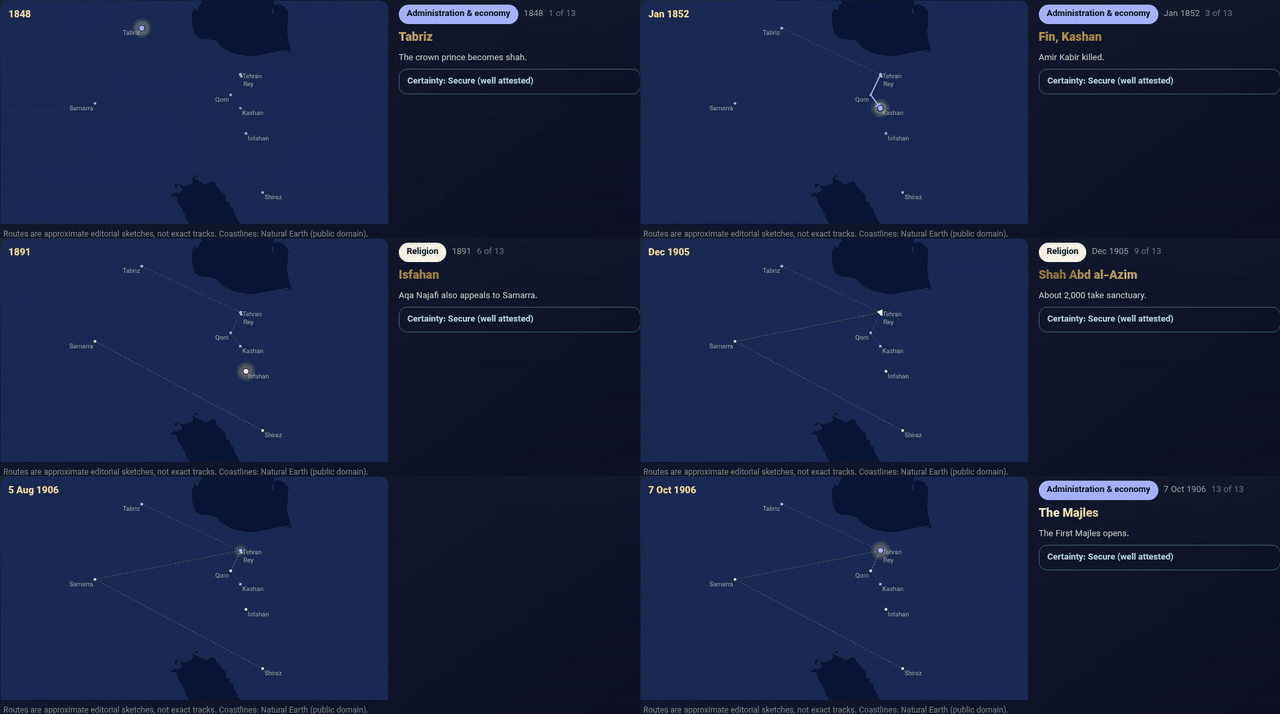
Amir Kabir’s ministry and murder, the Tobacco protest from Shiraz to Samarra and Tehran, and the sanctuaries of the Constitutional Revolution. Dates follow Iranica; the routes are sketches.
Administration & economy18481 of 13
Tabriz
The crown prince becomes shah.
Certainty: Secure (well attested)
BattleCampaignBuildingAdministration & economyReligionArrow keys, Home/End and Space work.
Three separate layers
Each section has three layers: “Historical evidence” is only what the sources say; “Philosophical interpretation” is our reading by the standard of property and liberty; “Modern cultural meaning”. Quotations come only from published translations, with references.
Historical evidencePhilosophical interpretationModern cultural meaning
Dossier · 1
Amir Kabir
Mirza Taqi Khan (1807–1852) was the son of a cook from Hazava in Farahan. He spent four years at Erzurum on the Ottoman–Iranian border commission and in 1848 became Naser al-Din Shah’s chief minister.
He balanced the budget by cutting pensions, built arms factories, founded the newspaper Ruz-nama-ye waqayeʿ-e ettefaqiya and established the Dar al-Fonun. In foreign policy he gave concessions to neither Russia nor Britain. He was dismissed in 1851 and killed at Fin in January 1852.
an unusually loyal and effective servant of the traditional state whose primary objective was the strengthening of the central government. He was only incidentally an agent of modernization and westernization


Algar attributes his fall and murder chiefly to his enemies at court, Mirza Aqa Khan Nuri and the queen mother. Yarshater calls his murder on the shah’s order “an indelible stain” on the shah’s reputation.
Algar warns against seeing Amir Kabir too much as a moderniser: above all he was a loyal servant of the traditional state. His policy has been called “negative equilibrium”. He also ordered the execution of the Bab (1850); Algar thinks his motive was “probably” political, to preserve the state.
In Iranian historiography Amir Kabir is one of the few capable and honest Qajar statesmen, and the Dar al-Fonun, in Algar’s words, “soon became a posthumous monument to its founder”. The bathhouse at Fin is visited today.
Sources: H. Algar, Encyclopaedia Iranica · E. Yarshater, Encyclopaedia Iranica
Dossier · 2
The Tobacco protest
The government gave a British company the tobacco monopoly. From spring 1891, when the company began operating, opposition led by the ulama grew. Sayyed Ali Falasiri was expelled from Shiraz and went by way of Basra to Mirza Hasan Shirazi at Samarra.
Mirza Hasan telegraphed the shah in July 1891 and again two months later, without answer. In December the boycott fatwa circulated in Tehran. The shah cancelled the concession, and the episode closed on 26 January 1892.
from this day forward, the use of tobacco for water pipes (tonbāku) and pipe tobacco (tutun), in whatever form it may be, is tantamount to warfare against the Imam of the Age [the Twelfth Imam], may God hasten his reappearance
Iranica calls the movement “the first instance of mass politics in Persia”, and Yarshater sees it as a prelude to the Constitutional Revolution and the first time in the modern period that the ulama successfully rallied the urban population against the government.
We show two disagreements: the year of the concession (1889 in one article, 1872 in another) and whether the fatwa really came from Mirza Hasan Shirazi. Iranica thinks outright forgery unlikely.
Yarshater sees the Tobacco protest as a prelude to the Constitutional Revolution. That it is remembered today as resistance to a foreign concession is our reading of public memory, not a claim from the sources.
Sources: Encyclopaedia Iranica · E. Yarshater, Encyclopaedia Iranica
Dossier · 3
Concessions and the shah’s purse
Yarshater writes that a railway concession and several others were granted to a British national and cancelled under popular pressure; the dispute that followed led to a new concession for the Imperial Bank of Persia with the exclusive right to issue banknotes. After the tobacco concession was cancelled, too, the country bore the financial consequences.
At the start of this same reign Amir Kabir found the treasury empty and balanced the budget by cutting pensions paid to courtiers and others.
Naser-al-Din Shah was a well-meaning king as long as his purse and pleasure were not involved.
This is our reading: in these concessions the country’s resources, from railways to tobacco and paper money, were treated as property the shah and his government could lease out, and the cost of cancelling them fell on the country, not the court. Yarshater calls Naser al-Din “a well-meaning king as long as his purse and pleasure were not involved”.
The limits of this reading: our sources do not measure what the shah or his ministers personally gained from the concessions, and we do not guess at motives. Amir Kabir shows that another path was tried within the same state.
Iranica writes that finances were one of the major problems facing the First Majles; linking that to the concessions of Naser al-Din’s reign is our reading.
Sources: E. Yarshater, Encyclopaedia Iranica · H. Algar, Encyclopaedia Iranica
Dossier · 4
Fifty years on the throne, and the end
Naser al-Din Shah reigned for a little under fifty years. In his time the telegraph (1857) and a modern postal service arrived, Dar al-Fonun graduates went to study in Europe, and the shah travelled to Europe three times. After a failed Babi attempt on his life, he ordered a massacre of the Babis.
On 1 May 1896 he was killed by Mirza Reza Kermani, who had been influenced by the ideas of Jamal al-Din Asadabadi.

Yarshater writes that contact with the West grew but the country suffered from backwardness, a poor economy, the corruption of the ruling class and the exploitation of the peasantry, and the European trips did not solve the basic problems. At the same time the idea of law and an awareness of the abuse of power spread, especially among the educated.
The diary of Eʿtemad al-Saltana, the minister of publications who read to the shah, is one of the main sources for his court life. The many photographs of him have made his image especially memorable; that second point is our own observation.
Sources: E. Yarshater, Encyclopaedia Iranica
Dossier · 5
Mozaffar al-Din Shah and the Constitutional Revolution
Mozaffar al-Din Shah (1896–1907) succeeded his father. In December 1905, after the governor of Tehran had two merchants bastinadoed for raising the price of sugar, the bazaar struck and about 2,000 people took sanctuary at the shrine of Shah Abd al-Azim. A rescript of 10 January 1906 promised a house of justice (ʿadālat-ḵāna).
In July 1906 the ulama left for Qom, and by 2 August 14,000 people had taken sanctuary at the British legation. The farmān of 5 August 1906 was issued, the First Majles opened on 7 October, and the Fundamental Law was adopted on 27 December 1906. The shah endorsed these documents before his death on 9 January 1907.
the principles (asās) of mašrūṭīyat cannot be suspended

Yarshater describes Mozaffar al-Din Shah as “weak, pleasure-loving, simple-minded, and considerate”. The revolution was born of an alliance of reformist ulama, merchants and intellectuals; Iranica writes that the vagueness of the demand for a “house of justice” made a compromise between the court and the ulama in sanctuary possible.
The two Iranica articles do not agree about the farmān of 5 August (the Constitutional edict, or a vague text that was rejected); we show the disagreement.
His son, Mohammad-Ali Shah, had the Majles bombarded on 23 June 1908, and in July 1909 the constitutionalists took Tehran and deposed him. Iranica writes that the goals of this era, such as a centralised state with a powerful army and an extensive bureaucracy, set the agenda for the early reforms under Reza Shah.
Sources: Encyclopaedia Iranica · Encyclopaedia Iranica · E. Yarshater, Encyclopaedia Iranica
Synthesis: from reform from above to a parliament
Early in this period reform from above was tried: Amir Kabir strengthened the state and balanced the budget, but courtiers’ hostility brought his dismissal and murder. After him, concessions and journeys took the place of reform.
The Tobacco protest showed that the ulama and the bazaar could mobilise the people. Ten years after the shah’s assassination, the same alliance, joined by intellectuals, made Mozaffar al-Din Shah accept a parliament and a constitution.
Bibliography
- J. R. Perry, Encyclopaedia Iranica, Āḡā Moḥammad Khan Qājār (1984, updated 2018 (print: vol. I, fasc. 6, pp. 602–605)). https://www.iranicaonline.org/articles/aga-mohammad-khan/The spine of the Agha Mohammad Khan page: captivity, Kerman, Tiflis, coronation, murder and character. Perry quotes Forster, Malcolm, Watson and Kotzebue.
- K. Hitchins, Encyclopaedia Iranica, Georgia ii. History of Iranian-Georgian Relations (2001, updated 2015). https://www.iranicaonline.org/articles/georgia-ii-history/The Treaty of Georgievsk, the capture of Tbilisi in September 1795 and the deportation of some 15,000 people as slaves. Hitchins cites Hambly’s chapter in the Cambridge History of Iran, vol. VII; we have not consulted that chapter directly.
- A. Amanat, Encyclopaedia Iranica, Fatḥ-ʿAlī Shah Qājār (1999, updated 2014). https://www.iranicaonline.org/articles/fath-ali-shah/The spine of the Fath-Ali Shah page: succession, court, diplomacy and the indemnity.
- H. Busse, Encyclopaedia Iranica, ʿAbbās Mīrzā Qajar (1982). https://www.iranicaonline.org/articles/abbas-mirza/The crown prince and commander in both wars with Russia.
- Encyclopaedia Iranica, Golestan Treaty (online edition). https://www.iranicaonline.org/articles/golestan-treaty/Background, conflicting dates and consequences of the Golestan treaty.
- Encyclopaedia Iranica, Russia i. Russo-Iranian relations up to the Bolshevik Revolution (online edition). https://www.iranicaonline.org/articles/russia-i/The course of the first Russo-Persian war (1804–1813) and the second.
- J. C. Hurewitz, Diplomacy in the Near and Middle East: A Documentary Record, vol. I (1535–1914) (1956). https://archive.org/details/diplomacyinnearm1956hureThe published English translation of the Golestan and Turkmanchay treaties; the treaty quotations are taken word for word from it.
- H. Algar, Encyclopaedia Iranica, Amīr(-e) Kabīr, Mīrzā Taqī Khan (1989). https://www.iranicaonline.org/articles/amir-e-kabir/The spine of the Amir Kabir section: reforms, the Dar al-Fonun, dismissal and murder at Fin.
- Encyclopaedia Iranica, Ḥasan Širāzi, Mirzā Moḥammad (online edition). https://www.iranicaonline.org/articles/hasan-sirazi-mirza-mohammad/The Tobacco protest, the telegrams and the boycott fatwa, with the doubts about it.
- E. Yarshater, Encyclopaedia Iranica, Iran ii. Iranian history (2) Islamic period, page 5: the Qajar dynasty (online edition). https://www.iranicaonline.org/articles/iran-ii2-islamic-period-page-5/An overview of the reigns of Naser al-Din Shah and Mozaffar al-Din Shah.
- Encyclopaedia Iranica, Constitutional Revolution i. Intellectual background (online edition). https://www.iranicaonline.org/articles/constitutional-revolution-i/The constitutional edict, the Fundamental Law and its supplement.
- Encyclopaedia Iranica, Constitutional Revolution ii. Events (online edition). https://www.iranicaonline.org/articles/constitutional-revolution-ii/The events of 1905–1909: the sanctuaries, the First Majles, the coup and the taking of Tehran.
All photos are from Wikimedia Commons; licence and author were checked on each file page.