The Pahlavis
Mohammad Reza Shah Pahlavi
محمدرضاشاه
- Reign
- 1941–1979 CE
- Dynasty
- The Pahlavis
- Persian page
- فارسی
Featured dossier
Mohammad Reza Shah: oil, coup, White Revolution and 1979
He became shah in 1941 in an occupied country. After the coup of 1953 and Mosaddeq’s fall his power grew; with the White Revolution and oil revenue he transformed the country, and in 1979 he left Iran in the revolution.
- reign (1941–1979)
- 38 years
- coup; Mosaddeq overthrown
- 19 Aug 1953
- oil revenue after 1973
- over $20 billion
- leaves Iran
- 16 Jan 1979
Animated map: life and events
Administration & economySeptember 1941 CE1 of 15
The crown prince becomes shah
After the occupation of Iran and Reza Shah’s abdication, the 21-year-old crown prince became shah with the agreement of the Allies.
Certainty: Secure (well attested)
Sources: E. Yarshater, Encyclopaedia Iranica, online edition · E. Yarshater, Encyclopaedia Iranica, 2004
BattleCampaignBuildingAdministration & economyReligionArrow keys, Home/End and Space work.
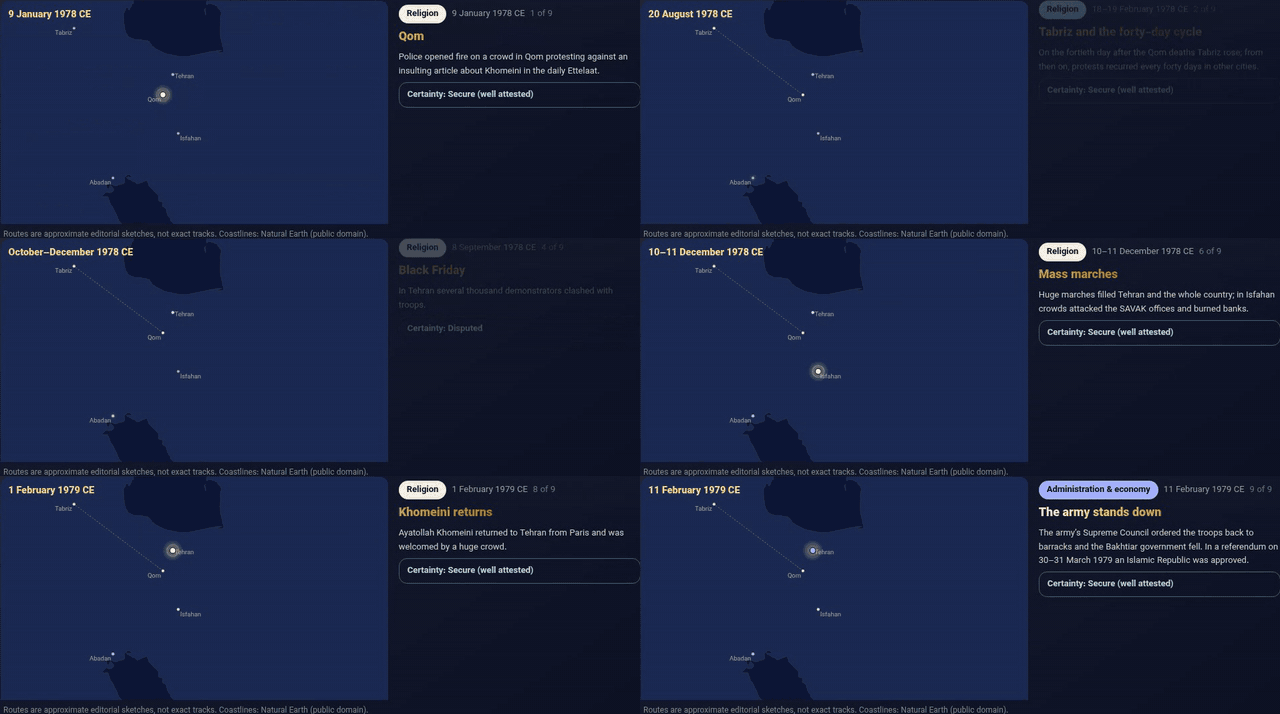
Revolution: from Qom to 11 February (1978–1979 CE)
A year of protest, strikes and marches, following the Iranica chronology. Lines are sketches.
Religion9 January 1978 CE1 of 9
Qom
Police opened fire on a crowd in Qom protesting against an insulting article about Khomeini in the daily Ettelaat.
Certainty: Secure (well attested)
Sources: E. Yarshater, Encyclopaedia Iranica, online edition
BattleCampaignBuildingAdministration & economyReligionArrow keys, Home/End and Space work.
Three separate layers
Each section has three layers: “Historical evidence” is only what the sources say; “Philosophical interpretation” is our reading by the standard of property and liberty; “Modern cultural meaning”. Quotations come only from published translations, with references.
Historical evidencePhilosophical interpretationModern cultural meaning
Dossier · 1
The young shah and the Majles
Mohammad Reza became shah in 1941 in an occupied country. Yarshater writes that in these years he followed the Majles’ vote in choosing prime ministers, and that freedom was “unprecedented”.
In 1946 Soviet troops left Azarbaijan. In 1949, after an attempt on the shah’s life, the Tudeh party was outlawed and the shah gained the power to dissolve the Majles.
The first phase of Moḥammad Reza Shah’s reign (1941-53) was characterized by factionalism in the Majles, unbridled disputes, and sometimes character assassinations in the press, as a fruit of unprecedented freedom, despite a measure of government control.

Yarshater also describes the same period as one of Majles factionalism and ineffective government. We give both sides from the same author.
This is our reading: 1941 to 1953 was the only part of this reign in which the Majles and the press truly competed with the court; arguments about it are still alive.
Sources: E. Yarshater, Encyclopaedia Iranica · E. Yarshater, Encyclopaedia Iranica
Dossier · 2
Mosaddeq, oil and the coup of 1953
In April 1951 Mosaddeq became prime minister and the oil industry was nationalised. Britain boycotted Iranian oil, and in 1952 Mosaddeq broke off relations with Britain.
In August 1953 the shah dismissed Mosaddeq, Mosaddeq refused to go and the shah left the country. On 19 August Mosaddeq was overthrown in a coup and the shah returned. In 1954 the consortium agreement was signed.
conceived by MI6 [the British Intelligence Service] and delivered by CIA
Eventually, a coup inspired and aided by the British and the Americans was conceived with the concurrence of the shah, who dismissed Moṣaddeq as prime minister, but Moṣaddeq ignored the royal decree and had the shah’s envoy arrested.

Iranica’s articles describe the roles of foreign powers and the shah in different words (see the note on the event). Yarshater writes that intellectuals were largely marginalised after the coup.
This is our reading: 19 August 1953 is still one of the most contested days in modern Iranian history, and each reader’s view of it is often tied to their judgement of the whole reign.
Sources: M. J. Gasiorowski, Encyclopaedia Iranica · E. Yarshater, Encyclopaedia Iranica · E. Yarshater, Encyclopaedia Iranica
Dossier · 3
Land, oil and property
The Iranica chronology says that from 1951 the shah returned most of the lands Reza Shah had taken in Mazandaran to their original owners at a low price.
The White Revolution (1963) gave farmland to the peasants. In these decades oil was nationalised, and after 1973 its revenue multiplied. In 1978 the prime minister, Sharif-Emami, was head of the Pahlavi Foundation.
The gap between the rich and the poor widened, and this lent further strength to the Islamic protest movement.
This is our reading: property was redivided twice in this reign: oil passed from a foreign company to the state, and land from large owners to peasants. But the oil revenue stayed with a state that did not answer to the Majles.
Yarshater writes that the gap between rich and poor widened, and that this strengthened the Islamic protest movement.
This is our reading: the question of whom the oil wealth belongs to, and who decides about it, remained open after 1979.
Sources: E. Yarshater, Encyclopaedia Iranica · E. Yarshater, Encyclopaedia Iranica · E. Yarshater, Encyclopaedia Iranica
Dossier · 4
SAVAK, Rastakhiz and Persepolis
SAVAK was formed in 1957 with American advice. In 1971 the 2,500-year celebrations were held at Persepolis, in 1975 Iran became a one-party state, and in 1976 the imperial calendar was introduced.
The Iranica chronology says nationalists praised the new calendar and the clergy resented it. The same year Amnesty International criticised the treatment of political prisoners.
Yarshater writes that the huge purchases of American arms let opponents call the shah a stooge of the United States. That is the opponents’ judgement as he reports it, not his own.
This is our reading: linking the monarchy to the Achaemenids, at Persepolis and in the calendar, was an attempt to draw legitimacy from ancient history; many people did not accept it.
Sources: E. Yarshater, Encyclopaedia Iranica · E. Yarshater, Encyclopaedia Iranica · E. Yarshater, Encyclopaedia Iranica
Dossier · 5
The revolution of 1978–79
From Qom in January 1978 to the oil strike in the autumn, protest lasted a year. The shah left Iran on 16 January 1979, Khomeini returned on 1 February, and on 11 February the army declared itself neutral.
The shah died in Cairo in 1980. The Iranica chronology says he had kept his cancer secret from the Iranian people.
Yarshater writes that fear of the shah had disappeared and soldiers refused to shoot. The death toll of Black Friday and who set the Rex cinema fire remain disputed (see the event notes).
This is our reading: judgement of Mohammad Reza Shah is still divided today; we have set out the events and the judgements with their sources and leave the final verdict to the reader.
Sources: E. Yarshater, Encyclopaedia Iranica · E. Yarshater, Encyclopaedia Iranica
Synthesis: modernisation without participation
The first twelve years of the reign had an unprecedented freedom that ended with the coup of 1953. After that the shah transformed the country with land reform, votes for women and oil revenue.
The same sources record SAVAK, the single party, a widening gap between rich and poor, and protest from both clerics and writers. In 1978 fear disappeared, and in 1979 the monarchy ended.
Bibliography
- E. Yarshater, Encyclopaedia Iranica, Iran ii. Iranian history (2) Islamic period, page 5: the coup of 1921 and Reza Shah (2004). https://www.iranicaonline.org/articles/iran-ii2-islamic-period-page-5/The spine of the Reza Shah page: the coup, the reforms, his character and his errors. Yarshater’s tone is admiring, so we set the criticism in other Iranica articles beside it.
- E. Yarshater, Encyclopaedia Iranica, Iran ii. Iranian history (2) Islamic period, page 6: Mohammad Reza Shah (2004). https://www.iranicaonline.org/articles/iran-ii2-islamic-period-page-6/The Second World War, Reza Shah’s abdication and the reign of Mohammad Reza Shah.
- E. Yarshater, Encyclopaedia Iranica, Chronology of Iranian History, Part 2 (1834–1932) (online edition). https://www.iranicaonline.org/articles/chronology-of-iranian-history-part-2/Year-by-year events from the 1921 coup to the cancellation of the D’Arcy concession.
- E. Yarshater, Encyclopaedia Iranica, Chronology of Iranian History, Part 3 (1933–1973) (online edition). https://www.iranicaonline.org/articles/chronology-of-iranian-history-part-3/The 1933 oil agreement, Gowharshad, unveiling, the abdication and the reign of Mohammad Reza Shah.
- R. W. Ferrier, Encyclopaedia Iranica, Anglo-Iranian Relations iii. Pahlavi period (1985, updated 2016). https://www.iranicaonline.org/articles/anglo-iranian-relations-iii/Britain’s role in the 1921 coup, the 1933 oil agreement and the 1941 abdication; it calls both the coup question and the abdication’s cause open to dispute.
- M. J. Sheikh-ol-Islami, Encyclopaedia Iranica, Army vi. Pahlavi period (1986, updated 2018). https://www.iranicaonline.org/articles/army-vi/The modern army, the Cossack division and the gendarmerie.
- A. Sheikholeslami, Encyclopaedia Iranica, Administration in Iran vii. Pahlavi period (1983, updated 2018). https://www.iranicaonline.org/articles/administration-vii-pahlavi/The bureaucracy, the railway and the state’s relation to the Pahlavi household; a more critical view than Yarshater’s.
- E. Yarshater, Encyclopaedia Iranica, Chronology of Iranian History, Part 4 (1974–1999) (online edition). https://www.iranicaonline.org/articles/chronology-of-iranian-history-part-4/The Rastakhiz party, the imperial calendar and a day-by-day account of the revolution of 1978–1979.
- M. J. Gasiorowski, Encyclopaedia Iranica, Coup d’état of 1332 Š./1953 (1993). https://www.iranicaonline.org/articles/coup-detat-1953/Mosaddeq’s premiership, oil nationalisation and the coup of 19 August 1953, drawing on British and American records.
All photos are from Wikimedia Commons; licence and author were checked on each file page.