Arsacids (Parthians)
Mithridates II the Great
مهرداد دوم
Epithets and titles
- the Greatbyname (later or foreign)Justin: his deeds earned him the surname “the Great”Source: Justin, Epitome 42.2.3, tr. J. S. Watson (1853)
- King of KingsΒΑΣΙΛΕΩΣ ΒΑΣΙΛΕΩΝofficial titleon his coins from c. 109/8 BCE; a revival of the Achaemenid titleSource: D. Sellwood, An Introduction to the Coinage of Parthia (2nd ed., 1980), type 27
- Reign
- c. 124/123–91 BCE (Iranica: to 88/87)
- Dynasty
- Arsacids (Parthians)
- Persian page
- فارسی
Featured dossier
Mithridates II the Great: King of Kings, from the Silk Road to the Euphrates
The king who pulled Parthia out of its deepest crisis and whom Justin called “the Great”. He beat the Scythians in the east, made Characene a vassal, pushed the border to the Euphrates and was the first Parthian king whose coins certainly read “King of Kings”. In his reign the envoys of the Han emperor of China reached Parthia, he set Tigranes on the Armenian throne, and his envoy met a Roman commander, Sulla, for the first time. Follow his campaigns and diplomacy on the animated map, with evidence, interpretation and modern meaning in three separate layers.
- years of reign
- ~33
- horsemen to meet the Han envoys (Sima Qian)
- 20,000
- Armenian valleys for Tigranes’ release
- 70
- first meeting with Rome (BCE)
- 96
Animated map: the life of Mithridates II
Administration & economy124/123 BCE1 of 9
The king who was called “the Great”
After Artabanus I died in the eastern war, Mithridates became king. Justin calls him Artabanus’ son.
Certainty: DisputedHis parentage is disputed: Justin makes him a son of Artabanus I (so does Olbrycht 2010). But a Nisa ostracon (91/90 BCE) calls him “grandson of Friyapat”, and a Babylonian text of 119 BCE has him speak of “my brother Artabanus”; so he may have been a son of Phriapatius and Artabanus’ brother (Sarkhosh Curtis 2019).
Sources: Justin, tr. J. S. Watson, 1853 · I. M. Diakonoff, V. A. Livshits, 1976–2001 · V. Sarkhosh Curtis, 2019 · M. J. Olbrycht, 2010
BattleCampaignBuildingAdministration & economyReligionArrow keys, Home/End and Space work.
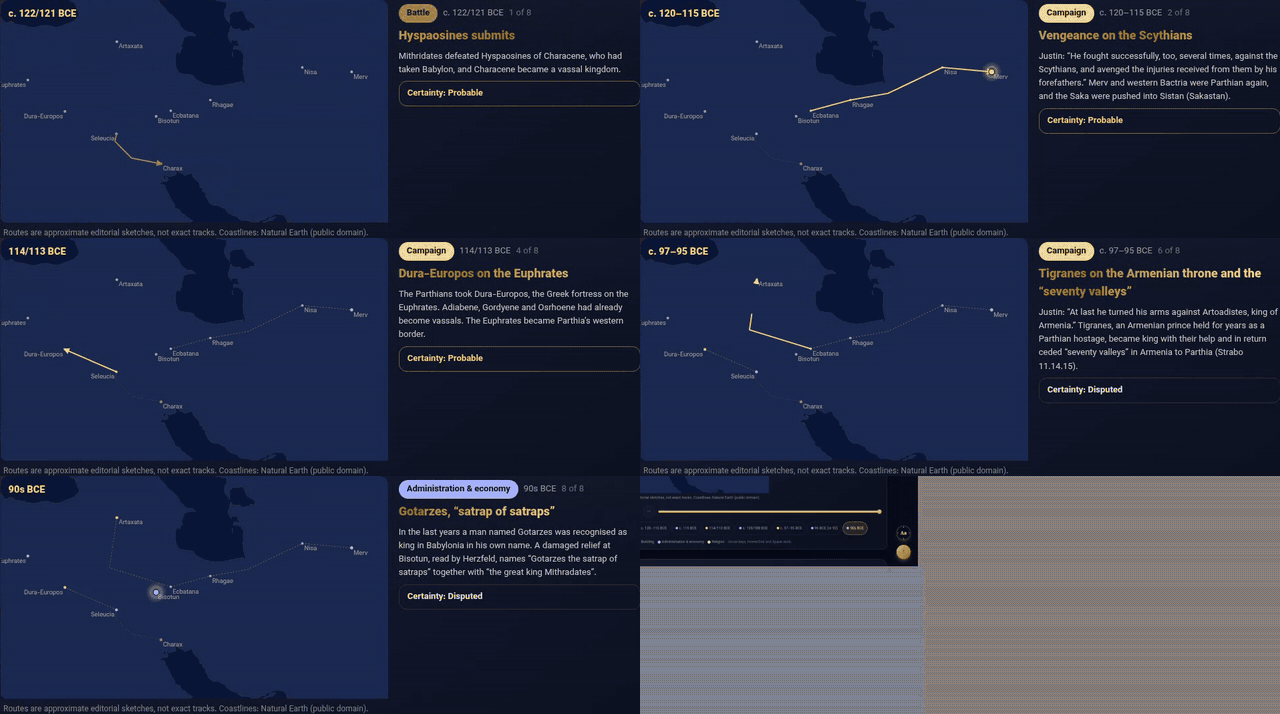
The Silk Road, Armenia and Rome, step by step (122–91 BCE)
From the Persian Gulf to Merv and from Armenia to the Euphrates. Each step says whether it is secure, probable or disputed. The narrative sources are Greek, Roman and Chinese; the routes are sketches.
Battlec. 122/121 BCE1 of 8
Hyspaosines submits
Mithridates defeated Hyspaosines of Characene, who had taken Babylon, and Characene became a vassal kingdom.
Certainty: Probable
Sources: K. Schippmann, Encyclopaedia Iranica, 1986, updated 2016 · A. J. Sachs, H. Hunger, 1996 · M. J. Olbrycht, 2010
BattleCampaignBuildingAdministration & economyReligionArrow keys, Home/End and Space work.
Three separate layers
Each section has three layers: “Historical evidence” is only what the sources say; “Philosophical interpretation” is our reading by the standard of property and liberty; “Modern cultural meaning”. Quotations come only from published translations, with references.
Historical evidencePhilosophical interpretationModern cultural meaning
Dossier · 1
“The Great” and “King of Kings”
Justin says his achievements earned him the surname “the Great”. His coins first carry the title “Soter” (Saviour) and from c. 109/8 “King of Kings”; he appears in a tall tiara and, on the reverse, the seated archer sits on a high-backed throne instead of the Greek omphalos stone.
He was succeeded by his son Mithridates, to whom his achievements procured the surname of Great; for, being fired with a desire to emulate the merit of his ancestors, he was enabled by the vast powers of his mind to surpass their renown. He carried on many wars, with great bravery, against his neighbours, and added many provinces to the Parthian kingdom.

Returning to the Achaemenid title was a deliberate message: the Arsacids presented themselves as heirs of the Achaemenids (Iranica). The throne replacing the omphalos means the Greek visual language was fading.
Titles are claims to power, not proof of legitimacy; what made a king acceptable to his subjects was security of roads and markets.
Sources: Justin, tr. J. S. Watson · K. Schippmann, Encyclopaedia Iranica · V. Sarkhosh Curtis · D. Sellwood
Dossier · 2
The Han envoys and the Silk Road
Sima Qian, the Han court historian, calls Parthia “Anxi” in chapter 123 of the Shiji: a land of hundreds of cities large and small, growing rice, wheat and vines, with merchants who travel by cart and boat to neighbouring lands, and silver coins bearing the king’s face that change with each new king. He says the king of Anxi sent twenty thousand horsemen to meet the Han envoys at the eastern border.
Iranica dates the embassy to c. 115 and the first caravan to 114 BCE (following Herrmann 1938).

“Silk Road” is a 19th-century name and no single treaty “opened” it; but the security Parthia imposed from Merv to the Euphrates made long-distance trade possible. The Parthians were middlemen and profited from transit dues (Isidore of Charax lists the stations of the route).
The wealth of nations comes from free trade and safe roads; a state that keeps the road safe and levies reasonable dues profits more than one that makes war.
Sources: Sima Qian, tr. B. Watson · K. Schippmann, Encyclopaedia Iranica · Isidore of Charax, tr. W. H. Schoff
Dossier · 3
The hostage Tigranes and the seventy valleys
Strabo says Tigranes “at first had served as a hostage among the Parthians; then by their means he returned to his country, in compensation for which service they obtained seventy valleys in Armenia”. After Mithridates’ death Tigranes took the valleys back and even laid waste the lands of Nineveh and Arbela.
At first he had served as a hostage among the Parthians; then by their means he returned to his country, in compensation for which service they obtained seventy valleys in Armenia. When he acquired power, he recovered these valleys, and devastated the country of the Parthians, the territory about Ninus, and that about Arbela.

Holding princes hostage was a tool of diplomacy; but loyalty bought that way ended with the buyer’s death.
An agreement founded on force breaks when the balance of power shifts; a lasting treaty rests on mutual benefit.
Sources: Strabo, tr. H. C. Hamilton & W. Falconer · K. Schippmann, Encyclopaedia Iranica · E. Dąbrowa
Dossier · 4
Three chairs on the Euphrates
Plutarch says Orobazus, envoy of “king Arsaces”, came to Sulla, and that this was the first time the Parthians asked the Romans for “alliance and friendship”. Sulla set three chairs and sat between the king of Cappadocia and the Parthian envoy; the Parthian king later had Orobazus executed.
During his stay on the banks of the Euphrates, there came to him Orobazus, a Parthian, ambassador from king Arsaces, as yet there having been no correspondence between the two nations. … having ordered three chairs of state to be set, one for Ariobarzanes, one for Orobazus, and a third for himself, he placed himself in the middle, and so gave audience. For this the king of Parthia afterwards put Orobazus to death.
The envoy’s execution shows that at the Parthian court the scene was a humiliation, not a treaty. Iranica calls the outcome unclear; the claim to parity or superiority began with this first meeting and lasted three centuries.
Diplomacy between great powers rests on mutual respect; a show of superiority looks cheap but costs dearly.
Sources: Plutarch, tr. J. Dryden, rev. A. H. Clough · E. Badian · K. Schippmann, Encyclopaedia Iranica · B. Dignas, E. Winter
Dossier · 5
Army, nobles and land
Justin describes the Parthian army as “not like other nations, of free men, but chiefly consisting of slaves”, each man furnishing horsemen in proportion to his wealth. Iranica sees a society of great landowners, dependent serfs, slaves and free villages; according to Wolski the nobles gained vast estates through the conquests.
They have an army, not like other nations, of free men, but chiefly consisting of slaves… As any one is eminent in wealth, so he furnishes the king with a proportionate number of horsemen for war. Indeed when fifty thousand cavalry encountered Antonius… only four hundred of them were free men.
Whether to call the system “feudal” is disputed: Widengren for, Schippmann against. Justin’s figure is also uncertain: in Watson’s translation “only four hundred” of fifty thousand horsemen were free, while Iranica gives 4,000.
Power resting on great estates and dependent labour makes the king dependent on the nobles; after Mithridates II this led to wars of succession. Individual freedom and widely held property are the basis of a stable state.
Sources: Justin, tr. J. S. Watson · K. Schippmann, Encyclopaedia Iranica · J. Wolski
Dossier · 6
Gotarzes and the end of the reign
In the last years Babylonian tablets know a king named Gotarzes. A relief at Bisotun, now almost destroyed, names in Herzfeld’s reading “Gotarzes the satrap of satraps” and “the great king Mithradates”. After Mithridates’ death the Armenians took back the seventy valleys and a period began that Sellwood called the “Parthian Dark Age”.
The date of death (91 for Assar, 88/7 for Iranica) and Gotarzes’ standing (rival or partner) are disputed.
A state that depends on one great man shakes at his death; institutions outlast heroes.
Sources: K. Schippmann, Encyclopaedia Iranica · M. R. Shayegan · G. F. Assar · D. Sellwood
Synthesis
Mithridates II took Parthia from two successive defeats in the east and the loss of Babylon to a power that exchanged envoys with China and set terms for Rome. But his power was personal and depended on landed nobles; at his death Armenia took back what it had given, and Parthia sank into wars of succession.
Bibliography
- Justin, tr. J. S. Watson, Epitome of Pompeius Trogus, books 38–42 (books 40–44 online) (1853). https://www.attalus.org/translate/justin7.htmlA Roman digest of the lost history of Pompeius Trogus (1st century BCE); the most continuous account of the early Parthians, but Roman in outlook and full of “Scythian” clichés.
- Strabo, tr. H. C. Hamilton & W. Falconer, Geography, book 11 (9.2–3, 14.15) (1854–1857). https://www.gutenberg.org/ebooks/44885
- Plutarch, tr. J. Dryden, rev. A. H. Clough, Life of Sulla, ch. 5 (1864). https://www.gutenberg.org/ebooks/674
- Sima Qian, tr. B. Watson, Records of the Grand Historian (Shiji), ch. 123: The Account of Dayuan (1961, rev. 1993). The Han court historian, contemporary with the embassies. He calls Parthia “Anxi”.
- Isidore of Charax, tr. W. H. Schoff, Parthian Stations, § 7 (1914).
- A. J. Sachs, H. Hunger, Astronomical Diaries and Related Texts from Babylonia, vol. III (164–61 BC) (1996). Contemporary notebooks of Babylonian astronomers that also logged political events; the firmest calendar for the period.
- I. M. Diakonoff, V. A. Livshits, Parthian Economic Documents from Nisa (Corpus Inscriptionum Iranicarum II/II) (1976–2001). Thousands of administrative ostraca from the wine stores of Nisa; the only native Parthian documents of the period.
- K. Schippmann, Encyclopaedia Iranica, Arsacids ii. The Arsacid dynasty (1986, updated 2016). https://www.iranicaonline.org/articles/arsacids-ii/
- G. F. Assar, A Revised Parthian Chronology of the Period 165–91 BC, Electrum 11, pp. 87–158 (2006). A new dating from coins and Babylonian tablets; e.g. it puts Mithridates I at 165–132 BCE.
- M. J. Olbrycht, The early reign of Mithradates II the Great in Parthia, Anabasis 1, pp. 144–158 (2010).
- V. Sarkhosh Curtis, From Mithradat I (c. 171–138 BCE) to Mithradat II (c. 122/1–91 BCE): the Formation of Arsacid Parthian Iconography, in Y. Moradi (ed.), Afarin Nameh, pp. 25–31 (2019). Used for the coinage, the titles and Mithridates II’s parentage.
- E. Dąbrowa, Studia Graeco-Parthica: Political and Cultural Relations between Greeks and Parthians (2011).
- E. Badian, Sulla’s Cilician command, in Studies in Greek and Roman History (1964).
- B. Dignas, E. Winter, Rome and Persia in Late Antiquity, p. 12 (2007).
- M. R. Shayegan, Arsacids and Sasanians: Political Ideology in Post-Hellenistic and Late Antique Persia (2011).
- D. Sellwood, An Introduction to the Coinage of Parthia, 2nd ed. (1980). The standard numbering of Parthian coins (“S”); some of its attributions have since been revised.
- J. Wolski, Le problème de la féodalité dans l’Iran arsacide, Klio 63 (1981).
- A. D. H. Bivar, The Political History of Iran under the Arsacids, Cambridge History of Iran 3/1, pp. 21–99 (1983).
All photos are from Wikimedia Commons; licence and author were checked on each file page.