Arsacids (Parthians)
Mithridates I
مهرداد یکم
Epithets and titles
- PhilhelleneΦΙΛΕΛΛΗΝΟΣofficial titlethe title on his tetradrachms after taking Seleucia, a gesture to the Greek citiesSource: D. Sellwood, An Introduction to the Coinage of Parthia (2nd ed., 1980), types 10–13
- Reign
- c. 171–138 BCE (Assar: 165–132)
- Dynasty
- Arsacids (Parthians)
- Persian page
- فارسی
Featured dossier
Mithridates I: from a Khorasan kingdom to an empire from Herat to the Euphrates
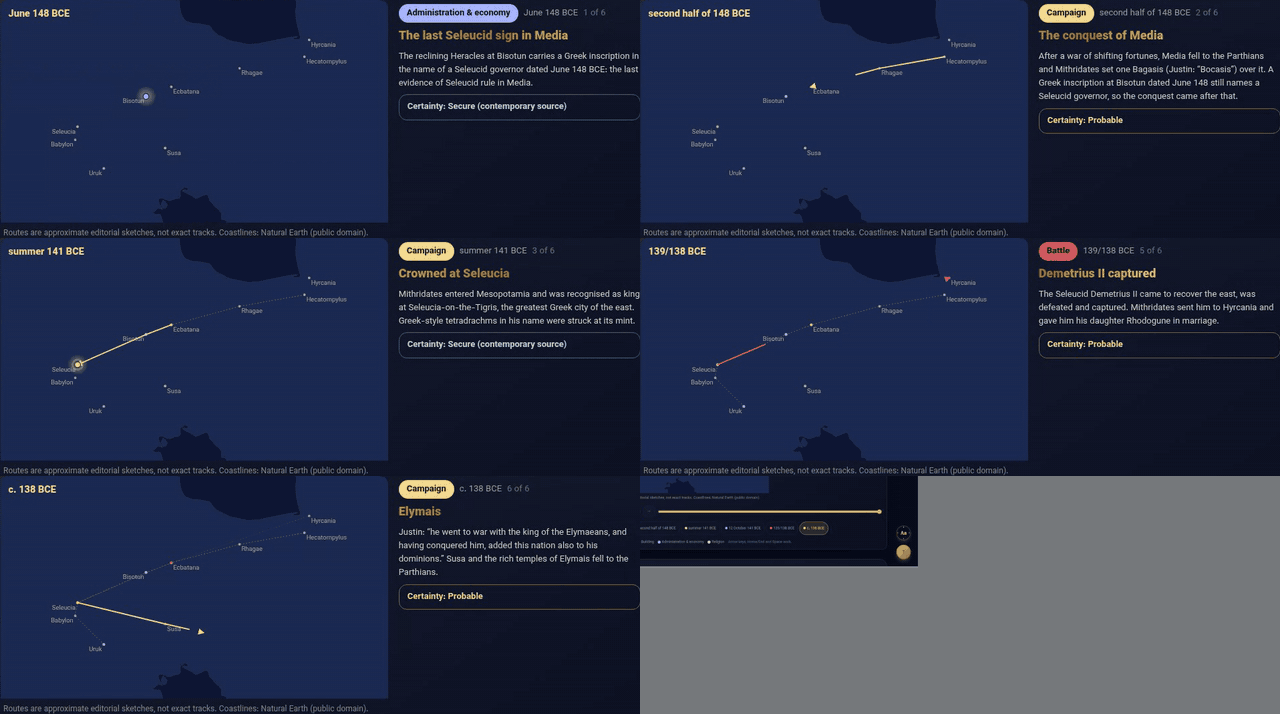
Phraates I’s brother, who turned Parthia from a kingdom in northern Khorasan into an empire. He took Herat and Merv from the Bactrian Greeks, conquered Media in 148 BCE, was recognised as king at Seleucia-on-the-Tigris in 141 and accepted by Babylonia, captured the Seleucid Demetrius II and took Elymais. He was the first Parthian king to call himself “Philhellene” on Greek-style coins. Follow the conquest of Media and Mesopotamia on the animated map, with evidence, interpretation and modern meaning in three separate layers.
- years of reign
- ~33
- conquest of Media (BCE)
- 148
- crowned at Seleucia (BCE)
- 141
- from Herat to the Euphrates
- ~2,000 km
Animated map: the life of Mithridates I
Administration & economyc. 171 BCE (Assar: 165)1 of 10
Phraates’ brother on the throne
Phraates I passed over his sons and left the throne to his brother Mithridates, “a man of extraordinary ability” (Justin 41.5.10).
Certainty: DisputedThe dates are disputed: tradition puts his reign at c. 171–138 BCE (Iranica: 171–139/8); Assar (2006), from Babylonian tablets and coins, at 165–132.
Sources: Justin, tr. J. S. Watson, 1853 · G. F. Assar, 2006 · K. Schippmann, Encyclopaedia Iranica, 1986, updated 2016
BattleCampaignBuildingAdministration & economyReligionArrow keys, Home/End and Space work.
The conquest of Media and Mesopotamia, step by step (148–138 BCE)
From the Seleucid inscription at Bisotun to Susa. The dates 148 and 141 come from contemporary documents; the routes are sketches. The narrative follows Justin and Iranica.
Administration & economyJune 148 BCE1 of 6
The last Seleucid sign in Media
The reclining Heracles at Bisotun carries a Greek inscription in the name of a Seleucid governor dated June 148 BCE: the last evidence of Seleucid rule in Media.
Certainty: Secure (contemporary source)
Sources: K. Schippmann, Encyclopaedia Iranica, 1986, updated 2016
BattleCampaignBuildingAdministration & economyReligionArrow keys, Home/End and Space work.
Three separate layers
Each section has three layers: “Historical evidence” is only what the sources say; “Philosophical interpretation” is our reading by the standard of property and liberty; “Modern cultural meaning”. Quotations come only from published translations, with references.
Historical evidencePhilosophical interpretationModern cultural meaning
Dossier · 1
From kingdom to empire
Justin describes the Median war as one of “fluctuating” fortune and says Mithridates at last extended Parthia “from Mount Caucasus to the river Euphrates”. Two dates are fixed by contemporary documents: the Seleucid inscription at Bisotun (June 148) and the Uruk text dated by Arsaces (12 October 141). Strabo also records the taking of part of Bactria from Eucratides.
…a war arose between the Parthians and Medes, and after fortune on each side had been some time fluctuating, victory at length fell to the Parthians; when Mithridates, enforced with this addition to his power, appointed Bocasis over Media, while he himself marched into Hyrcania. On his return from thence, he went to war with the king of the Elymaeans, and having conquered him, added this nation also to his dominions, and extended the Parthian empire, by reducing many other tribes under his yoke, from Mount Caucasus to the river Euphrates.
They deprived Eucratidas, and then the Scythians, by force of arms, of a part of Bactriana.

Wolski thought Mithridates aimed at the Mediterranean; Schippmann (Iranica) calls this “quite probable” and writes that the wars “can no longer simply be classified as a series of raids for the purpose of pillaging and capturing booty.” In other words, this was state-building, not plunder.
The difference between a state and a raider is that a state sets rules and stays; the Babylonian scribes who re-dated their contracts by the new king saw the difference.
Sources: Justin, tr. J. S. Watson · Strabo, tr. H. C. Hamilton & W. Falconer · K. Schippmann, Encyclopaedia Iranica · J. Wolski · M. J. Olbrycht
Dossier · 2
“Philhellene” and “King of Kings”
Mithridates I’s coins, especially the Seleucia tetradrachms, show the king bearded in a Greek diadem with Heracles or Greek gods on the reverse and bear the title “Philhellene” (friend of the Greeks). Later documents and coins also use “Great King” and finally “King of Kings”.

Iranica takes “Philhellene” as probably a political device aimed at the Greek cities of Mesopotamia rather than cultural affection. Whether Mithridates I or Mithridates II first used “King of Kings” is disputed: the securely dated coins with the title belong to Mithridates II (from c. 109/8).
A wise ruler leaves self-governing cities and their merchants in peace, because contented taxpayers are worth more than rebels. Under the Parthians Seleucia seems to have kept its own civic institutions.
Sources: K. Schippmann, Encyclopaedia Iranica · D. Sellwood · V. Sarkhosh Curtis
Dossier · 3
What is still unclear
The start and end of the reign (171–138 or 165–132); the extent and timing of the eastern wars; and whether the Hung-e Noruzi rock relief (Izeh) shows Mithridates I taking Elymais or, as Kawami argues, an Elymaean king (Kamnaskires).
Ctesiphon, opposite Seleucia, became the king’s winter camp from this time; Strabo calls it a “camp”, and Iranica calls its role as capital “possible”.
Parthian history is rebuilt mostly from coins and tablets; each new tablet can shift dates by years.
Informed doubt is part of knowledge; this page says so wherever it is unsure.
Sources: G. F. Assar · K. Schippmann, Encyclopaedia Iranica · M. J. Olbrycht · Strabo, tr. H. C. Hamilton & W. Falconer · T. S. Kawami
Synthesis
Mithridates I took Parthia from the Caspian shore to the Tigris and turned a tribal kingdom into a multi-ethnic empire. More important than its extent was the manner of rule: he kept the Greek cities, the Babylonian scribes and the old satrapies and simply sat on top of them. That model held Parthia together for nearly four centuries.
Bibliography
- Justin, tr. J. S. Watson, Epitome of Pompeius Trogus, books 38–42 (books 40–44 online) (1853). https://www.attalus.org/translate/justin7.htmlA Roman digest of the lost history of Pompeius Trogus (1st century BCE); the most continuous account of the early Parthians, but Roman in outlook and full of “Scythian” clichés.
- Strabo, tr. H. C. Hamilton & W. Falconer, Geography, book 11 (9.2–3, 14.15) (1854–1857). https://www.gutenberg.org/ebooks/44885
- A. J. Sachs, H. Hunger, Astronomical Diaries and Related Texts from Babylonia, vol. III (164–61 BC) (1996). Contemporary notebooks of Babylonian astronomers that also logged political events; the firmest calendar for the period.
- K. Schippmann, Encyclopaedia Iranica, Arsacids ii. The Arsacid dynasty (1986, updated 2016). https://www.iranicaonline.org/articles/arsacids-ii/
- G. F. Assar, A Revised Parthian Chronology of the Period 165–91 BC, Electrum 11, pp. 87–158 (2006). A new dating from coins and Babylonian tablets; e.g. it puts Mithridates I at 165–132 BCE.
- M. J. Olbrycht, Mithradates I of Parthia and his conquests up to 141 B.C., in Hortus Historiae, pp. 229–245 (2010).
- J. Wolski, L’Empire des Arsacides (Acta Iranica 32) (1993).
- A. D. H. Bivar, The Political History of Iran under the Arsacids, Cambridge History of Iran 3/1, pp. 21–99 (1983).
- D. Sellwood, An Introduction to the Coinage of Parthia, 2nd ed. (1980). The standard numbering of Parthian coins (“S”); some of its attributions have since been revised.
- V. Sarkhosh Curtis, From Mithradat I (c. 171–138 BCE) to Mithradat II (c. 122/1–91 BCE): the Formation of Arsacid Parthian Iconography, in Y. Moradi (ed.), Afarin Nameh, pp. 25–31 (2019). Used for the coinage, the titles and Mithridates II’s parentage.
- T. S. Kawami, Monumental Art of the Parthian Period in Iran (Acta Iranica 26) (1987).
All photos are from Wikimedia Commons; licence and author were checked on each file page.
Phraates I, his brotherPhraates II, his sonMithridates IIThe Arsacid dynasty