Featured dossier
Mahmud of Ghazna: an empire built on plunder
The grandson of a Turkish slave who ruled from Ray and Khwarazm to the Punjab. His court sheltered Persian poets and Biruni, yet Bosworth says he saw his subjects only as “sources of revenue”. The “idol-breaking holy warrior” image is labelled. Follow his campaigns on the animated map.
- in power
- 32 years
- Indian campaigns
- c. 17
- dinars from Somnath (“said to”)
- 20 million
- library of Ray burned (CE)
- 1029
Animated map: life and campaigns
Campaign994–995 CE1 of 11
Commander of the Khorasan army
He fought the rebel generals beside his father Sebüktegin, and the Samanid amir Nuh II made him commander of the army of Khorasan with the title Sayf al-Dawla.
Certainty: Secure (well attested)The sources give no routes; the lines are sketches.
Sources: C. E. Bosworth, Encyclopaedia Iranica, 2012, updated 2015
BattleCampaignBuildingAdministration & economyReligionArrow keys, Home/End and Space work.
The campaigns: from Ray to Somnath (998–1029 CE)
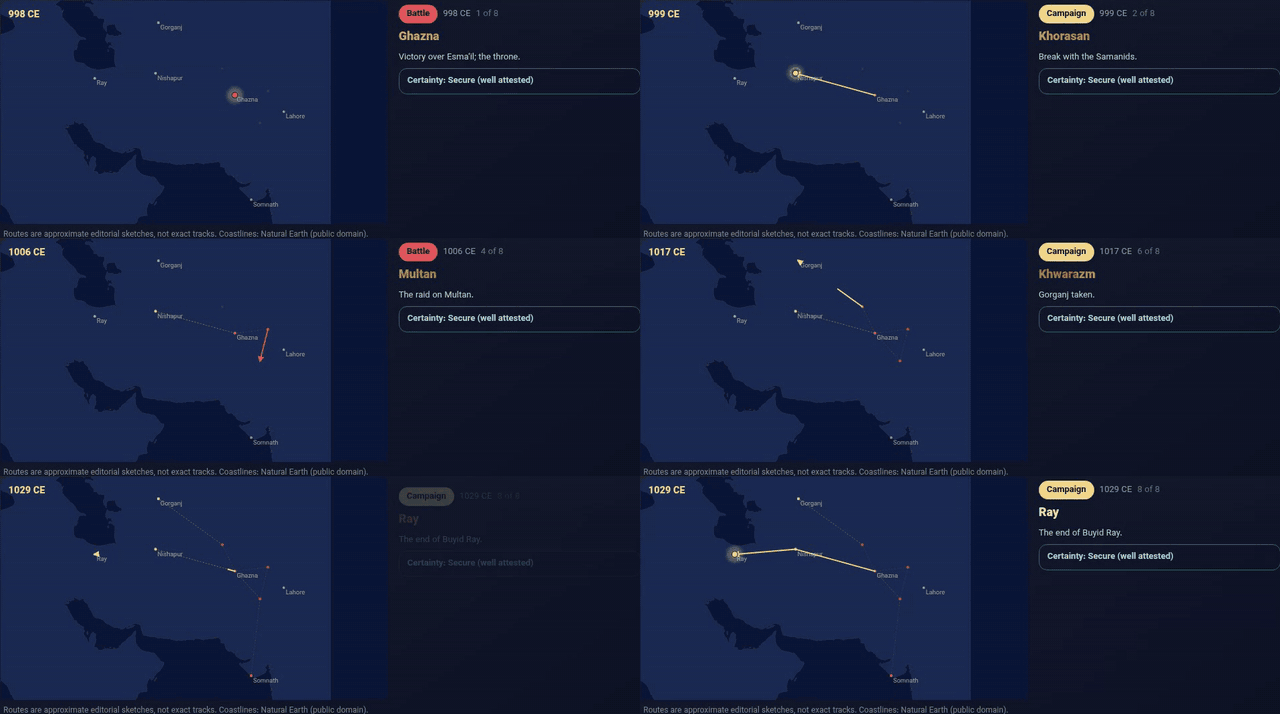
From Ghazna to Khorasan, then India (Wayhind and Multan), Balkh, Khwarazm, Somnath and finally Ray. The events are from Bosworth’s article; the routes are sketches.
Battle998 CE1 of 8
Ghazna
Victory over Esma‘il; the throne.
Certainty: Secure (well attested)
Sources: C. E. Bosworth, Encyclopaedia Iranica, 2012, updated 2015
BattleCampaignBuildingAdministration & economyReligionArrow keys, Home/End and Space work.
Three separate layers
Each section has three layers: “Historical evidence” is only what the sources say; “Philosophical interpretation” is our reading by the standard of property and liberty; “Modern cultural meaning”. Quotations come only from published translations, with references.
Historical evidencePhilosophical interpretationModern cultural meaning
Dossier · 1
Sources: holy warrior or plunderer?
Court historians such as ‘Otbi and Gardizi presented Mahmud as an idol-breaker and champion of the caliph. Bosworth says this image was fixed in Persian literature by the thirteenth century. In 1926 Mohammad Habib of Aligarh argued that Mahmud’s motive was plunder, not faith, and drew a torrent of abuse.

Bosworth agrees with Habib: the raids’ primary motive was “clearly financial rather than religious”. Hindus were not converted en masse, and many of Mahmud’s own Indian soldiers stayed non-Muslim. We treat the “holy warrior” image as court propaganda and later legend.
Mahmud is still a religious hero in parts of South Asia and a symbol of destruction in India. Both images say more about today than about the eleventh century.
Sources: C. E. Bosworth, Encyclopaedia Iranica · al-ʿOtbi · Gardizi
Dossier · 2
The court: Persian, Biruni and Ferdowsi
Mahmud ran an administration of capable Persian secretaries, with viziers such as Ahmad b. Hasan Maymandi and Hasanak. Persian poets such as Farrokhi and ‘Onsori praised him; Ferdowsi too came to his court “for a short time”. Biruni was brought to Ghazna after the conquest of Khwarazm and served there for some thirty years.
We treat the later stories of Mahmud’s meanness to Ferdowsi as legend and leave them out; the sources we read do not confirm them. Biruni was “brought”, not invited: cultural patronage, too, was part of the spoils of war.
Persian flourished at the court of a ruler of Turkish slave descent; Iranian culture was not made by the ruler’s ancestry.
Dossier · 3
Property: a state that ran on plunder
Bosworth writes that the centralised Ghaznavid state, with its large professional army, was “extremely expensive”. It “bore down hard on its civilian population”, and Mahmud was “an unyielding despot unconcerned about his subjects except as sources of revenue”. Taxation was supplemented by Hindu temple treasures and large numbers of Indian captives; this wealth kept a high-standard gold and silver coinage and beautified Ghazna.

This is our reading: Mahmud’s state did not create property; it took it. Heavy taxes from its own subjects, treasure and people from its neighbours. Such a state must keep fighting to survive; once its war machine broke at Dandanqan, the empire collapsed. Burning the library of Ray shows that even intellectual property was not safe.
Wealth gained by plunder does not build a prosperous country; it only pays for the next war.
Sources: C. E. Bosworth, Encyclopaedia Iranica · C. E. Bosworth, Encyclopaedia Iranica
Synthesis: a one-man empire
Mahmud built the largest empire in the Islamic world since the ‘Abbasid heyday. Bosworth says it was held together “only by the vitality of its sovereign”; ten years after his death Khorasan passed to the Seljuks at Dandanqan.
Through the lens of property, this state rested on taking: heavy tax, temple treasure and captives. That wealth paid for Ghazna’s splendour and its Persian-speaking court.
Bibliography
- C. E. Bosworth, Encyclopaedia Iranica, Maḥmud b. Sebüktegin (2012, updated 2015). https://www.iranicaonline.org/articles/mahmud-b-sebuktegin/The spine of this page; the dates, places and figures come from this article.
- al-ʿOtbi, Taʾriḵ al-Yamini (c. 1020). A contemporary court history of Mahmud.
- Gardizi, Zayn al-aḵbār (c. 1050). A Persian history written soon after Mahmud.
All photos are from Wikimedia Commons; licence and author were checked on each file page.