Featured dossier
‘Adud al-Dawla: the Shahanshah who took Baghdad and built Band-e Amir
The grandson of a Daylamite fisherman who became ruler of Fars at thirteen, took Kerman and Oman, killed his cousin in 978 and by 980 united the whole Buyid realm. His Sasanian pedigree is labelled a legend. Follow his campaigns on the animated map.
- in power
- 34 years
- realm united (CE)
- 980
- tax of Fars (Ibn al-Jawzi)
- 3×
- dinars a year the Buyids paid the Samanids under the peace of 361 AH (971–972 CE)
- 150,000
Animated map: life and campaigns
Administration & economy24 September 936 CE1 of 11
Born in Isfahan
Fanna Khosrow, son of Rukn al-Dawla Hasan, was born in Isfahan.
Certainty: Secure (well attested)
Sources: J. C. Bürgel and R. Mottahedeh, Encyclopaedia Iranica, 1987, updated 2011
BattleCampaignBuildingAdministration & economyReligionArrow keys, Home/End and Space work.
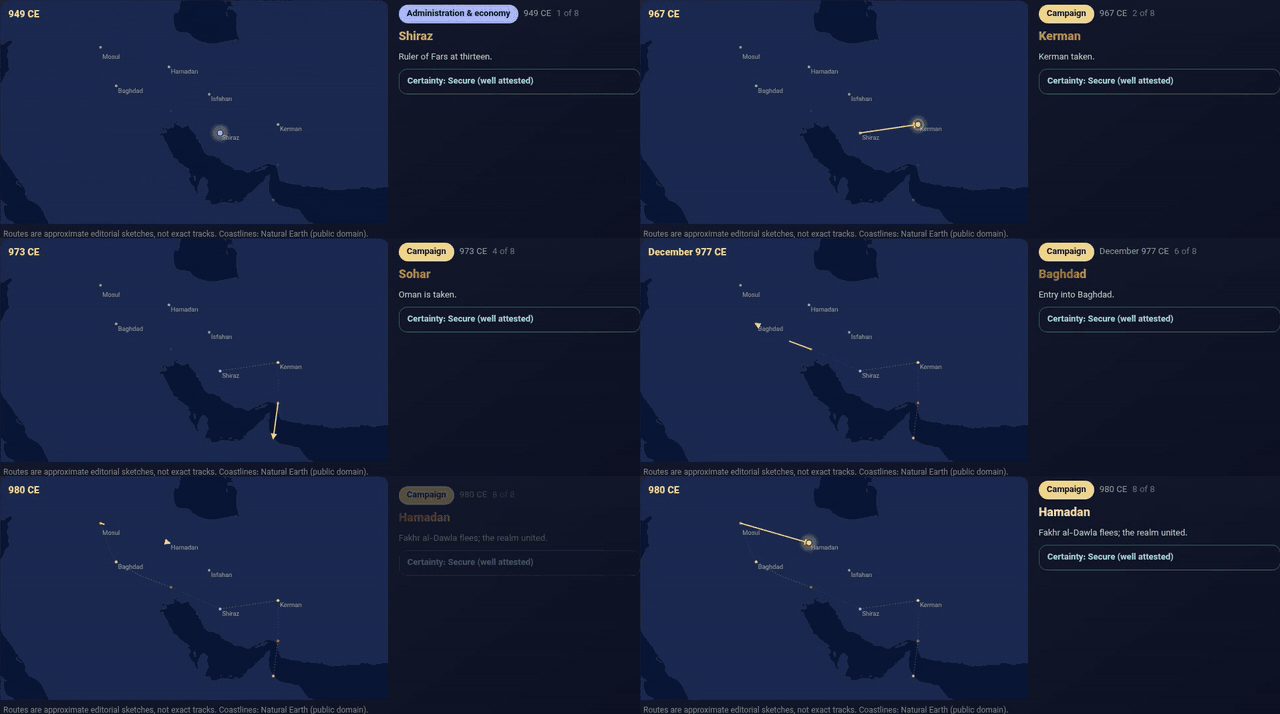
The campaigns: from Shiraz to Mosul (949–980 CE)
From Shiraz to Kerman, Hormoz and Oman, then Ahvaz, Baghdad, Samarra and Mosul, and finally Hamadan. The events are from Iranica; the routes are sketches.
Administration & economy949 CE1 of 8
Shiraz
Ruler of Fars at thirteen.
Certainty: Secure (well attested)
Sources: J. C. Bürgel and R. Mottahedeh, Encyclopaedia Iranica, 1987, updated 2011
BattleCampaignBuildingAdministration & economyReligionArrow keys, Home/End and Space work.
Three separate layers
Each section has three layers: “Historical evidence” is only what the sources say; “Philosophical interpretation” is our reading by the standard of property and liberty; “Modern cultural meaning”. Quotations come only from published translations, with references.
Historical evidencePhilosophical interpretationModern cultural meaning
Dossier · 1
Sources: a fisherman’s grandson with a Sasanian pedigree
Nagel says the family’s ancestor Buya was a humble fisherman of Daylam. ‘Adud al-Dawla had a genealogy made linking the family to the Sasanian Bahram Gur; Biruni doubted it at the time. ‘Adud also claimed his father had been amir al-umara, which Nagel says was untrue.

The Sasanian pedigree is a legend: Nagel calls it “almost certainly a forgery”. We read it as a tool of legitimacy, not historical fact.
Rulers who rise from below often invent a royal past. That this worked shows how much the old Iranian legitimacy still counted.
Sources: T. Nagel, Encyclopaedia Iranica · J. C. Bürgel and R. Mottahedeh, Encyclopaedia Iranica · al-Bīrūnī
Dossier · 2
Shahanshah and caliph
Bürgel and Mottahedeh say ‘Adud al-Dawla was “probably” the first Muslim ruler to take the title Shahanshah. He left an inscription at Persepolis, celebrated Sada and Mehregan, and forced the caliph to marry his daughter. He also repaired the shrine of Hosayn at Karbala and built the shrine over ‘Ali’s grave at Najaf.
He wanted two things at once: the splendour of Iranian kings and the survival of the caliphate. Nagel says this balance rested not on new institutions but only on his forceful personality, and it fell apart when he died.
A state resting on one man dies with him; institutions, not heroes, make things last.
Sources: J. C. Bürgel and R. Mottahedeh, Encyclopaedia Iranica · T. Nagel, Encyclopaedia Iranica
Dossier · 3
Property: dam, bazaar and tax
Near Shiraz, on the Kor river, ‘Adud al-Dawla built the Band-e ‘Adudi (today’s Band-e Amir), which brought a large area into cultivation and is still in use. In Fars he built caravanserais, cisterns and dams, at Ramhormoz bazaars, and in Baghdad a hospital that lasted until the Mongol invasion. Ibn al-Jawzi says the tax income of Fars under him was triple what it had been at the start of the tenth century. He paid the army promptly but did not reverse the iqta‘ system.

This is our reading: the dam and bazaars created productive property, brought waste land into use and made Shiraz a major city. But tripled tax means the state took a larger share of that wealth; and the iqta‘, granting land revenue to soldiers, kept the farmer’s ownership insecure.
Infrastructure that makes property productive is valuable; the question is whether the return reaches those who produce or the treasury.
Sources: J. C. Bürgel and R. Mottahedeh, Encyclopaedia Iranica · al-Moqaddasī
Synthesis: peak and fragility
‘Adud al-Dawla brought the Buyids to their peak: from Oman to Mosul, with Baghdad and the caliph under his control. Iranica says Shiraz gained under him an economic and cultural importance it kept for centuries.
But executing his cousin broke the Buyid family system, and he named no successor; after his death his sons fought each other. Through the lens of property, Band-e Amir still waters fields; tripled tax and the iqta‘ were the price of that prosperity.
Bibliography
- J. C. Bürgel and R. Mottahedeh, Encyclopaedia Iranica, ʿAżod-al-Dawla (1987, updated 2011). https://www.iranicaonline.org/articles/azod-al-dawla/The spine of this page; the dates, places and figures come from this article.
- T. Nagel, Encyclopaedia Iranica, Buyids (1990, updated 2011). https://www.iranicaonline.org/articles/buyids/On the family’s origins, the Sasanian pedigree and the break-up after ‘Adud al-Dawla.
- al-Moqaddasī, Aḥsan al-taqāsīm (c. 985). A contemporary geographer; the source for the dam, palace, library and hospital of Shiraz.
- al-Bīrūnī, The Chronology of Ancient Nations (c. 1000). On the festivals of Kard-e Fanna Khosrow and doubts about the Buyids’ Sasanian pedigree.
All photos are from Wikimedia Commons; licence and author were checked on each file page.