Featured dossier
Esma‘il Samani: the amir who took Khorasan from the Saffarids
The governor of Bukhara who became amir of all Transoxania in 892, defeated ‘Amr b. Layth near Balkh in 900 and pushed as far as Ray. He named the caliph in the sermon but, Bosworth says, sent no tribute to Baghdad. His Sasanian pedigree and the tomb attributed to him are labelled. Follow his campaigns on the animated map.
- as amir
- 15 years
- victory at Balkh (CE)
- 900
- dirhams of tribute withheld from Nasr
- 500,000
- as governor of Bukhara
- 18 years
Animated map: life and campaigns
Administration & economy874 CE1 of 8
Governor of Bukhara
His brother Nasr, governor of Transoxania at Samarqand, made him governor of Bukhara. He held the post for almost two decades.
Certainty: Secure (well attested)
Sources: C. E. Bosworth, Encyclopaedia Iranica, 1998, updated 2013 · Naršaḵī, tr. R. N. Frye (1954), 943–944, abridged 1128
BattleCampaignBuildingAdministration & economyReligionArrow keys, Home/End and Space work.
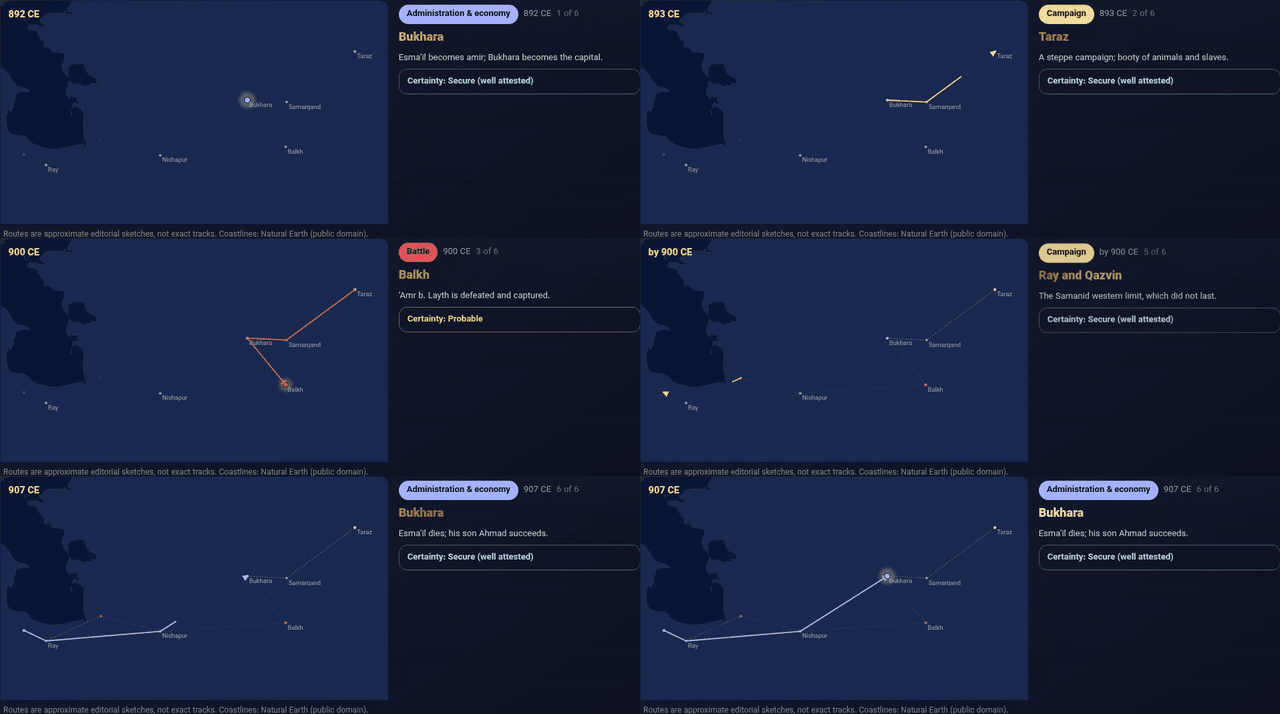
The campaigns: from Taraz to Qazvin (892–907 CE)
From Bukhara to the steppes at Taraz, then Balkh and the victory over ‘Amr b. Layth, and west to Gorgan, Ray and Qazvin. The events are from Bosworth’s article; the routes are sketches.
Administration & economy892 CE1 of 6
Bukhara
Esma‘il becomes amir; Bukhara becomes the capital.
Certainty: Secure (well attested)
Sources: C. E. Bosworth, Encyclopaedia Iranica, 1998, updated 2013
BattleCampaignBuildingAdministration & economyReligionArrow keys, Home/End and Space work.
Three separate layers
Each section has three layers: “Historical evidence” is only what the sources say; “Philosophical interpretation” is our reading by the standard of property and liberty; “Modern cultural meaning”. Quotations come only from published translations, with references.
Historical evidencePhilosophical interpretationModern cultural meaning
Dossier · 1
Sources: a good name and a doubtful pedigree
Bosworth says Esma‘il left a reputation for justice, piety and faithful service to the caliph, preserved in later historical and adab literature, where he is called Amir-e Mazi and Amir-e ‘Adel. Most stories of his justice come from Narshakhi’s History of Bukhara and Nezam al-Molk’s Siyasat-nama, written later.
Biruni traces the Samanids to Bahram Chobin, the Sasanian general, and Gardizi back to Gayomarth, the first man. Bosworth says this link, “whatever its truth”, was generally accepted at the time. We treat it as a legendary, unproven pedigree. We also read the stories of his justice as mirror-for-princes literature, not daily record.
The family’s real ancestor, Saman-khoda, was in Bosworth’s words a local landowner (dehqān) of the village of Saman near Balkh.
Sources: C. E. Bosworth, Encyclopaedia Iranica · C. E. Bosworth, Encyclopaedia Iranica · Naršaḵī, tr. R. N. Frye (1954)
Dossier · 2
From Bukhara to all of Transoxania
1. Born 849 CE; son of Ahmad b. Asad, who with his brothers had been appointed to towns of Transoxania by the caliph’s governor.
2. Governor of Bukhara for his brother Nasr from 874 to 892.
3. He twice withheld the 500,000-dirham tribute, and Nasr attacked Bukhara in 885 and 888.
4. In August 892, on Nasr’s death, he became amir of all Transoxania and made Bukhara the capital.
The brothers’ war shows that tribute was the real bond between governor and ruler: by keeping the money, Esma‘il tested his independence.
From his time Bukhara was the Samanid centre and, Yarshater says, a centre of Arabic and Persian culture.
Sources: C. E. Bosworth, Encyclopaedia Iranica · C. E. Bosworth, Encyclopaedia Iranica · E. Yarshater, Encyclopaedia Iranica
Dossier · 3
Balkh, 900 CE: the end of Saffarid power in Khorasan
The caliph had granted Ray, eastern Persia and Transoxania to ‘Amr b. Layth, which meant deposing Esma‘il. ‘Amr invaded the upper Oxus provinces but was defeated and captured near Balkh, probably in March 900. The caliph then appointed Esma‘il governor of Khorasan, Sistan, Ray, Tabarestan and Isfahan.
Bosworth says this victory brought Esma‘il his greatest renown among contemporaries, and relieved the caliphs of Saffarid pressure. The caliph used one eastern ruler to check another.
Bosworth says Esma‘il’s successors kept permanent control only of Khorasan and Transoxania; the caliph’s grant on paper was larger than real power.
Sources: C. E. Bosworth, Encyclopaedia Iranica · al-Ṭabari
Dossier · 4
Loyal in the sermon, independent in practice
Esma‘il named the caliph in the Friday sermon and on his coins. Bosworth says his distance from Iraq and his new prestige let him act as an independent sovereign, and that “there is no evidence” he ever sent regular tribute or tax to Baghdad.
Ya‘qub b. Layth openly scorned the caliph; Esma‘il kept the outward respect and kept the money. These were two ways of breaking free of the caliphate.
Naming a distant authority while sending it nothing was a common form of independence in that age.
Dossier · 5
The Samanids and the Persian language
Yarshater writes in Iranica that at the Samanid court and with their encouragement Persian was revived as a vehicle for poetry, scholarship and history: Rudaki, Shahid of Balkh, Daqiqi, and Ferdowsi’s Shahnama, conceived under the Samanids. The Persian versions of Tabari’s history and commentary also date from this period.
This flowering belongs mostly to the reigns of Nasr II and Mansur I, not to Esma‘il himself. The sources we read do not show a personal role for Esma‘il in the revival; some sources even say his son Ahmad switched the language of the chancery from Persian to Arabic.
Esma‘il built the state in which this culture grew; crediting him with the flowering itself is a claim our sources do not support.
Sources: E. Yarshater, Encyclopaedia Iranica · C. E. Bosworth, Encyclopaedia Iranica
Dossier · 6
Property: tribute, booty and slaves
Esma‘il fought his brother over 500,000 dirhams of tribute. In 893 he brought back from Taraz an immense booty of animals and Turkish slaves. Yarshater says the Samanids took large numbers of Turkish captives in their Central Asian campaigns and set them to work in the army and the palace.

This is our reading: Esma‘il’s reputation for justice sat beside a state built on slave-taking. People were themselves counted as “booty”. And these Turkish slaves, Yarshater says, eventually became commanders and then the Samanids’ successors; Sebüktegin, father of Mahmud of Ghazna, was one of them. A state that took other people’s property and freedom was in the end taken over by that “property”.
Justice for those inside the state and slavery for those outside it: the property question is always whose rights count.
Sources: C. E. Bosworth, Encyclopaedia Iranica · E. Yarshater, Encyclopaedia Iranica
Dossier · 7
The Samanid mausoleum: Esma‘il’s or later?
A brick tomb in Bukhara has been identified as Esma‘il’s (Schroeder). Sheila Blair, in her study of early Islamic monumental inscriptions, dates it to the later Samanid period (Bosworth, Iranica).

This dating is disputed. We call the building “the Samanid mausoleum” and do not attribute it to Esma‘il with confidence.
The building that now symbolises Esma‘il may belong to his descendants; historical memory and evidence are not always the same.
Synthesis: quiet independence
By defeating ‘Amr b. Layth, Esma‘il made the Samanids the leading power of the eastern Islamic world. Unlike Ya‘qub, he did not fight the caliph; he kept his name in the sermon and kept the money. Bosworth calls him the greatest of the Samanids. His Sasanian pedigree and the tomb attributed to him are both open to doubt.
Through the lens of property, his reputation for justice sat beside a state kept by tribute and slave-taking; and those Turkish slaves eventually succeeded the Samanids.
Bibliography
- C. E. Bosworth, Encyclopaedia Iranica, Esmāʿīl b. Aḥmad b. Asad Sāmānī (1998, updated 2013). https://www.iranicaonline.org/articles/esmail-b-ahmad-b-asad-samani/The spine of this page; the dates, places and figures come from this article.
- C. E. Bosworth, Encyclopaedia Iranica, Asad b. Sāmānḵodā (1987, updated 2017). https://www.iranicaonline.org/articles/asad-b-1/On the family’s ancestor and the genealogy linking them to Bahram Chobin.
- E. Yarshater, Encyclopaedia Iranica, Iran ii. Iranian History (2) Islamic period (2004). https://www.iranicaonline.org/articles/iran-ii2-islamic-period-page-2/On the Samanids’ place in the revival of Persian and on their Turkish slave soldiers.
- Naršaḵī, tr. R. N. Frye (1954), The History of Bukhara (943–944, abridged 1128). The local history of Bukhara; the source of most later stories about Esma‘il’s justice.
- al-Ṭabari, Taʾriḵ al-rosol wa’l-moluk, vol. III (early 10th century). The caliphate’s history, contemporary with Esma‘il.
All photos are from Wikimedia Commons; licence and author were checked on each file page.