The Saffarids
Ya‘qub b. Layth al-Saffar
یعقوب لیث صفار
- Reign
- 861–879 CE
- Dynasty
- The Saffarids
- Persian page
- فارسی
Featured dossier
Ya‘qub b. Layth: the coppersmith who marched on Baghdad
A coppersmith from Sistan who rose in the ‘ayyār bands, became Amir in 861, overthrew the Tahirids and reached Dayr al-‘Aqul near Baghdad. The Arabic sources call him a brigand and the Tarikh-e Sistan a hero; both are labelled. Follow his western campaign on the animated map.
- as Amir
- 18 years
- end of the Tahirids (CE)
- 873
- dirhams of Fars tax in 870
- 30 million
- from Baghdad, at Dayr al-‘Aqul
- 80 km
Animated map: life and campaigns
Administration & economy10 April 861 CE1 of 10
Amir of Sistan
A coppersmith from the village of Qarnin who had risen in the ‘ayyār bands set Derham b. Nasr aside and was hailed as Amir in Zarang.
Certainty: Secure (well attested)
Sources: C. E. Bosworth, Encyclopaedia Iranica, 2002, updated 2018 · Anonymous, ed. M.-T. Bahār (1935); Eng. tr. M. Gold (1976), c. 11th century
BattleCampaignBuildingAdministration & economyReligionArrow keys, Home/End and Space work.
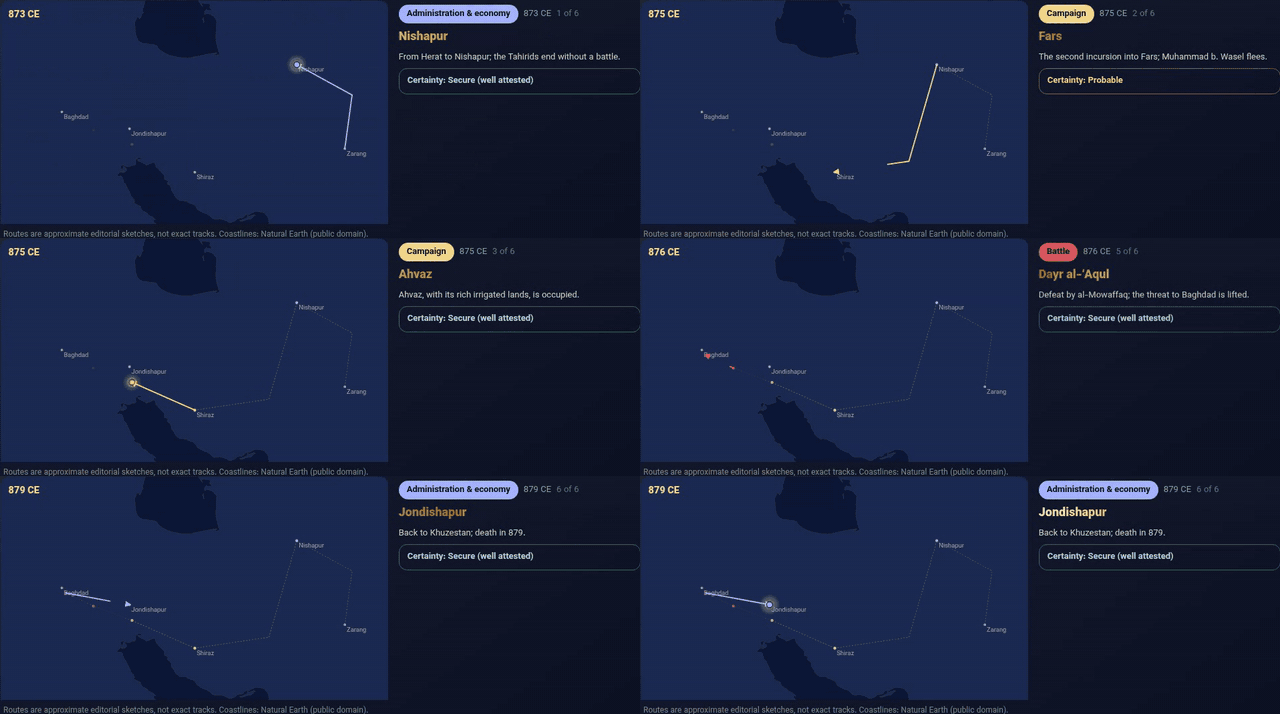
The western campaign: from Nishapur to Dayr al-‘Aqul (873–879 CE)
From Nishapur to Fars and Ahvaz, then Wasit and Dayr al-‘Aqul, and back to Jondishapur. The events are from Bosworth’s article; the routes are sketches.
Administration & economy873 CE1 of 6
Nishapur
From Herat to Nishapur; the Tahirids end without a battle.
Certainty: Secure (well attested)
Sources: C. E. Bosworth, Encyclopaedia Iranica, 2002, updated 2018
BattleCampaignBuildingAdministration & economyReligionArrow keys, Home/End and Space work.
Three separate layers
Each section has three layers: “Historical evidence” is only what the sources say; “Philosophical interpretation” is our reading by the standard of property and liberty; “Modern cultural meaning”. Quotations come only from published translations, with references.
Historical evidencePhilosophical interpretationModern cultural meaning
Dossier · 1
Sources: one admiring history and many hostile ones
There are two groups of sources. The Arabic histories of the caliphate, such as Tabari, see Ya‘qub as a disruptive force and little better than a brigand. The Tarikh-e Sistan, written about two generations after the Saffarids, remembers him with local pride. Mas‘udi is the one Arabic writer who, Bosworth says, judges his military skill more sympathetically.
Bosworth says later eulogists fabricated a descent for Ya‘qub back to the Sasanians and legendary kings, but his origins were “in reality firmly plebeian”. That genealogy is a legend and is not used on this page.
Both groups of sources take sides. We take dates and places where the sources agree, and show where they disagree.
Sources: C. E. Bosworth, Encyclopaedia Iranica · C. E. Bosworth, Encyclopaedia Iranica · Anonymous, ed. M.-T. Bahār (1935); Eng. tr. M. Gold (1976) · al-Ṭabari
Dossier · 2
From coppersmith to amir
1. A coppersmith (saffār) born in the village of Qarnin; his brother ‘Amr was a mule-hirer.
2. He rose in the ‘ayyār bands of Sistan, groups formed to fight the Kharijites.
3. On 10 April 861 he was hailed as Amir in Zarang.
4. In 865 he defeated the Kharijites of northern Sistan and took many of them into his army.
5. He took Herat; the Tahirids recognised him as governor of Sistan, Kabul, Kerman and Fars.
6. In 873 he took Nishapur without a battle and overthrew the Tahirids.
Bosworth says Ya‘qub came to power “solely by the sword”, with no advantages of birth or court connections. Taking defeated Kharijites into his army made up for his small manpower, and also gave his enemies a pretext to call him a Kharijite sympathiser.
Ya‘qub showed that in the ninth century, military ability could take the place of birth.
Sources: C. E. Bosworth, Encyclopaedia Iranica · C. E. Bosworth, Encyclopaedia Iranica · Anonymous, ed. M.-T. Bahār (1935); Eng. tr. M. Gold (1976)
Dossier · 3
The march on Baghdad and Dayr al-‘Aqul
In 875 he occupied Fars and Ahvaz. The caliph offered him the governorship of a vast array of lands, but Ya‘qub refused, took Wasit and marched on Baghdad. In 876 at Dayr al-‘Aqul, in ground cut by irrigation canals that his army did not know, he was defeated by al-Mowaffaq, the caliph’s brother.

The defeat did not end his career: until his death in 879 he held Fars, Ahvaz and Kerman, and southern and eastern Iran stayed outside caliphal control. The caliph feared a link with the Zanj rebels of southern Iraq; Bosworth says there was no formal pact, but there was local cooperation.
From Nishapur to near Baghdad in three years: Ya‘qub showed that the caliphate could no longer hold all its lands.
Sources: C. E. Bosworth, Encyclopaedia Iranica · al-Ṭabari · Anonymous, ed. M.-T. Bahār (1935); Eng. tr. M. Gold (1976)
Dossier · 4
Ya‘qub and the caliph
According to the Tarikh-e Sistan, Ya‘qub often said that the Abbasids had built their rule on treachery and had mistreated those who served them.
Don’t you see what they did to Abu Salama, Abu Moslem, the Barmakid family and Fażl b. Sahl, despite everything which these men had done on the dynasty’s behalf? Let no-one ever trust them!
Bosworth sees him as an exponent of Realpolitik who had no time for the “caliphal fiction” that every ruler held power only by the caliph’s delegation. He calls Ya‘qub a mouthpiece of local Sistani protest, but “not a proto-Persian nationalist”. This judgment differs from the common modern image of Ya‘qub as a national hero.
Ya‘qub’s distrust of the caliphs came from the experience of men who had served power and been destroyed by it.
Sources: Anonymous, ed. M.-T. Bahār (1935); Eng. tr. M. Gold (1976) · C. E. Bosworth, Encyclopaedia Iranica · C. E. Bosworth, Encyclopaedia Iranica
Dossier · 5
The Persian language: “what I do not understand”
The Tarikh-e Sistan (pp. 209–10 of Bahar’s edition) says that after his victory over the Kharijites, poets praised him in Arabic, as was the custom. Ya‘qub knew no Arabic and said: “Why should something be recited that I do not understand?” So his secretary, Muhammad b. Wasif, began writing verse for him in Persian.
The Tarikh-e Sistan calls Muhammad b. Wasif the first Persian poet. Bosworth, following Lazard, finds this claim “less sustainable”, because Persian verse in quantitative metres was emerging elsewhere at the time, and says the Saffarids cannot be given a place in the Persian literary revival comparable to the Samanids’.
Ya‘qub’s remark is plain: a poem the listener cannot understand is useless. That plainness is why Persian speakers still remember it.
Sources: Anonymous, ed. M.-T. Bahār (1935); Eng. tr. M. Gold (1976) · C. E. Bosworth, Encyclopaedia Iranica
Dossier · 6
Property: booty, tax and treasury
According to Bosworth, in 870 Ya‘qub collected 30 million dirhams of land tax from Fars alone. From his eastern raids he brought back slaves and temple treasures. At his death his treasury held four million dinars and fifty million dirhams. He himself lived simply: he is said to have slept on an old saddle cloth and ate barley bread and onions.

This is our reading: Ya‘qub accused the caliphs of treachery, but his army was kept by the same means as every ruler of the age, booty and land tax. Bosworth says what drew him to Fars and Ahvaz was their tax yield. His simple personal life sat alongside a great treasury filled from other people’s property. People enslaved in the eastern raids were themselves counted as “booty”.
A shift of power from the caliph to a local amir did not by itself make people’s property more secure. The question is who takes, and what limits him.
Sources: C. E. Bosworth, Encyclopaedia Iranica · C. E. Bosworth, Encyclopaedia Iranica
Dossier · 7
Family and succession
Father: Layth b. Mo‘addal.
Brothers: ‘Amr, who succeeded him, and ‘Ali, whom Ya‘qub had chosen as successor.
Children: the sources we read name no son.
Successor: ‘Amr b. Layth, who, Bosworth says, set ‘Ali aside.
The succession did not go as Ya‘qub wished. ‘Amr intrigued against ‘Ali and, unlike his brother, at least nominally presented himself as the caliph’s deputy.
A power built on one man’s sword was disputed the moment he died.
Sources: C. E. Bosworth, Encyclopaedia Iranica · C. E. Bosworth, Encyclopaedia Iranica
Synthesis: power from the sword, not the caliph
Ya‘qub was the first ruler in the eastern Islamic world to build a large state without birth or caliphal appointment, by his army alone. Bosworth sees him as an early stage in the break-up of caliphal unity, but not as a nationalist. His famous remark about Arabic poetry comes from the Tarikh-e Sistan.
Through the lens of property, Ya‘qub was the model ruler of his age: the land tax of Fars and the booty of the east built a great treasury. Moving power from Baghdad to Zarang did not make people’s property more secure; it only changed who took it.
Bibliography
- C. E. Bosworth, Encyclopaedia Iranica, Yaʿqub b. Layṯ b. Moʿaddal (2002, updated 2018). https://www.iranicaonline.org/articles/yaqub-b-lay-b-moaddal/The spine of this page; the dates and places come from this article, which also flags where the sources disagree.
- C. E. Bosworth, Encyclopaedia Iranica, Saffarids (2000, updated 2014). https://www.iranicaonline.org/articles/saffarids/On the Saffarid army, treasury and culture, and on the hostile Arabic sources versus the admiring Tarikh-e Sistan.
- Anonymous, ed. M.-T. Bahār (1935); Eng. tr. M. Gold (1976), Tāriḵ-e Sistān (c. 11th century). The local history of Sistan, written two generations after the Saffarids; Bosworth says it treats Ya‘qub and ‘Amr with local pride.
- al-Ṭabari, Taʾriḵ al-rosol wa’l-moluk, vol. III (early 10th century). The caliphate’s history; Bosworth says that, like most Arabic sources, it sees the Saffarids as a disruptive force.
- Encyclopaedia Iranica, Taherids (online). https://www.iranicaonline.org/articles/taherid-dynasty/
All photos are from Wikimedia Commons; licence and author were checked on each file page.