Featured dossier
Deioces: the founder of Media in Herodotus’ tradition
Herodotus says the Medes chose a just judge named Deioces as king and that he built Ecbatana with seven walls. This is a traditional account, and Schmitt judges it unreliable. Separately, the annals of Sargon II name Daiukku, a Mannean governor exiled in 715 BCE; no document shows the two were the same man.
- reign, per Herodotus
- 53 years
- walls of Ecbatana, per Herodotus
- 7
- Daiukku in Sargon’s annals (BCE)
- 715
- contemporary documents of his own
- 0
Animated map: tradition and evidence
Administration & economyc. 727 BCE (traditional)1 of 5
Chosen king, according to Herodotus
According to Herodotus, the Medes lived in separate villages and lawlessness was everywhere. Deioces became a just judge in his own village. Then he stopped judging, lawlessness grew worse, and the Medes assembled and chose him as king.
Certainty: DisputedThe year 727 is Diakonoff’s suggestion, counted back from the rise of Cyrus; Schmitt says exact dates for the reign cannot be given.
Sources: Herodotus, tr. A. D. Godley (Loeb, 1920), 1920 · R. Schmitt, Encyclopaedia Iranica, 1994, updated 2013 · I. M. Diakonoff, 1985
BattleCampaignBuildingAdministration & economyReligionArrow keys, Home/End and Space work.
Three separate layers
Each section has three layers: “Historical evidence” is only what the sources say; “Philosophical interpretation” is our reading by the standard of property and liberty; “Modern cultural meaning”. Quotations come only from published translations, with references.
Historical evidencePhilosophical interpretationModern cultural meaning
Dossier · 1
Sources: two separate layers
There are two kinds of source on Deioces and we keep them apart. The first layer is Herodotus’ account (1.96–102), written some two centuries later. Later Greek writers added almost nothing to it. The second layer is the annals of Sargon II of Assyria, which name a man called Daiukku in 715 BCE.
Schmitt says Herodotus’ account may rest on an oral tradition, but it “is a mixture of Greek and eastern legends and is not historically reliable”. So everything from Herodotus is labelled “according to Herodotus” and none of it is marked secure.
We know the founder of the first Iranian state only from a Greek’s story. That is a lesson in itself: beginnings are kept more by legends than by documents.
Sources: Herodotus, tr. A. D. Godley (Loeb, 1920) · R. Schmitt, Encyclopaedia Iranica · D. D. Luckenbill
Dossier · 2
Herodotus’ story: from judge to king
1. According to Herodotus, Deioces was the son of Phraortes and a notable man in his own town.
2. In a time of lawlessness he became a just judge, and people from other towns came to him too.
3. Then he said judging brought him no advantage and stopped. Robbery and lawlessness increased.
4. The Medes assembled; Herodotus supposes Deioces’ friends did most of the talking. They chose him king.
5. He asked for a bodyguard and a palace; then he built Ecbatana with seven walls.
6. He set up court rules: no one should see the king, all business went through messengers, and laughing or spitting before him was a disgrace.
7. He received pleas in writing, sent his judgments out, and had spies everywhere.
Deioces was infatuated with sovereignty, and so he set about gaining it.
and he had spies and eavesdroppers everywhere in his domain.
Schmitt says scholars have deduced from this story that Deioces founded the Median dynasty and was the first Median king to break from Assyria; but the story itself is not reliable. He sees the “watchers and listeners” as forerunners of the Achaemenid “king’s eyes” and “ears”.
Herodotus tells the story with deliberate double edges: Deioces was just, but because he wanted power. It is a story about how power is born, not a report of an event.
Sources: Herodotus, tr. A. D. Godley (Loeb, 1920) · R. Schmitt, Encyclopaedia Iranica
Dossier · 3
The Assyrian evidence: Sargon’s Daiukku
George Smith noticed in 1869 that the name Daiukku appears several times in the texts of Sargon II. In the annals of the eighth year (715 BCE) and the Khorsabad Display Inscription, Daiukku is governor (šaknu) of a Mannean province. He backed Rusa I of Urartu against Ullusunu, king of Mannea; Sargon captured him and exiled him and his family to Hamath.
it is improbable in the extreme that a Mede who was the governor of a Mannean province for less than a year . . . could have become associated . . . with the founding of the Median state.

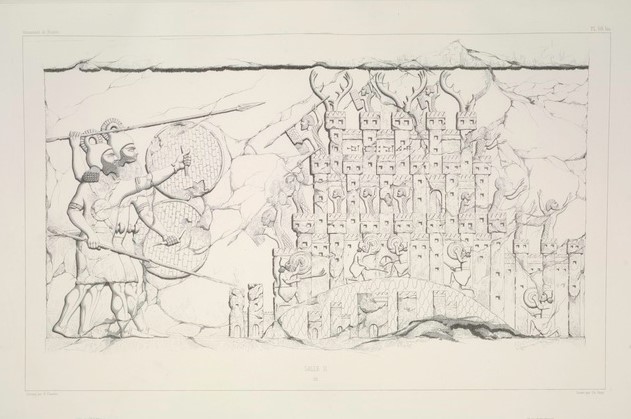
Schmitt says the “House of Deioces” (Bit-Daiukku), on which earlier reconstructions relied, never existed: it came from a misreading of “the land of the Medes” in the annals for 713. Any link between this governor and the Median dynasty is “only hypothetical”. Only the name brings the two layers together, and *Dahyuka- remained common later, appearing for various officials in the Persepolis Fortification Tablets.
This section shows how history-writing works: one misreading can create a “house”, and a more careful reading can erase it.
Sources: D. D. Luckenbill · A. G. Lie · R. Schmitt, Encyclopaedia Iranica · S. C. Brown
Dossier · 4
Ecbatana and the court
According to Herodotus, Ecbatana had seven concentric walls, each higher than the one outside it. The battlements of five walls were coloured white, black, purple, blue and orange; the two inner walls were coated with silver and gold. The longest wall was about the length of the wall of Athens.
So he built the big and strong walls, one standing inside the next in circles, which are now called Ecbatana.

This description comes only from Herodotus. Schmitt identifies the city with Old Persian Hagmatāna and modern Hamadan, but cites no other evidence for the seven walls. So we take it as a literary picture, not the plan of a city.
In Herodotus’ story the king hides behind seven walls so that people think him “different”. The distance between power and people is in the story from the very start.
Sources: Herodotus, tr. A. D. Godley (Loeb, 1920) · R. Schmitt, Encyclopaedia Iranica
Dossier · 5
Property and liberty: justice, kingship and the price of order
According to Herodotus, the Medes chose a king so that “the land will be well governed” and they could “attend to our business”. In return the king got a palace, a bodyguard, a city the people built with their own labour, and spies everywhere.
Since we cannot go on living in the present way in the land, come, let us set up a king over us; in this way the land will be well governed, and we ourselves shall attend to our business and not be routed by lawlessness.
This is our reading: Herodotus’ story is a parable about the origin of the state. People wanted arbitration to keep their property and work safe; a judge who withheld judgment took its price in the form of absolute power. It is a parable, not history.
The story’s question is still alive: how can people have impartial justice without the judge becoming an unchecked ruler?
Sources: Herodotus, tr. A. D. Godley (Loeb, 1920) · R. Schmitt, Encyclopaedia Iranica
Dossier · 6
Name, family and succession
Name: Greek Dēïókēs, Assyrian Daiukku, Elamite Dayauka; all from Iranian *Dahyuka-, a pet name built on dahyu-, “land”.
According to Herodotus: son of Phraortes, father of Phraortes, and grandfather of Cyaxares.
Successor: his son Phraortes, who according to Herodotus subdued the Persians and died fighting Assyria.
Diakonoff suspects that the king at the centre of Herodotus’ story was really Phraortes. So even the family tree of this dynasty is disputed.
A name that means “land” is a fitting name for the legendary founder of a country.
Sources: R. Schmitt, Encyclopaedia Iranica · Herodotus, tr. A. D. Godley (Loeb, 1920) · I. M. Diakonoff
Synthesis: a founder who lives in a story
Herodotus’ Deioces may never have lived in this form. What we know is this: the name Daiukku is in the Assyrian annals, but for a Mannean governor who was exiled, not for the founder of a state. Herodotus’ story must be read as tradition, not report.
Even so, his story carries a lasting question: people chose a king for justice and the safety of their property, and paid for it with their liberty. That question outlives any historical document.
Bibliography
- R. Schmitt, Encyclopaedia Iranica, Deioces (1994, updated 2013). https://www.iranicaonline.org/articles/deioces/The spine of this page: calls Herodotus’ account “a mixture of Greek and eastern legends” that “is not historically reliable”, and keeps Sargon’s Daiukku apart from it.
- Herodotus, tr. A. D. Godley (Loeb, 1920), The Histories, book 1, chapters 96–102 (Perseus) (1920). https://www.perseus.tufts.edu/hopper/text?doc=Perseus:text:1999.01.0126:book=1:chapter=96The only continuous account of Deioces, written some two centuries after his time; always labelled “according to Herodotus”.
- I. M. Diakonoff, Media, in The Cambridge History of Iran II, pp. 36–148 (esp. 80 ff., 109) (1985). Suggests 727–675 BCE by counting back from the rise of Cyrus.
- S. C. Brown, The Mêdikos Logos of Herodotus and the Evolution of the Median State, in Achaemenid History III, pp. 71–86 (1988).
- D. D. Luckenbill, Ancient Records of Assyria and Babylonia II (Sargon II, annals of year 8 and the Display Inscription) (1927).
- A. G. Lie, The Inscriptions of Sargon II, King of Assyria I. The Annals (1929).
All photos are from Wikimedia Commons; licence and author were checked on each file page.
Cyaxares, his grandson per HerodotusPhraortes, his sonThe Median dynasty