Featured dossier
Cyaxares: the Median king who took Nineveh
The Median king who, with Nabopolassar of Babylon, ended the Assyrian empire: Assur in 614, Nineveh in 612 and Harran in 610 BCE. We know these events from a contemporary Babylonian tablet. The stories of the Scythians, the army reform and the eclipse come from Herodotus and are labelled as his. Follow the campaign on the animated map.
- siege of Nineveh (ABC 3)
- 3 months
- fall of Nineveh (BCE)
- 612
- war with Lydia, per Herodotus
- 5 years
- Median–Lydian frontier
- Halys
Animated map: life and reign
Administration & economyc. 625 BCE1 of 8
King of the Medes
Herodotus makes him the son and successor of Phraortes. Diakonoff says this may be a confusion and his father may have been Xšaθrita (Assyrian Kaštariti).
Certainty: DisputedThe start of the reign (625) comes only from Herodotus’ count of regnal years; no contemporary document confirms it.
Sources: Herodotus, tr. A. D. Godley (Loeb, 1920), 1920 · I. M. Diakonoff, Encyclopaedia Iranica, 1993, updated 2013
BattleCampaignBuildingAdministration & economyReligionArrow keys, Home/End and Space work.
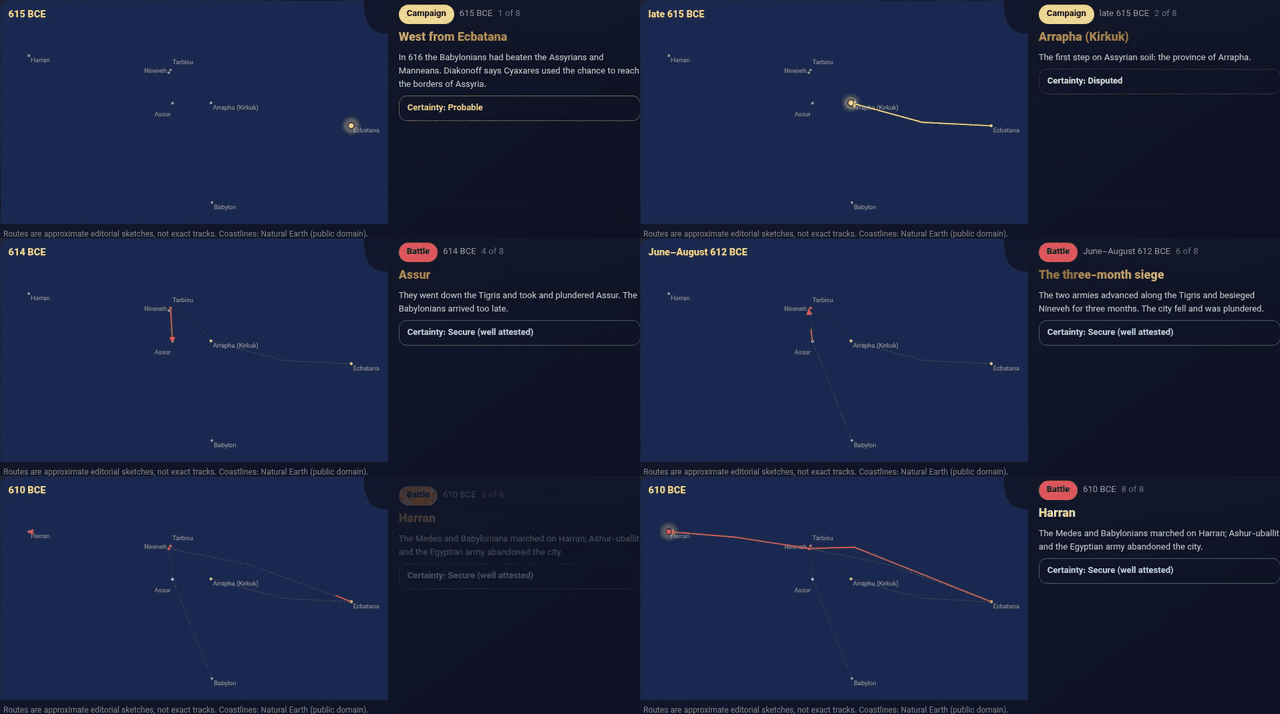
The end of Assyria, step by step (615–610 BCE)
From Ecbatana to Arrapha, Assur, Nineveh and Harran. Each step is from the Babylonian chronicle ABC 3; the routes are sketches.
Campaign615 BCE1 of 8
West from Ecbatana
In 616 the Babylonians had beaten the Assyrians and Manneans. Diakonoff says Cyaxares used the chance to reach the borders of Assyria.
Certainty: ProbableThe chronicle gives the camps, not the roads; the lines are sketches.
Sources: I. M. Diakonoff, Encyclopaedia Iranica, 1993, updated 2013 · Babylonian chronicle, tr. A. K. Grayson (1975), adapted by J. Lendering, online
BattleCampaignBuildingAdministration & economyReligionArrow keys, Home/End and Space work.
Three separate layers
Each section has three layers: “Historical evidence” is only what the sources say; “Philosophical interpretation” is our reading by the standard of property and liberty; “Modern cultural meaning”. Quotations come only from published translations, with references.
Historical evidencePhilosophical interpretationModern cultural meaning
Dossier · 1
Sources: a Babylonian tablet and a Greek historian
We have two main sources. One is the Babylonian “Fall of Nineveh” tablet (ABC 3) in the British Museum, written year by year at the time and naming Cyaxares (Umakishtar). The other is Herodotus, a Greek historian writing about 150 years later. Diakonoff (Iranica) says the other Greek accounts, derived from Berossus and Ctesias, have “little value”.

Wherever the Babylonian tablet speaks, we treat it as secure. Wherever only Herodotus speaks, we label it “according to Herodotus”. Diakonoff says some of Herodotus’ stories, such as the 28 years of Scythian rule, contradict the eastern sources.
We know the first great Iranian king through others: a Babylonian scribe and a Greek. No writing by the Medes themselves survives.
Sources: Babylonian chronicle, tr. A. K. Grayson (1975), adapted by J. Lendering · British Museum · Herodotus, tr. A. D. Godley (Loeb, 1920) · I. M. Diakonoff, Encyclopaedia Iranica · A. K. Grayson
Dossier · 2
Life and reign in order
1. According to Herodotus he was the son of Phraortes; Diakonoff suggests his father may have been Xšaθrita (below).
2. Around 615 BCE he reached Assyrian soil and took Arrapha (Kirkuk).
3. In 614 BCE he captured Assur, the religious city of the Assyrians, and made a pact with Nabopolassar of Babylon.
4. In 612 BCE, with the Babylonians, he took Nineveh after a three-month siege.
5. In 610 BCE, with the Babylonians, he took Harran, the last Assyrian stronghold.
6. According to Herodotus he fought Lydia for five years; after an eclipse peace was made and the Halys became the frontier.
7. He died in 585/584 BCE and his son Ishtumegu (Astyages) succeeded him.
Diakonoff says Cyaxares is “the only historically attested Median king named Cyaxares”. The supposed “Cyaxares I” of the 8th century is, in his words, “a phantom”.
In under ten years a mountain kingdom helped bring down the greatest empire of its age.
Sources: I. M. Diakonoff, Encyclopaedia Iranica · Babylonian chronicle, tr. A. K. Grayson (1975), adapted by J. Lendering · Herodotus, tr. A. D. Godley (Loeb, 1920)
Dossier · 3
The army: a new organisation, according to Herodotus
Herodotus says Cyaxares was the first to organise the army by arms: spearmen, archers and cavalry apart. The Babylonian chronicle says nothing about how the Median army was organised; it only shows that this army could take large walled cities.
He is said to have been a much greater soldier than his ancestors: it was he who first organized the men of Asia in companies and posted each arm apart, the spearmen and archers and cavalry: before this they were all mingled together in confusion.
This claim cannot be checked against another source. Herodotus may be explaining Cyaxares’ great victories by an “innovation”. So we treat it as Herodotus’ account, not a secure fact.
Taking Assur and Nineveh was the work of an organised army; how it was organised we do not know.
Sources: Herodotus, tr. A. D. Godley (Loeb, 1920) · Babylonian chronicle, tr. A. K. Grayson (1975), adapted by J. Lendering
Dossier · 4
The end of Assyria: Assur, Nineveh and Harran
The Babylonian chronicle tells it step by step: in 614 the Medes took Tarbisu and Assur; Nabopolassar arrived late and the two kings made a pact by the city. In 612 the two armies advanced along the Tigris and besieged Nineveh for three months. The city fell, the king of Assyria died and the city was plundered. In 610 the Medes and Babylonians marched on Harran and the Assyrians and Egyptians abandoned it.
From the month Simanu until the month Âbu - for three months - they subjected the city to a heavy siege. On the Nth day of the month Âbu they inflicted a major defeat upon a great people. At that time Sin-šar-iškun, king of Assyria, died. They carried off the vast booty of the city and the temple and turned the city into a ruin heap

Diakonoff says “a huge amount of booty” was carried off to Media after Assur, turning it from “a poor and semidemocratic country into a rich oriental empire”. Whether the Medes also fought at Carchemish (605) is unclear. According to Berossus the pact was sealed by a marriage; whether the bride was Cyaxares’ daughter or granddaughter is disputed.
The ruins of Nineveh lie by modern Mosul. The rebuilt gates of its wall recall a city that was once the capital of the Near Eastern world.
Sources: Babylonian chronicle, tr. A. K. Grayson (1975), adapted by J. Lendering · I. M. Diakonoff, Encyclopaedia Iranica · S. Zawadzki · A. K. Grayson
Dossier · 5
The Scythians: a story the documents do not match
Herodotus says that while Cyaxares was besieging Nineveh, the Scythians under Madyes attacked him and ruled Asia for 28 years. Then Cyaxares invited their leaders to a feast, made them drunk and killed them.
besides exacting from each the tribute which was assessed, they rode about the land carrying off everyone's possessions.
Diakonoff says this report “contradicts the evidence of the oriental sources” and may rest on an error: the Scythians may have beaten the Medes during the war of Cyaxares’ father with Assyria. The Babylonian chronicle does not confirm 28 years of Scythian rule.
Herodotus himself sees the evil of Scythian rule in their seizing people’s property. His judgement is simple: tribute is one thing, plunder another.
Sources: Herodotus, tr. A. D. Godley (Loeb, 1920) · I. M. Diakonoff, Encyclopaedia Iranica
Dossier · 6
Lydia: the eclipse and the Halys frontier
According to Herodotus, the Medes and Lydians fought for five years. In the sixth year, during a battle, day turned to night and both armies stopped fighting. Syennesis of Cilicia and the king of Babylon mediated. The river Halys became the frontier and Alyattes gave his daughter Aryenis in marriage to Astyages, son of Cyaxares.
They were still warring with equal success, when it happened, at an encounter which occurred in the sixth year, that during the battle the day was suddenly turned to night.
Diakonoff accepts the war itself and the Halys frontier and says Cyaxares finally drove the Lydians into the interior of Asia Minor. The year 585 comes from identifying the eclipse with that of 28 May 585; Diakonoff puts it with an “if”. That Thales foretold it is also only Herodotus’ story.
A war ended by a sign in the sky was settled by an agreement: a clear border between two kingdoms. A clear border is the basis of peace and trade.
Sources: Herodotus, tr. A. D. Godley (Loeb, 1920) · I. M. Diakonoff, Encyclopaedia Iranica
Dossier · 7
Property and liberty: from a poor country to an empire of booty
The Babylonian chronicle speaks of plunder again and again: at Assur the Medes “plundered and sacked”; at Nineveh they carried off “the vast booty of the city and the temple”. Diakonoff says this booty turned Media from “a poor and semidemocratic country into a rich oriental empire”. No economic document from Media itself, such as a contract or tax record, survives.
This is our reading: wealth that comes from plunder, not from production and exchange, concentrates power in the king’s hands. If Diakonoff is right, that same booty turned a semi-democratic Median society into a centralised monarchy. This interpretation is disputed, because we know very little about Median society before 614.
An empire built on booty must always find new booty. Media fell to Cyrus sixty years after Nineveh.
Sources: Babylonian chronicle, tr. A. K. Grayson (1975), adapted by J. Lendering · I. M. Diakonoff, Encyclopaedia Iranica · I. M. Diakonoff
Dossier · 8
Family and succession
Father: Herodotus makes him the son of Phraortes. Diakonoff says no Phraortes is attested in 7th-century Media and his real father may have been Xšaθrita (Kaštariti), who led a successful revolt against Assyria about 673 BCE.
Son: Ishtumegu (Astyages), the last Median king. According to Herodotus he married Aryenis, daughter of the king of Lydia.
The Babylonian link: according to Berossus, Nebuchadnezzar, son of Nabopolassar, married Amytis, daughter (or granddaughter) of the Median king.

Identifying Cyaxares’ father with Xšaθrita is a proposal of Cameron and Diakonoff and is disputed. The “Hanging Gardens” that later stories say were built for Amytis are not in the contemporary sources; we leave them out here.
Three royal marriages, three alliances: Media, Babylon and Lydia were bound by kinship.
Sources: Herodotus, tr. A. D. Godley (Loeb, 1920) · I. M. Diakonoff, Encyclopaedia Iranica
Synthesis: a great victory, few documents
Cyaxares did something great: with Babylon he brought down an empire that had dominated the Near East for three centuries. We know this from a Babylonian tablet, not from later stories. Most of his colourful tales, from the Scythians to the eclipse, come from Herodotus and must be read with care.
Through the lens of property, Media’s wealth came from the booty of Assur and Nineveh. In Diakonoff’s words, that wealth turned Media into an empire. But Cyaxares’ most lasting achievement may have been an agreement: the Halys frontier, which ended the war with Lydia.
Bibliography
- I. M. Diakonoff, Encyclopaedia Iranica, Cyaxares (1993, updated 2013). https://www.iranicaonline.org/articles/cyaxares/The spine of this page: the only attested Cyaxares, the events of 615–609, and a critique of Herodotus’ stories.
- Babylonian chronicle, tr. A. K. Grayson (1975), adapted by J. Lendering, ABC 3, the Fall of Nineveh Chronicle (BM 21901), Livius.org (online). https://www.livius.org/sources/content/mesopotamian-chronicles-content/abc-3-fall-of-nineveh-chronicle/The contemporary Babylonian year-by-year record, 616–609 BCE.
- A. K. Grayson, Assyrian and Babylonian Chronicles (Texts from Cuneiform Sources V) (1975).
- Herodotus, tr. A. D. Godley (Loeb, 1920), The Histories, book 1, chapters 73–74 and 103–106 (Perseus) (1920). https://www.perseus.tufts.edu/hopper/text?doc=Perseus:text:1999.01.0126:book=1:chapter=103A Greek account written c. 150 years later; always labelled “according to Herodotus”.
- I. M. Diakonoff, Media, in The Cambridge History of Iran II, pp. 36–148 (esp. 112–119) (1985).
- S. Zawadzki, The Fall of Assyria and Median-Babylonian Relations in the Light of the Nabopolassar Chronicle (1988).
- British Museum, Chronicle tablet BM 21901 (1896,0409.6) (collection record) (online). https://www.britishmuseum.org/collection/object/W_1896-0409-6
All photos are from Wikimedia Commons; licence and author were checked on each file page.