Featured dossier
Astyages: the last king of the Medes
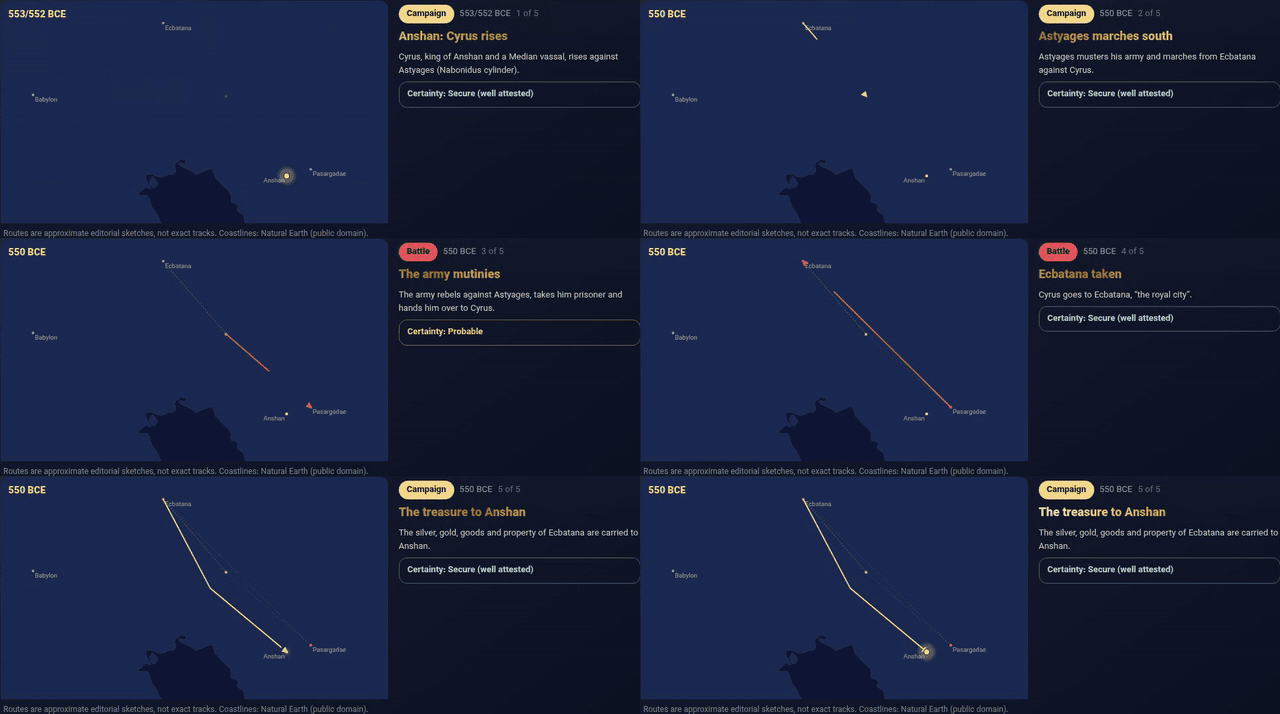
The son of Cyaxares and the last king of the Medes. Of his 35-year reign we know only the end from a contemporary document: according to the Nabonidus Chronicle, in 550 BCE he marched against Cyrus, his army mutinied and handed him over to Cyrus. The story of Harpagus and Cyrus’ childhood is Herodotus’ and is labelled as such. Follow the campaign on the animated map.
- reign, per Herodotus
- 35 years
- end of Media (BCE)
- 550
- from Cyrus’ revolt to the end
- 3 years
- where Ecbatana’s treasure went
- Anshan
Animated map: life and reign
Administration & economy585/584 BCE1 of 6
King of the Medes
The son of Cyaxares became king on his father’s death. Herodotus gives him 35 years; Schmitt puts the reign at “probably 584–550”.
Certainty: ProbableThe first year is counted from Herodotus’ 35 years.
Sources: R. Schmitt, Encyclopaedia Iranica, 1987, updated 2017 · Herodotus, tr. A. D. Godley (Loeb, 1920), 1920
BattleCampaignBuildingAdministration & economyReligionArrow keys, Home/End and Space work.
Cyrus’ revolt and the end of Media (553–550 BCE)
From Anshan to Ecbatana and the treasure’s return to Anshan. The steps are from the Nabonidus Chronicle and cylinder; the place of the mutiny follows a later tradition and the routes are sketches.
Campaign553/552 BCE1 of 5
Anshan: Cyrus rises
Cyrus, king of Anshan and a Median vassal, rises against Astyages (Nabonidus cylinder).
Certainty: Secure (well attested)
Sources: S. Smith, 1924 · R. Schmitt, Encyclopaedia Iranica, 1987, updated 2017
BattleCampaignBuildingAdministration & economyReligionArrow keys, Home/End and Space work.
Three separate layers
Each section has three layers: “Historical evidence” is only what the sources say; “Philosophical interpretation” is our reading by the standard of property and liberty; “Modern cultural meaning”. Quotations come only from published translations, with references.
Historical evidencePhilosophical interpretationModern cultural meaning
Dossier · 1
Sources: a Babylonian tablet and two Greek stories
The contemporary record of Astyages’ fall is in two texts of Nabonidus, king of Babylon: the Nabonidus Chronicle and a cylinder from Abu Habba (Sippar). Both are very short. The long stories come from Herodotus and Ctesias.

Schmitt says the ancient sources report “almost nothing” about Astyages’ reign. Herodotus shows him as a tyrant and Ctesias is sympathetic; Schmitt calls both “biased” and says a final judgment on his character is not possible.
Of a 35-year reign, we know only its end from a contemporary document. Astyages is known mostly by his defeat.
Sources: Babylonian chronicle, tr. A. K. Grayson (1975), adapted by J. Lendering · S. Smith · R. Schmitt, Encyclopaedia Iranica · Herodotus, tr. A. D. Godley (Loeb, 1920)
Dossier · 2
Life and reign in order
1. Son of Cyaxares; became king on his father’s death in 585/584 BCE.
2. According to Herodotus he married Aryenis, daughter of the king of Lydia.
3. According to Herodotus his daughter Mandane married the Persian Cambyses and was the mother of Cyrus.
4. In 553/552 BCE Cyrus, king of Anshan, rose against him (Nabonidus cylinder).
5. In 550 BCE he marched against Cyrus; his army mutinied and handed him over to Cyrus (Nabonidus Chronicle).
6. Cyrus took Ecbatana and carried its treasure to Anshan.
7. According to Herodotus, Cyrus kept him in his own house for the rest of his life.
His Babylonian name is Ištumegu. Schmitt derives it from Iranian *Ṛšti-vaiga-, “lance-hurler”; the Greek form Astyages was reshaped by popular etymology.
Family ties bound Media, Lydia and Persia together; Astyages’ end showed that kinship does not replace an army’s loyalty.
Sources: R. Schmitt, Encyclopaedia Iranica · Babylonian chronicle, tr. A. K. Grayson (1975), adapted by J. Lendering · S. Smith · Herodotus, tr. A. D. Godley (Loeb, 1920)
Dossier · 3
The end of Media: what the Babylonian tablet says
The Nabonidus Chronicle, under Nabonidus’ sixth year (550 BCE), says Astyages marched against Cyrus, his army rebelled, he was taken prisoner and handed over to Cyrus. Then Cyrus went to Ecbatana and took the booty to Anshan. The Nabonidus cylinder places the start of Cyrus’ revolt three years earlier.
Astyages mustered (his army) and marched against Cyrus, king of Anšan, for conquest [...] The army rebelled against Astyages and he was taken prisoner. Th[ey handed him over] to Cyrus.

Nicolaus of Damascus (following Ctesias) and Justin speak of three battles: Cyrus was defeated twice and won the third, in the mountains near Pasargadae. The chronicle says nothing of these battles, only of the army’s mutiny. Schmitt says that with the fall of Ecbatana, Media ceased to be an independent and leading nation.
The Median empire ended not with a great defeat but with its own army turning.
Sources: Babylonian chronicle, tr. A. K. Grayson (1975), adapted by J. Lendering · S. Smith · R. Schmitt, Encyclopaedia Iranica · A. K. Grayson
Dossier · 4
Harpagus and Cyrus’ childhood: Herodotus’ story
According to Herodotus, Astyages had a dream and ordered his daughter’s infant, Cyrus, to be killed. Harpagus handed the task to a herdsman, who kept the child alive. When Astyages learned of it, he punished Harpagus terribly. Years later Harpagus won the Median nobles over to Cyrus and joined him in battle.
since Astyages was harsh toward the Medes, he associated with each of the chief Medes and persuaded them to make Cyrus their leader and depose Astyages.
Schmitt says Herodotus here followed the stories of the Harpagids, Harpagus’ descendants in Lycia, and describes Cyrus’ childhood “in a very fantastic way”. Nicolaus of Damascus gives the same role to a Persian named Oebaras. So the Harpagus story is a family’s tale about its own ancestor, not a neutral report.
Even so, Herodotus’ story agrees with the Babylonian tablet on one point: the Median army itself abandoned Astyages.
Sources: Herodotus, tr. A. D. Godley (Loeb, 1920) · R. Schmitt, Encyclopaedia Iranica
Dossier · 5
Property and liberty: the treasure of Ecbatana and Persian “freedom”
The Babylonian chronicle gives a list: the silver, gold, goods and property of Ecbatana went to Anshan. Herodotus tells the same event from the Persian side: they were discontent with Median rule and “won their freedom”.
Cyrus to Ecbatana, the royal city. The silver, gold, goods, property, [...] which he carried off as booty (from) Ecbatana, he took to Anšan.
The Persians had long been discontent that the Medes ruled them, and now having got a champion they were glad to win their freedom.

This is our reading: one event has two faces. For the Persians it was freedom from rule by others; for the people of Ecbatana, their property became someone else’s booty. The treasure that, in Diakonoff’s account on our Cyaxares page, came to Media from the sack of Nineveh now went to Persia.
One nation’s “freedom” from another is not the same as the liberty and secure property of each person. The distinction is visible from the very start of Iranian history.
Sources: Babylonian chronicle, tr. A. K. Grayson (1975), adapted by J. Lendering · Herodotus, tr. A. D. Godley (Loeb, 1920) · R. Schmitt, Encyclopaedia Iranica
Dossier · 6
Family and fate
Father: Cyaxares, king of the Medes.
Wife: Aryenis, daughter of Alyattes of Lydia (Herodotus’ account).
Daughter: Mandane, wife of Cambyses and mother of Cyrus (Herodotus’ account).
Fate: according to Herodotus, Cyrus did him no harm and kept him in his own house until his death. According to Ctesias, he was being brought to court from Barcania, where he had perhaps been satrap, when Cyrus’ servant Oebaras killed him without the king’s knowledge.
As for Astyages, Cyrus did him no further harm, and kept him in his own house until Astyages died.
That Cyrus was Astyages’ grandson comes only from Herodotus, and no contemporary document confirms it. Schmitt calls Ctesias’ account of Astyages “on the whole very unreliable”.
In both accounts the defeated king is not put to death, at least not on the victor’s orders.
Sources: Herodotus, tr. A. D. Godley (Loeb, 1920) · R. Schmitt, Encyclopaedia Iranica
Synthesis: a king abandoned by his army
We know Astyages mostly through stories: the dreams, the abandoned infant and Harpagus’ revenge come from Herodotus, and Schmitt calls them biased. What the contemporary document says is short and clear: his army rebelled against him and Cyrus took Ecbatana.
Through the lens of property, the end of Media was a transfer of treasure: the silver and gold of Ecbatana went to Anshan. The Persians’ “freedom” from Media meant the loss of property for the people of Ecbatana. A nation’s freedom and the security of people’s property are two different things.
Bibliography
- R. Schmitt, Encyclopaedia Iranica, Astyages (1987, updated 2017). https://www.iranicaonline.org/articles/astyages/The spine of this page: separates the contemporary Babylonian record from the stories of Herodotus and Ctesias, and calls both judgments of his character “biased”.
- Babylonian chronicle, tr. A. K. Grayson (1975), adapted by J. Lendering, ABC 7, the Nabonidus Chronicle, Livius.org (online). https://www.livius.org/sources/content/mesopotamian-chronicles-content/abc-7-nabonidus-chronicle/The short contemporary Babylonian record of Astyages’ fall in Nabonidus’ sixth year (550 BCE); the tablet is damaged.
- A. K. Grayson, Assyrian and Babylonian Chronicles (Texts from Cuneiform Sources V) (1975).
- S. Smith, Babylonian Historical Texts (Nabonidus cylinder from Abu Habba, col. I 28 f.; Nabonidus Chronicle, col. II 1 f.) (1924). According to Schmitt, the Nabonidus cylinder places Cyrus’ revolt in Nabonidus’ third year (553/552 BCE).
- Herodotus, tr. A. D. Godley (Loeb, 1920), The Histories, book 1, chapters 73–75 and 107–130 (Perseus) (1920). https://www.perseus.tufts.edu/hopper/text?doc=Perseus:text:1999.01.0126:book=1:chapter=123A Greek account that, Schmitt says, follows the stories of the Harpagid family in Lycia; always labelled “according to Herodotus”.
All photos are from Wikimedia Commons; licence and author were checked on each file page.