Sasanians
Shapur II
شاپور دوم (ذوالاکتاف)
Epithets and titles
- Dhu’l-AktafḎu’l-Aktāf (Ar.); Huya sonbā (Pers.); *Šānag āhanj (MP)byname (later or foreign)“he who pierces shoulders”, from his harsh campaigns against the ArabsSource: T. Daryaee, “Šāpur II”, Encyclopaedia Iranica
- Reign
- 309–379 CE
- Dynasty
- Sasanians
- Persian page
- فارسی
Featured dossier
Shapur II: seventy years on the throne, Amida, and the defeat of Julian
Shapur II had the longest Sasanian reign. By one tradition he was crowned before he was born. As a youth he attacked the Arab tribes and earned the name Dhu’l-Aktaf. He fought Rome for more than twenty years: three sieges of Nisibis failed, but in 359 he took Amida. In 363 the emperor Julian reached Ctesiphon, turned back and was killed in battle, and his successor Jovian handed Nisibis and five provinces to Persia. In his reign the Christians of Iran were harshly persecuted.
- years on the throne
- 70
- days’ siege of Amida
- 73
- forts in the 363 treaty
- 15
- years of Jovian’s peace
- 30
Animated map: Amida and Julian’s campaign
Administration & economy309 CE1 of 17
A crown on the mother’s womb (tradition)
According to Agathias, Hamza Isfahani and the Mojmal al-Tawarikh, the nobles and priests placed the crown on the womb of Shapur’s pregnant mother, so that he was king before he was born. Iranica calls this a “legend”. What is firmer: the nobles pushed aside Hormizd II’s older sons.
Certainty: DisputedThis is tradition, not a historical report. The Shahnameh says Shapur was born forty days after his father’s death.
Sources: T. Daryaee, Encyclopaedia Iranica, 2009 · Agathias, tr. J. D. Frendo, 1975 · A. Sh. Shahbazi, Encyclopaedia Iranica, 1986
BattleCampaignBuildingAdministration & economyReligionArrow keys, Home/End and Space work.
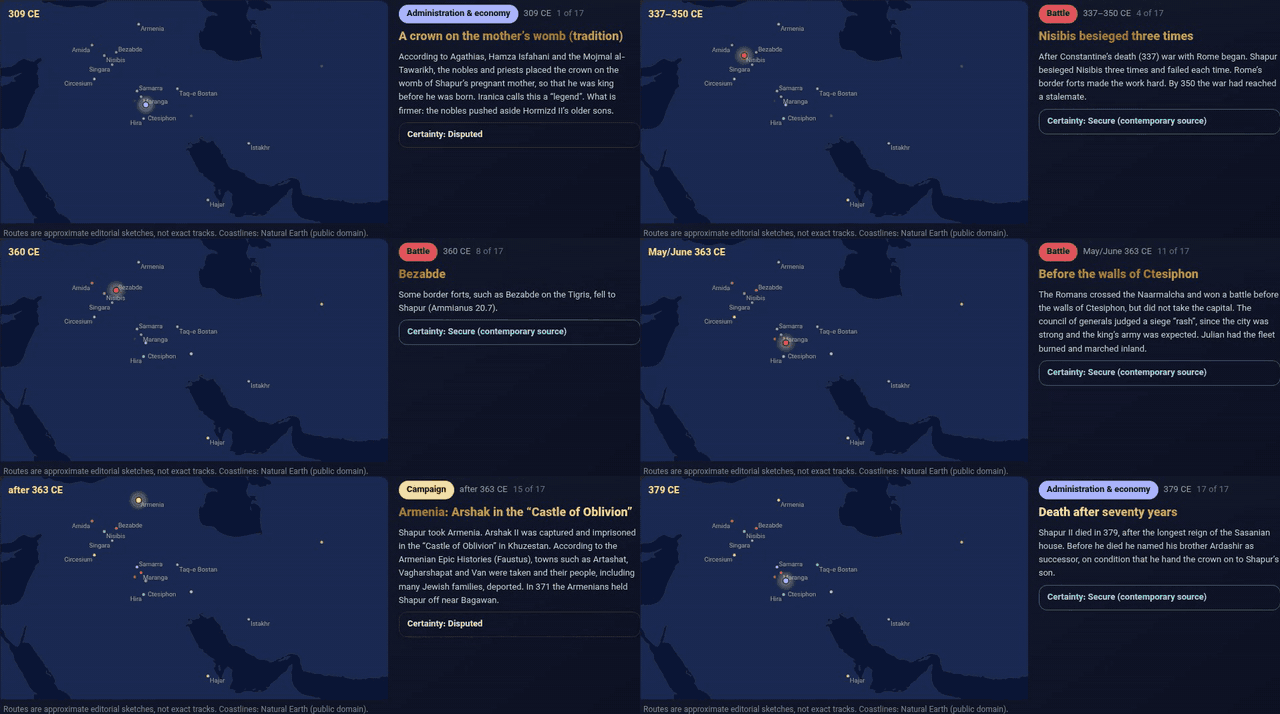
From Hajar to Amida and Ctesiphon, step by step (309–379 CE)
Shapur II’s wars as told by Ammianus, the Arabic sources and Iranica. Each step says whether it is secure, probable or disputed; the routes are sketches. The step-by-step diagram of Julian’s retreat from Ctesiphon to Samarra is below the map.
Administration & economy309 CE1 of 17
A crown on the mother’s womb (tradition)
According to Agathias, Hamza Isfahani and the Mojmal al-Tawarikh, the nobles and priests placed the crown on the womb of Shapur’s pregnant mother, so that he was king before he was born. Iranica calls this a “legend”. What is firmer: the nobles pushed aside Hormizd II’s older sons.
Certainty: DisputedThis is tradition, not a historical report. The Shahnameh says Shapur was born forty days after his father’s death.
Sources: T. Daryaee, Encyclopaedia Iranica, 2009 · Agathias, tr. J. D. Frendo, 1975 · A. Sh. Shahbazi, Encyclopaedia Iranica, 1986
BattleCampaignBuildingAdministration & economyReligionArrow keys, Home/End and Space work.
From Ctesiphon to Samarra, 363 CE (schematic)
May to July 363 CE · Schematic; exact positions are debated
Phase 1 / 5 · secure
Victory before the walls, but no city
The Romans won before the walls of Ctesiphon. But the council of generals said the city was impregnable “by its situation alone” and that the king’s army was coming. No siege was made.
The route follows Ammianus; army positions are editorial and schematic. North is at the top, and the Tigris runs from top to bottom.
Ammianus Marcellinus, tr. J. C. Rolfe (Loeb, 1935–1940)
Iranians (Sasanian)Romans
Three separate layers
Each section has three layers: “Historical evidence” is only what the sources say; “Philosophical interpretation” is our reading by the standard of property and liberty; “Modern cultural meaning”. Quotations come only from published translations, with references.
Historical evidencePhilosophical interpretationModern cultural meaning
Dossier · 1
The king before birth
Agathias, the 6th-century Byzantine historian who says he used the Persian royal annals, tells it this way: Hormizd II died while his wife was pregnant. The Magi said the child would be a boy, and the nobles placed the diadem on the mother’s womb. Hamza Isfahani and the Mojmal al-Tawarikh tell the same.
When the magi said that a male child would be born they no longer delayed, but putting the diadem around the mother’s womb they proclaimed as Emperor the foetus conferring upon it the distinction of a name and a title
Possessed of the royal title at birth, he grew up on the throne and he grew old on it, living to the ripe old age of seventy.

Iranica (Daryaee) calls this a “legend”. Shahbazi puts it in its political setting: the nobles pushed aside Hormizd’s older sons and made a child king so as to rule themselves. Tabari, too, says the same courtiers and priests who served his father ran the empire.
A crown placed on a womb asks no one’s consent. The legend is charming, but its message is plain: kingship was hereditary and blood, not the people’s consent, gave the right to rule.
Sources: Agathias, tr. J. D. Frendo · T. Daryaee, Encyclopaedia Iranica · A. Sh. Shahbazi, Encyclopaedia Iranica
Dossier · 2
The Arab war and the name Dhu’l-Aktaf
In Shapur’s childhood, tribes from Bahrain and Hajar crossed the Persian Gulf and plundered the coast of Fars and the district of Ardashir-Khwarrah. According to Tabari and Miskawayh, at sixteen Shapur attacked them: the Iyad in Iraq, then al-Khatt, Hajar and Yamama. He moved the Taghlib, ʿAbd al-Qays, Tamim and Bakr ibn Waʾil to new lands. To stop new raids he built the “wall of the Arabs” near Hira.
he destroyed the Arabs and took the land and destroyed many Arab rulers and pulled out many number of shoulders
Checking the epithet: Dhu’l-Aktaf is Arabic, “he of the shoulders”. Iranica renders it “he who pierces shoulders” and says the Persian form is Huya sonbā (Hamza Isfahani, Mojmal), which may render a Middle Persian *Šānag āhanj (“shoulder-puller”). The asterisk means that form is reconstructed, not attested. The epithet appears in no Sasanian inscription or coin. The Bundahišn, a Zoroastrian text, speaks of pulling out “many shoulders”. So the epithet comes from post-Sasanian tradition, but has roots in Zoroastrian lore too.
Moving tribes and destroying wells, if true, was war on people’s very livelihood, not only on fighters. Water in the desert was everyone’s property. The campaign secured the Persian Gulf for the empire, but others paid its price.
Sources: T. Daryaee, Encyclopaedia Iranica · C. E. Bosworth, Encyclopaedia Iranica
Dossier · 3
Amida, 359 CE
In 359 Shapur came to Amida (modern Diyarbakır) with Grumbates, king of the Chionitae. Ammianus Marcellinus, a Roman officer, was inside the city. Shapur rode forward wearing a golden ram’s-head crown. During the parley a ballista bolt killed Grumbates’ young son, and the fight began in anger. After 73 days the Persians broke into the city over earthen mounds.
discharging a ballista, pierced both cuirass and breast of Grumbates’ son, a youth just come to manhood, who was riding at his father’s side
armed and unarmed alike without distinction of sex were slaughtered like so many cattle
when he had invested Amida for seventy-three days with a great force of armed men, he lost 30,000 warriors, as was reckoned a little later by Discenes, a tribune and secretary

This is an eyewitness account, but from inside the besieged city. Ammianus himself calls the figure of 30,000 Persian dead the “reckoning” of a Roman tribune. Iranica says the townspeople were deported to Khuzestan because Grumbates’ son had been killed. The next year the fort of Bezabde fell to him as well.
In a mass deportation the townspeople were counted as spoils of war. For those taken to Khuzestan it made no difference whether Rome or Persia was in the right: they had lost their homes and land.
Sources: Ammianus Marcellinus, tr. J. C. Rolfe (Loeb, 1935–1940) · T. Daryaee, Encyclopaedia Iranica
Dossier · 4
Julian’s invasion, 363 CE
In spring 363 the emperor Julian invaded Persia with a large army and a fleet on the Euphrates. He took forts, crossed the Naarmalcha and won before the walls of Ctesiphon. But the council of generals judged a siege rash. Julian burned the fleet and marched inland. The Persians burned the crops and harassed the Roman column from a distance. The army turned back; near Maranga there was a great battle with elephants, and a few days later Julian was wounded and died.
the city, impregnable by its situation alone, was well defended; and, besides, it was believed that the king would soon appear with a formidable force
he gave orders that all the ships should be burned, with the exception of twelve of the smaller ones
the enemy, in order to torment us with hunger, set fire to the plants and the ripe grain
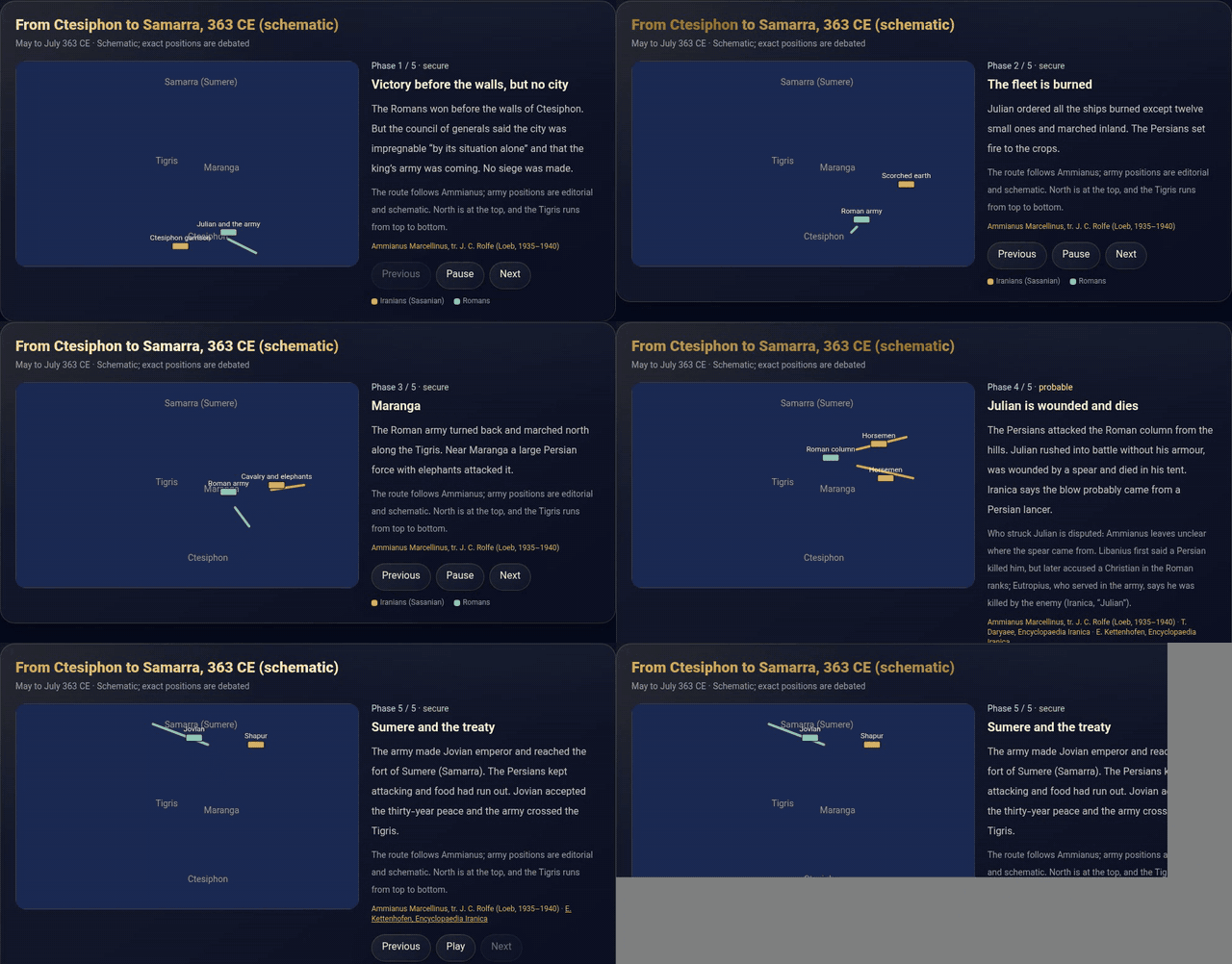

Iranica says the capital was not taken partly because of disorder and plundering in the Roman army (Libanius). Shapur’s scorched-earth policy starved the Roman army. Eutropius, who was himself on the campaign, says Julian was killed by the enemy. Ardashir II’s relief at Taq-e Bostan shows a fallen Roman underfoot, whom many identify as Julian.
Scorched earth means a state burning its own farmers’ fields so that the enemy starves. The strategy saved Persia, but a year’s harvest of those who worked that land became ash. No one asked them.
Sources: Ammianus Marcellinus, tr. J. C. Rolfe (Loeb, 1935–1940) · T. Daryaee, Encyclopaedia Iranica · E. Kettenhofen, Encyclopaedia Iranica · A. Sh. Shahbazi, Encyclopaedia Iranica
Dossier · 5
Jovian’s treaty
The starving army made Jovian emperor. Shapur, as Ammianus tells it, demanded lands which he said were his and had been taken from Persia by Maximianus. Jovian gave up five provinces beyond the Tigris, fifteen forts, and Nisibis, Singara and Castra Maurorum, and agreed that Rome would not help Arshak, king of Armenia. A thirty-year peace was sworn.
he required as our ransom five provinces on the far side of the Tigris: Arzanena, Moxoëna, and Zabdicena, as well as Rehimena and Corduena with fifteen fortresses, besides Nisibis, Singara and Castra Maurorum, a very important stronghold
Nisibis and Singara should pass into control of the Persians without their inhabitants
And so a peace of thirty years was made and consecrated by the sanctity of oaths
Ammianus calls the peace “necessary, but shameful” and says it would have been better to fight ten battles than give up any of these places; that is a Roman verdict. Iranica (Kettenhofen) says that with this treaty Rome lost the eastern half of its province of Mesopotamia. Jovian tried to present the outcome as a success on his coins, and the Sasanians immortalized it in the relief at Taq-e Bostan. The treaty also left Armenia open to Persia.
Jovian won only one point by insisting: the people of Nisibis and Singara could leave. The land went to Persia, but its people had the right not to live under a rule they did not want.
Sources: Ammianus Marcellinus, tr. J. C. Rolfe (Loeb, 1935–1940) · E. Kettenhofen, Encyclopaedia Iranica · T. Daryaee, Encyclopaedia Iranica
Dossier · 6
The persecution of the Christians
Iranica (Daryaee): from 337 the persecution of Christians grew. One reason was that Rome had become Christian, and the Christians of Iran were seen as collaborators with the enemy. During the war Shapur asked a double tax of them. According to the Acts of Simeon, their leader, he refused. Among the martyrs named are Posi (Pusai), Shapur’s master craftsman, and his daughter Martha.
Simeon wants to make his followers and his people rebel against my kingdom and convert them into servants Caesar, their coreligionist
Most of what we know comes from Syriac martyr acts; religious writings meant to honour the martyrs, not neutral history. Iranica notes that in them persecution is usually blamed on the priests. Not all were persecutors either: according to the Chronicle of Arbela, a mowbed named Pagrasp refused to order persecution, or the king cancelled the order. The Chronicle of Arbela’s own authenticity is questioned.
A double tax on one religious group meant people’s property was taken because of their faith. When political loyalty is measured by religion, every subject’s conscience is under suspicion. Two liberties were trampled together here: freedom of belief and security of property.
Sources: T. Daryaee, Encyclopaedia Iranica
Dossier · 7
Armenia after the treaty
The 363 treaty kept Rome out of Armenia. Shapur seized Arshak II, who had joined Julian, and imprisoned him in the “Castle of Oblivion” in Khuzestan. The towns of Artashat, Vagharshapat, Eruandashat, Zarehawan, Zarishat, Van and Nakhchivan were taken and their people, including many Jewish families, deported. In 367 Rome put Pap, Arshak’s son, on the throne, and in 371 the Armenians held Shapur off near Bagawan.
Arsaces, our steadfast and faithful friend should never, if he asked it, be given help against the Persians
The main source, the Armenian Epic Histories (Faustus of Byzantium), is vivid and sometimes legendary; the story of Arshak’s suicide in prison comes from it. Iranica reports it with “is said to”.
Armenia between the two empires was like a field two neighbours fight over without asking its owner. The Armenian nobles (naxarars) sided now with one, now with the other, to keep their own lands and rank.
Sources: T. Daryaee, Encyclopaedia Iranica · Ammianus Marcellinus, tr. J. C. Rolfe (Loeb, 1935–1940)
Dossier · 8
Taq-e Bostan: two kings in the small grotto
With Shapur II royal reliefs move from Fars to Kermanshah. In the small grotto at Taq-e Bostan two kings stand side by side. The inscriptions name them as Shapur II and his son Shapur III, and in it Shapur II calls himself son of Ohrmazd and grandson of Narseh.
Ardashir II and the Taq-e Bostan relief

Overlaet (2011) argues that the second figure’s crown matches Ardashir II’s coins, not Shapur III’s, and that the inscriptions were probably added later. So who the second figure is remains disputed.
An inscription added later rewrites history in favour of the new king. It is the same thing Narseh did to Bahram I’s relief.
Sources: T. Daryaee, Encyclopaedia Iranica · B. Overlaet
Synthesis
Shapur II was a child the nobles made king for their own power, but he became a king who took power back and held it for seventy years. He closed the Persian Gulf frontier with a harsh war on the Arabs, beat Rome at Amida, and in 363 defeated Julian’s invasion with scorched earth and patience. Jovian’s treaty gave Nisibis and Armenia to Persia.
Many paid for this success: the resettled tribes, the people of Amida, the farmers of Mesopotamia, the Christians of Iran and the people of Armenia. Most of our sources come from his enemies or his victims (Ammianus, the martyr acts, the Armenian Epic Histories), and that should be kept in mind when reading them.
Bibliography
- T. Daryaee, Encyclopaedia Iranica, Šāpur II (2009). https://www.iranicaonline.org/articles/shapur-ii/
- Ammianus Marcellinus, tr. J. C. Rolfe (Loeb, 1935–1940), Res Gestae, books 18–25 (LacusCurtius) (1935–1940). https://penelope.uchicago.edu/Thayer/E/Roman/Texts/Ammian/home.htmlAmmianus was a Roman officer who was himself present at Amida (359) and on Julian’s campaign (363). An eyewitness, but on the Roman side.
- Agathias, tr. J. D. Frendo, The Histories (CFHB 2A), book 4.25–27 (1975). https://archive.org/details/cfhb-11.1-nicetae-choniatae-historiaAgathias (6th century) took his list of Sasanian kings, by his own account, from the Persian royal annals.
- E. Kettenhofen, Encyclopaedia Iranica, Jovian (2009). https://www.iranicaonline.org/articles/jovian/
- E. Kettenhofen, Encyclopaedia Iranica, Julian (2009). https://www.iranicaonline.org/articles/julian/
- A. Sh. Shahbazi, Encyclopaedia Iranica, Ardašīr II (1986). https://www.iranicaonline.org/articles/ardasir-ii-sasanian-king/
- A. Sh. Shahbazi, Encyclopaedia Iranica, Hormozd II (2004). https://www.iranicaonline.org/articles/hormozd-ii/
- C. E. Bosworth, Encyclopaedia Iranica, Ḥira (2003). https://www.iranicaonline.org/articles/hira/
- B. Overlaet, Ardashir II or Shapur III? Reflections on the identity of a king in the smaller grotto at Taq-i Bustan, Iranica Antiqua 46, pp. 235–50 (2011). https://doi.org/10.2143/IA.46.0.2084421
All photos are from Wikimedia Commons; licence and author were checked on each file page.
Hormizd II, his fatherArdashir II, his brother and successorShapur III, his sonNarseh, his grandfatherThe Sasanian dynasty