Featured dossier
Alp Arslan: Manzikert and a captured emperor
Tughril’s nephew who, with his vizier Nizam al-Mulk, spread Seljuk rule from Khorasan to Armenia. At Manzikert he captured the Byzantine emperor, though Cahen doubts he meant to destroy Byzantium. Follow the campaign on the map and the battle step by step.
- as sultan
- 9 years
- Manzikert (CE)
- 1071
- emperor captured
- 1
- “relatively small” at Manzikert
- small force
Animated map: life and campaigns
BattleNov–Dec 1063 CE1 of 8
Succeeding Tughril
Tughril died at Ray on 4 September 1063, having named Solayman as heir. His vizier Kondori went over to Alp Arslan, who routed another claimant, Qutlumush, near Ray.
Certainty: Secure (well attested)
Sources: K. A. Luther, Encyclopaedia Iranica, 1985 · Ebn al-Aṯir, c. 1231
BattleCampaignBuildingAdministration & economyReligionArrow keys, Home/End and Space work.
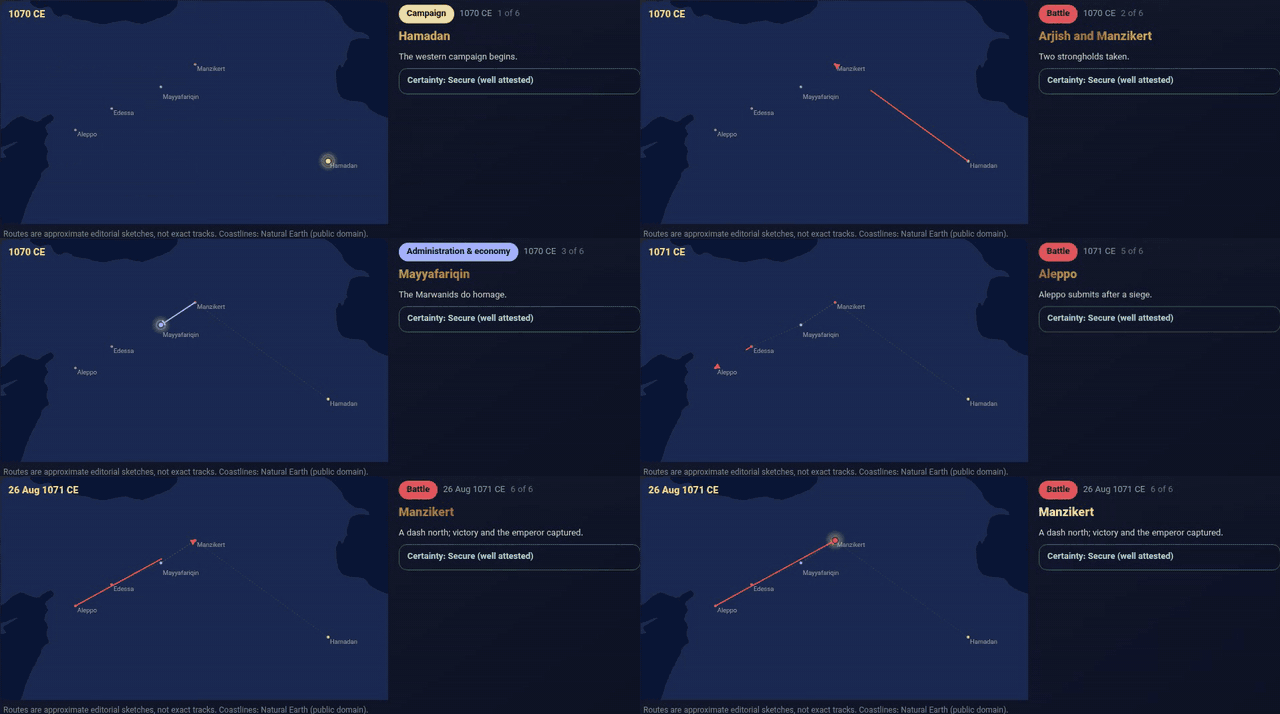
The western campaign: Hamadan to Manzikert (1070–1071 CE)
From Hamadan to Arjish and Manzikert, Mayyafariqin, Edessa and Aleppo, then a dash north to meet Romanus. The events are from Iranica; the routes are sketches.
Campaign1070 CE1 of 6
Hamadan
The western campaign begins.
Certainty: Secure (well attested)
BattleCampaignBuildingAdministration & economyReligionArrow keys, Home/End and Space work.
Manzikert, step by step (schematic)
26 August 1071 CE · Schematic; exact positions are debated
Phase 1 / 4 · secure
Romanus divides his army
Romanus sent part of his army to take Akhlat on Lake Van and went with the rest to Manzikert. Alp Arslan, in Syria, hurried towards Manzikert.
T. Bunting, Encyclopaedia Britannica · K. A. Luther, Encyclopaedia Iranica
SeljuksByzantines
Three separate layers
Each section has three layers: “Historical evidence” is only what the sources say; “Philosophical interpretation” is our reading by the standard of property and liberty; “Modern cultural meaning”. Quotations come only from published translations, with references.
Historical evidencePhilosophical interpretationModern cultural meaning
Dossier · 1
Sources: an idealised sultan
Most of what we know comes from Ebn al-Athir and later histories. Iranica says the sources idealise him, though anecdotes of harshness when drunk survive. Even his birth is uncertain: 1029 according to Ebn al-Athir, 1032–33 according to Bondari.
We treat the image of “the chivalrous sultan who pardoned the emperor” as partly legend: Romanus was freed in exchange for ceding territory, not out of pure magnanimity.
For history, the sources’ praise must be kept apart from the recorded deeds.
Sources: K. A. Luther, Encyclopaedia Iranica · Ebn al-Aṯir
Dossier · 2
Manzikert: a victory that was not the goal
As Iranica reports, Cahen does not believe Alp Arslan intended the destruction of Byzantium; in one report the sultan was on his way to Fatimid Egypt. Yet the defeat, capture and deposition of the emperor were “disastrous for the Byzantine cause”.


The common view of Manzikert as “the start of the Turkish settlement of Anatolia” is hindsight. Britannica sees it as the beginning of Byzantium’s military decline and a road to the Crusades; that is interpretation, not record.
The result of a battle should not be confused with the winner’s plan.
Sources: K. A. Luther, Encyclopaedia Iranica · T. Bunting, Encyclopaedia Britannica
Dossier · 3
Property: tribute and booty
Iranica shows that much of the sultan’s work was extracting tribute from local rulers: Harran submitted with tribute, the Marwanids and Aleppo after threat or siege. Alp Arslan also abolished the intelligence service, which Nizam al-Mulk disliked.
This is our reading: in this state, property belonged to whoever held the sword. Cities bought safety with tribute, and what a city would not give was taken by siege. Stability lasted only as long as the sultan lived and won; his sudden death made everything hang on a new succession.
Safety bought with tribute is not a right; it is a rent.
Sources: K. A. Luther, Encyclopaedia Iranica
Synthesis: a great victory, a fragile state
In nine years Alp Arslan secured Tughril’s contested succession, campaigned in Armenia and the Caucasus and captured the Byzantine emperor at Manzikert. Administration lay in the hands of Nizam al-Mulk.
Through the lens of property, his state rested on tribute and booty. With one captive’s blow beyond the Oxus, everything came to hang on the succession of his young son Malikshah.
Bibliography
- K. A. Luther, Encyclopaedia Iranica, Alp Arslān (1985). https://www.iranicaonline.org/articles/alp-arslan-saljuq-sultan/The spine of this page; the dates and places come from this article.
- T. Bunting, Encyclopaedia Britannica, Battle of Manzikert (online, read 2026). https://www.britannica.com/event/Battle-of-ManzikertFor the steps of the battle of Manzikert.
- N. Yavari, Encyclopaedia Iranica, Neẓām-al-Molk (2015). https://www.iranicaonline.org/articles/nezam-al-molk/On the vizier and the Nizamiyya colleges.
- Ebn al-Aṯir, al-Kāmel fi’l-taʾriḵ (c. 1231). The Arabic chronicle on which the Iranica article chiefly relies.
All photos are from Wikimedia Commons; licence and author were checked on each file page.