The Khwarazmshahs
Muhammad II of Khwarazm
علاءالدین محمد
- Reign
- 1200–1220 CE
- Dynasty
- The Khwarazmshahs
- Persian page
- فارسی
Featured dossier
Muhammad II of Khwarazm: Otrar and the Mongol invasion
‘Ala’ al-Din Muhammad brought the Khwarazmian empire to its peak and even marched on Baghdad. But the massacre of merchants at Otrar and the killing of Chinggis Khan’s envoys brought the Mongol invasion. The sultan fled and died on an island in the Caspian. Follow the invasion on the map.
- as sultan
- 20 years
- merchants killed at Otrar (per Juvayni)
- 450
- Otrar massacre (CE)
- 1218
- where he died, in the Caspian
- 1 island
Animated map: life and campaigns
Administration & economyAugust 1200 CE1 of 9
Succeeds Tekish
The second son of Tekish and Terken Khatun, he succeeded his father at Gurganj. Formally he was still a vassal of the Qara Khitay.
Certainty: Secure (well attested)
Sources: C. E. Bosworth, Encyclopaedia Iranica, Vol. I, updated 2018
BattleCampaignBuildingAdministration & economyReligionArrow keys, Home/End and Space work.
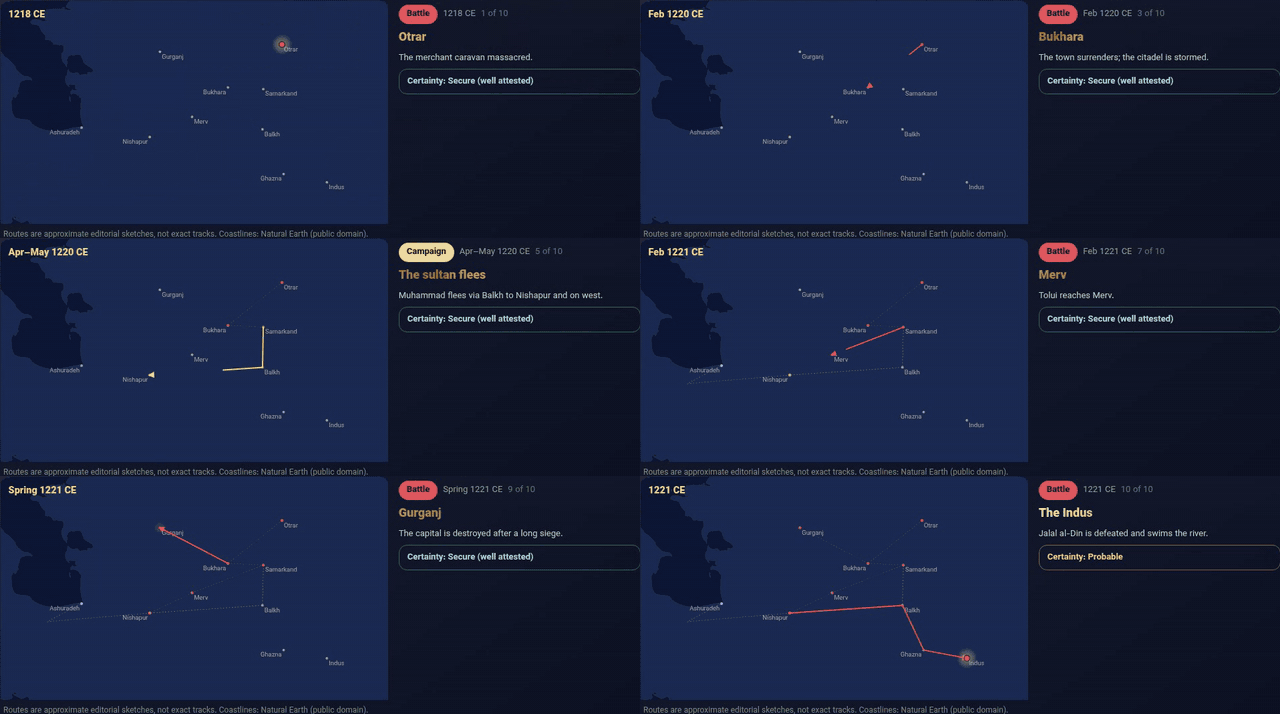
The Mongol invasion: from Otrar to the Indus (1218–1221 CE)
From the Otrar massacre to Bukhara and Samarkand, the sultan’s flight and death on the Caspian, then Merv, Nishapur, Gurganj and the battle on the Indus. Dates follow Boyle and Iranica; the routes are sketches.
Battle1218 CE1 of 10
Otrar
The merchant caravan massacred.
Certainty: Secure (well attested)
Sources: C. E. Bosworth, Encyclopaedia Iranica, 2002, updated 2012
BattleCampaignBuildingAdministration & economyReligionArrow keys, Home/End and Space work.
Three separate layers
Each section has three layers: “Historical evidence” is only what the sources say; “Philosophical interpretation” is our reading by the standard of property and liberty; “Modern cultural meaning”. Quotations come only from published translations, with references.
Historical evidencePhilosophical interpretationModern cultural meaning
Dossier · 1
Otrar: the caravan that started a war
In 1218 a caravan of Muslim merchants, sent by Chinggis Khan to open trade with Khwarazm, reached Otrar. The governor, Inalchuq, a kinsman of the sultan, called them spies, took their goods and killed them. Chinggis demanded redress; Muhammad killed his envoys. A year later the Mongol army stood on the Jaxartes.

The sultan’s part is disputed. In the Otrar article Bosworth says the governor acted “apparently with the agreement of the king himself”; in the article on the sultan he calls it a “blunder” that may be excused by the sultan’s lack of control over a frontier subordinate, but calls the killing of the envoys “a senseless act of provocation by Moḥammad himself”. Boyle writes that the sultan “authorized or at any rate connived at” the massacre. Jackson notes that for Chinggis it “furnished a pretext”.
Killing the messenger closes the road to talks, and the people pay the price, not the ruler.
Sources: C. E. Bosworth, Encyclopaedia Iranica · C. E. Bosworth, Encyclopaedia Iranica · J. A. Boyle, Cambridge History of Iran, vol. 5 · P. Jackson, Encyclopaedia Iranica
Dossier · 2
The invasion: from Otrar to the Indus
In autumn 1219 Chinggis divided his army at Otrar: his sons besieged the town while he went for Bukhara, which fell in February 1220, and then Samarkand. Muhammad abandoned Transoxania without a battle and fled. In 1221 Merv, Nishapur and Gurganj were taken and destroyed one after another, and Jalal al-Din was defeated on the Indus.

The death tolls in the sources are enormous and scholars treat them as exaggerated; we give no figures. The dates follow Boyle, who sets Juvayni and Nasawi side by side. Barthold estimated the Mongol army at 150,000 to 200,000 men; that is an estimate, not a count.
Cities built over centuries were destroyed in two years; rebuilding sometimes took generations, and sometimes never came.
Sources: J. A. Boyle, Cambridge History of Iran, vol. 5 · C. E. Bosworth, Encyclopaedia Iranica
Dossier · 3
Property: a caravan, booty and a disloyal army
The Otrar caravan carried gold, silver, silks and furs, and Boyle writes that this wealth excited the governor’s greed. Bosworth says the Khwarazmian army was largely Qipchaq Turks, still virtually pagan, whose excesses quickly lost the sultan support in Transoxania and Iran.
This is our reading: in this state a merchant’s property had no protection from a governor; a whole caravan was confiscated by one order. An army held together by booty did not stay loyal when the war turned hard. Bosworth also says Khwarazm lacked the manpower and treasure to run so far-flung an empire.
Security for a merchant’s goods is not only a moral matter; it is the basis of trade and of peace between states.
Sources: J. A. Boyle, Cambridge History of Iran, vol. 5 · C. E. Bosworth, Encyclopaedia Iranica
Synthesis: an empire that fell in two years
Muhammad defeated the Qara Khitay, took Samarkand and advanced to the Zagros. But by provoking the Mongols, Bosworth says, he “threw away … the chance of building up an empire of some permanence” and unleashed “a series of human and social disasters” over much of the Islamic world.
Through the lens of property, both a merchant’s security and the army’s loyalty hung on one man’s will. When that man fled, no institution was left to defend the cities.
Bibliography
- C. E. Bosworth, Encyclopaedia Iranica, ʿAlāʾ-al-Dīn Moḥammad (Vol. I, updated 2018). https://www.iranicaonline.org/articles/ala-al-din-abul-fath-mohammad-b/The spine of the Muhammad II page.
- C. E. Bosworth, Encyclopaedia Iranica, Jalāl-al-Din Ḵᵛārazmšāh(i) Mengübirni (2008, updated 2013). https://www.iranicaonline.org/articles/jalal-al-din-kvarazmsahi-mengbirni/The spine of the Jalal al-Din page.
- C. E. Bosworth, Encyclopaedia Iranica, Khwarazmshahs iii. The Line of Anuštigin (2009, updated 2012). https://www.iranicaonline.org/articles/khwarazmshah/iii-the-line-of-anustigin/The history of the whole line.
- C. E. Bosworth, Encyclopaedia Iranica, Otrār (2002, updated 2012). https://www.iranicaonline.org/articles/otrar/On the massacre of the merchants at Otrar.
- P. Jackson, Encyclopaedia Iranica, Mongols (2002, updated 2012). https://www.iranicaonline.org/articles/mongols/Background to Chinggis Khan’s rise and the invasion.
- J. A. Boyle, Cambridge History of Iran, vol. 5, Dynastic and Political History of the Il-Khāns (1968). https://archive.org/details/Boyle1968IlKhansCHIran05A step-by-step account of the invasion, with dates from Juvayni and Nasawi.
All photos are from Wikimedia Commons; licence and author were checked on each file page.